
Top Exercises for Rotator Cuff Injury
Introduction:
After a rotator cuff injury, such as a tear or strain, several exercises can assist in increasing range of motion and strength. Numerous of these motions can also aid in the promotion of recovery and the avoidance of difficulties.
Shoulder injuries are serious, as both sportsmen and sports fans are aware. They can be very painful, restrictive, and take a long time to heal.
What is Rotator Cuff Injury?
Four muscles make up the rotator cuff, which stabilises and permits movement of the shoulder.
Tears and impingements are the most frequent rotator cuff injuries.
Impingement: Impingement happens when a rotator cuff tendon is crushed in the small gap between the humerus, the upper arm bone, and the acromion, the front of the shoulder blade. Pain and oedema may result from the tendon being compressed.
Tear: When a rotator cuff tendon or muscle is damaged, a less frequent injury known as a rotator cuff tear (sometimes called a strain) results. Surgery won’t be necessary for most tears.
The rotator cuff muscles can be weakened by repetitive, overhead motions, which is why they are frequently injured. This explains why shoulder problems are common among athletes like baseball pitchers.
Injuries might also result from severe events, such as falling on your arm. Regardless of how it occurs, as we age and our bodies wear out, the likelihood of a rotator cuff tear increases.
Can Exercises help with the Rotator Cuff Injury?
Certain exercises can help you recuperate and avoid problems like a “frozen shoulder” or loss of range of motion once the swelling has subsided, and moving your arm no longer hurts. Among these exercises are:
- Stretch of the doorway
- High-to-low rows
- Side-lying external rotation
- Fly in reverse
- Pull a lawnmower
Additionally, try applying the “RICE” method—rest, ice, compression, and elevation—as soon as possible after an injury to lessen discomfort and swelling.
Try using a light dumbbell or resistance band for repetitions if you feel comfortable adding weight to these exercises. Try using a soup can if you don’t have a light dumbbell.
Exercise:
Pendulum exercise:
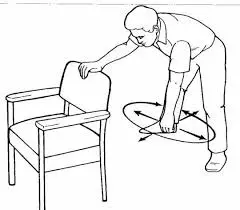
- Bend gently at the waist while maintaining an erect posture. If necessary, you can use your uninjured arm to gently grasp a table or chair for support. Allow the afflicted arm to drop to the ground.
- Allow the momentum to swing your hanging arm in tiny circles as you gently sway your torso in a minor circular motion. Recall that you should allow your body’s gentle swaying motion to move your arm rather than aggressively moving it with your muscles.
- If it’s comfortable, start with tiny circles that are around the size of a dinner plate and progressively expand the diameter. Spend roughly 30 seconds doing this.
- For an additional 30 seconds, change the direction of the movement and do circles in the opposite direction.
Doorway Stretch:

- Take a position in an open doorway. Place your hands or forearms on the door frame at shoulder height while extending your arms to the side. The angle of each elbow should be 90 degrees.
- Lean forward or take a step slowly until your shoulders and chest start to gently expand. Avoid bending your body forward and maintain a straight back. The shoulders should be the source of the movement.
- As tolerated, hold this position for 15 to 30 seconds.
External Rotation with Resistance Band:

- Hold a resistance band with both hands while standing straight. Your upper arms should be close to your sides, and your hands should be in front of your stomach with your elbows bent at a 90-degree angle. This is where you should start.
- Stretch the band and move your hands apart by slowly rotating your forearms outward while keeping your elbows close to your sides. Your shoulder muscles should tighten.
- When your forearms are nearly parallel to the floor or your hands are as widely apart as is comfortable, take a brief break.
- Return your hands to the starting position slowly.
- Aim for two to three sets of ten to fifteen repetitions of this exercise.
Internal Rotation with Resistance Band:
- Attach one end of a resistance band at waist height to a doorknob or another sturdy fixture. Hold the opposite end of the band with the hand of the arm next to the door while standing sideways to it. Keep your upper arm near your side and your elbow bent at a 90-degree angle.
- Pull the band over your waist while you slowly turn your forearm in the direction of your body. Your shoulder muscles should start to contract.
- When your hand reaches the front of your tummy or as far as is comfortable, pause for a little moment.
- As you release the tension in the band, slowly reverse the motion to return your arm to its initial position while keeping control.
- After ten to fifteen repetitions of this exercise, switch to the opposite side. For each side, aim for two to three sets.
Shoulder blade squeeze exercise:

- Keep your arms by your sides and stand or sit up straight. When standing, your feet should be shoulder-width apart. When seated, avoid leaning against the chair back and maintain a straight back.
- As if you were attempting to cram a pencil between your shoulder blades (scapulae), gently pull them back and down. It’s crucial to make sure that this movement isn’t overdone or pushed; a light squeeze will do.
- Hold this posture for five to ten seconds. A slight stiffness should be felt between your shoulder blades.
- Return to the starting position gradually.
- Perform this exercise in two to three sets of ten to fifteen repetitions.
Arm Reach:

- Start on your hands and knees on a tabletop. Your knees should be beneath your hips, and your hands should be squarely beneath your shoulders.
- Keeping one arm level with your torso, slowly stretch it out in front of you. Make an effort to draw a straight line from your outstretched hand to your tailbone and outstretched leg.
- Hold this pose for a few seconds, paying attention to your balance and stability.
- Return your arm to the beginning position slowly.
- After ten to fifteen repetitions of this motion, switch to your other arm.
Avoidable Exercises in Rotator Cuff Injury:
Overhead activities: Your rotator cuff may be severely strained by some overhead activities. Military presses, overhead presses, and overhead triceps extensions are some of these exercises.
Heavy lifting: Heavy lifting can strain a damaged rotator cuff, although mild weightlifting can help strengthen the shoulder muscles.
High-intensity throwing: Rotator cuff problems can be made worse by sports or activities that require a lot of throwing or high-intensity pitching.
Bench presses: If done incorrectly, the position needed for bench presses can put a lot of strain on your rotator cuff.
Excessive or aggressive stretching: Although stretching the shoulder muscles gently can be helpful, doing so excessively frequently or with excessive force can cause more harm.
Pull-ups and push-ups: If you have a severe injury or perform these exercises incorrectly, they can put a lot of strain on your rotator cuff muscles.
FAQs
How to tell if a rotator cuff is torn or strained?
You might have a rotator cuff strain if you experience modest shoulder pain, slight swelling, and stiffness after physical exertion. On the other hand, a rotator cuff tear could be the cause of severe discomfort, shoulder weakness, and trouble raising your arm.
If my rotator cuff is hurting, should I stretch it?
A quick and efficient exercise to increase shoulder range of motion and flexibility is the doorway stretch. It is frequently used to ease discomfort and tension caused by diseases, including rotator cuff injuries.
Which two symptoms indicate a torn rotator cuff?
The shoulder region is usually where warning indications of a torn rotator cuff are felt. Both complete, full-thickness rotator cuff tears (FTRCTs) and partial rotator cuff tears can cause intense pain or a dull shoulder soreness that gets worse at night, as well as make it difficult to move your arms.
How long will a rotator cuff injury take to heal on its own?
How much time does it take for a rotator cuff to heal? The majority of rotator cuff injuries can take up to four to six months to heal; small rips may mend in two to four weeks. The rotator cuff may not fully recover for up to a year, depending on the extent of the rupture.
What sleeping position is best for rotator cuff pain?
Sleeping on your back instead of your side can help if you have rotator cuff problems. In order to reduce swelling and inflammation, you can even elevate your injured shoulder in this position by putting a folded towel or cushion underneath it.
References:
- 6 Best rotator cuff exercises for pain relief – 2025 – Kristian/academyorthopedic.com/insights/rotator-cuff-pain-exercises/
- Rotator Cuff exercises to help heal or strengthen – 2024 – Barta/www.healthline.com/health/rotator-cuff-injury-stretches
- The 6 Best Exercises for your rotator cuff | Hartford Hospital | Hartford, CT/hartfordhospital.org/about-hh/news-center/news-detail?articleId=67070