Chest Press Exercise
Introduction
The Chest Press Exercise is a popular strength-training movement that targets the chest muscles, along with the shoulders and triceps. It helps build upper-body strength, improve muscle tone, and enhance pushing power. The exercise can be performed using dumbbells, barbells, or machines, making it suitable for beginners and advanced fitness enthusiasts alike.
If you’re just getting started, find a personal trainer or workout buddy who can spot you, monitor your form, and provide feedback. You can perform a variety of chest press exercises with or without a machine.
How to perform a chest press?
Tips
Here are a few suggestions for improved form before starting this exercise:
- Throughout the exercise, maintain a flat spine and avoid arching your lower back.
- Throughout, keep your head, shoulders, and buttocks pressed against the bench.
- A raised platform below your feet is an option.
- Throughout the exercise, firmly plant your feet on the ground or platform.
- Draw your elbows close to your sides to work your triceps.
- Flare your elbows out from your body to target your pectorals.
- To prevent your wrists from bending in either direction, keep them neutral.
Chest Press Steps:

Step 1:
Starting Position: Take a seat with your back pressed firmly against the backrest. The handles should be positioned no lower than chest level (level with the front of your chest), and the seat height should be adjusted so that they are level with your mid-chest (about nipple level). Maintain a neutral wrist position (i.e., wrists in line with your forearms) and firmly grasp the handles with a full grip (thumbs clasped around the handles).
To stabilize your body, place your feet firmly on the ground or on the footrests. To stabilize your spine, stiffen (or “brace”) your abdominal muscles; however, avoid pressing your lower back against the backrest. Throughout the exercise, keep your low back in its natural arch and avoid arching it.
Step 2: Exhale gently and slowly press your elbows forward while keeping your wrists neutral. Keep your head in line with your spine and avoid arching your lower back.
Step 3:
Keep applying pressure until your elbows are completely extended but not locked. Instead of rounding or bending forward, your shoulder blades should stay in contact with the backrest. After some time, slowly and carefully flex (bend) your elbows while bringing the stool back to its starting position. Repeat the motion.
(a) Do single-arm, unilateral presses
(b) Sit upright off the backrest; this will make it harder for your core to keep your trunk stable while you press.
People will often press the bar until their shoulder blades move off the backrest and round forward. The muscles holding the shoulder blades to the ribs become more unstable as a result. Although this “push-plus” exercise is regarded as an advanced exercise, at first, concentrate on pressing while keeping your shoulder blades flat and securely pressed against the backrest.
Variations of the chest press
These variations of the chest press target slightly different muscles. Try a few to determine which you like best, or incorporate some into your daily exercise routine.
Supine

- Avoid arching your lower back and maintain a flat spine throughout the exercise.
- Throughout, keep your head, shoulders, and buttocks pressed into the bench.
- An elevated platform beneath your feet is an option.
- Throughout the exercise, firmly plant your feet on the floor or platform.
- Bring your elbows close to your sides to work your triceps.
- Flare your elbows out from your body to work your pectorals.
- To prevent them from bending in either direction, keep your wrists neutral.
Incline

- This variation is performed on an inclined bench. This lessens the strain on the rotator cuffs while focusing on the shoulders and upper pectorals.
- You might need to use a lower weight load for this variation because your shoulders aren’t usually as strong as your chest muscles.
- This variation has the disadvantage of not using all of the pectoral muscles. In order to prevent overuse and possible injury, you will also need to rest your shoulders the next day.
Cable
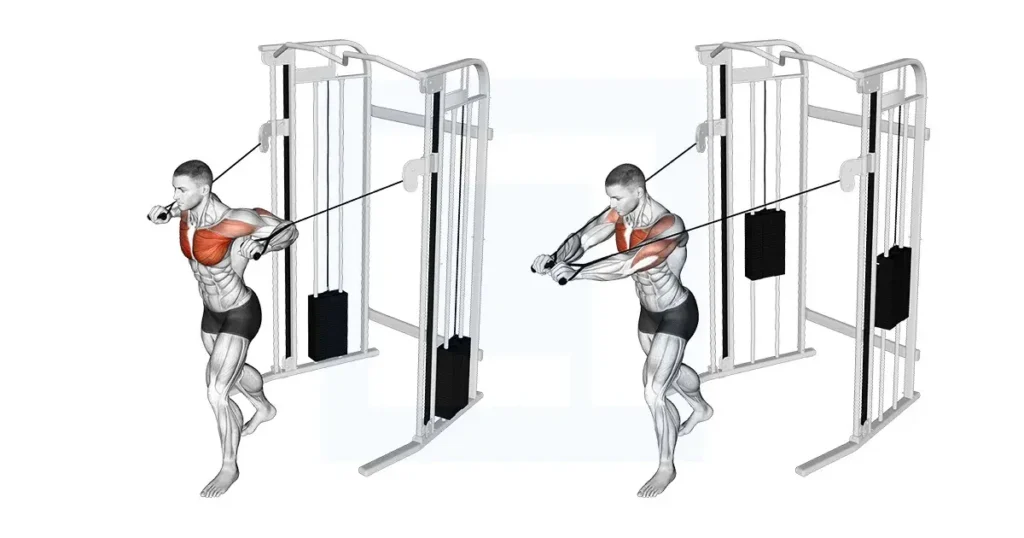
- You can move carefully and gently with this variation. Your core muscles are strengthened by the cable chest press, which enhances stability and balance.
- You can target different parts of your chest by doing it one arm at a time and varying the height of each push.
Standing

- The standing chest press strengthens your stabilizer muscles and enhances your balance. These consist of the transversus abdominus, erector spinae, and rotator cuff.
- If you already have good form and a solid foundation, this variation is perfect for you. One disadvantage is that your chest muscles are used less.
Plate-loaded
- This variation can be performed while lying on a bench or standing. It reduces the risk of injury and isolates your inner pectorals.
- Squeezing the weight compels you to keep your muscles active throughout the workout.
Chest press vs. bench press
Bench presses and chest presses are both good workouts. Though in slightly different ways, they work the same muscle groups.
It really depends on your preferences and how each exercise feels on your body to determine which is better. To change up your routine, consider alternating between the bench press and chest press on different days.
How to avoid injury
It’s necessary to perform the chest press carefully to stay safe and prevent injury.
Before starting any new fitness regimen, consult your physician, especially if you have any pre-existing injuries or health conditions that could impact your routine.
Do a warmup and cool down.
Warm up for five to ten minutes before starting your workout. Stretch your arms, chest, and shoulders in addition to walking, jogging, or jumping.
After every workout, stretch the muscles you worked and perform a cool-down.
Start with small weights.
Once you have mastered the technique, gradually increase the weights from the beginning.
If you’re new, use a spotter. They can be used to support your movements, check your form, hold weights, and make sure you’re using the right amount of weight.
Try it two to three times per week.
Two or three times a week, incorporate chest presses into the way you work out. To prevent overtraining muscle groups, take at least one day off between training sessions.
Strengthen your shoulders to balance your chest exercises. This lessens the chance of suffering injuries from lifting objects that are too heavy for your shoulders.
Exercise only to the extent that it is comfortable and doesn’t result in pain, stress, or strain. If you experience severe pain, stop working out and take a break until your body heals completely.
Tips for form and technique
Be sure that you keep to these guidelines with every representative:
- Avoid bringing the weights over your shoulders when lowering them, as this may cause rotator cuff strain.
- Lift weights in equal amounts to balance your left and right sides. Use all of your fingers to equally grasp the weight.
- Choose the incline or bench chest press if the flat bench chest press hurts you.
- When you finish using dumbbells, do not place them on the floor by your sides. Your rotator cuff may get hurt if you do this. Rather, put them on your chest and slowly rise to a sitting position. Before lowering the dumbbells to the floor, place them on your thighs.
Chest Press Common Mistakes
To maximize the benefits of the chest press and avoid strain or injury, keep clear of these mistakes.
Losing Natural Back Arch
Don’t push your lower back into the surface; instead, keep it in its natural arch. This is a natural stability mechanism known as the lordotic curve.
Arms Too Far Apart
Avoid spreading your forearms so that the weights are outside the elbow line. Move in an arc toward the center of the chest, but prevent accidents with the weights at the top of the move.
Weights Too Heavy
Avoid twisting your shoulders and upper body to raise the weights. The weights are too heavy if you find yourself doing this. Reduce the number of repetitions or use lighter weights if fatigue develops during the last repetitions of any set. Don’t put yourself or other people in danger.
Lifting Too Fast
Elbow injuries can result from lifting too quickly or with excessive force. Move the weights slowly and with care.
Not Using a Spotter
When performing a chest press, always have someone help you, especially if you’re more experienced and using larger weights. Many people at the gym are willing to spot you if you ask, and this person is frequently referred to as a spotter.
Safety and Precautions
If you have recently had surgery on your shoulder or chest muscles or are recovering from an injury, ask your doctor or physical therapist if the chest press is suitable for you. Stop the chest press if you experience any pain in your arms, shoulders, or chest.
FAQs
What is a chest press good for?
Builds Strength and Muscle: This primarily strengthens the pectoral muscles, but it also works the arms (triceps) and shoulders (deltoids) for total upper body power.
Boosts Functional Fitness: Makes routine tasks like vacuuming, pushing doors, and carrying groceries safer and easier.
Enhances Posture: Strengthens the rhomboids and traps, two supporting muscles that support a straighter spine and help keep shoulders back.
Aids Body Composition: Increases metabolism and aids in the reduction of body fat by burning calories and gaining muscle.
Boosts Bone Density: Stronger bones are a result of resistance training, which includes chest presses.
Sports Performance: Essential for power in sports like basketball, tennis, and swimming that call for pushing or swinging motions.
Versatility and Isolation: Dumbbells enable unilateral training to correct imbalances, while machines provide stability for beginners.
Are 2 exercises enough for the chest?
For beginners, a strong foundation can be built with two carefully selected exercises (e.g., Barbell Bench Press + Dumbbell Incline Press) performed with proper form.
For Efficiency: Two exercises that target different parts of the chest, such as a fly/dip and a flat press, can be effective if you’re pressed for time or simply want maintenance.
High-quality Sessions: You can achieve excellent results if your two exercises are extremely hard and cover every angle (e.g., a heavy flat press and a heavy incline fly).
What is the 2 2 2 rule?
“2-2-2” stands for two workouts a week. Two full-body workouts. Each exercise requires two intense sets.
Can I do 5 chest exercises?
Each workout should consist of one to four chest exercises; the ideal range is two to three different chest exercises in a single training session.
Is the chest press better than push-ups?
The bench press will typically work more quickly than push-ups if your objective is strength and muscle growth because it can overload the muscles with greater resistance. But push-ups can still be very beneficial if you’re looking for convenience, functional strength, or endurance.
Can chest press lift breasts?
Fiction: Workouts like the bench press and chest fly will strengthen the pectoral muscle, raise the breasts, and prevent sagging. Fact: While these exercises will improve tone, they won’t alter the position or form of the breasts.
Why should girls do chest press?
Women should indeed exercise their chest muscles.
Dumbbell presses, or push-ups, help you build these vital muscles. Regular chest exercises can help women prevent injuries and improve upper-body balance. They won’t make you overweight. Alternatively, you can develop firm, lean muscles.
What is the best chest workout?
The Top 5 Exercises for the Chest That Everybody Should Do…
When you incorporate these into your chest day exercise program, the outcomes become evident.
Bench press with a barbell. The inner chest is the main target. Incline dumbbell bench press. The upper chest is the main target. Bodyweight dip. Lower Chest is the main target. Incline Bench Cable Bodyweight push-ups, single-arm cable crossovers, and chest flies.
References
- Cronkleton, E. (2019, July 15). How to Do a Chest Press with Proper Form. Healthline. https://www.healthline.com/health/exercise-fitness/chest-press
- How to do a chest press | Exercise Library | ACE. (n.d.). https://www.acefitness.org/resources/everyone/exercise-library/19/chest-press/?srsltid=AfmBOopLLCO0X3CF-4KJQwF11yGxaXHjOkTcv51z4RFLySdUh7cpaASY
- Rogers, P. (2024, June 30). How to do a chest press. Verywell Fit. https://www.verywellfit.com/how-to-do-the-chest-press-3498606
- Seated Chest Press Exercise Guide | Exercise Library | ACE. (n.d.). https://www.acefitness.org/resources/everyone/exercise-library/188/seated-chest-press/?srsltid=AfmBOorLBoQRi2UhUGa5HrNPgDQWQvRIs2emUZfuKSLUpF9HKQzz5_I_
- Video: Chest press with dumbbell. (n.d.). Mayo Clinic. https://www.mayoclinic.org/healthy-lifestyle/fitness/multimedia/chest-press/vid-20084677#:~:text=Campbell%3A%20To%20do%20the%20chest,tension%20across%20your%20upper%20chest.