
Upavistha Konasana (Wide Angled Seated Forward Bend)
What is Upavistha Konasana?
Upavistha konasana is a basic sitting forward bend position. As the name implies, it is performed sitting with the legs spread wide and leaning forward. It is incorporated into the fundamental series postures of Ashtanga Yoga. This is a strenuous stretching position that improves the flexibility of the hamstrings and adductor muscles.
This posture is practiced as a sitting hip opening. Aside from the physical and psychological advantages, it also prepares the practitioner for standing wide-legged asanas. It clarifies that the asana is performed while sitting on the ground with the legs spread at a wide angle. This is followed by a forward bend and rhythmic breathing. It produces a relaxing impact on the brain.
The forward bend gently compresses and massages the abdominal organs while lifting the heart, which opens the chest cavity and enhances blood flow.
Muscle Work during Upavistha Konasana:
- Neck & Upper Back Muscles
- Lower Back Muscles
- Core Muscles
- Pelvic Muscles
- Hip Muscles
- Gluteus Muscle
- Hamstring Muscle
- Quadricep Muscle
Video of Upavistha Konasana
How to Perform Upavistha Konasana?
- Sit in Dandasana.
- Spread your legs wide apart and place your palms between them.
- Maintain an upright posture with your shoulders away from your ears.
- Begin walking your palms forward while inhaling slowly.
- Continue stretching forward, pressing your palms to the floor as far as you are comfortable.
- Gently bring your elbows to the floor and totally bend down, your head lengthening your hands.
- Inhale, elevate your head, and place your chin on the floor.
- Keep your palms flat on the floor and look ahead.
- Continue breathing normally and remain there for a few breaths.
- When you’re pleased with the stretch, begin walking your hands towards you.
- Simultaneously, move your upper body into the centre.
- Bring your hands to your outer thighs and pull your legs together.
- Shake them slightly and rest in dandasana.
Benefits:
- Increases muscular strength.
Upavistha konasana requires extending the muscles in the lower body. It stretches the hamstrings and groin while also opening up the hips. Aside from that, it helps to expand the shoulders and chest while strengthening the spine. The growth of these muscles increases flexibility and strength. - Tone the abdominal organs.
When the legs are wide apart at an angle in this position, forward bending provides a smooth stretch to the abdominal muscles. It gently massages the abdominal organs. It tones the abdominal organs and enhances the digestive system. - Soothes the nervous system.
Upavistha konasana is a posture that stretches the spinal muscles while breathing rhythmically. This increases blood flow to the brain and calms it. It helps the neurological system function more efficiently. This helps to relieve stress, anxiety, and other mental health difficulties. It also promotes proper sleep and memory retention. - Improves the cleansing process.
The forward-bending stage requires stimulating the kidneys. This helps to filter the blood and remove contaminants. It also helps to keep the kidneys healthy and avoid renal diseases. - It relieves sciatica.
The wide-angle sitting forward bend position stretches the spine, lower back, and adductors. According to one study, these exercises can help relieve severe back discomfort. It can even treat sciatica. - Therapeutic benefit.
This asana improves the flexibility of the body. It improves joint flexibility and avoids discomfort. As a result, upavistha konasana reduces joint discomfort and has anti-arthritic properties.
Preparatory Poses:
- Bound Angle Pose (Baddha Konasana)
- Reclining Bound Angle Pose (Supta Baddha Konasana)
- Staff Pose (Dandasana)
- Reclining Hand-to-Big-Toe Pose (Supta Padangusthasana)
- wide-legged Forward Bend (Prasarita Padottanasana)
Beginner’s Tip:
It is a difficult stance to master; therefore, novices should start by relaxing their knees somewhat. Keep your toes pointing towards the ceiling. These tactics assist in softening the position at first.
Modifications:
Block/blanket: If you feel like your pelvic bone is shifting back, consider practicing the posture while sitting on a block or folded blanket. This facilitates sitting with an upright back and good alignment. You can also retain a block to rest your palms on while walking ahead.
Bolster: Place a bolster vertically between your legs, in front of you. As you lean forward, it supports your body, and you lay your head on it.
Chair: Place a chair in front of you. Instead of leaning forward to reach the floor with your head, extend your hands and rest them on the chair.
Variations:
Neck Drop Variation:
This is an intermediate-level posture variation that can help you relax your neck and spine after a hard day at work.
Extend your legs wide and slowly lower your neck to the back. Hold this stance for no more than 30 to 60 seconds, as it puts your neck at risk.
Revolved Head to Knee Pose:
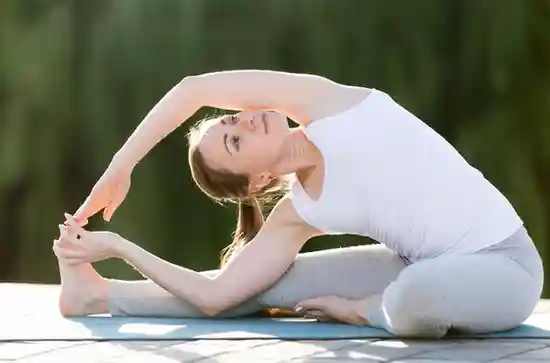
Parivrtta translates to “revolved,” Janu to “knee,” and Sirsasana to “head”.
This is a more advanced version of Upavistha Konasana, in which you flex deeply into one side with one leg bowed. In this position, rotate your ribs to one side and extend your arms upwards until your head reaches your knee.
Revolved Seated Angle Pose:

This is a continuation of Parivrtta Janu Sirsasana. All you need to do is modify your leg positioning.
In the previous position, one leg was bent. Now, maintain both of your legs wide extended while rotating your upper body and bowing down to one side. Hold this stance just until you are comfortable and avoid overstretching.
Precautions & Contraindications:
- Avoid this asana if you have a slipped disc.
- Upavistha konasana should not be practiced if you have a back, hip, knee, or hamstring issue.
- Avoid this position during pregnancy.
- If your hamstrings and hip joints are tight, do not press yourself to bend forward after reaching your limit.
- Avoid rounding your back when performing the position to avoid injury.
FAQs
What are the benefits of Upavistha Konasana?
Here are some of the advantages of Upavistha Konasana:
It helps to calm the mind.
Enhances knee and hip joint mobility.
Improves both digestive and sexual health.
stretches the spine and shoulders.
Stretches the hamstrings and glutes.
Strengthens the legs, ankles, hamstrings, and back.
Burns extra fat in the thighs and core.
Stimulates the flow of Prana and promotes bodily relaxation.
What are the different poses to prepare for Upavishta Konasana?
To prepare for Upavistha Konasana, you can complete the following poses:
Yoga poses include Uttanasana (standing forward bend), Paschimottanasana (seated forward bend), Baddha Konasana (bound angle pose), and Parivrtta Janu Sirsasana (revolved head-to-knee pose).
What is Parivrtta Upavishta Konasana Iyengar?
Parivrtta Upavishta Konasana Iyengar is a more advanced variation of Upavistha Konasana. This position stretches the deep muscles of your obliques, shoulders, hamstrings, and glutes. Furthermore, this version might provide a fast burst of energy. It’s a wonderful stretch for opening your hips, abductors, and chest muscles.
How do you perform Parsva Upavishta Konasana?
To execute Parsva Upavishta Konasana, follow the instructions below:
Begin in a Staff position and go into Baddha Konasana.
While performing Baddha Konasana, concentrate on your breath.
Inhale deeply and stretch your legs sideways as much as is comfortable.
Maintain flexion in your legs while focusing on your breathing.
Inhale and slowly twist your lower ribs while flexing your arms to one side.
When you reach down, exhale, and remain in the posture until you feel comfortable.
Let go of the stance and relax. Repeat on the opposite side.
How do you do Upavistha Konasana for beginners?
To execute Upavistha Konasana for beginners, just modify your stance. There are two techniques to alter Upavistha Konasana for beginners:
If you are unable to stretch your legs, attempt Baddha Konasana to increase leg flexibility.
If bending forward is not an option, consider putting bolsters in front to provide upper body support.
References:
- Upavistha Konasana (Wide-Angle seated forward bend): Steps, Benefits & Variation – Fitsri Yoga. https://www.fitsri.com/poses/upavistha-konasana
- Wide Angled Seated Forward Bend Pose Yoga Pose (Upavistha Konasana ). Tummee. https://www.tummee.com/yoga-poses/Upavistha Konasana
- Allen, W. (2025f, August 26). Upavistha konasana. https://myyogateacher.com/yoga-asana/upavista-konasana