Hammer Curl
Hammer Curl is a strength training exercise that targets the biceps and forearms, helping to build upper arm size and improve grip strength. It is performed by holding dumbbells with a neutral grip and curling them toward the shoulders.
Introduction
- Pick up a pair of dumbbells and hold them at your sides as you stand up. To maintain the tension on the biceps, bend your arms slightly while maintaining a neutral grip. Slowly curl the dumbbells as high as you can while keeping your palms facing your body.
- They enlarge the arms and are also visible to the lifter. Because it emphasizes the biceps bulge, the standard biceps curl is well-known to most people.
- However, the hammer curl is an ideal exercise to incorporate into your routine to improve the overall circumference of your arms. Although the hammer curl is a seemingly easy exercise, proper form is essential.
- The hammer curl can be altered in several ways to add variation and make use of the tools you already have. This should motivate you to incorporate this fantastic workout into your daily regimen.
- A variation on the biceps curl, the hammer curl works the muscles in both the upper and lower arms. Although a dumbbell is typically used for this exercise, cables or bands can also be used. You should incorporate hammer curls into your upper-body strength training regimen.
What are the essential elements or components of the hammer curl?
- Important elements consist of:
- Grip: Keeping your palms facing each other in a neutral grip.
- Weight is raised from the thigh to the area close to the shoulder to increase the range of motion.
- Elbow Position: To optimize muscle activation, keep your elbows close to your body.
- Movement Control: To fully engage muscles, lift and lower weights in a controlled manner.
- Breathing involves inhaling when lowering the weight and exhaling when lifting it.
Which important terms related to hammer curl have definitions?
- Hammer curls are primarily used to target the brachialis, a muscle situated beneath the biceps.
- The biceps Brachii. During hammer curls, the front of the upper arm muscle is used secondarily.
- This exercise greatly activates the brachioradialis, a forearm muscle that aids in elbow flexion.
- The neutral grip, sometimes referred to as a hammer grip, involves placing the palms inward while performing the exercise.
- Range of Motion (ROM): A joint’s entire range of motion; it aids in efficiently targeting arm muscles during hammer curls.
In what ways does the hammer curl fit into or complement other strength and conditioning methods used in fitness and sport coaching?
- By offering a targeted, isolated exercise that enhances compound lifts like chin-ups and rows, hammer curls fit in perfectly with strength and conditioning regimens. They help prevent muscular imbalances that can result in injury by promoting the growth of muscular endurance and hypertrophy. By incorporating hammer curls into a thorough training regimen, coaches can improve athletes’ functional strength and performance.
Do Hammer Curls or Bicep Curls Increase Arm Size?
- Hammer curls are a variation of the classic supinated bicep curls. Although they work different parts of the arm, the two exercises are complementary. The brachialis and the long head of the biceps brachii are the main muscles worked during a hammer curl.
- A hammer curl is more about increasing the thickness and the overall development and strength of the arm and the forearm, while a conventional, supinated bicep curl will improve the peak of your bicep because it increases activation of the short head of the bicep brachii. This will help more with larger compound exercises like pull-ups and wide grip pull-downs that require a more pronated grip.
- Brachii biceps
- Located directly in front of the triceps, this muscle has two heads. Commonly known as the biceps.
- Prolonged Bicep Head Brachii
- A muscle that aids in controlling the motion of both the elbow and the shoulder joint, extending from just above the latter. This muscle can be isolated especially well with hammer curls.
- Brief Head of the Brachii Biceps
- The short head of the second portion of the biceps brachii begins at the top of the scapula and connects to the long head at the elbow. This muscle can be worked with exercises like concentration curls.
- The brachialis
- A tiny muscle located directly beneath your bicep, the brachialis’s long and short heads.
What advantages do hammer curls offer?
- Because the grip position frequently enables you to lift heavier weights, the hammer curl may aid in building muscle in your arms. Therefore, strengthening all three of the muscles that bend your elbow is a good idea.
- Compared to the traditional biceps curl, which is executed with a supinated grip (palms facing up), hammer curls have a slightly different pattern of muscle activation, partly due to the neutral grip (palms facing each other).
- The hammer curl grip makes it possible to concentrate more on the biceps’ short head.
Additionally, if you have shoulder or forearm pain, this kind of curl might be more tolerable than traditional curls. Shoulder pain is frequently caused by injuries to the long head of the biceps. - This can occasionally be lessened while still strengthening your biceps by changing the position of your forearms.
- However, it’s best to start with a light weight when performing hammer curls. It might be wiser to wait and seek medical advice if you feel any pain.
- Within the body, the biceps brachii is an elbow flexor because it is responsible for the bending movement at the elbow joint.
- It also helps to rotate (supinate) the forearm. Strong biceps aid in lifting and carrying heavy objects during daily activities. Other arm-based motions, such as pulling objects toward or across your body or shutting a door, are made easier by these muscles.
- One technique to strengthen your biceps muscles and give them more definition and power is to perform hammer curls 3.
- It may also help improve grip strength and wrist stability if you incorporate it into your workout routine.
Which muscles are used in hammer curls?
The muscles that bend your elbow to bring your hand to your shoulder are called elbow flexors, and hammer curls strengthen them. The brachii, brachioradialis, and brachialis biceps make up the elbow flexors.
- The most noticeable mass on the front of the arm is the biceps brachii, the superficial flexor. It has a bony protrusion on the front of the shoulder blade and two heads that start at the shoulder joint. Just below the elbow, it inserts on the radius bone.
- The biceps brachii produces motion in both the elbow and shoulder joints because it crosses them. Specifically, it aids in shoulder flexion and flexes the elbow.
- The brachioradialis muscle begins near the elbow joint on the upper arm and ends just before the wrist on the forearm. In addition to providing noticeable mass to the front of the forearm, this muscle aids in elbow flexion.
- The ulna, the large inside bone of the forearm, is where the brachialis attaches after beginning on the lower part of the upper arm bone. During the hammer curl, it is the strongest elbow flexor and the least noticeable.
Methods for Hammer Curls

- Despite their apparent simplicity, hammer curls require more than just turning your hand 90 degrees to become proficient.
- To begin, sit on a bench with two dumbbells by your sides and your back in the upright position. Another option is to perform hammer curls while standing.
- To reduce the temptation to use your deltoids while sitting, keep your elbows close to your sides and pull your shoulders back.
- Instead of holding the dumbbells in the middle, pick them up and hold them at the top end. According to Buckton, this will further isolate those muscles.
- Curl the dumbbells until your thumbs are close to your shoulders while keeping your arms fully extended and in a neutral position, with your hands facing each other.
- Counting to two during the concentric (lifting) and eccentric (lengthening) portions of the exercise will help beginners the most, even though both fast and slow repetitions have advantages.
- At the peak of the exercise, pause, and then carefully lower the dumbbell. That is a single repetition.
Ways to Avoid Hammer Curls
- People frequently shorten the repetitions and fail to work all of their muscle fibers, or they use their momentum to lift the dumbbells. It’s not winning to swing.
- “The most common mistake you see with hammer curls is probably swinging the dumbbell.” People typically choose weights that are too heavy for them when they try to use momentum to lift.
- You naturally want to start using your shoulders and torso when you choose a weight that is too heavy, so you begin swinging your elbows.The other is not achieving a complete range of motion, which means that the arm is not fully extended at the bottom, and the muscle is not stretched before being coiled back up.
- To avoid using those extra few muscle fibers at the end of the rep, many people shorten them.
- Ideally, you should also make an effort to maintain your elbows locked into place.
Should You Use Dumbbells or Cables for Hammer Curls?
- Of course, dumbbells aren’t the only tool you can use for hammer curls. The exercise can also be done with a cable machine, and there are advantages to that as well.
Using cables can help you control the weight and activate your long head and brachialis more if you’re having trouble stopping yourself from swinging the dumbbells. - You will undoubtedly develop some stabilizing muscles that will be useful when working on other compound exercises if you perform hammer curls with dumbbells.
Do You Need to Do a Lot of Hammer Curls?
For hammer curls, you should choose a weight that is appropriate for your strength and level of exercise experience. You might discover that you can lift more weight with hammer curls than with bicep curls. Generally speaking, strive for:
- Beginners: 7.5–15 kg each hand
- Intermediate: 15–20 kg per hand
- Advanced: more than 20 kg per hand
But modify these according to your skills. To gain strength and muscle, you should ideally be able to perform 3–4 sets of 8–15 repetitions at your selected weight.
Rope hammer curl
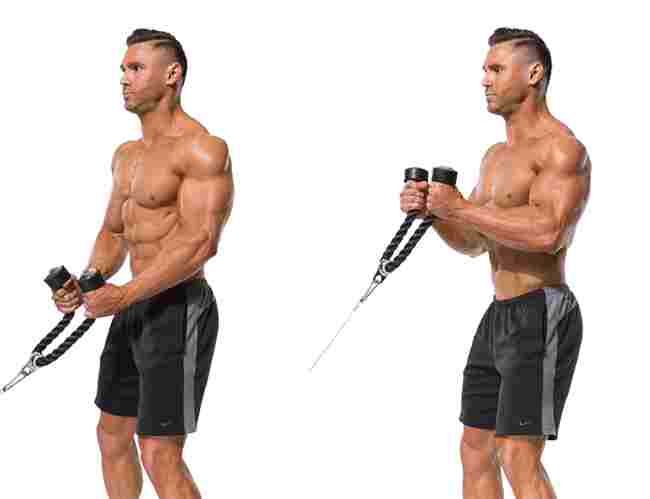
The rope hammer curl is a variation of the bicep curl in which resistance is created by fastening a rope handle to a cable machine. The movement uses less stabilization than a dumbbell movement, but it can isolate your biceps more because it occurs in a fixed plane of motion. This short how-to article explains how to do the exercise correctly, which muscles are used in a rope hammer curl, and the benefits and drawbacks of using a pair of dumbbells for training.
Muscles worked in the curling rope hammer
- The primary muscle that the rope hammer curl works is your bicep long head because it is an isolation exercise.
- By twisting the handles outwards at the top of the movement, you can slightly highlight the short head.
- The brachialis, an elbow flexor and stabilizing muscle, is also targeted as a secondary focus, which is excellent for enhancing arm stability in general.
- It is important to note, though, that dumbbell hammer curls will be more beneficial if your primary goal is to strengthen your brachialis.
The differences between dumbbell and rope hammer curls
What is the difference between using a cable machine and a set of dumbbells to perform hammer curls? Before your next arm workout, you should think about a few minor differences between the two.
Rope Hammer Curls
Because cables have a limited range of motion, rope hammer curls put more emphasis on your bicep long head. If you’re just returning to training after a break, they’re also an excellent way to recover from injuries, just like most cable exercises.
Hammer curls using dumbbells
Conversely, dumbbell hammer curls offer a few special advantages of their own. Because they use free weights, your muscles are under more tension for longer periods of time, which requires more stabilization. In terms of brachialis development, this is better than their cable machine counterparts. With dumbbells, you can also go heavier because the movement is slightly less isolating on one area of your bicep.
Three of the Greatest Variations
Now that you’ve perfected the “simple” seated hammer curl, you’re trying to figure out how to make it harder. Don’t worry; these two variations will give you a more intense workout while also isolating your long head and brachialis.
Hammer Curls on an Incline

Similar to a standard seated hammer curl, perform these exercises, but instead of sitting upright, raise the bench 45 degrees to an incline, as you would with an incline bench press. According to Bukton, “this position will increase the stretch and the range of movement.” “That position will also minimize the amount of deltoid involvement you will experience, resulting in a true isolation of the long head and brachialis.”
Hammer Curl Kettlebell Exercises
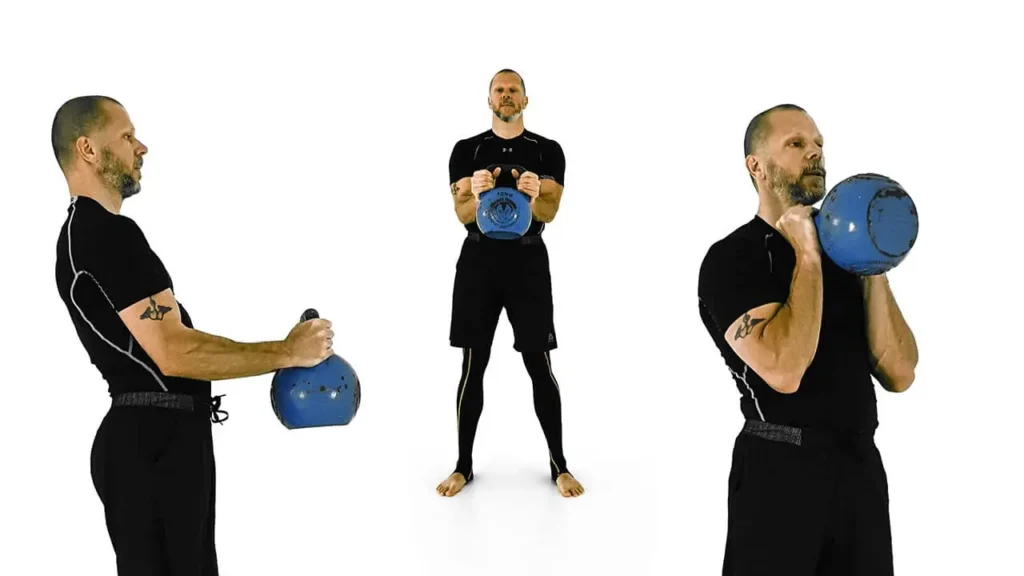
A kettlebell hammer curl is an additional variation that is slightly more difficult and sophisticated. Once more, execute these in the same manner as a typical hammer curl; however, as Buckton states, using a kettlebell will strengthen your muscles and enhance your grip. It’s also a fantastic variation for strengthening your shoulders. Either hold the handle of two kettlebells, one in each hand, or complete with a single kettlebell.
Hammer Curls with Towels

Try towel hammer curls to replicate the same movement pattern as dumbbell hammer curls, but with a bit more instability and, consequently, more difficulty. Put a towel through the kettlebell’s handle. Lower the kettlebell until the arms are straight while holding the towel with the hands facing inward. Curl the hands upward until the thumbs touch the collarbone, keeping the elbows close to the waist. Prepare to repeat by reversing the motion.
Hammer Curls: Typical Errors
To keep hammer curls safe and maximize their effectiveness, steer clear of these common mistakes.
Making Use of Momentum
- When performing hammer curls, using momentum reduces your capacity to gain strength. Additionally, swinging motions may increase your risk of injury because momentum takes over, and you lose control.
- If you begin hammer curls with a slight forward lean and bring the weights behind your hips, you can determine if you’re using momentum. You can better wind up for the workload in this posture.
- A common indicator that you are lifting too much weight is the use of momentum. Reduce the weight and concentrate on form if you observe that you are getting tired before each repetition.
Curling Too Quickly
- Because hammer curls use a comparatively limited range of motion, it’s simple to move quickly and hurriedly through this exercise, particularly when lowering.
- You can control the movements and concentrate on form by taking your time going up and down. Because you have to use your muscles for a longer period of time, slowing down your movements also makes them more difficult.
- Additionally, curling too quickly may indicate that you aren’t lifting enough weight. About two breaths should be taken during the eccentric or lengthening phase (when you lower the weight) and the concentric or shortening phase (when you lift the weight).
Elbows that float
- When performing hammer curls, it’s simple to let the elbows float away from the body. This works the deltoids (shoulders) and other muscles involved in the lift, but the more you work other muscles, the less you work the biceps.
- During hammer curls, focus on moving only the lower arm while maintaining a stable, fixed elbow position. The weight is too heavy if you can’t lift it without bending your elbow.
Precautions and Safety
- The majority of exercisers can perform hammer curls, but people who have lower arm injuries (like carpal tunnel syndrome) might require a different exercise or modification.
- When you feel tension in your biceps, it means that the exercise is targeting your upper-arm muscles. But if you experience pain while doing hammer curls, stop.
- Try two sets of seven to ten repetitions each when you first start. Start by adding repetitions as your strength and flexibility increase. Then increase the weight.
- Try the movements without weight (or very little weight) to get a feel for them if you’ve never done this or any other weight training exercise before. For guidance and recommendations, you can also consult a fitness trainer.
Which occupations would have an understanding of hammer curls?
- Among the roles are:
- Individual Trainers
- Conditioning and Strength Coaches
- Physiotherapists
- Instructors of Fitness
- Trainers of athletes
What function do hammer curls serve in families, schools, or sports?
- Sports: Hammer curls improve an athlete’s upper body strength, especially for sports like basketball, tennis, and rock climbing that call for strong grips and arm endurance.
- Family: Including hammer curls in workout regimens can help people of all ages maintain healthy joints and functional fitness.
- Schools: To help students develop lifelong healthy exercise habits, physical education programs may utilize hammer curls to teach them about muscle anatomy and strength training.
- An exercise that works for a variety of people, from athletes to fitness enthusiasts in general, is the hammer curl.
FAQs
What muscles do hammer curls work?
The brachialis, brachioradialis, and biceps brachii are the main muscles worked by hammer curls, which result in thicker upper arms, stronger forearms, and better grip strength. They are particularly useful for arm development because the neutral, or “hammer,” grip position places more emphasis on the brachialis and brachioradialis than a conventional bicep curl.
Do hammer curls build bigger arms?
Instead of using a supinated (palms-up) grip, the hammer curl calls for a neutral grip. This gives you balanced size and strength gains by activating the forearm, upper, and outer biceps.
What is the most effective curl?
The Hammer Curl
Additionally, you can lift more weight because the neutral grip is our strongest grip. How to accomplish it: With your wrists in neutral, shoulders down, and chest up, hold a pair of dumbbells by your side. Curl the dumbbells until the end is at the front of your shoulders while maintaining a neutral wrist position.
Are hammer curls good for forearms?
The Hammer Curl ought to be a staple of your exercise regimen if you want to build larger, more powerful arms. This workout is ideal for strengthening your forearm and biceps muscles, which will help you develop strong, well-balanced upper arms.
Are hammer curls easier than normal curls?
Bicep curls only work the biceps, but hammer curls work the triceps as well. Hammer curls are, therefore, a far more difficult exercise. Hammer curls are a great way to increase upper arm strength and muscle definition, so the extra work is worthwhile.
Are hammer curls better than bicep curls?
Because they work different muscles, hammer curls and standard bicep curls are neither inherently “better.” Instead, their efficacy will depend on your personal fitness objectives. Because they target the biceps brachii, bicep curls are the best exercise for developing the “peak” of the bicep muscle. The brachialis and brachioradialis muscles, which are situated beneath and on the side of the biceps, respectively, are used in hammer curls, which are superior for building the arm’s overall thickness and strength.
Is 10 kg hammer curl good?
For hammer curls, you should choose a weight that is appropriate for your strength and level of exercise experience. You might discover that you can lift more weight with hammer curls than with bicep curls. Generally speaking, strive for: Beginners: each hand, 7.5–15 kg.
Reference
- Cpt, M. F. M. A. (2024, May 10). Hammer curls: Learn proper form to maximize your results. Very well Fit. https://www.verywellfit.com/how-to-hammer-curls-techniques-benefits-variations-4788329
- Davies, D., & Neudecker, K. (2025, January 8). How dumbbell hammer curls can help you build even bigger arms. Men’s Health. https://www.menshealth.com/uk/building-muscle/a30873513/dumbell-hammer-curls/
- Mpt, T. E. P. (2022, March 16). Hammer Curls: How-To and Variations. Healthline. https://www.healthline.com/health/fitness/hammer-curls
- Hammer Curl Exercise Guide for Stronger arms | Exercise Library | ACE. (n.d.). https://www.acefitness.org/resources/everyone/exercise-library/10/hammer-curl/?srsltid=AfmBOopTYuf15lerQuAqR7yzEyG-2mshTWzXmgCVE3vkkfWn_7rxbVLE
- Nelson, J. B. (2025, February 4). Unleashing arm power: The significance of hammer curl in strength and conditioning – Skillmaker. Skillmaker. https://www.skillmaker.education/unleashing-arm-power-the-significance-of-hammer-curl-in-strength-and-conditioning/