
Half Moon Pose (Ardha Chandrasana)
What is Half Moon Pose?
Ardha Chandrasana is a combination of three Sanskrit words: Ardha, meaning “half,” Chandra, meaning “moon,” and Asana, meaning “pose.” This position is inspired by the form of a half moon, which represents balance, illumination, and reflection. In yoga, the Half Moon Pose symbolises the moon’s capacity to balance light and darkness, as well as the search for inner peace.
The Half Moon Exercise (Ardha Chandrasana in Sanskrit) is an intermediate yoga practice that improves balance, strength, and flexibility. This posture tests both the body and the mind, demanding attention and concentration, making it an excellent complement to any yoga routine.
Half Moon Pose is frequently used in sequences designed to improve stability and core strength, serving as a solid foundation for more advanced balancing poses. It engages several muscle groups, including the legs, hips, core, and shoulders, thereby improving whole-body coordination and proprioception.
Muscle Work During Half Moon Pose:
- Arm & Shoulder Muscles
- Core Muscles
- Back Muscles
- Hip and Knee Muscles
- Hamstring Muscle
Video of Half Moon Pose
How to Perform?
- Begin standing in Virabhadrasana II (Warrior 2).
- Place the back hand on the back hip. The front leg will be your standing leg.
- Transfer your weight to your front foot and place your front fingers on the ground diagonally in front of your standing leg. The further the hand is in front, the simpler it becomes.
- Move the back foot a few centimetres forward. You can even drag it forward.
- Keep your front knee bent and your entire weight shifted forward into your front leg and hand.
- When you feel the body weight shifting forward, elevate the rear leg with an inhale, using the strength of the outer back hip.
- Spread your arms wide so that they extend in line with your shoulders.
- As in Warrior II, keep your pelvis open and your chest towards the sky.
- Flex your rear foot (the lifted one) and engage it by pressing the heel away from your body.
- Maintain a little bend in your standing leg. This will also help activate the buttocks muscles more.
- Fix your eyes on a single spot in front of you. This will help you maintain equilibrium.
- Engage your core muscles to raise and return to Virabhadrasana II.
Benefits:
Improves Balance and Stability: The Half Moon Pose involves balancing on one leg while holding the body in a lateral stance. This tests and improves your general balance and stability, which may be useful in daily activities and other yoga positions.
Strengthens Leg Muscles: Balancing on one leg while elevating the other works the glutes, quads, and hamstrings. This develops the leg muscles, increasing total lower-body strength and endurance.
Opens Hips and Shoulders: This pose lengthens and stretches the hips and shoulders, which increases flexibility and range of motion.
Improves Core Strength: Staying balanced in the Half Moon Pose necessitates strong core activation. This strengthens the core muscles, especially the abdominal and lower back, resulting in improved posture and stability.
Stretches the Spine and Back: The pose thoroughly stretches the spine and back muscles by extending the body and reaching one arm up while reaching down with the other.
Improves Digestive Health: The posture stimulates and massages the abdominal organs, promoting digestion and relieving constipation. This moderate inside massage promotes improved digestive function.
Relieves Menstrual Discomfort: Menstrual cramps and pain can be relieved by the pose’s stretching and strengthening, which increases blood flow and reduces stress in the lower abdomen.
Reduces tension: The Half Moon Pose’s emphasis on balance helps to calm the mind and relieve tension. The position promotes attention and focus, which can have a soothing impact on the nervous system.
Improves general Flexibility: The position stretches several parts of the body, including the hips, legs, and spine, increasing general flexibility and range of motion.
Preparatory Pose:
- Triangle Pose (Trikonasana)
- Warrior Pose I (Virabhadrasana I)
- Warrior II (Virabhadrasana II)
Variations:
Half Moon Pose on the Floor version
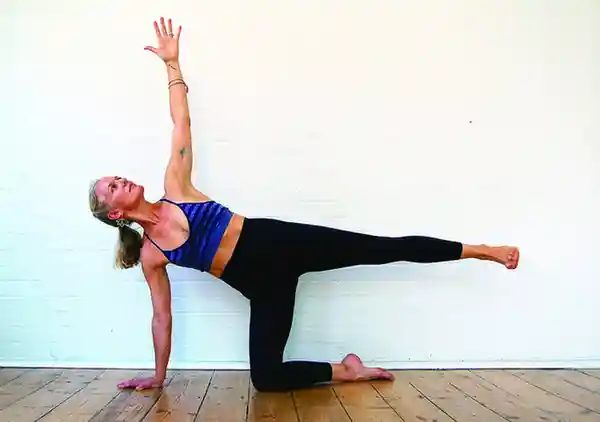
This version is suitable for beginners who are still working on increasing core strength. Assume a tabletop stance, engage your core slightly, and elevate your right leg straight off the mat.
Next, lift your right arm off the mat, twist your chest upward, and extend your arm straight to the ceiling.
Hold the stance on each side for a few minutes, gradually building core strength for the main pose.
Sugarcane Moon Pose
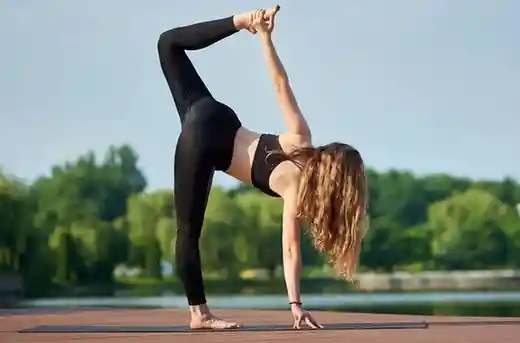
Begin in the fundamental Half Moon posture, then stretch your elevated leg straight to the ceiling.
Next, expand your chest muscles and spin your upper body, creating a sideways “T” shape with your arms. Shift your eyes to your upper arm, bend your extended leg, and grab your foot with your hands just where your shin joins it.
Hold this semi-standing, Bow pose-like stance for a few seconds on each side to activate your back, core, and legs all at once.
Revolved Half Moon Pose

This is a tough version since you must balance on alternating legs and arms.
Balance on your right foot and extend your left leg parallel to the ground, keeping your right arm extended in the air to form a “T” shape with your left arm contacting the ground. This is the “Revolved Half Moon” variation.
Precautions:
- If you have balance or dizziness difficulties, practise the posture along a wall or with a block for support.
- If you have lower back pain, place a block beneath your hand or avoid the position to relieve tension.
- If you have wrist or shoulder issues, make sure your weight is adequately distributed and consider placing a block beneath your hand for extra support.
- Maintain good alignment by stacking your hips and keeping your chest wide. Avoid collapsing your torso and letting your lifted leg slump.
- Use your core muscles to support your lower back and stay balanced. Don’t overextend or strain your back.
- If you experience severe or strong pain, relax out of the posture and stretch only to your comfort level.
- Use a yoga block or a wall for more support and stability, especially if you’re new to this posture.
Contraindications:
- Avoid this position if you have recent or chronic wrist, shoulder, hip, or lower back issues.
- Pregnant women should avoid this posture, particularly in the latter stages, because of probable abdominal strain and balance issues.
- Those with high blood pressure should avoid this position or see a doctor beforehand, because balancing on one leg might impair circulation.
- Individuals with hip or knee difficulties should exercise caution and may need to avoid or alter the position to avoid exacerbating their condition.
- People with glaucoma or other eye disorders should avoid gazing up or straining their neck while doing this position.
- If you have severe dizziness or balance concerns, avoid this position or practise it with the help of a wall or block.
- Those who have recently had abdominal or hip surgery should avoid this position unless they have fully recovered and been cleared by a medical expert.
Common Mistakes:
Even while yoga is a beneficial type of exercise, it is not without risks. Moderately challenging positions, such as the half-moon stance, can cause injuries if not done correctly.
Go slowly. When practicing yoga, keep your movements calm and deliberate. Quick actions might easily result in an injury. Moving slowly is also applicable to changing problems. Don’t attempt more difficult methods like the half-moon stance unless you’re ready.
Use props. Yoga blocks and straps are often used for a purpose. Use yoga supports to alleviate the strain of specific postures and movements.
Create a safe area. The half-moon stance involves balance, so you’ll definitely fall a few times while learning it. Make sure the area surrounding you is clear so you do not injure yourself if you fall.
Listen to your body. Yoga naturally causes some discomfort in your body since it engages your muscles. If a stance or action does not seem natural, halt.
FAQs:
What is a half moon yoga pose?
Ardha Chandrasana (Half Moon Pose) is a difficult position that requires balance. You draw in energies from both the moon (calm, cooling) and the sun (hot, intense) as you root down with your standing leg and stabilising arm while elevating and extending your elevated leg and opposing arm.
What are the most common faults in the Half Moon Pose?
Common Mistakes in the Half Moon Pose
Not warming up correctly.
Locking out the standing knee.
Allowing the sight to wander.
not maintaining the elevated leg straight.
Who should avoid Half Moon Pose?
Before trying Half Moon, a few factors should be considered. If you have a neck problem, maintain your look straight ahead or towards the floor, and if you have a knee ailment, reduce the bend in the knee. If you have vertigo, avoid this stance.
What are the benefits of Ardha Chandrasana?
Benefits of Ardha Chandrasana (Half Moon Pose):
Stretches the entire skeletal system.
A fantastic stretch for the shoulders, neck, back, and chest.
reduces kyphosis.
Promotes the health of the spine and nerve system.
Reduces anxiousness.
opens the heart chakra.
Increases female energy.
Increases Kapha.
References:
- Half Moon Pose (Ardha Chandrasana): Steps, Variations & Benefits – Fitsri Yoga. https://www.fitsri.com/poses/half-moon-pose
- insideyoga.org. (2024, March 27). Ardha Chandrasana – Insideyoga.org. https://insideyoga.org/asana-library/ardha-chandrasana/
- Allen, W. (2025a, August 26). Ardha Chandrasana. https://myyogateacher.com/yoga-asana/ardha-chandrasana
- Smith, L. (2024, August 21). Yoga How-To: The Half-Moon Pose. WebMD. https://www.webmd.com/fitness-exercise/yoga-how-to-the-half-moon-pose