Turkish Get-Up Exercise
Introduction
The Turkish Get-Up is a full-body functional exercise that builds strength, stability, and coordination by guiding the body through a controlled sequence of movements from lying down to standing.
Although a kettlebell is typically used for the Turkish get-up, dumbbells, sandbags, barbells, and even another person can be used! According to legend, when traditional strongmen were asked to train an apprentice, they would send him away and instruct him not to come back until he could execute one Turkish get-up with a 100-pound weight.
The Turkish get-up exercise is also thought to have been created by ancient wrestlers in what is now Turkey in order to prepare for their demanding competitions. According to the past, Turkish Janissaries incorporated the get-up into their strength training routine. Kettlebells were used by Russian warriors to get ready for battle. It strengthened them and gave them the stamina they required to fight. You may now train for a Spartan race using the Turkish outfit.
No matter where the Turkish get-up started, individuals who don’t know how to do it or what it can accomplish for the body tend to fail to consider it. But once you master the movement, the advantages are amazing.
First of all, it reveals flaws and imbalances. You can find asymmetries between the left and right sides of your body by performing the Turkish get-up exercise. This is a major injury-proofing advantage for runners. You will begin to improve your general mobility, stability, and the frequently disregarded time under strain after you master this technique and all of its steps.
The get-up provides immediate feedback on your areas of improvement. Take a time to consider this. To perform the get-up, you must move through several planes of motion, find points of stability in the anterior, lateral, and overhead positions, support yourself with one hand, and move from lying to kneeling to standing while holding one arm in a secure overhead position.
What Is a Turkish Get-Up?
A Turkish get-up is a practical exercise that covers every plane of motion and movement pattern your body requires to maintain stability, strength, and mobility.
That may seem like a grandiose promise if you’re not familiar with this exercise, but it is true. This exercise gradually targets many major muscle groups in your body throughout the course of a single repetition because it comprises multiple steps.
The intricacy of the Turkish attire is like an elephant in the room. It’s important to understand why the activity is recognized as challenging before you can profit from it.
It has a steeper learning curve than your typical squat, deadlift, or overhead press, but the advantages make it more difficult. This is because it incorporates many things, such as movement patterns.
Consider this to be crawling’s older sibling. To create a symphony of movement, use your entire body, both hemispheres of your brain, and activate your vestibular, proprioceptive, and visual senses to develop spatial awareness in different orientations. Turkish get-ups, which involve loading overhead for shoulder stability, are common in full-body, core, and upper-body exercises.
This exercise improves your confidence and even your cognitive function in addition to strengthening your body.
Can the Turkish Get-Up Help Overall Mobility?
The benefits of the Turkish get-up for general core, shoulder, and hip mobility and stability are remarkable. There isn’t another exercise that can do all of this.
You will get incredible strength when the Turkish get-up is loaded to what you would consider bulky. There are numerous ways that heavy get-ups increase your strength, but one of the most important is by teaching you the essential skill of “linkage” while preventing strength “leakage.”
The mechanical advantage that makes you stronger comes from stabilizers. Strong Turkish get-ups strengthen your stabilizers, which will strengthen your linkage. In other words, greater linkage means more strength.
The wonderful thing about linkage is that it is a skill that works incredibly well with all hanging obstacles, including multi-rig, monkey bars, and many more.
What Muscles Does a Turkish Get-Up Work?
The Turkish getup is a full-body exercise. One repetition of this lying-to-standing exercise requires the use of almost every muscle in the body, including the arms, shoulders, chest, legs, and core. Holding a weight over your head will stress your wrists and fingers, so you’re even getting some grip practice.
Once more, the Turkish getup should not be considered a muscle or strength-building workout for any one body region, even though it works every muscle. You will, however, benefit from an increased test of muscular stabilization, which is a fitness component essential to any training objective you may have.
What Equipment Do You Need to Do the Turkish Getup
Although the main objective is to work your way up to holding an implement equivalent to half your bodyweight, the Turkish getup is flexible enough that you can profit from utilizing only your bodyweight.
Additionally, you can use barbells and dumbbells; if you’re feeling particularly inventive, you could even try utilizing an open, full water bottle. However, because of its design, which keeps your shoulder in a comfortable and secure posture throughout the exercise, the kettlebell is likely the most popular and efficient instrument for performing Turkish getups. One of the many alternatives available with kettlebells is the bottom-up Turkish getup, which will put your stability to the test.
The Phases of a Turkish Get-Up
Five to six upward periods and five to six downward phases. (It’s also a helpful cheat sheet to refer to when you’re doing this exercise.)
From a Supine Position
- Roll to your elbow
- Supported seated
- High bridge
- Half-kneeling windmill
- Half-kneeling position
- Stand up
From Standing
- Half-kneeling position
- Half-kneeling windmill
- Kick to the high bridge
- Supported seat
- Lower down to the elbow
- Roll down to a supine position.
How to Do the Turkish Getup
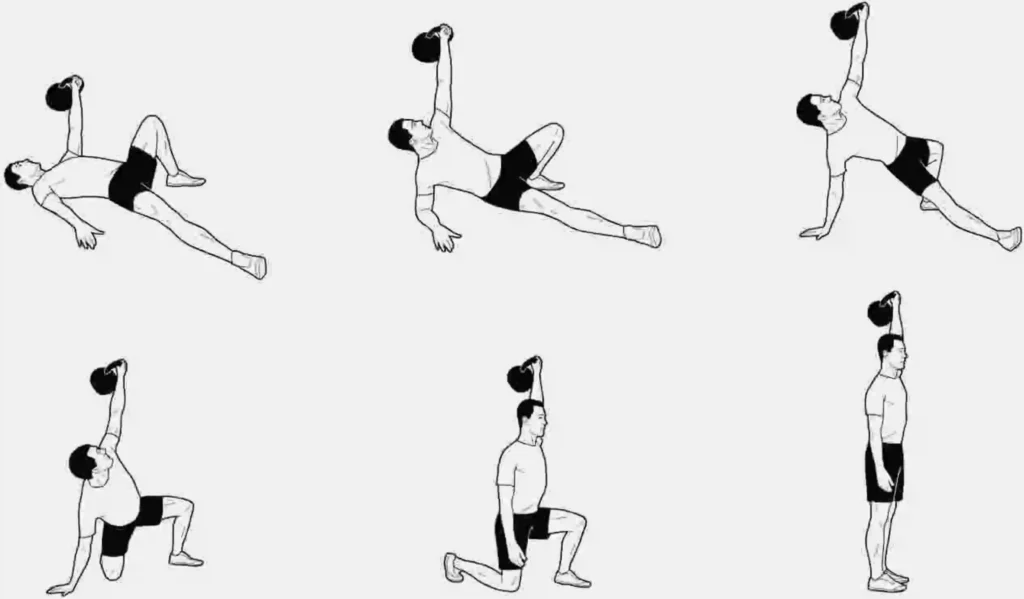
Hold a kettlebell straight above your body while lying down. (Remember to keep your eyes on the kettlebell the entire time.) Make sure your wrist, elbow, and shoulders are stacked with your wrist curled slightly over you. Throughout the exercise, maintain this posture.
Drive your foot into the ground with your same-side (the one carrying the kettlebell) leg bent. At the same time, drive your opposite hand—which is straight out—into the floor while your opposite heel is planted in the ground and extended away from your torso.
Drive your loaded shoulder up and across your body slowly and deliberately while using your opposing elbow to brace yourself. Keep your eyes on the bell and remain stacked. Lift off your elbow and place your hand on the floor while you extend your torso upward using your core.
As you execute a glute bridge and start driving up, squeeze your glutes while keeping an eye on the kettlebell. Both of your wrists and arms should be extended taller. and shoulders continue to be stacked.
From here, keep your eyes on the kettlebell and thread your back leg until you are kneeling. Now straighten that rear leg until you are in a lunge position, using your core, which will demand a lot of oblique strength. You’ve finished the first part of the maneuver; now rise.
It’s the same in reverse after that, going slowly until you’re back in the lying position.
Once more, it’s a very deliberate and gradual motion. It’s the kind of thing where we’re attached to every step, keeping an eye on the bell to maintain tension and pushing whatever load we have as high as possible to maintain our strength and a nice, tight core. It turns out to be an extremely exhausting exercise that you can perform in many different ways.
When you perform Turkish get-ups
Start with bodyweight Turkish get-ups if you’re a beginner. Don’t use a kettlebell or dumbbell until you’ve mastered every stage. As usual, if you have arthritic joints or any injuries, stay away from this exercise.
Choose to start by practicing only specific parts of the exercises, like moving from the starting position to the kneeling position.
According to Rebecca, Turkish get-ups can be used as a mini-evaluation of your strength and mobility. You might be able to pinpoint some of those problems by concentrating on each stage. For instance, it advises you to examine your shoulder mobility and/or stability (packing the shoulder in flexion and external rotation) if you are unable to sustain the overhead posture during phases.
Add in a workout
The Turkish getup works well for many people when used as an assessment tool once or twice a month. In this instance, you are using the motion to identify weaknesses in your movement patterns rather than to gain strength.
If you are having trouble at some spots, you can also dissect the Turkish getup into its parts. For instance, you can train just those particular areas a few times to strengthen that area of weakness if you see a hitch in your form while maintaining the stack posture, bridging, or even threading your leg to a lunge position.
It should be sufficient to end the fight after three sets of eight to ten repetitions of the difficulty spot. This will strengthen the connection between your mind and muscles. After a month or so, return and retest yourself.
You can perform the Turkish getup more frequently, but remember that you won’t be gaining as much strength or muscle.
Best Sets and Reps:
You can include Turkish getups in your warm-up if you’re among those who would rather do them more frequently. Using a moderate weight, begin with three to five repetitions on each side for three sets, then work your way up. This ought to activate your central nervous system.
Still insufficient? Next, incorporate the exercise into one of your exercises by selecting a difficult weight and performing three sets of three to five repetitions.
Your body will feel fantastic at the end, and you’ll work on that wonderful basic principle that we’ve all learned: you get off the ground whenever you need to.
Common Mistakes while performing Turkish Get-Up
Turkish get-ups shouldn’t scare you, but there are a few typical blunders to steer clear of.
- Attempting the exercise with a weight for the first time.
- Hurrying through the exercise or moving too quickly.
- Not putting the exercise into practice.
- Failing to pay attention to how your body is positioned during each step of the pattern.
- Not breathing during the workout.
- Not focusing on your first or the weight.
- Either not packing your shoulder or bending your raised arm.
- Taking yourself too seriously. Turkish get-ups can be difficult, but they can also be enjoyable and empowering.
Too much weight. Use a very light kettlebell or, if you don’t have one, any other light object you can easily handle, like a tiny water bottle, to start learning the exercise, even if you feel (or are) really strong. Better still, create a fist, place a shoe on your knuckles, and practice the get-up without letting go of the shoe.
Too quickly. Avoid hurrying during the exercise. A heavy bell will eventually hang over your head. Just because you are too excited to finish the activity doesn’t mean you should lose control of it. You should either acquire the patience to proceed slowly or stay away from the Turkish get-up completely.
Grip a barbell. In contrast to a barbell grip, your wrist should be straight, and your knuckles should point up toward the ceiling. You risk overstressing your wrist if you use a barbell grip when holding your kettlebell. Additionally, it could make your shoulder shake when you’re in the overhead position.
Your supporting arm should be moved. Don’t move your supporting arm until you are off the ground after you have positioned its palm at a 45-degree angle. If you don’t keep your palm glued to that one spot while on the floor, your body may have trouble locating the support.
Not glancing at the bell. Throughout the exercise, keep your gaze on the bell. You know where the floor is—right below your feet—so don’t look down at it. You run the risk of losing your equilibrium if you take your eyes off the kettlebell. That’s not what you want to do. Do you recall the large piece of metal above your head?
Kind arm. The arm holding the bell must stay straight for the duration of the exercise after it has been extended. There should be alignment between the shoulder, elbow, and wrist. No soft elbow, no shoulder shifting, and no “barbell” grip on the kettlebell.
Soft physique. Your body may lose the appropriate tension if you perform the exercise quickly instead of slowly and deliberately. Keep your arms, legs, and core all active. You must also pause if your form breaks. Avoid performing the Turkish get-up while exhausted.
The Benefits of the Turkish Get-Up
Your entire body is strengthened by this workout, which also improves your balance, mobility, stability, and coordination.
In several planes of motion, the [Turkish get-up] maintains your strength, agility, and stability. I call this kind of activity “keeping you superhuman.” Maintaining the ability to get on and off the floor is important as we age, and it’s a terrific way to boost our confidence and strength.
Here are some of the main advantages of the Turkish get-up for the body and mind:
- Teaches you how to balance your upper and lower bodies.
- Encourages proprioception, or spatial awareness.
- Helps increase mobility in your hips, shoulders, and spine
- Boosts your overall strength
- Promotes cross-laterality (cross-crawl patterns that make both sides of your brain and body work together)
- Develops strong posture
- Promotes stability in your trunk
- Builds confidence
- Increases your self-awareness
- Boost the stability of your shoulders
- Boost your overall strength, particularly as you work through different movement planes.
- Gain a lot of rotational and core strength.
FAQs
Are Turkish getups a good exercise?
The benefits of the Turkish get-up for general core, shoulder, and hip mobility and stability are astounding. There isn’t another exercise that can accomplish all of this. You will get absurd strength when the Turkish get-up is loaded to what you would consider hefty.
What muscles do Turkish get-ups work out?
It may take you twenty to twenty-five minutes to complete ten sets of kettlebell get-ups, which is a significant amount of time under stress. Your major muscular groups—the glutes, traps, lower back, core, hams, triceps, lats, and calves—as well as minor stabilizers, will be worked during a full-body Turkish get-up.
Do Turkish get-ups burn fat?
It Provides You with a Full Workout
Turkish kettlebell get-ups are an excellent pre-workout and cool-down exercise because of this. Use this at-home full-body fat-burning exercise to enhance your fitness game.
Can you do Turkish get-ups every day?
You usually don’t need to perform the Turkish Get-Up every day because it’s not primarily a hypertrophy exercise. Additionally, less is frequently more because this movement calls for focus and accuracy. Doing Turkish Get-Ups two or three times a week may help you with mobility and warm-up.
Why is it called Turkish get-up?
It may seem quite easy, but don’t be fooled. It’s a really intricate technique that requires a wide range of talents and movement patterns. Why is it referred to as the Turkish get-up? It is thought to have originated in Turkey, where it was incorporated into the strength training regimen of ancient Turkish troops.
What are the 7 pillars of anti-aging?
We examine the seven pillars of senior wellness—nutrition, exercise, mental health, social engagement, sleep, preventive care, and lifestyle.
Which exercise makes you look younger?
Exercises that make you look younger fight aging by improving your posture, circulation, and muscle mass to make up for lost muscle. Strength-training moves like squats, lunges, push-ups, and planks; yoga for flexibility and reducing inflammation; and moves that fix your posture, such as shoulder blade squeezes, are all important. These make the skin more elastic and improve mobility.
Important Exercises to Make You Look Younger:
Strength training, like squats, lunges, and push-ups, builds muscle and improves posture, which gets rid of the “hunch” that makes you look older.
Glute Bridges: Strengthening your glutes can help you walk more smoothly and like a younger person.
Spine Ladder: This exercise makes your spine more flexible and helps fix stiff, painful backs.
Yoga and Pilates can help reduce inflammation and make your skin look better, especially poses like child’s pose or downward dog.
Facial Exercises: Techniques like the “V” exercise (pinching eyebrows and smoothing forehead) can tone facial muscles and make fine lines less noticeable.
Cardiovascular exercise, like walking, running, or aerobics, gets your blood flowing better, which makes your skin look younger and healthier.
How exercise fights aging:
Fixing your posture: Making your back and core stronger directly fights the look of being older and slumped.
Better blood flow helps skin cells get the nutrients they need.
Telomere Protection: Studies show that doing intense exercise on a regular basis can slow down the shortening of telomeres, which are the biological markers of cellular aging.
What kills the most belly fat?
To lose the most belly fat, you need to do cardio, strength training, and eat a diet that is low in calories. High-intensity interval training (HIIT) and aerobic exercises like running or swimming are the best ways to lose visceral fat. Adding these to resistance training builds muscle, which speeds up your metabolism. Cutting back on processed foods and added sugars, on the other hand, helps you store less fat.
Belly Fat Exercises
HIIT, or high-intensity interval training, is a great way to lose belly fat. It involves short bursts of intense exercise followed by short breaks.
Aerobic exercise, like brisk walking, running, swimming, or biking for 30 to 60 minutes every day, lowers insulin levels, which helps you lose visceral fat.
Strength training, or weight lifting, is important for long-term fat loss because it helps you burn more calories when you’re not working out.
Targeted Core Exercises: Planks, oblique twists, and leg raises are some examples of exercises that can help tone your abdominal muscles. However, they work best when you also try to lose weight in general.
Changes to your diet to get rid of belly fat
Eat More Protein: Eating more foods high in protein, like meat, fish, eggs, and dairy, speeds up your metabolism and makes you feel full.
Cut Back on Sugar and Refined Carbs: Getting rid of sugary drinks and processed snacks helps your body store less fat.
Eat Foods High in Fiber: Fruits and vegetables are high in fiber, which helps lower visceral fat.
Drink green tea and stay hydrated. Green tea, especially Matcha, has chemicals that help fat burn.
Important Changes to Your Lifestyle
Take Care of Stress: Lowering your stress levels lowers cortisol, a hormone that makes your body store fat in your belly.
Sleep is important for managing your weight.
Consistency over Speed: Long-term diet and exercise regimens work better than temporary solutions.
What are the common mistakes in Turkish get-ups?
Turkish Get-Up Mistakes
The Wrong Hand Position.
Incorrect Knee Placement.
Short Stepping on Descend.
References
- Bathurst, J., & Bathurst, J. (2023, December 12). How to do a Turkish get-up (and workout examples). Nerd Fitness. https://www.nerdfitness.com/blog/turkish-get-up-workout/
- Sayer, A. (1970, January 1). Don’t be intimidated by the Turkish Get-Up. Here’s how to do it properly. https://www.onepeloton.com/blog/turkish-get-up
- Soccer, S. T. F. (2023, September 15). Turkish Get-Up. https://www.nsca.com/education/articles/kinetic-select/turkish-get-up/?srsltid=AfmBOopU3r6AXhQbNysh–9Rxl3oosWoExxQcVtmHTXJMAbPb2QaFpkl
- The Spartan Editors. (n.d.). 9 Benefits of the Turkish get-up: How to master the exercise. https://www.spartan.com/en/blog/turkish-get-up
- Tomko, J. (2022, December 13). Here’s how, when, and why you should be doing the Turkish getup. Men’s Health. https://www.menshealth.com/fitness/a42229662/how-to-do-turkish-get-up/
- Turkish Get up: Fundamental Kettlebell Exercise #6. (n.d.). USA Iron Kettlebells. https://www.usa-iron.com/pages/kettlebell-turkish-get-up