Hanging Leg Raise Exercise
Intoduction
The Hanging Leg Raise is an effective core-strengthening exercise that primarily targets the abdominal muscles, especially the lower abs.
One of the best workouts for strengthening your complete core and targeting your lower abs is the hanging knee raise. Excellent grip and forearm strength are also developed by this exercise.
A hanging knee lift requires very little equipment. Really, all you need is a pull-up bar or other object to hold onto and hang from. Some businesses now produce specialized equipment for hanging knee lifts.
The hanging knee raise is explained in this article, along with how to do it, its advantages, the muscles used, some typical errors, and modifications to make it tougher or easier.
What Are Hanging Leg Raises?
Grabbing a draw bar and carefully pulling your lower body off the ground in a controlled motion is the hallmark of hanging leg raises, an ab exercise. By using your abdominal muscles, especially the lower abs, which can be challenging to activate with other core exercises, hanging leg raises can strengthen your core when done correctly. Hanging leg lifts can also strengthen your grip while working your hip flexor and lower back muscles.
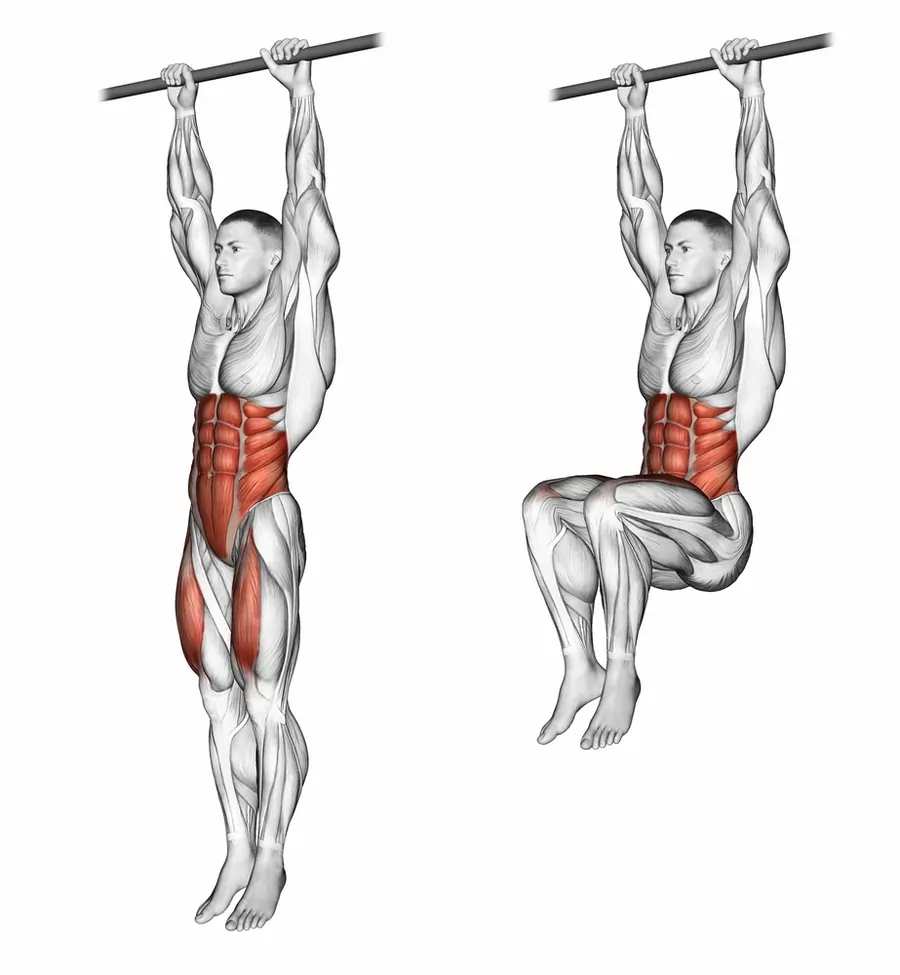
Muscles worked with the hanging knee raise.
The abdominal muscles are the main objective of the hanging knee raise. This contains a number of important abdominal wall and core muscles.
Studies indicate that the rectus abdominis and external oblique are particularly well-targeted by hanging knee raise variations.
On the other hand, the hanging knee raise engages all of the upper and lower body muscles.
Apart from the rectus abdominis and external obliques, the following muscles were worked:
- Internal obliques
- Hip flexors
- Forearm muscles
- Shoulder girdle muscles
How to perform the hanging knee raise

It’s easy to execute the hanging knee lift.
When holding your equipment, you should utilize a pronated, overhand grip, which means your palms will be facing away from you.
Maintaining a neutral pelvis or a modest posterior tilt by engaging your lower abs prior to lifting your knees is essential for guaranteeing appropriate muscle activation.
To accomplish this, picture yourself softly squeezing your glutes while tilting the top of your pelvis, or your hip bones, up toward your lower ribs.
Keep in mind that if you over-squeeze your glutes, you won’t be able to raise your knees, so simply contract them enough to keep your lower back from arching.
As they activate, you should feel the lower abdominal muscles slightly above your hip crease. The front of your body should become slightly hollowed out as a result.
To put it briefly, take these steps to execute the hanging knee raise:
- Start hanging by using an overhand, pronated grip on your pull-up bar or other equipment.
- Engage your glutes and tilt your pelvis toward your ribs to activate your lower abs.
- Maintaining a hollowed posture and braced lower abs, slowly bring your knees nearer your chest.
- To get back to the bottom position, slowly lower your legs.
- Continue until the required number of repetitions is reached.
How to Do Captain’s Chair Hanging Leg Raises

Place your forearms on the padded armrests of the captain’s chair frame. If the handles are available, grab them. Make sure your arms are firmly positioned so you can raise your legs with correct form. You should have a straight back.
To get ready for leg lifts, take a breath and contract your abdominal muscles.
Raise your legs until your quadriceps are parallel to the floor while bending your knees slightly.
Breathe out as you carefully lower your legs till you return to the starting position. Maintain a strong core.
In many gyms, the Roman chair, sometimes known as the captain’s chair, is used for exercise. When performing hanging leg raises, stand in the frame and utilize the chair’s two arms to support your body weight.
Tips to Do Hanging Leg Raises Correctly
Before performing hanging leg lifts, keep these pointers in mind.
Make your way up to it. An advanced ab workout that calls for stability and strength in the upper body is the hanging leg lift.
Bend your knees to begin. Both bent and straight legs can be used for hanging leg lifts. Start with a bent-knee version, sometimes referred to as a dangling-knee raise. This variation is a little less taxing on your lower back and hamstrings.
Maintain control over your movement. Using momentum to swing yourself during the hanging leg lift is one of the most frequent blunders. Carefully raise your legs while using your core. Consider using a captain’s chair at your neighborhood gym if you’re having trouble staying stable. This piece of equipment lets you rest on your elbows instead of hanging from a pull bar.
Keep your pelvis tilted posteriorly. Maintain a posterior pelvic tilt with your legs somewhat ahead of you, even at the bottom of the exercise. Your lower back muscles will be protected, and your abdominal muscles will remain active in this position.
Benefits of Hanging Leg Raises
With a maximal voluntary contraction (MVC) of almost 130% in the rectus abdominis and 88% in the external obliques, this exercise focuses on the abdominal muscles. The iliopsoas, or hip flexors, are also worked.
Isolation techniques are the foundation of hanging leg lifts. To strengthen certain portions of the body or muscle group that could be weaker or would otherwise benefit from a strength-training program, isolation exercises focus on a single location.
Many muscles are employed in daily activities, such as carrying groceries or climbing stairs. The captain’s chair hanging leg raises help prepare these muscles, which must coordinate and cooperate.
There are several excellent advantages to the hanging knee raise in terms of strength, fitness, and appearance.
Compared to other exercises like crunches, this one is more thorough because it works the entire core and abdominal area.
Other exercises and motions, such as heavier lifts that call for bracing, like squats or deadlifts, benefit from the stability needed to maintain correct form and control during the hanging knee raise.
By strengthening the muscles that fight this action, performing hanging knee raises correctly counteracts the lower back’s propensity to arch.
The secret to securely loading the spine with additional weight is to lessen the tendency of the lower back to arch.
One of the main advantages of performing hanging knee raises correctly is that they strengthen the core and promote a neutral spine position.
Additionally, the requirement to hang by clutching the bar improves hand and forearm strength, which is applicable to both functional and athletic tasks like climbing, as well as other hanging workouts like pullups.
Lastly, this exercise can encourage muscle hypertrophy and muscle growth throughout the entire abdominal region because of the strong resistance the hanging knee raise places on the abdominal wall.
The hanging knee raise will significantly improve the size and shape of your oblique and six-pack muscles when paired with a diet that encourages fat reduction.
Other Variations of Hanging Leg Raises
Leg Raises Without a Captain’s Chair

If you don’t have access to a leg raise machine, you can still get a similar workout with lying hip raises. To perform them, lie on your back, raise your legs so that your toes point toward the ceiling, and slightly bend your knees. Lift your hips and contract your core.
Pull-Up Hanging Leg Raises

Replace the chair frame with a pull-up bar to add another level of difficulty to hanging leg lifts. With your palms facing away from you, grasp the bar with your hands somewhat wider than shoulder width. Raise your legs and let your body hang. Maintain a straight back and a strong core.
Hanging Leg Raises: Common Mistakes
To maintain your captain’s chair hanging leg raises secure and efficient, steer clear of these blunders.
Arching Your Back
Leg lifts while hanging put additional strain on the spine, resulting in compression. One. Keep your back firmly on the pad and straight, not arched, as you complete leg lifts. You should have a steady head and neck.
When doing this exercise, arching your lower back is the most frequent error. This mostly happens when you don’t use your glutes and lower abdominals.
As a result, your stomach seems to protrude, and there is a noticeable arch from your lumbar spine to your mid-back. In order to elevate your lower body weight, you must use only your hip flexors because this position deactivates your abs. This can worsen low back discomfort and result in hyperactive hip flexors and decreased strength development in the core muscles.
You will probably experience strain at the top of your thighs and possibly your lower back when completing the hanging knee raise with an arched lower back. This feeling indicates that you’re not doing the workout correctly.
Put a lot of emphasis on using your glutes and bringing the front of your pelvis to your ribs to avoid making this error. When the exercise is done correctly, you should feel the front of your stomach’s core muscles working.
You’re probably doing the exercise correctly if, toward the conclusion of your set, you can feel your abs getting hotter.
Swinging your legs
Swinging their legs and using momentum is the second most frequent error people make when performing the hanging knee lift.
Even though you might be tempted to swing your legs in order to complete more repetitions on a particular set, doing so ultimately results in less work being done and less progress being made in strengthening your core.
Your abs and core are working harder because they aren’t contracting during the exercise, thanks to the momentum from the swing.
Your abs will spend less time under tension if you allow your legs to fully swing down from the top position because they won’t be fighting gravity as they descend.
Additionally, the force of the uncontrolled lowering offers your legs a boost, so your abs don’t have to work as hard as they contract as your knees rise thanks to the momentum from the swing.
High repetition counts without control,l therefore, have less bearing on the amount of work you really completed. Rather, concentrate on managing the full range of motion as your knees rise and fall. If you want to increase the speed, ascend quickly, stop at the peak, and then gradually return your knees to the starting position while keeping your contraction.
For core strength, the total amount of time your abs are under tension is considerably more significant than the total number of repetitions. Throughout the whole range of motion, concentrate on sensing the contraction. Avoid trying to get high repetitions via cheating. To maintain control throughout the set, you can lower the number of repetitions if necessary.
Not Using Your Core
Engaging your core before lifting your legs is one of the secrets to executing hanging leg lifts with proper technique. In addition to losing out on the strengthening effects of the exercise, lifting your legs before your abdominal muscles are fully engaged increases your chance of injury.
Using Momentum
Move slowly and deliberately. You can’t get the most out of hanging leg lifts if you rely on momentum.
Keeping Your Breath in
You might be tensing up so much that you forget to breathe while you contract your abdominal muscles and get ready to raise your legs. You may prevent holding your breath by timing your lifts with your breathing. Recall that oxygen is necessary for your muscles to function at their best.
Safety and Precautions
Exercises like the captain’s chair, hanging leg lifts, put a lot of strain on your core and upper body. You might have to stay away from them if you.
Are you pregnant or recovering from childbirth
Have you lately had abdominal surgery?
suffer from diastasis recti, a disorder that causes the abdominal muscles to separate, such as after pregnancy.
Are you recuperating from surgery or injuries to your arms, legs, neck, or back?
Before beginning an exercise regimen or adding something new to your workout, consult your physician if you have any of these medical issues or others that make it difficult for you to exercise. And if you experience pain, always stop. (Pain is not normal; discomfort is.)
Before you rest, try to finish eight or ten hanging leg lifts. Work up to three sets of ten hanging leg lifts as your strength increases.
FAQs
Can walking help tone your stomach?
Walking is a simple, low-impact workout that can increase your metabolism, burn calories, and help with weight loss. Walking can help attain a flatter tummy when paired with a nutritious diet, adequate hydration, and core exercises.
What are hanging leg raises good for?
Hanging leg raises are an advanced-level exercise that is very effective at building intense strength and definition of the abdominals, especially the lower rectus abdominis. They hit the hip flexors outside the core, develop grip endurance, and stretch the spine and lats deeply. The movement also works the obliques and shoulders.
Key Advantages of Hanging Leg Raises:
Targeted Abdominal Development: This exercise places enormous stress on the abdominal wall and accounts for great hypertrophy of the rectus abdominis, the so-called “six-pack” muscle.
Lower Ab Core Strength: Hanging leg raises are great for working the lower abs. It can be difficult to work the lower abs with traditional crunches.
Grip and Upper Body Strength. Hanging from the bar develops functional grip strength in the hands and forearms, and activates the shoulders and lats.
Core Stability & Pelvic Control – This is achieved by holding a “hollow body” position, which trains the abdominal muscles to stabilize the spine, lowering the risk of lower back pain.
Standard Variations and Techniques:
Hanging Knee Raises: An easier variation for beginners, with less leverage on the abs.
Captain’s Chair Leg Raises W:orks with a supportive chair to help reduce grip fatigue, so you can focus more on the abs.
Hanging Twists Incorporating a twist at the top w, working the obliques.
Tips for Success:
No Swinging: Move at a slow and controlled pace. Don’t rely on momentum, as it can make the exercise ineffective.
Active Hanging: Rather than simply hanging, engage your shoulders and back to hold yourself in an “active” position, as shown in this tutorial.
Posterior Pelvic Tilt: To really engage the abs and protect your back, focus on tucking your pelvis under and crunching, rather than just lifting the legs.
What happens if you do hanging leg raises every day?
1. Strengthens the core muscles, such as the hip flexors, back, and abs. 2. Hip flexor engagement: For example, exercising the hip flexors helps enhance stability and lessen lower back tension.
What is the number one exercise for aging?
Aerobic exercise
Consider jogging, cycling, dancing, swimming, or brisk walking. Your heart beats faster, and your lungs take in more breath as a result of these exercises. Improving cardiovascular fitness can reduce your risk of heart disease, hypertension, diabetes, and stroke because heart and lung function deteriorate with age.
How long should I do hanging leg raises?
The hanging leg raise improves the hip flexors throughout a wide range of motion and the abs in trunk flexion. You can do hanging leg lifts in sets of ten to thirty or more repetitions. Strong athletes can increase their weight by holding a dumbbell between their ankles or using ankle weights.
Do leg raises burn belly fat?
Leg raises are great for strengthening and toning the lower abdominal muscles and hip flexors,s which will help create a tighter core. But they don’t “spot reduce” or burn fat directly only on the belly. Leg raises must be combined with a calorie-burning diet and cardiovascular exercise to lose belly fat.
Highlights.
Specific toning: Leg raises will help to strengthen the lower part of the rectus abdominis to tone that area.
Muscle Strength: Building abdominal strength helps with posture and creates a more sculpted look.
Total Fat Loss Needed: You can’t choose where your body will shed fat. You need regular exercise for your whole body and a healthy diet to lower total body fat, including belly fat.
Effective Routine: Combine leg raises with other exercises like planks, mountain climbers, and cycling as part of a larger routine for better results.
How to do it for the best results: Lie down on your back. Arms at your sides, legs straight.
Bring your legs up toward the ceiling.
Lower down slowly, not touching the floor, to maintain the tension in the abdominal muscles.
Do about 3 sets for best results.
Can you get a 6-pack from leg raises?
To achieve the six-pack appearance, the leg raise can be employed to hypertrophy (grow) the abdominal muscles. The posterior chain muscular groups of the hamstrings, hips, and lower back all benefit greatly from the full hanging leg raise.
Do leg raises grow the upper abs?
An exercise for strengthening the iliopsoas, or anterior hip flexors, is the leg lift. Leg lifts are frequently used to strengthen the rectus abdominis muscle as well as the internal and external oblique muscles, since the abdominal muscles are engaged isometrically to stabilize the body throughout the motion.
Is hanging good for your abs?
You may engage your entire core with hanging workouts, especially the lower abs, which can be challenging to work on the floor. They are often harsh and provide you with the opportunity to fully use your trunk muscles, which increases your strength.
How many hanging leg raises should I do?
For the average person, shoot for 3 sets of 6-10 reps with strict form or work up to 10-15 reps per set as you get stronger. Instead of high repetitions, focus on controlled movement to get the most out of your abs. Beginners can start with 2 sets of 10 or knee raises. Advanced trainees can go to a higher volume.
Important Recommendations:
Sets/Reps: 3-5 x 3-8 reps (strength/control) or 3-4 x 10-20+ reps (endurance)
Form: This video and article suggest you should try to curl the pelvis towards the ribs, not just lift the legs.
Progression: Begin with knee raises, then progress to partial range and finally to full range of motion.
Frequency: Consider this strength and avoid doing high rep sets every day to avoid overtraining.
Beginner: Knee raises to hang.
Intermediate: Leg raises, straight (to 90 degrees).
Advanced: Full range of motion, toes to bar.
References
- Cpt, T. R. B. (2021, June 4). Hanging Knee Raises: Benefits, Muscles Worked, and How-To. Healthline. https://www.healthline.com/health/fitness/hanging-knee-raises
- Hanging Leg raise exercise demo video & info. (n.d.). https://www.catalystathletics.com/exercise/45/Hanging-Leg-Raise/
- Hanging leg raises | Build Core Strength Today — Hybrid Calisthenics. (n.d.). Hybrid Calisthenics. https://www.hybridcalisthenics.com/hanging-leg-raises
- MuscleTech. (2025, November 19). VPN Detected · MuscleTech. https://www.muscletech.com/pages/redirected-vpn
- Nasm, B. W. (2025, June 9). I did hanging leg raises every workout for 30 days. Here’s what happened. Men’s Health. https://www.menshealth.com/fitness/a64994630/30-day-abs-challenge-hanging-leg-raise/