
11 Best Upper Body Exercises at Home
Best Upper Body Exercises at Home focus on strengthening and toning the muscles of your arms, shoulders, chest, and back using minimal or no equipment. These exercises improve posture, enhance upper body strength, and help to build lean muscle for a balanced, fit physique.
It increases the strength and stamina of the muscles in your shoulders, arms, back, and chest. Additionally, it lowers your chance of injury, increases bone strength, and burns calories.
11 Best Upper Body Exercises at Home
Dumbbell curls

- Start with a Standing or sitting position, hold a dumbbell in each hand, arms at your sides, and feet shoulder-width apart.
- Keep your elbows close to your upper body and twist the dumbbells so that your palms face your body. This is where you should start.
- After inhaling deeply, tense your biceps and curl the weights upward as you exhale.
- Pause at the top of the curl before lowering to the starting position.
- Perform 10-15 reps.
- Perform two or three sets.
Triceps kickback

- Start with a sitting position. Holding a dumbbell in each hand with the palms facing inward. Bend your knees gently.
- Hinge forward at the waist such that your body is nearly parallel to the floor while maintaining a straight spine. Put your core into action.
- Keep your forearms bent forward, your head in alignment with your spine, and your upper arms close to your body.
- Push your forearms back and contract your triceps to straighten your elbows while holding your upper arms stationary as you exhale.
- After pausing, take a breath and go back to the beginning.
- Perform 10-15 times.
- Do two or three sets.
Triceps dip

- Take a seat in a comfortable chair. Keep your feet flat on the ground and your arms by your sides.
- Grip the front of the seat with your palms facing down next to your hips.
- While holding onto the seat, lift your body off the chair. Your glutes should control the floor, and your knees should be slightly bent. In order to support your weight, your arms should be fully extended.
- Take a breath, then lower yourself until your elbows are at a 90-degree angle.
- Squeeze your triceps at the top as you push your body up to the starting position after pausing at the bottom and exhaling.
- Perform ten to fifteen times.
- Do two or three sets.
Resistance band pull apart.
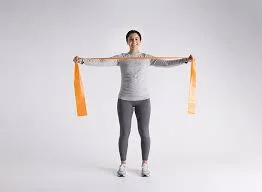
- Start in a standing position.
- Place your arms at chest height in front of you.
- A resistance band should be held firmly between your hands so that it is parallel to the floor.
- Pull the band towards your chest by extending both arms outward while maintaining a straight posture. Start this movement with your mid-back.
- Keeping your spine straight, press your shoulder blades together. After a small pause, carefully go back to where you were.
- Do this 12–15 times.
- Do two or three sets.
Wall angels

- Place your head, shoulders, upper back, and butt firmly against a wall while standing. To properly posture your body, you can place your feet a little bit apart from the wall. Bend your knees gently.
- Place the backs of your hands against the wall and extend your arms straight above your head. This is where you should start.
- Slide your arms down to your shoulders while contracting your mid-back muscles. Throughout the exercise, keep your body firmly pressed against the wall.
- Your arms should be just below your shoulders when you slide them down the wall. Hold this position for a brief moment, then, while remaining pressed against the wall, slide your arms back up to the beginning position.
- Do this 15–20 times.
- Perform two or three sets.
Chest press
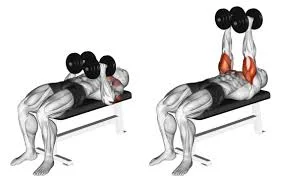
- Bend your knees and hold a light dumbbell in each hand while lying on an exercise mat or bench. This exercise can also be performed on a bench.
- Raise your elbows to a 90-degree angle, with the back of your arms resting on the floor. Place the dumbbells above your chest.
- Exhale deeply, then raise your arms until they nearly touch the dumbbells.
- After pausing, go back to where you were.
- Perform ten to fifteen times.
- Do two or three sets.
Mountain climbers

Mountain climbers steps:
- Take a plank or push-up stance.
- Keep your feet hip-width apart, your hips in line with your shoulders, your hands beneath your shoulders, and your core and glutes active.
- Bring your right knee in close to your chest. Pull the left knee in towards your chest as you thrust it back.
- Move quickly back and forth between your legs.
- Repeat for 20-40 seconds.
- Do two or three sets.
Dumbbell front raise

- Hold a small dumbbell in each hand.
- Place the dumbbells in front of your upper legs, either straight or slightly bent at the elbows.
- Dumbbells should be raised forward and upward until the upper arms are above the horizontal.
- Lower yourself to the beginning position.
- Perform ten to fifteen times.
- Do three sets.
Push-Ups

Push-up steps:
- Start in a prone lying position.
- Put your elbows in a push-up position.
- Repeat the exercise by pushing yourself back up.
- Perform 10-15 reps.
Reverse Fly
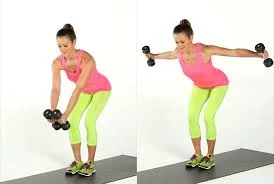
- Start in a standing position.
- Lift the arms straight up to about upper body level, elbows slightly bent, while keeping the neck in proper posture and abs engaged.
- Instead of jerking your arms up, lift the weight with your shoulders.
- Repeat the preceding procedures after lowering the weights.
- Perform 10-15 reps.
Standing wall push-up

- Start with a standing position.
- Place your feet shoulder-width apart. With your hands on the wall and your arms extended at shoulder height, lean gently against the wall. Avoid locking your knees or elbows.
- Bend your arms at the elbow and slowly move your body in the direction of the wall. Don’t move your feet.
- Breathe out as you gently push away against your body weight and return to the beginning position once your nose is near the wall.
- Do it again.
- Perform 10-15 times.
- Do two or three sets.
Safety tips:
Warm up and cool down. In addition to preparing your body for activity, warming up before beginning any weight training lowers your risk of injury. Engage in aerobic or dynamic stretches for at least five to eight minutes. Spend some time stretching and cooling down after your workout.
Pay attention to your form. Miller advises concentrating on your form or technique when you initially begin a specific exercise regimen. You can then start increasing the weight or performing more sets as your strength, endurance, and confidence grow.
Put your core into action. To support your lower back, each of the exercises calls for core strength. Make sure your abdominal muscles are contracted before beginning any workout and remain contracted throughout to ensure your safety.
Stop if you are in pain. Exercises for your upper body may test your muscles and may cause some soreness, but you shouldn’t experience any pain. If so, pause and evaluate the issue. If poor form is the source of the discomfort, you might want to think about hiring a personal trainer. See your doctor or physical therapist again if your pain doesn’t go away even after you make form corrections.
Summary
The advantages of upper-body resistance or strength training are numerous. It increases the strength and stamina of the muscles in your shoulders, arms, back, and chest. Additionally, it lowers your chance of injury, increases bone strength, and burns calories.
Try to work out your upper body a few times a week for optimal results. As you gain strength, progressively raise the intensity of your workout, starting out with fewer repetitions and sets.
FAQs
What is the most effective at-home upper body exercise?
The Most Popular 20 At-Home Upper-Body Exercises:
Push-ups.
Floor triceps.
Triceps dip.
Alternating punches.
Inchworms.
Back extensions.
Side and lateral arm raises.
Plank rise.
Are five upper-body workouts sufficient?
Targeting each muscle group at least twice a week, and occasionally even three times a week, is known as training upper/lower splits. You might incorporate 4–12 various exercises per muscle group in every program, with each workout consisting of 2-4 different exercises per muscle group on a particular day.
How many days a week should I work out my upper body?
Two or three days a week
Strength training has several advantages, such as keeping a healthy weight and developing stronger bones and muscles, but you shouldn’t lift weights every day. According to data, most people benefit from strength training two or three times a week.
Can excessive exercise lead to weight gain?
Your body loses fluids through perspiration as you exercise. You can retain water when you rehydrate, which could cause a little weight gain. Additionally, even if your body fat reduces, you may perceive an increase on the scale as you grow muscle mass through strength training.
Why is my upper body so weak?
Even something as basic as a strenuous workout can result in short-term muscle weakness. However, an underlying medical condition like multiple sclerosis, an autoimmune disease, or an electrolyte imbalance may also be the cause. You must address the underlying problem in order to treat muscle weakness.
Referances
- Lindberg, S. (2019, October 31). 10 great upper body exercises for women. Healthline. https://www.healthline.com/health/upper-body-workout-for-women#takeaway
- Cpt, P. W. (2024c, July 8). Upper-Body workout for chest, back, shoulders, and arms. Verywell Fit. https://www.verywellfit.com/great-workout-for-chest-back-shoulders-and-arms-1231474
- Cancer Council NSW. (2025, January 22). Upper Body Exercises | Exercise & Cancer | Cancer Council NSW. https://www.cancercouncil.com.au/cancer-information/living-well/exercise-cancer/strength-training/strength-training-upper-body/