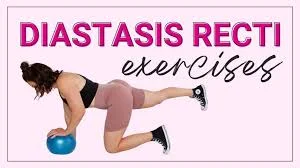

Mountain Climber Exercise
What is Mountain Climber Exercise?
Mountain climber exercises are an effective bodyweight workout that works multiple muscle groups at once, improving blood circulation, strength, flexibility, balance, agility, and coordination. Mountain climbing is a high-intensity interval training (HIIT) workout.
Mountain climber exercises are a great way to strengthen your arms, back, shoulders, core, and legs since they target several muscle groups throughout your body.
Using many muscles at once elevates your heart rate, increasing your calorie expenditure. As a result, if you want to improve the definition of your abdominals, this is an excellent exercise.
Furthermore, mountain climbers can improve your overall stability, joint mobility, and response time. Mountain climbers may be executed anywhere and at any time; therefore, no equipment is required.
Muscles are Used in The Mountain Climber Exercise
- The mountain climber is a great bodyweight workout that targets a variety of muscles.
- The shoulder, triceps, chest, serratus anterior, and abdominal muscles’ principal job is to sustain your body against gravity when in a plank posture.
- During the workout, your glutes, quadriceps, hip flexors, hamstrings, and calves contract, propelling your legs.
Advantages of Mountain Climber Exercise
- Because mountain climbers are generally completed fast, they are a fantastic way to strengthen your heart and supplement a high-intensity interval training regimen.
- Adults with low levels of physical activity can enhance their cardiovascular function by performing mountain climbers, a whole-body, high-intensity interval training exercise. They may reduce the risk of cardiovascular disease if done on a regular basis.
- Beginners should proceed at a modest and steady pace. Furthermore, mountain climbers begin in a plank position, which is a great core-building exercise.
Video of Mountain Climber Exercise
How to Perform The Mountain Climber Exercise
- Begin by getting to your hands and knees on the ground. Hold your hands shoulder-width apart, your shoulders higher than your wrists.
- Spread your fingers apart and press the space between your thumb and index finger into the mat to help stabilise your shoulders and upper torso.
- To maintain a straight line from heel to head, step your right leg back into a high plank posture.
- In the plank stance, step your left leg back until it contacts your right leg.
- Check the neutrality of your spine.
- Continue to feel like you’re pressing your hands into the ground and elevating the space between your shoulder blades slightly towards the ceiling. This will increase the activation of your serratus anterior muscles.
- Fix your eyes on the floor directly in front of your hands, maintaining your neck and spine straight.
- Step your right leg back into a plank posture after bending it towards your chest with your core muscles.
- Repeat with your left leg, stepping back after it has come close to your chest.
- This is a single mountain climber repeat.
- For a faster rhythm, change your legs so that one is moving forward and the other is moving backward.
- Perform two to three sets of ten to fifteen slow, controlled repetitions as part of a muscle-building and fitness program.
- As part of an HIIT-focused cardiovascular program, perform 6-8 rounds of fast mountain climbers, each lasting 20 seconds and separated by 10-second rests.
Different Types of Mountain Climber Exercise
If you want to mix up the conventional mountain climber workout, you may do so in a variety of ways.
Incline modification
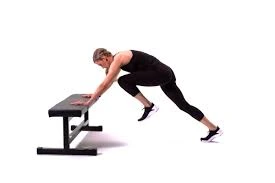
- Perform the exercise as stated above, but with your hands on a bench or step to form an incline plank posture.
- This option puts less tension on your upper body and wrists, which is useful if you want to avoid injury or gradually improve your strength in these areas.
- People who struggle to maintain appropriate form in a plank stance will find it easier to do so on an elevation.
- If you are higher off the ground than if your hands are on the ground, your abdominal muscles will be less active.
- Other research shows that movements like mountain climbers, which combine core activity with deltoid and glute activation, stimulate the lumbar and ab muscles more than more traditional ab exercises like crunches.
Decline Plank Progression

- Place both feet on a bench to make a decline plank.
- This sequence is good for strengthening your upper body since it puts extra strain on your shoulders.
Burpee or Pushup Progression
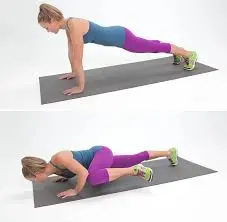
- It’s a good idea to mix mountain climbers with other workouts like burpees and pushups to keep yourself motivated, especially when you get adapted to them.
- As part of an HIIT program, consider completing four mountain climber repeats followed by two pushup or burpee repetitions, then repeat this sequence for 30 seconds.
Twist Variation
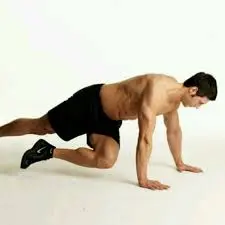
- Instead of bringing both legs straight forward towards your chest, while in the plank position, move your right knee close to your left upper arm and your left knee closer to your right upper arm.
- Maintain a level shoulder posture above the wrist. If you maintain your arms and upper body steady, you will see a twist in your waist.
Pushup Handles Modification
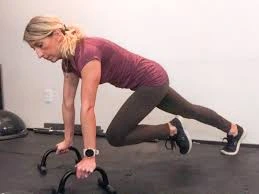
- The pushup handles allow you to alter your hand and grip position.
- This requires less wrist extension than lying your hands flat on the floor.
- If you have issues with your fingers or wrists, it may be more comfortable.
How to Include Mountain Climber Exercise in Your Workout?
The mountain climber is a very adaptable bodyweight exercise that can be included in a range of fitness routines. You can repeat the exercise for a certain number of reps, and a knee drive with both legs counts as one rep. You could be better suited to spend your time with mountain climbers.
Set a timer for 6 minutes and then alternate between 20 seconds of labour and 10 seconds of rest, making sure to push hard throughout each work phase. You can also work for an extended amount of time, such as 30 seconds or more. Simply maintain a forceful stance with your core engaged and your hips lower than your shoulders.
Instructions for Mountain Climber Exercise
- Using an exercise mat is the best option for maintaining hand comfort and reducing slippage.
- In terms of technical challenges, mountain climbers frequently raise their hips too high, resulting in a triangle or downward dog posture.
- In addition, your head would fall too low in this position.
- On the other side, your hips may occasionally descend too low, causing your lower back to arch abnormally.
- Maintain your head in alignment with the rest of your spine, your hips in alignment with your shoulders, and your gaze slightly forward to a point on the floor in front of you.
- This will help you build both your stomach muscles and your upper body.
Safety and Precautions for Mountain Climber Exercise
Mountain climbers of all skill levels must be able to assume and maintain a proper plank stance. This requires making sure that:
- You extend your wrists and arms straight down from your shoulders.
- Your back is level and straight, not curved or bent.
- Your buttocks and hips should not be lifted.
- Examine the right planking shape to ensure the move’s safety and success. Poor plank technique may raise your risk of injury and dramatically reduce the advantages of employing mountain climbers in your training program.
- If you have any shoulder or pelvic injuries or instabilities, you should avoid mountain climbing.
- Although mountain climbers are a terrific approach to strengthen your knees, you should consult your doctor or physical therapist before introducing them into your routine if you have had surgery or require it. (for example, to replace an arthritis-affected joint or repair a sports injury).
- If you were recently pregnant or underwent abdominal surgery, you may develop diastasis recti, a condition in which the muscles of your abdomen separate. You should avoid undertaking any core activities or mountain climbing until this condition has fully recovered.
Summary
- Mountain climbing is a diverse activity that can be adjusted to a variety of ability levels.
- To begin, perform them slowly and deliberately, using your legs to march while keeping flawless form.
- After that, progress to jogging with your legs, including increasingly challenging versions and mountain climbers, into your regular HIIT workout to promote cardiovascular health.
FAQs
For abs, are mountain climbers sufficient?
Mountain climbers, when done correctly, provide a more effective ab workout than crunches. Here’s how to perfect your approach. Without a gym, mountain climbers are an excellent method to improve your core. Lifting the hips or caving the lower back are two common errors that can reduce an exercise’s effectiveness.
Do mountain climbers help you lose belly fat?
Mountain climbers can help you lose body fat if you follow a calorie deficit, which is required for fat loss.
What are the advantages of standing mountain climbers?
Mountain climbing is a popular activity since it works all of your muscles above and below the waist. Your heart rate will also increase as your arms, legs, and core work together to finish the activity.
References:
- Cpt, P. W. (2024, May 19). Learn to master mountain climbers. Verywell Fit. https://www.verywellfit.com/mountain-climbers-exercise-3966947
- Nasm, B. W., & CSCS, E. S. (2022, April 13). How to do mountain climbers the right way. Men’s Health. https://www.menshealth.com/fitness/a28775134/mountain-climber-abs-workout/
- How to do Mountain Climbers. (n.d.). PureGym. https://www.puregym.com/exercises/full-body/mountain-climbers/
- Ba, G. R. (2022, March 10). What muscles do mountain climbers work? Healthline. https://www.healthline.com/health/fitness/what-do-mountain-climbers-work#bottom-line
- Goriya, D. (2024, November 20). Mountain Climber Exercise: a Core-Strengthening Powerhouse. Physical Therapy Treatment and Exercise. https://physical-therapy.us/mountain-climber-exercise/