Warrior Pose 3 (Virbhadrasana 3)
What is Warrior Pose 3?
Warrior Pose 3 (Virbhadrasana 3) is a powerful standing yoga pose that improves balance, strengthens the legs, core, and back, and enhances focus. It involves balancing on one leg while extending the other leg and torso parallel to the floor, creating a straight line from head to toe.
Virabhadrasana 3 is named after a powerful warrior named Virabhadra, whom Lord Shiva created out of fury against Daksha. The narrative has been told in three key scenes, in which Virabhadra battles Daksha at Shiva’s order.
Warrior 3 is one of the most dynamic balancing standing yoga positions. It focuses on strengthening and stabilising the core, arms, and legs. It is a little more difficult and advanced than Warriors 1 and 2, hence it falls within the intermediate category.
Holding this stance for a few breaths improves posture and stability by promoting full-body coordination.
Muscle Work During Warrior Pose 3:
- Chest Muscles
- Middle Back Muscles
- Core Muscles
- Gluteus and Hamstring Muscles
- Hip Muscles
- Psoas Muscles
- Quadricep Muscles
Video of Warrior Pose 3
How to Perform?
- Start by standing in the mountain posture and taking a deep breath.
- Bring the right foot forward, moving your entire bodyweight to it.
- Taking a big breath in, lift your arms, open your fingers, and stretch them up to the ceiling.
- Exhale and raise the left leg to the hip level.
- Along with elevating the left leg, the arms will be lowered. Keep them parallel to the ground.
- Align the left leg and torso. Keep your right leg solid and sturdy.
- The body will be shown in a T-shape.
- Look at the ground; keeping your eyes fixated on a certain location helps you maintain your balance.
- Maintain the stance for 2-3 breaths.
- Begin lifting the arms and bringing the left leg back to the wall.
- Lower your arms and rest in mountain position for 2-3 breaths.
Benefits:
Activates lower-body muscles.
In Virabhadrasana 3, the body weight is maintained on one leg, allowing for endurance. It exercises the entire lower body and engages the muscles that strengthen the ankles, legs, and overall lower body.
Reduces body fat.
The intensity of warrior posture 3 is so strong that it causes heat in the body. As a result, the position is ideal for burning excess fat. It keeps the body fit and toned.
Improves focus.
This asana helps the practitioner focus and concentrate better. It promotes attention and allows us to concentrate on the current moment, cleansing the mind.
Improves cardiac health.
The asana is vigorous enough to enhance oxygen intake. It improves cardiovascular endurance.
Sharpens memory.
Warrior Pose III is all about attention and concentration. With consistent practice, the memory is revitalised and sharpened. Thus, improving concentration power boosts memory cells.
Preparatory Pose:
- Half-Moon Pose (Ardha Chandrasana)
- Chair Pose (Utkatasana
- Standing Forward Bend (Uttanasana)
- Warrior Pose I (Virabhadrasana I)
- Warrior Pose II (Virbhadrasana II)
- Tree Pose (Vrikshasana)
Beginner’s Advice:
- Keep the standing leg slightly bent to avoid the body from wobbling or becoming unstable.
- Maintain a strong grasp on the standing leg. For this, push your standing leg’s inner and outer feet evenly on the ground.
- Focusing on a certain spot by focusing the eyes helps to balance the body weight.
- Maintain your posture by fully engaging your core muscles.
Modifications:
Using a chair: Position a chair ahead of you, near to your mat, with its back to you. Hold the top of the chair while extending your hands forward. As you learn to stretch, fully slide the chair away from you and place your palms on it for support.
Against a wall: Like the chair, the wall may be used to support either the arms or the elevated leg.
Using blocks: Take two yoga blocks for each hand and arrange them on your mat. Begin by balancing your hands on the blocks without slouching, and then move your left foot back. When everything is lined up, elevate your left leg. Then, progressively add the arm movement by elevating the arms one at a time.
Yoga strap: Once you’ve achieved balance in Warrior III, you might want to try utilising a yoga strap. Make a loop using a strap large enough to completely cover you from the heel to the hip bone. While keeping balance on the right leg, place the strap underneath the left heel and bring it to the right hip bone. Uplift the left leg with the strap, providing the additional stretch.
Variations:
Warrior Pose 3 with arms on sideways:
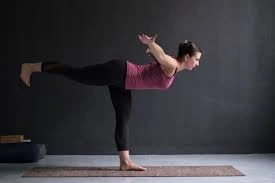
While in warrior posture III, make a few tweaks to the location of your arms. Try extending them sideways, like wings, to fly. Another option is to move them backward with the palms facing up.
Anjali Mudra Variation:
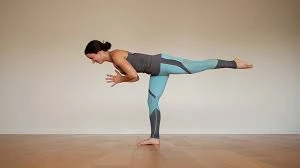
While maintaining the forward stretch, one can unite both extended hands in the Anjali Mudra prayer stance.
Kali Mudra Variation:
Interlock the fingers of the hands, then point the index fingers forward to form the Kali mudra. This is another method of achieving the warrior posture III.
Contraindications:
- Warrior 3 is not appropriate for persons with high blood pressure. The sudden blood influx to the brain while doing the position may cause complications for certain individuals.
- If you have spondylitis, never practise virabhadrasana 3, as the position is too hard for such a major back issue.
- Avoid it if you have a persistent leg, hip, back, or shoulder ailment.
- Do not perform Virabhadrasana III when pregnant.
Common Mistakes:
- Hips are shifting sideways instead of staying level.
- Standing knee locked, putting undue strain on the joint.
- The back limb droops instead of completely stretching.
- The chest collapsed forward, disrupting the body’s straight line.
FAQs
What is the Warrior 3 pose good for?
This yoga stance engages a multitude of muscles, the majority of which assist you in maintaining your balance. This comprises the muscles in your upper body, lower body, and core. Warrior 3 is ideal for increasing overall body strength. The major muscles addressed are those in the core.
Why is Warrior 3 so hard?
Sitting causes our hips to automatically expand and spin outward, shortening the external rotators and lateral hip muscles over time. It just so happens that in order to generate the elegance of the Warrior 3 stance, these four muscle groups must be in peak performance.
Does Warrior 3 improve flexibility?
Improves attention and concentration: Holding the position demands focus and concentration, which contributes to increased mental clarity and focus. Stretches the hamstrings and spine: Virabhadrasana III stretches the hamstrings, calves, and spine, increasing flexibility and relieving stress.
What are the common mistakes in the Warrior 3?
Hip Opening: To maintain proper alignment, keep your hips square to the ground.
To minimise tension and collapse, soften your standing knee.
Collapsing the Chest: Extend the spine while keeping the chest elevated.
Allowing the Back Leg to Sag: Actively reach through the elevated foot.
Who should avoid Virabhadrasana 3?
Anyone with high blood pressure, recent or chronic injuries to the legs, hips, back, or shoulders should avoid doing the warrior 3. Pregnant ladies should avoid the asanas.
Is Warrior Pose good for back pain?
Warrior II Pose can help relieve sciatica and back pain while stretching your groin, legs, abdomen, and chest.
What are the physical benefits of Warrior 3?
Warrior 3 is ideal for increasing overall body strength. The major muscles addressed are those in the core. It also strengthens the quadriceps and ankle muscles of the standing foot. Warrior 3 exercises the glutes and hamstrings while extending the leg.
References:
- Warrior 3 Pose (Virabhadrasana 3): Meaning, Benefits & Variations – Fitsri. Yoga.https://www.fitsri.com/poses/warrior-3
- Warrior Pose 3 Yoga Pose (Virbhadrasana 3). Tummee. https://www.tummee.com/yoga-poses/Virbhadrasana 3
- Filippo. (2024c, December 8). Warrior Pose 1, 2, 3 – Steps, Benefits, and variations of virabhadrasana. One Yoga. https://oneyogathailand.com/warrior-pose-1-2-3-steps-benefits-and-variations-of-virabhadrasana/