
9 Best Calf Stretching Exercises
Calf stretching exercises help improve flexibility in the lower leg muscles, reduce tightness, and prevent injuries. They are ideal for runners, athletes, and anyone experiencing calf stiffness or heel pain.
The Calf Muscle: What is it?
The calf consists of two muscles: gastrocnemius and soleus. Both of these muscles connect to the Achilles tendon at the rear of the Ankle. The calf’s lengthy lever arm and ankle shape make it a potent plantar flexor.
To stretch the gastrocnemius muscle, fully extend the knee, and it originates above the knee. The soleus muscle is deep to the gastrocnemius, and it originates below the knee.
Why is This Stretch important?
- It is critical to have the calf muscles stretched to walk and run effectively.
- Walking properly requires the ability to raise the foot to a 15-degree angle. If the ankle cannot travel that far, compensating motions must be performed at other joints, such as the forefoot or knee. Excessive toeing out, forefoot pronation, hindfoot inversion, and knee rotation are all possible outcomes. Compensatory motions may induce injuries, tendinitis, fasciitis, and joint degeneration. Running requires significantly more movement.
- Flexibility in the calves is essential for sports that involve walking, jogging, or leaping for extended periods.
9 Best Calf Stretching Exercises:
Standing calf stretch(gastrocnemius)

- Stand about three feet from a wall and place your right foot behind you, toes pointing front.
- Keep your heel on the ground and lean forward, right knee straight.
- To target the medial and lateral sections of this muscle independently, rotate the toes gently in and out.
- Hold this for 30-60 seconds.
Standing Calf Stretch (Soleus)

- Stand away from a wall, with your right foot behind you and toes facing forward.
- Lean forward at the ankle, bend the right knee, and maintain your heel on the ground.
- Flexing the knee relieves strain on the gastrocnemius and transfers it to the soleus muscle.
- Hold this for 30-60 seconds.
Wall calf stretch

- Stand around two feet away from a wall.
- Place the ball of your right foot on the wall, keeping your heel on the ground.
- Slowly and gently lean against the wall, maintaining your knee straight.
- Hold this for 30-60 seconds.
Downward Dog Yoga Stretch

Downward Dog pose:
- Get down on all fours and place your hands beneath your shoulders on the floor.
- Walk your hands forwards gently on the floor.
- Spread your fingers widely to form a broad foundation of support.
- Tighten your core muscles while pushing your hips up towards the ceiling.
- Keep your heels on the ground and softly straighten your knees.
- Hold this till the perfect moment.
Towel Stretch

- Sit on the floor, legs straight out in front.
- Loop a hand towel around the ball of one foot. Hold both ends of the cloth.
- Bring the towel towards your body while maintaining your legs straight.
- Hold this posture for 30 seconds. Then release for 30 seconds.
- Do three sets.
Calf stretching exercises with the stick

- Sit on the floor with your forefoot up against the wall.
- Roll the stick over a 3-4 inch region of the calf muscles for around 10 seconds.
- Repeat this over the rest of the calf until it is completely coated.
- Consult a physical therapist or family doctor for further evaluation.
Calf stretching exercises with a foam roller
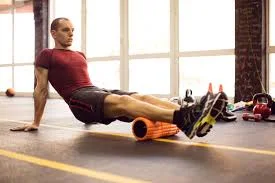
- Sit on the floor, legs extended out in front of you. Position the foam roller beneath the bottom portion of your right leg.
- Roll back and forth on the foam roll while pushing up with your arms.
- Roll slowly over the foam roll, working your way up the muscle to the knee.
- Do not cross over the knee.
- Perform with your toes pointed inward and outward.
Calf stretch exercises with a belt

- Sit in an upright chair, with your back straight and your head centred over your shoulders.
- Secure a strap or cloth around the ball of your right foot.
- Straighten your right knee and tighten the strap to concentrate on the gastrocnemius.
- Hold this. To target the soleus, repeat the same stretch but with the right knee bent.
- This calf stretch may also be done while sitting on the floor or on your bed.
Calf raise

- Stand with equal weight on each foot.
- Hold on to a tabletop or the back of a chair for stability.
- Bend the right knee and elevate your right foot.
- The left foot should bear all of the body’s weight.
- Keep the left leg straight and elevate the left heel as high as possible.
- Lower it and repeat the exercise ten times.
- Do three sets, then repeat on the opposite leg.
Conclusion
Healthy calf muscles are essential for maintaining balance and posture, as well as preventing injuries. Calf raises are a basic exercise that works the back of your legs. Many activities, like hiking, swimming, and tennis, may give good exercise. Are you new to fitness or feeling out of shape? Seek counsel from your doctor and a fitness specialist at a gym to ensure your safety.
FAQs
What causes tight calves?
Tight calf muscles might develop for a variety of causes. Overtraining, especially in sprinting and jumping sports, is a frequent cause. When you raise your exercise intensity or distance too soon without enough recovery, you might overload the calf muscles, causing stiffness and pain.
Why is calf stretching so important?
Calf stretching can gradually reduce muscle stiffness, enhancing overall flexibility and movement quality. As a result, this mobility improves your body’s protection against future injuries or strains.
Should I massage a stiff calf?
Applying moderate or deep pressure to this spot might assist in relaxing tight calf muscles and relieving tension. Furthermore, rubbing the ankle joint and the calf muscle might improve blood flow and alleviate calf discomfort.
Should I massage a tight calf?
Applying moderate or deep pressure to this region may help to relax tight calf muscles and decrease stress. Furthermore, massaging the ankle joint and calf muscle may increase blood flow and relieve calf soreness.
What is the quickest approach to relieve muscular knots?
To relieve pain and enhance muscular function, muscle knots must be addressed proactively with a mix of focused heat treatment, massage methods, and frequent stretching. Incorporating these tactics into your practice will significantly improve blood flow, reduce stress, and promote muscle recovery.
Referances
- Eske, J. (2023, May 23). How to treat, identify, and recover from a pulled calf muscle. https://www.medicalnewstoday.com/articles/326431
- CU ORTHOPEDICS – FOOT & ANKLE. (n.d.). Calf stretches. https://medschool.cuanschutz.edu/docs/librariesprovider65/foot-ankle/useful-links/calf-stretches-foot-ankle.pdf?sfvrsn=4a919cba_2#:~:text=CALF%20STRETCH%20EXERCISES%20USING%20A%20BELT&text=Loop%20a%20strap%20or%20towel,with%20the%20right%20knee%20bent.
- Taylor, R. B. (2025b, January 2). Best exercises for strengthening calf muscles. WebMD. https://www.webmd.com/fitness-exercise/strengthening-calf-muscles