Dead Butt Syndrome Exercises
What is Dead Butt Syndrome?
Dead Butt Syndrome, often known as lower cross syndrome, occurs when your body becomes unbalanced due to muscle weakness.
The most frequent cause is prolonged sitting in a car or in front of a desk. One of the three main muscles in your buttocks, the gluteus medius, eventually becomes weaker if you remain in that sedentary position.
The gluteus medius stabilises your hips and pelvis. Your buttocks may experience instant numbness or tingling as that muscle weakens, but not your legs or feet.
However, dead butt syndrome can develop into more serious problems with the hip, lower back, and buttocks over time.
Other factors may also contribute to the issue. Muscle tension can lead to lower cross syndrome in athletes (particularly avid runners) who neglect cross-training and routine stretching.
When that weakness increases, it has an outstanding snowball effect. Dead butt syndrome may be a funny term, but it can develop into some significant health problems that impair mobility.
How to fix dead butt syndrome?
If prolonged sitting is the source of lower cross syndrome, it is quite easy to prevent or reverse. a few suggestions for your work schedule, along with a few stretches and exercises.
Perfect your posture.
You usually sit a lot if you work at a desk. By improving your sitting technique, you can prevent dead butt syndrome.
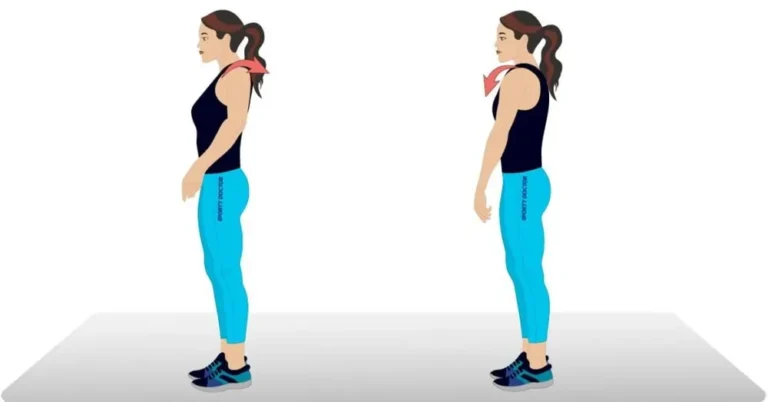
Straighten your posture. To prevent slouching, which puts more strain on your glutes, keep your shoulders relaxed and your back upright. To maintain proper posture, utilise a lumbar support, such as a pillow or rolled-up towel, if it helps.
Make sure the floor and your feet are level: Keep your knees at a 90-degree angle and your feet flat on the floor because proper alignment begins with a solid foundation. Make sure your hips are level with your knees or slightly higher by adjusting the height of your chair.
Don’t cross your legs. Your pelvis may tilt and spin when you move into this position, which could put uneven pressure on your glutes.
Move around a lot. Moving about in your seat helps keep your lower back and buttock muscles active, even if your workplace chair is ergonomically sound (that is, it promotes proper posture). For variation, think about utilising a kneeling chair or therapy ball.
Get up regularly.
Even though sitting might not seem like a very taxing activity, it actually causes your muscles to be overworked.
One set of muscles is overworking because they are keeping you upright,t while another set of muscles isn’t working at all, even if sitting doesn’t feel taxing.
Standing up and moving about regularly can activate other muscles while providing a break for those “sitting muscles.” The muscles that connect your lower back, pelvis, hips, and groin are called hip flexors.
Every hour in the workplace, try to get in at least 20 minutes of walking or standing.
It can be as simple as walking over to talk with a coworker or getting up while on the phone. Even though these are minor things, the advantages of shifting from sitting to moving throughout the day are substantial.
Set an alarm to remind you to get up and stretch every thirty minutes or so. An additional useful tool for getting out of your chair is a standing desk.
Treating DBS
The extent of dead butt syndrome and your desired level of physical activity will determine the best course of treatment. To safely resume running, you should collaborate closely with a sports medicine specialist if you’re a runner looking to get back on track as soon as possible.
The typical course of treatment for most people, including runners and other athletes, is to take a vacation from physical activity or sports. Depending on the severity of your DBS, doctors might additionally advise:
If a doctor advises it, apply ice or a heating pad for brief periods of time to lessen pain, compression, and elevation. Rest, especially by abstaining from painful activities
Muscle tenseness can be relieved with massage therapy, light stretching, and exercise can assistin mendingd strained muscles, and physical treatment can improve strength and flexibility.
Additionally, certain medications may be used to reduce discomfort. Nonsteroidal anti-inflammatory drugs (NSAIDs) such as acetaminophen and Tylenol may be among them.
Ibuprofen (Advil, Motrin), aspirin, and naproxen (Aleve, Naprosyn)
A doctor might suggest injectable therapies like platelet-rich plasma (PRP) therapy, which may promote healing, or corticosteroids, which may lessen inflammation, if you’ve suffered a severe injury to your tendons and muscles.
PRP involves injecting a concentration of your own platelets, which are blood cells involved in healing and blood clotting. Your injured location is where the injections are administered. Their purpose is to expedite the healing process.
Another technique to promote healing is shockwave therapy, which involves applying acoustic (shock) waves to the location of an injury.
Preventing DBS
Breaking up extended periods of sitting with brief walks and activity, such as getting up every hour, is the most straightforward way to prevent dead butt syndrome. It can be especially beneficial to go up and down stairs.
Set a timer on your computer or phone to remind you every hour or every half hour if you need one. Your “dead butt” may be revived by the movement, which can help increase blood flow to the constricted areas.
Generally speaking, make every effort to use the stairs. In addition to engaging the DBS-affected muscles and tendons, this is a beneficial cardiovascular and weight-bearing exercise.
Exercises for dead butt syndrome
If dead butt syndrome is caused by muscle weakness, the fix appears to be straightforward: Strengthen your buttocks. Your glutes and surrounding muscles will be strengthened by these exercises.
1. Glute squeeze

Three phrases make up the directions for this: Squeeze your bottom.
How to do it: Tighten your back end and contract your butt muscles while seated. That causes the muscles to contract and the blood to flow.
Hold for 15 to 30 seconds, then release.
2. Side-lying leg lifts
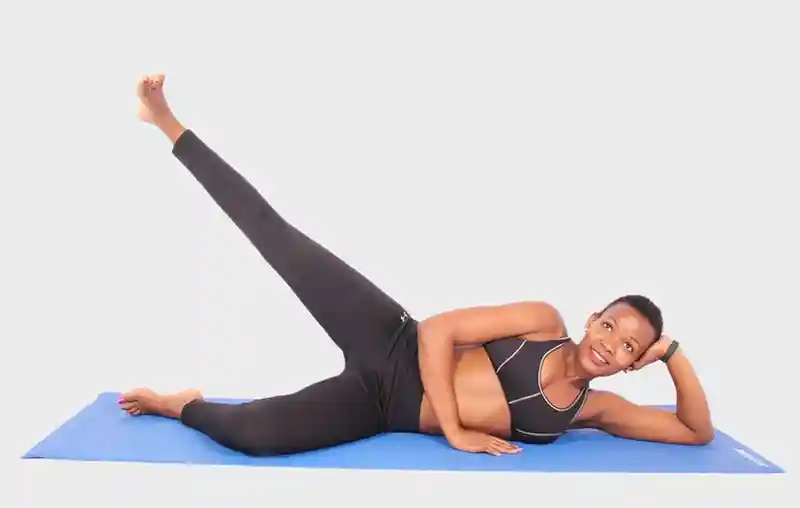
This exercise targets your hip flexors and core muscles by turning your legs into scissors.
How to do it: Stretch and extend your legs while lying on your right side.
Raise your left leg slowly toward the ceiling, then lower it again (like opening and closing scissors). For a complete set, repeat the move 15–30 times.
Repeat with your right leg up after flipping over.
For each leg, perform up to three sets.
To increase the difficulty of the exercise, use ankle weights or resistance bands.
3. Glute bridges
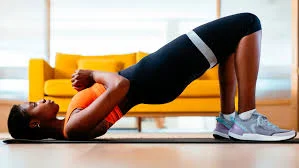
This is an exercise that will “lift” your butt.
How to do it: Bend your knees and lie on your back. Maintain your feet flat on the ground, six inches from your butt and hip-width apart. Stretch your arms to both sides.
Tighten your abs and butt muscles while raising your hips. Avoid arching your back by reaching as high as you can. Ten to fifteen seconds of holding.
While keeping your muscles taut, slowly bring your hips back to the floor. Do this ten times.
Perform two or three sets.
Repeat as required.
4. Clamshell
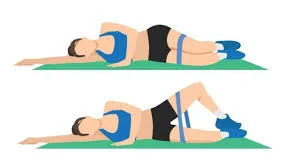
The “clamshell” exercise simulates the open-and-close shell action of a clam. Your hip and glute muscles are the focus of this strengthening workout.
How to do it: With your feet together, knees bent, and hips stacked, lie on your right side.
Open your legs like a clam and raise your bowed left leg toward the ceiling. Return your left knee to the starting position after reaching the peak of the exercise. For a complete set, repeat the move 20–40 times.
Repeat by flipping over and raising your right leg 20–40 times.
For each leg, do up to three sets.
To increase the difficulty of the exercise, wrap a resistance band over your thighs.
5. Squats

Your glutes, quads, hamstrings, abdominal muscles, and calves are all worked during this exercise. Weights are not necessary for this exercise.
How to do it:
Stand with your feet shoulder-width apart.
Tighten your core muscles and bend your knees gradually until your thighs are nearly parallel to the floor.
After that, slowly go back to where you were. There is one recurrence of this.
A few days a week, perform 12 to 15 repetitions.
Use a professionally made squat rack or a dumbbell across your shoulders for more resistance.
6. Hamstring stretches
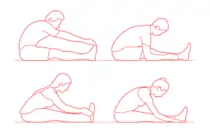
The muscles at the back of your thigh can be stretched in several ways, but one easy method is to stand with your left leg in front of your right.
How to do it: Bend at the waist just enough to feel a small tug on your left hamstring while keeping your left leg straight and your right leg slightly bent.
After ten seconds of holding, switch legs.
Increase the duration of the stretches to 30 seconds at a time.
7. Chair Step-Up
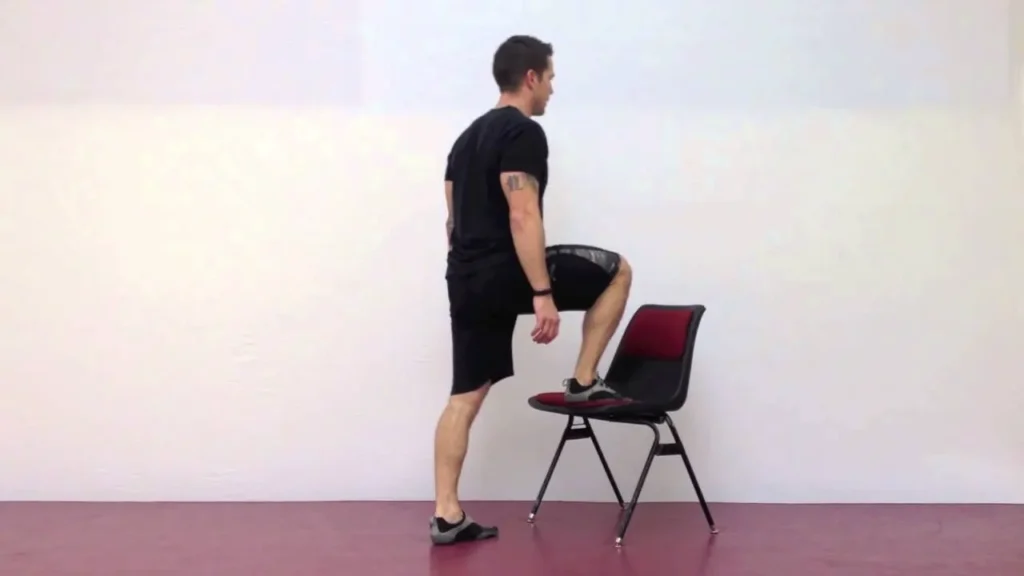
Pushing yourself to the top of the chair improves your gluteus maximus. Additionally, it strengthens your core and improves lower-body stability:
How to do it: Position yourself facing the front of a chair or bench that is around 20 inches (50.8 cm) high, with your feet hip-width apart and your arms by your sides.
Step onto the top of the chair or bench by placing your right foot on the seat and driving through it.
Maintaining an active core, raise your left knee to hip height.
Return to the starting position by slowly lowering your left leg back to the ground. After ten repetitions, switch to the opposite side.
8. Grasshopper
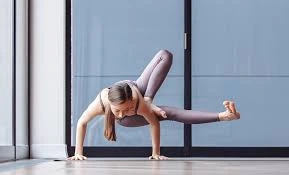
Your glute muscles, which must contract to control your pelvis when you move your legs, are activated by the grasshopper:
How to do it: Place yourself on your stomach, bend your knees, and bring your feet together while keeping your knees slightly apart.
To raise the legs an inch or so off the ground, contract your glutes.
Drop back down. Ten repetitions (reps) should be performed.
9. Half-Kneeling Hip Stretch

You can extend your hips and glutes with this exercise. Stretching can increase range of motion and ease muscle tension:
How to do it: Take a half-kneeling position to begin. Bend your knees to a 90-degree angle and put your right foot forward.
For support, place your hands on your front thigh. Pull your belly button in the direction of your spine while tucking your hips forward.
Avoid rounding back or untucking your hips as you rock forward gently.
Wait 30 seconds. Hold each side for 30 seconds in three sets.
10. Lateral Lunge
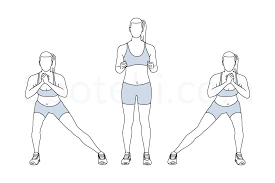
The gluteus medius and maximus are targeted and strengthened via the lateral lunge:
How to do it: Place your hands together in front of your chest and stand with your feet together.
Leap into a lunge right away after taking a big step out to the right. To align your right foot with your hips, bend your right knee and sink your hips back.
Keep your feet pointing forward and your left leg straight but not locked.
Step your right foot next to the left, push off your right foot to straighten your right leg, and then go back to where you were before. After ten repetitions, switch to the opposite side.
11. Lateral Walk With Band
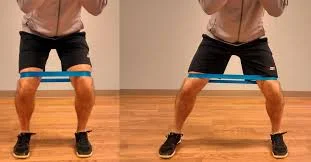
This workout increases stability and strengthens your hips. To increase the resistance of your movements, use a band:
How to do it: You should stand with a resistance band wrapped just above your knees and your feet somewhat wider than hip-width apart.
Lower yourself into a small squat by bending your knees slightly.
Rotate your right knee in and out ten times after taking twenty steps to the left and pausing. Oppositely, repeat.
12. Marching Glute Bridge
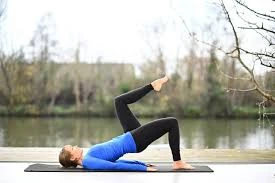
As you raise your hips off the floor, your glute muscles will be activated, stabilising your pelvis:
How to do it: Place your feet hip-width apart, bend your knees, and keep your heels a few inches from your butt while lying flat on your back. Your arms should remain by your sides.
To elevate your hips, squeeze your glutes.
Maintain a 90-degree bend at the knee, raise your right foot, and keep your left foot on the ground.
Repeat on the left side after lowering your right leg. For 12 repetitions, keep switching.
Stretches to relieve dead butt syndrome
Muscle stiffness that contributes to lower cross syndrome can be relieved with stretches. To get the full benefits, hold the stretch for one to two minutes.
Try these two stretches and set a timer for at least 60 seconds.
1. Seated spinal twist

If your lower back is tight, it’s likely that your hip flexors are as well. You may perform this easy stretch while seated in your computer chair to help relax those muscle regions.
How to do it: With your feet flat on the floor, take a straight seat in your chair.
Keep your shoulders square and twist your torso to one side. (You can use your hands to grasp the chair’s top as you slowly rotate into position to increase the depth of the lumbar stretch.)
Return to your starting posture after holding the stretch for one to two minutes.
Turn in the opposite way and repeat.
2. Runner’s lunge
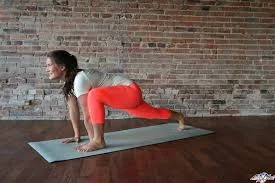
Dead butt syndrome can be made more uncomfortable by tight hip flexors. This stretch may help reduce the intensity of the pain.
How to do it: On your right knee, kneel. With your left knee bent at a 90-degree angle, take a step forward with your left foot. Keep your torso straight and your shoulders square.
Maintaining a straight back, gently thrust your hips forward. For balance, keep your hands on your hips. Your right kneeling leg should feel stretched in the hip and thigh.
Aim to maintain the stretch for a duration of one to two minutes.
Repeat after switching legs.
Outlook for DBS
You can revive your “dead butt” and keep it that way for a long time with the right care and exercise.
You may aid in your body’s recovery and stop DBS from recurring if you make time to move throughout the day and incorporate DBS-preventing activities into your weekly regimen.
But be aware that those symptoms can reappear if you spend a lot of time sitting down and then run or engage in other intense activities that strain your hip flexors and glutes.
You might want to discuss undergoing a functional movement screening (FMS) with a sports medicine specialist if you’re a serious runner. By examining your running form’s biomechanics, this screening can help you run better and lower your chance of receiving a DBS return.
Conclusion
Buttock numbness or pain is a common side effect of DBS. If severe, it may also spread to the legs, hips, or lower back.
With rest, pain relief, and mild stretching and exercise, you might be able to heal at home.
However, it is important to consult a physician, such as an orthopaedic expert, if your pain is severe or doesn’t seem to be getting better. They might suggest particular workouts or alternative forms of therapy.
FAQs
How to fix dead glute syndrome?
To treat dead butt syndrome (gluteal amnesia), concentrate on strengthening and activating your glutes with exercises like hip pushes, clamshells, and glute bridges. You should also take frequent breaks from sitting to stretch and move. The key to re-engaging these underutilised muscles is regular movement, foam rolling tight spots, and a physical therapist’s guidance for persistent issues.
What are the signs of weak glutes?
Because other muscles compensate or joints become strained, weak glutes can cause symptoms such as lower back, hip, or knee pain, poor posture (pelvic tilt), instability, trouble climbing stairs or standing up, decreased athletic performance, and even problems like runner’s knee or plantar fasciitis. Walking with the hips lowered and general buttock weakness or exhaustion are warning signs.
What strengthens your glutes?
One of the best workouts for building stronger glutes is the squat. The gluteus maximus, gluteus medius, and gluteus minimus are the three glute muscles they target. You can practice squats with your own body weight or with additional resistance like dumbbells or a barbell.
What causes buttock muscle wasting?
Spending too much time sitting in a chair, on the couch, or in your car might cause this. You can have DBS just by not doing enough gluteal exercise, even if you’re fairly active! People who are really active and have strong quadriceps or hamstrings may experience the same kind of muscle imbalance.
What are the biggest mistakes in glute workouts?
Not starting with the glutes. The Error: Immediately engaging in heavy lifts without first activating the glute muscles.
Insufficient Gluteal Training Frequency…
Poor Range of Motion and Form.
Ignoring Progressive Overload.
forgetting the connection between the mind and muscles.
References:
- Rd, A. L. (2025b, October 13). 7 Exercises to fix dead butt syndrome (Gluteal amnesia). Health. https://www.health.com/fitness/dead-butt-syndrome-gluteal-amnesia
- Roland, J. (2025b, June 17). All about gluteal amnesia (‘Dead butt syndrome’). Healthline. https://www.healthline.com/health/dead-butt-syndrome
- Wallack, R. M. (2026b, January 2). 4 Exercises to revive your dead butt. Triathlete. https://www.triathlete.com/training/workouts/4-exercises-revive-dead-butt/