Pasasana (Noose Pose)
What is Pasasana?
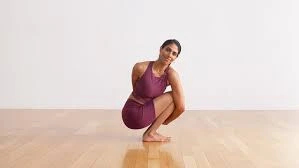
Pasasana is an intermediate series pose in Ashtanga yoga that is done while sitting on one’s feet. This pose, which requires supporting the body while keeping a twist in a full squat, is particularly difficult anatomically.
In this position, the squatted legs are twisted gently to one side, and the entire body weight is on the feet. The torso is twisted in the opposite direction from the swing. The shins are encircled by the arm corresponding to the swinging direction, and the loop is secured by the other arm, clasping the hands from behind.
Noose pose’s twists and stretches work the muscles in the neck, shoulders, chest, groin, thighs, and ankles. The core muscles and spine are also affected.
Meaning:
“Asana” means “pose,” and “Pasa” means “tie” or “noose” in Sanskrit. The arms create a loop in this pose, holding the knees and back together. The name comes from the way the arms are utilised as a noose to secure the trunk to the legs in this position.
The position strains the muscles and calls for body balance. This enhances general posture and fortifies the engaging muscle.
Muscle Work During Pasasana:
- Neck Muscles
- Biceps and Triceps Muscles
- Chest Muscles
- Middle Back Muscles
- Lower Back Muscles
- Core Muscle
- Hip Muscles
- Psoas Muscle
- Gluteus Muscle
How to Perform?
- Put yourself in tadasana.
- Come to a full squat, bending your knees.
- Make sure you sit completely on your feet and keep your heels grounded.
- Swing your knees to the left a little.
- Breathe out while lowering your left shoulder to your outer right knee and turning your torso to the right.
- With your left arm encircling your left outer thigh and both shins, keep your right hand on the ground.
- Take a breath, raise your right shoulder, and grasp your left wrist with your right arm from behind.
- Continue to stare up while raising your chin towards your shoulder.
- Hold the stance for thirty seconds while continuing to breathe.
- Breathe out and let go of the twist as you return to the centre.
- To the left, repeat.
- Sitting on the mat, let go of your hands and unwind.
Benefits:
Makes the ankles stronger:
As the entire body rests on the feet during pasasana, pressure is applied to the ankles, resulting in toned ankles. Ankles develop stronger when the muscles surrounding them are worked. Particularly for people who stand for extended periods of time at work, Pasasana is incredibly calming for the feet.
Increases flexibility and stretches:
Pasasana extends the shoulders, thighs, and groin in addition to stretching the spine. Stretches in these regions increase the surrounding muscles’ size and flexibility.
Facilitates digestion:
Pasasana’s torso twisting stimulates the internal organs by massaging the abdominal muscles. This improves the digestive system’s performance. It acts as a remedy for indigestion and flatulence.
Facilitates respiration:
In the noose posture, the torso is twisted to move the upper body to one side, opening the shoulders and chest. It increases the capacity to breathe by enlarging the lungs. Additionally, it helps prevent and treat respiratory conditions like asthma.
Boost the flow of blood:
This position lifts the heart by opening the chest cavity and applying pressure to the muscles. It improves the heart’s efficiency, which increases blood flow to the muscles and maintains a healthy circulatory system.
Reduces the discomfort associated with menstruation:
In order to stimulate the uterus and other reproductive organs, Pasasana stretches the groin. As a result, it relieves the discomfort and cramps associated with menstruation.
Reduces discomfort:
Additionally, Pasasana is a stance that relieves discomfort. It involves the muscles expanding and releasing the tension that has been contained in them. As a result, it eases back, shoulder, and neck pain.
Beginner’s Advice:
For any, it is a difficult pose. Use pops (provided below) without hesitation. It is most useful to perform against a wall that is hand-distance away. Try using one hand on the wall to balance the stance. Bring the hands to be held by the hand wrapped over the back and shin as you regain your balance.
Preparatory Pose:
- Lord of the Fishes Pose (Ardha Matsyendrasana)
- Bound-Angle Pose (Baddha Konasana)
- Bharadvaja’s Twist (Bharadvajasana)
- Cow Face Pose (Gomukhasana)
- Garland Pose (Malasana)
Modifications:
- Blanket: If there is space between the heel and the floor, keep the stance while placing a folded blanket beneath the heel.
- Yoga blocks: Place several blocks on top of one another. You can place your buttocks over the blocks while you squat. To lower them, adjust them to your limit.
- Pasasana should be done against a wall. You can bring your hands to the wall after lowering yourself to a squat while twisting. Maintaining the posture while balancing the body is beneficial.
Variations:
Pasasana with one leg:
With your buttocks over your heels, sit on your feet. In front of you, your arms are positioned between your legs. To place your left hand over your right leg, wrap your left arm from behind. Now place your right hand around your right shin, grip your left wrist, and move your right armpit in the direction of your inner right knee. Turn your head so that you can see the elevated left shoulder.
Twisted Toe-stand Squat:

Do a complete squat. Raise your heel and use your toes for balance. Now move your left armpit past your right outer knee while twisting from your torso to your right. This causes the chest to open to the right. Put your hands together in a prayer position, pushing your chest while glancing over your right shoulder.
Precautions and Contraindications:
- By keeping your heels down, you can prevent them from lifting off the ground.
- Don’t drop your buttocks to the floor when you’re fully squatting to lose the pose’s basis.
- Throughout the pose, pay attention to your breathing.
- If you have a lower back injury, stay away from it.
- If you have a herniated disc, avoid doing pasasana.
- Avoiding the complete squat is not advised if you have a fractured knee.
- Pasasana should not be attempted by those who have arthritis or spondylitis.
FAQs
What are the benefits of Pasasana?
Pasasana strengthens the legs and core muscles, promotes digestion, and increases spinal flexibility. It also promotes balance, concentration, and deep breathing. Because of its intricacy, it calls for flexibility and strength in the ankles, hips, and shoulders.
How does one feel after performing Pasasana?
The spine is greatly stretched by pasasana. It eases shoulder and upper back stress. The squatting position of the legs strengthens the hips and ankles. Additionally, the position enhances blood circulation and facilitates better digestion and disposal.
What are the Contraindications of Pasasana?
Pasasana should be avoided by people who have knee pain or injuries since the deep squat can strain the knee joints. The pose should ideally be avoided by those who have ankle problems or restricted ankle flexibility because it may be painful and dangerous.
What is Pasasana?
The difficult sitting twisting pose known as Pasasana, or “Noose Pose,” is typically performed in the advanced phases of the Ashtanga Yoga sequence. This posture requires you to kneel low with your feet together, bind your hands behind your back like a noose, and wrap your arms around your knees. Pasasana strengthens the legs and core muscles, promotes digestion, and increases spinal flexibility.
Is Pasasana an easy pose for beginners?
No, in Ashtanga yoga, Pasasana is regarded as an advanced or intermediate pose. To progressively gain the required strength and flexibility, beginners should employ props and adaptations.
References:
- Pasasana (Noose Pose): How to Do, Benefits & Variations – Fitsri Yoga. https://www.fitsri.com/poses/pasasana
- Noose Pose Yoga Pose (Pasasana). Tummee. https://www.tummee.com/yoga-poses/Pasasana
- Singhdeo, A. (2025, August 13). How to Practice the Noose Pose: How to do Pasasana. https://www.shvasa.com/yoga-blog/how-to-do-pasasana-noose-pose