
Top Exercise for Rhomboid Muscles
Introduction:
Exercises for the rhomboid muscles help strengthen the upper back muscles located between the shoulder blades. These muscles play an important role in maintaining proper posture, stabilizing the shoulders, and supporting healthy scapular movement.
The way you sit or stand reveals how well your muscles and joints are functioning. Chronic back, neck, and shoulder discomfort are among the issues that can result from poor postural alignment. Additionally, it may result in weakening and atrophy of the muscles.
However, strengthening your back muscles through exercise can improve your posture and reduce pain as you age.
What are Rhomboids?
One significant muscle group that works around the shoulder complex is the rhomboids. The rhomboids, which are divided into the rhomboid major and rhomboid minor, are crucial for upper-body pulling exercises because they cooperate to raise and retract the scapula, drawing it up and back, respectively.
Defining Rhomboid Muscles:
When it comes to posture, the rhomboid muscles, which are situated on your upper back beneath the trapezius muscle, are crucial. This is particularly true if your shoulders are pronated forward or if your chest muscles are overdeveloped.
The shoulder blades are drawn together by the rhomboid muscles. They also give your shoulders stability and rotate your scapula downward.
Benefits:
Better posture: By preventing rounded shoulders, strong rhomboids aid in maintaining an erect, self-assured attitude.
Improved shoulder stability: When performing overhead motions, proper scapular control lowers the chance of injury.
Increased pulling power: Crucial for functional pulling actions and rowing motions
Less strain on the upper back: Stress and discomfort are reduced by balanced muscular growth.
Prevents injuries: by guarding against rotator cuff problems and shoulder impingement.
Exercise For Rhomboid:
Prone Lateral Raise:

- On a mat or bench, lie flat on your stomach. Each hand should hold a light dumbbell. Put your forehead down on the mat. Make sure your feet are shoulder-width apart. Keep your arms outstretched and at rest. Turn your palms inward toward your body. This is where you should start.
- Raise your arms to your sides until they are parallel to the floor and your elbows at shoulder height. Breathe out. Throughout the exercise, keep your arms completely extended and perpendicular to your torso.
- Squeeze your shoulder blades together and hold for one count once you’ve reached shoulder height. You should only be raising your arms. Isolating your upper back is the aim.
- Take a breath, then gradually return the dumbbells to their initial position. Do this eight times.
Front Raise Thumbs Up:
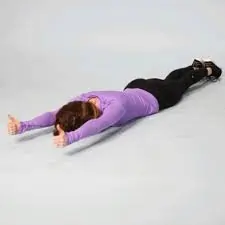
- On a mat or bench, lie on your stomach with your forehead lowered. Make sure your feet are shoulder-width apart. With your thumbs raised in the air, extend your arms straight above you and rest them completely. This is where you should start.
- Breathe out, then straighten your arms. Do not raise your head off the mat while keeping it completely extended. Keep your torso and lower body attached to the mat because this is only an upper-back and shoulder workout.
- As you raise yourself as high as you can without losing form, contract the muscles between your shoulder blades. For one count, hold this position.
- Breathe in, then slowly return to your starting posture with your arms at rest. Do this fifteen times.
- For Next Level: Instead of pointing your thumbs up, you can perform an advanced variation of this exercise by holding dumbbells in your palms.
Scapular Retraction:
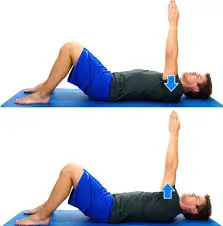
- Place your chest directly beneath the bar while sitting on the floor. Bend your knees to a 90-degree angle while keeping your feet shoulder-width apart.
- Grasp the bar with your palms facing away from you while using your core. Maintaining a straight line with your shoulders, chest, hips, and knees, pull yourself up. This is where you should start.
- Squeeze your shoulder blades together while keeping your chest open by pushing them back and down until you can clearly bring yourself up to the bar by two to three inches. Avoid pulling yourself up or rowing. For one count, hold this retraction.
- Continue breathing, let go of the contraction, and return to your initial position. Do this fifteen times.
Rear Delt Fly:

- With your feet flat on the ground, take a seat on a bench. Maintain a 90-degree angle between your knees. Hold a dumbbell in each hand with the palms facing away from you while hunching forward at the hips. Place the dumbbells between your legs and the bench. Your arms should be fully stretched to your sides, and your stomach should rest on your thighs. This is where you should start.
- Breathe out and contract your core. Lift your torso off your thighs and sit erect, then execute a reverse fly in one move.
- Rotate your wrists to face the sky as you raise the dumbbells to your sides, finishing at shoulder height. If necessary, you can slightly bend your elbows. You should have your upper body in a “T” shape.
- Rotate your wrists down to the floor and back up to the ceiling once while sitting upright with your hands shoulder-high. You are compelled to remain in this position for an additional count as a result. Your forearms will become stronger, and your shoulder blades will flex downward and backward.
- Breathe in, slowly reverse the steps, and return the dumbbells to your starting position by placing your body on your thighs. Do this twelve times.
Scapular Wall Slide:
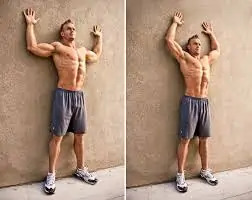
- Press yourself up against a wall. To avoid having an arch in your back, maintain a tilt in your pelvis. You should forcefully press your butt, head, and back into the wall. To prevent your legs from becoming completely locked, keep your knees slightly bent. With your hands facing away from the wall, fully extend your arms straight above you. This is where you should start.
- Squeeze your midback muscles while sliding your arms down toward your shoulders, keeping your back straight and your chest wide. Press your back against the wall, as well as the backs of your wrists, elbows, and palms. A contraction ought to occur immediately.
- Remember that if you have poor posture or are tight, this exercise will be challenging. When your elbows are just below shoulder height, stop.
- For one count, hold this position. Take a breath, then raise your arms back to where you were before, making sure nothing lifts off the wall. Do this fifteen times.
Chest Supported Dumbbell Row:
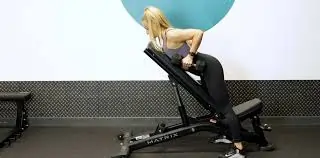
- Set the incline bench’s angle between thirty and forty-five degrees.
- Lie face down on the bench with your chest against the padding while holding a dumbbell in each hand.
- Allow the dumbbells to fall straight to the ground.
- Pull the dumbbells toward your hips and retract your shoulder blades to start the rowing motion.
- At the peak of the exercise, squeeze your shoulder blades together.
- Carefully return the dumbbells to their initial position.
- Continue until you reach the required number of repetitions.
Banded Pull Apart:

- With both hands, grasp a resistance band while extending your arms shoulder-high in front of you.
- Place your feet shoulder-width apart.
- Squeeze your shoulder blades together as you move your hands outward to pull the band apart.
- Feel the contraction in your upper back as you hold the position for a little while.
- Return your hands to their initial position slowly.
- Continue until you reach the required number of repetitions.
Common Mistakes:
- Putting on too much weight: Give appropriate scapular retraction priority over high loads.
- During rows, shrugging: Focus on bringing your shoulder blades together while keeping your traps loose.
- Inadequate range of motion: With each repetition, fully extend and retract your scapulae.
- Ignoring movement: For optimal muscular activation, regulate both the concentric and eccentric periods.
- Bad posture when working out: Throughout every action, keep your spine neutral.
Conclusion:
Your posture can improve if you learn to contract your shoulder blades and strengthen your back muscles. When you have good posture, you feel confident and in control, and your back is less stressed.
Your chest press, pullups, and squats will all be better if you can retract and contract your shoulder blades. More importantly, you will be less likely to get an injury when working out or at your workplace if you strengthen your back.
Regular rhomboid strengthening exercises can help reduce upper back pain, improve posture, and enhance overall shoulder and upper body function.
FAQs
Can rhomboids cause neck pain?
Limited range of motion while twisting or reaching. A noticeable hard lump in the muscle and tenderness to the touch. When the shoulder blade is moved, snapping or grinding noises are heard. referred pain that could spread to the arm, neck, or lower back.
Can poor posture affect rhomboids?
A major cause of rhomboid muscle pain and overall shoulder and neck discomfort is poor posture. A vicious cycle of pain can be created by slouching, rounding the shoulders, or continuously leaning forward, especially when using a computer or desk.
What are the common rhomboid major problems?
Discomfort in the space between your shoulders.
pain that gets worse when you spend a lot of time standing or sitting.
a stiffness or tension in the space between your shoulder blades.
When you move your shoulders, you may hear a popping or grinding sound near your shoulder blades.
Do pull-ups strengthen rhomboids?
During the second half of each repeat, the muscle continues to contract as we lower ourselves, producing force to propel us upward. Other muscles that support the lats and generate force for shoulder retraction are the rhomboids, trapezius, infraspinatus, and rear deltoids.
References:
- 5 easy rhomboid exercises to define your back – 2019 – Cpt//www.healthline.com/health/fitness-exercise/rhomboid-exercises#takeaway
- 10 Rhomboid Exercises for a Defined Back – Ewan Hammond – 2023/mirafit.co.uk/blog/10-rhomboid-exercises-for-a-defined-back/
- Rhomboid Exercises: Strengthen your upper back for better posture – 2026 – Groves/https://trainingstation.co.uk/blogs/news/rhomboid-exercises-strengthen-your-upper-back-for-better-posture?