
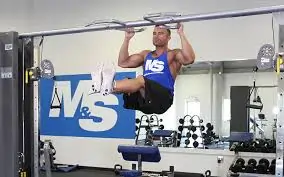
L-Sit Pull-Ups Exercise
Introduction:
The L-Sit Pull-Ups Exercise is an advanced upper-body and core strengthening movement that combines the benefits of a traditional pull-up with an L-sit hold.
The pull-up is arguably the most difficult bodyweight exercise to master. Your arm and back muscles are the only ones you can use to raise your entire body. The unpleasant drawback of these exercises is that they might be tedious to perform repeatedly at the gym, even once you have mastered this strength-related feat.
That is, unless you add a difficulty, such as the L-sit pull-up, which enhances an already impressive exercise with a strenuous core workout.
Learn the standard pull-up and L-sit motions before attempting an L-sit pull-up. Try hanging with your legs straight in a pull-up position after you’re comfortable. After that, you can perform flutter kicks. Next, perform one leg of L-sit pull-ups before adding the other leg.
To accomplish an L-sit pull-up, as with many fitness objectives, you will need to take baby steps. It calls for exceptional strength in the arm, back, and core muscles. You can gradually build strength until you’re ready for the full exercise by setting smaller objectives for yourself.
Muscle Worked During L-Sit Pull-Ups:
- Abdominal Muscles
- Hip Flexors Muscle
- Latissimus Dorsi Muscle
- Rhomboids and Scapular Stabilizers
- Quadriceps Muscle
- Biceps Muscle
- Forearms Muscles
How to Perform?
- Place a pull-up bar beneath you so that it is just out of your reach while you are standing.
- With your palms facing away from your body, leap up and grasp the bar with both hands.
- Make a 90-degree angle with your torso by raising and straightening your legs in front of you.
- Keeping your knees level, raise your body until your chin is over the bar.
- Repeat the exercise by carefully lowering yourself back down without letting your feet touch the floor.
Benefits:
Midline Control and Core Stability:
The l-sit pull-up ensures appropriate spinal integrity and stabilisation across the full range of motion, much like hanging knee raises, planks, and other core stability exercises. This indicates that throughout this exercise, the transverse abdominals, hip flexors, obliques, and abdominals are all actively supporting stability and structural strength.
Time Under Tension Training:
Another factor that can be used to improve muscular hypertrophy, isometric contraction skills (holds), and angular strength is time under strain. The l-sit pull-up keeps the lifter in intense muscle contractions throughout the entire range of motion and demands a high level of isometric strength and core muscle coordination.
Scapular Control and Stabilization:
Similar to other hanging motions, this position requires the scapular stabilisers to maintain overhead integrity so that the back muscles may contract correctly and the scapulae can move freely over the back of the rib cage. This allows the muscles to contract and extend without hindrance and shields the shoulders from undue strain.
Application of Gymnastics:
This exercise is directly applicable to gymnastics and strength training on parallel bars and rings, to mention a few. This combines two strong strength exercises for the core and upper body, two muscle groups required to regulate and encourage movement in gymnastic routines.
Variations:
Tuck L Sit Pull Ups:
The bent-leg form provides a simpler option than L-Sit pull-ups. Maintaining the body position is made easier by keeping the legs closer to the body, which lessens the lever effect. This keeps your basic core tension while letting you concentrate more on the pulling portion of the exercise.
- Begin in the hang position.
- Flex your knees and hips 90 degrees.
- Retrace your shoulder blades.
- Draw the chest in the direction of the rings.
- Slowly and deliberately descend into the hang position.
One Leg L Sit Pull Ups:
One extended leg and one bent leg in a tucked posture are combined in single-leg L-Sit pull-ups on gymnastic rings, sometimes referred to as one-leg L-Sit ring pull-ups. This position improves core tension and the lever action. Because of the asymmetrical leg posture, they require even more core stability than tuck L-Sit pull-ups, but the pulling strength for the upper body stays the same.
- Begin in the hang position.
- Make a 90-degree angle with your hips
- Your left leg should be bent.
- The right leg is still stretched.
- Retrace your shoulder blades.
- Draw your chest in the direction of the rings.
- Return to the hang by lowering yourself carefully and slowly.
Safety Tips:
- Because hyperextending the neck can cause compensations throughout the spine, try to maintain a neutral head position (looking straight ahead or slightly up).
- Maintain a hollow body position with the legs straight and in front of the body if the bar is high enough.
- Squeeze your glutes and brace your abs to prevent lumbar spine overextension.
- When the lats are fully flexed, the pull-up is over; stop pulling and use your pecs to compensate. The shoulder will round forward, the elbows will flare out behind the torso, and you’ll start to feel pressure at the front of your shoulders.
- Whether or not a lifter can truly get their chin over the bar depends on their segment length, although this isn’t always the case.
- Avoid locking out entirely, as this may place undue strain on the ligamentous structures of the elbow and shoulder. Instead, lower the elbow to nearly full extension.
- Start with gradual negatives (increase weight when these can be performed under control) or flexed arm hangs in the top position if you are unable to perform a single bodyweight pullup.
When to Avoid:
- Severe shoulder impingement
- Lower back pain
- Elbow or wrist injuries
Common Mistakes:
- Swinging or kipping one’s body.
- Lowering legs while pulling.
- Forward-rounding shoulders.
- Locking the lower elbows.
- A back arch is caused by insufficient core involvement.
FAQs
Are L-sit pull-ups effective?
Your arms, shoulders, and core are tested with the L Sit Pull Up. It increases core stability and balance while improving strength and flexibility. This challenging, sophisticated exercise efficiently increases upper body strength.
Why are L-sit pullups so much harder?
Because gravity pulls your legs down as you ascend, performing an L-sit pull-up is extremely difficult. You have to maintain the stability of your legs in addition to using your upper body muscles to pull.
Are L-sit pull-ups worth it?
A further advantage of l-sit pull-ups is that their back posture makes them perfect for powerful pulling. So the bar naturally drops in front of you rather than over you. They are therefore perfect for training explosive pull-ups, which is usually something you want to do to build that muscle.
What are the common mistakes in L-sit pull-ups?
Using your arms excessively.
The pull-up is not considered a full-body exercise.
Insufficient Tension to Prevent the Body from Swinging.
Poor Grip Power.
Relying on pull-ups with a band.
Are L-sit pull-ups harder than plank?
One of the most basic and difficult holds in callisthenics is the L-sit Pull-Ups. Compared to a plank hold, it works differently and overloads the abs more successfully when they are flexed and shortened.
References:
- L Sit Pull Ups, L Sit Chin Ups with gym rings – 2025 – Ringe/dieringe.com/exercises/l-sit-ring-pull-ups
- Your Guide to Mastering L-Sit Pull-Ups with Baby Steps – 2022 – C/shefit.com/blogs/shefit-blog/lsit-pullup-guide?srsltid=AfmBOoq0rtC9-kPLc2Pe__zP27MXs9tP5tZm0h-0V6zSK0mxkhswq9jl
- L Sit pull up – Trainwell/www.trainwell.net/exercises/l-sit-pull-up
- L-Sit Pull Up Video Exercise Guide – MuscleandStrength/https://www.muscleandstrength.com/exercises/l-sit-pull-up
- L-Sit Pull-Up – Exercise Guide | Motra – 2026 – Motra/www.motra.com/exercises/lSitPullUp


