Leg Press Exercise
Introduction
Leg Press Exercise is a powerful lower-body strengthening movement that targets your quadriceps, hamstrings, and glutes while providing controlled support for your back. It’s an effective machine-based exercise to build muscle, improve leg power, and enhance overall lower-body stability.
- Also Known As: Sitting leg press, machine squat press, and machine leg press
- Targets: Hamstrings, gluteus maximus, and quadriceps
- Equipment Needed: a machine for leg presses
- Level: Beginner
The leg press is an exercise that targets the leg muscles and is a variation on the squat.
Depending on which part of the foot is pushed through, the leg press can be used to target both the hamstring and quadriceps muscles.
Many people consider the leg press to be a machine version of the barbell back squat. Although the mechanics are somewhat similar, the leg press does not exactly replicate the squat’s movement pattern. Additionally, it doesn’t engage every muscle group that the squat does.
The leg press works best as an addition to the squat or as the main exercise in gyms without the equipment needed to train the squat movement pattern.
One common piece of exercise equipment that can help develop important leg muscles is the leg press. The standard horizontal leg press and the 45-degree leg press, which has a seat that reclines at an angle while your legs press upward in a diagonal direction.
Both exercises strengthen the thigh’s quadriceps, hamstrings, and gluteus (buttocks). Even though it seems like a straightforward exercise, it’s important to understand how to use it correctly. You can maximize the benefits of strength-building and avoid injury by paying attention to your form. The leg press is a machine circuit exercise or a part of a leg strengthening method.
These large barbell exercises are good choices, and the deadlift and back squat may be the first exercises that spring to mind. However, increase your horizons by incorporating machine-based exercises. The leg press machine is a simple solution to this issue.
Exercisers are presented with an alluring opportunity by the leg press: put as much weight as you can manage onto the apparatus, fall into the seat, and push away. Theoretically, there is much less to worry about in terms of form because you are not using free weights. But in order to do the exercise as safely and effectively as possible, you’ll actually need to know a little more about it and how your body functions.
One of the best lower-body exercises ever is the squat. They work the muscles you use daily, such as when you sit, stand, or ascend stairs. Additionally, they are excellent for increasing total muscle mass because they target the biggest muscles in your legs.
However, a lot of people, particularly those who are new to the gym, have trouble with proper squat form. The leg press machine can help with that. People who are just beginning their fitness journeys can make the most of leg day with this machine. It also helps those with back or joint issues, as well as those recovering from an injury.
All of the lower body muscles are worked by the leg press, but the quadriceps, hamstrings, and glutes are particularly highlighted. The ability to develop those bigger muscles and ease of use are two major advantages of a machine like the leg press. Some claim that free weight exercises are more effective at increasing overall strength than this machine, but the truth is that you will still gain strength while using it.
Types of Leg Press Exercise
There are two main types of leg press:
- The vertical “sled” or diagonal (incline) leg press. A sled that is mounted on rails has weight plates connected directly to it. The user uses their feet to push the sled upward while seated under it. In order to keep the user from becoming trapped under the weight, these machines typically have adjustable safety brackets.
- Multigyms frequently use the “cable” type leg press, also known as the “seated leg press.” With this kind, the user sits up straight and presses their feet forward onto a plate. A lengthy steel cable connects the plate to the weight stack.
Which Muscles does the Leg Press train
- Quadriceps
- Hamstrings
- Glutes
Since the leg press focuses on your legs, it works all of your major lower-body muscles. This refers to the glutes, hamstrings, and quadriceps. The larger muscles in your legs will be the main focus, but you will also work the smaller supporting muscles, albeit not to the same extent as in free weight exercises.
Who Should Do the Leg Press
- Bodybuilders
- Strength training athletes
- Beginners
The leg press is an excellent choice for bodybuilders and anyone else whose primary goal is to gain muscle because it truly enables you to focus on the legs and work with heavy loads without concentrating on the exact form or function of free weight movements.
The leg press can be used by more functionally-minded strength training athletes to overload their hamstrings, glutes, and quadriceps, which will eventually improve their other lifts and overall strength performance. As mentioned above, as they develop their strength for free weight movements, beginners will also profit from the absence of axial loading. The exercise can be used by anyone, and how frequently you incorporate it into your training will ultimately depend on your objectives.
How to use the machine
First, fill the machine with the weight you wish to lift. Your level of overall fitness will determine how much weight you should choose. Generally speaking, beginners should begin with half of their body weight. Experienced individuals can begin at three-quarters of their body weight. Your objective should be to maximize the range of motion from your machine reps, no matter where you begin. Don’t just concentrate on lifting as much weight as you can! You don’t get anywhere with extra weight and bad form.
Different machines load the weight in different ways. Some employ a straightforward pin system, such as the assisted pull-up machine. Others involve adding weight plates to the bars on either side of the machine, such as those found in our fitness centers. When lifting the heavier plates, especially if you’re just getting started, exercise caution. If someone has left hundreds of pounds on the machine, don’t be scared to ask for assistance. Additionally, make sure that the weight is distributed equally on both sides of the bars. You could be in danger, and the equipment could break due to an uneven weight distribution.
Now take a seat and recline on the machine with your back to the pressure platform. Make sure your feet are shoulder-width apart. Taller people must place their feet higher up on the pressure plate, while shorter people must place their feet lower down. Try different positions until you find one that suits you.
What is a Leg Press Machine?
With a leg press machine, you can safely and carefully move extremely heavy loads while maintaining the stability of your spine. Because of this, it’s a great option for developing your lower body safely. A leg press can help strengthen the legs and protect the knees while enhancing stability and balance.
In order to maximize the benefits and reduce the risk of injury, proper leg press foot placement is essential.
Various leg muscles can be targeted by five primary foot positions:
Standard Position: Place your feet hip-width apart in the center of the sled. Balance the activation of the hamstrings, glutes, and quadriceps.
Heels that are slightly off the sled are in the low position. Prioritizes the quadriceps over the hamstrings and glutes.
High Position: Toes are close to the top edge, and feet are at the top of the platform. A high foot position increases hip flexion and extension while decreasing the range of motion. It also works the hamstrings and glutes.
Wide Stance: The feet are wider than the distance between the hips. Hits the glutes and inner thighs more forcefully.
Feet are positioned closer together in a narrow stance. Works and isolates the outer quadriceps more.
To fully develop the various muscle groups, experiment with different foot positions. To improve muscle imbalances and target weak areas, purposefully change your stance.
How to do Leg Press Exercise

Step-by-Step Instructions
Your body should be positioned in a specific way when using a seated leg press machine. Your head and back should be comfortably resting against the padded support as you sit on the machine. Make sure your heels are flat as you place your feet on the footplate approximately hip-width apart.
Avoid being elevated; your buttocks should be flat against the seat. Your glutes will be strained if your feet are too high on the plate, and your knees will be overly compressed if they are too low. Your knees should not be bent inward or outward; instead, they should be in line with your feet.
- Push the platform away with your heels and forefoot while flexing your abdominal muscles. On the footplate, your heels should stay flat. Never move the pad forward simply with your toes or the front of your foot.
- Keep your head and back flat against the seat pad and extend your legs as you exhale. Instead of making an explosive movement, extend slowly and thoughtfully.
- At the peak of the movement, pause. Make sure your knees are not bowing in or out, and avoid locking them out.
- As you inhale, slowly bend your knees to return the footplate to its initial position. Throughout, maintain a flat back and feet.
- Start out slowly with three sets of ten leg presses if you have never performed them before. As you gain strength, you can move forward from there.
Leg Press Common Mistakes
To get the most out of your leg press routine, you must make sure that your form is correct. Keep clear of these mistakes to make sure you are performing the leg press safely.
Too Much Weight
Making sure you’re not attempting to lift more weight than you should is one of the most important things. You have to lower the weight if you are unable to control your movements. The amount of weight you are lifting is not as important as your form.
The exercise must be performed with total control, even though it should demand effort. Never rush the exercise or let your legs give out when you’re done.
Buttocks Not Flat Against Seat
Your legs are at an excessively sharp angle if your buttocks are lifted off the seat. The seat must be moved back until your buttocks and knees are in a comfortable position. When you feel tightness and/or your knees appear to be right in front of your eyes, you can identify poor positioning.
Placing Hands on Knees
A common error that will ruin your form is placing your hands on your knees. Instead, hold onto the assist handles.
Short Range of Motion
Never lift your hips as you go through the full range of motion. Lower your weights and/or adjust the seat if necessary. This means lying in a deep position with your knees wide and your butt below your hips.
Raising Head
Focus on the position of your head. It should rest comfortably against the seatback and be stable. You are using too much weight if you are jerking your head forward.
Breathing
Do not hold your breath during the effort phase; instead, continue to breathe. If you focus on exhaling on exertion and inhaling on release, your breathing will eventually become automatic.
Benefits of the Leg Press
- Work with big weights
- Less stress to the CNS
- Develop leg muscle and strength
- Good for beginners
As previously mentioned, you can train your legs with heavy loads using the leg press. For the straightforward reason that you’re not putting excessive stress on your spine, you’ll be able to work with larger numbers than your free weight exercises (that is, exercises using tools like dumbbells, barbells, and kettlebells).
You will be able to put on more plates and use only your big leg muscles because your position within the machine does not require you to support the weight with your spine. Additionally, you won’t put too much strain on your central nervous system (CNS), which can lead to fatigue and make it harder for you to perform repetitions as quickly.
Additionally, this position makes the leg press an easy tool for beginners. Compared to the form-intensive free weight exercises, you’ll be able to work with heavier weights faster. However, you shouldn’t entirely drop those exercises (squats, deadlifts, lunges) in favor of the leg press; rather, use the machine as a strength-building tool to increase the intensity of your free weight exercises.
Some of the advantages of a barbell squat for quadriceps development can be obtained with the leg press machine. Second, it strengthens the calves, hamstrings, and gluteus maximus.
By adjusting your leg press foot position, you can highlight different muscles with the leg press machine. It strengthens these muscles, and you can use it to correct imbalances like overdeveloped hamstrings relative to quadriceps.
The leg press is less of a full-body exercise because it lowers the force on your core, even though it mimics the barbell squat. By doing this, you can keep strengthening your quadriceps and other leg press muscles without experiencing the extra strain that comes with putting a barbell on your back.
By strengthening the muscles required to advance, strengthen your quadriceps further can improve your squat performance. Adding the leg press could be beneficial if you discover that your barbell squat strength has decreased.
If you are new to lifting large weights, using a seated leg press machine may also help improve your stability and balance. Some people are not ready to use a barbell for squatting until they are used to lifting large weights with their legs in a way that improves core and leg stability and balance in a safe way, like the leg press.
Leg Press Tips
- Keep the knees just short of lockout to maintain tension in the quadriceps.
- Push through the heels to highlight the glutes more.
- Push through the balls of your feet to highlight your quadriceps.
- Prevent the hips from rolling off the pad due to posterior tilt.
- Throughout the exercise, maintain a flat low back against the pad.
- Don’t look up or down too much to keep your head in a neutral position.
- You can self-spot by just using your hands to apply pressure to your knees. Use only when required.
- Each person’s hip anatomy and ankle mobility will determine the toe angle; experiment and make adjustments based on feel.
Leg Press Modifications and Variations
The leg press can be modified to make it easier for beginners to use and to advance.
Need a Modification?
This is a very personalized exercise that you must modify to fit your body. Before beginning, you might want to ask a trainer to demonstrate how to safely adjust the machine because they can differ.
Beginners should practice proper form and use lighter weights. Instead of focusing on the number of repetitions or the weight you’re lifting, focus on slow, deliberate movements. If you see any unnecessary tension or discomfort, have a trainer examine your form and provide you with particular guidance.
Up for a Challenge?
There are several ways to work muscles with foot positioning. The inner thigh muscles will be worked by placing your feet wider apart. The outer thigh muscles will be worked by placing the feet closer together.
Your hamstrings and gluteus maximus will be worked harder if you place your feet higher on the footplate. Lowering your feet on the footplate will highlight your quadriceps more, but it should be done carefully because it puts additional strain on your knees.
If you are trying to correct imbalances, you can also perform the leg press on one leg at a time.
1. Press using resistance bands

A leg press machine’s weight can be swapped out for a resistance band. The same muscles used in machine leg presses are used in leg presses with resistance bands. Because resistance bands are small and lightweight, they can be used in many different contexts.
Equipment required: A chair or mat and a resistance band
The quadriceps, hamstrings, glutes, and calves were used.
Similar to leg presses on a machine, this version requires you to work against gravity.
- Face up, lie on a mat. Raise your feet off the mat. Make a 90-degree angle by bending your knees. Point your toes up at the ceiling while flexing your feet.
- Hold the ends of the band as you wrap it around your feet. Keep your feet next to each other.
- To straighten your legs, press your feet against the bands.
- To get your knees back to a 90-degree angle, bend them.
You can perform leg presses in a chair if your back needs a rest.
- Take a chair and sit up straight. Maintain a flat back and tighten your core.
- Holding the ends slightly above your thighs, wrap the band around both of your feet.
- To straighten your legs, press your feet against the band.
- To get back to the starting position, bend your knees.
Leg press with an advanced resistance band
Use a thicker or shorter band to increase resistance.
2. Squats

Leg presses and squats are similar exercises. Because they are performed vertically, less strain is placed on your lower back. Squats could be a great substitute for leg presses if you have back pain or injuries.
Required equipment: Not a single
Hamstrings, glutes, and quadriceps were used.
- Place your feet hip-width apart as you stand. Face your toes forward while placing your heels firmly on the ground.
- Stretch your arms straight ahead or put your hands together for balance.
- Return your hips. Lower your buttocks and bend your knees. Maintain a straight back and an elevated chest.
- Your thighs should be parallel to the floor as you lower yourself. Maintain your knees above your ankles.
- Get up by pushing through your heels.
Advanced squats
Try performing squats while holding a dumbbell or kettlebell as you gain strength.
3. Lunges

Similar to squats, lunges work your leg muscles without putting additional strain on your back. Stepping forward exercises your glutes and quadriceps.
The split squat and the lunge are not the same. A split squat uses one leg at a time, and a lunge uses both legs simultaneously.
Required equipment: Not a single
Hamstrings, glutes, and quadriceps were used.
- Place your feet hip-width apart as you stand.
- Bend your knees to a 90-degree angle while stepping one foot forward and lowering your hips.
- Your front thigh should be parallel to the floor as you lower yourself. Maintain your front knee above your ankle.
- To get back to your starting position, push into your front leg.
- Continue with the other leg.
- Advanced lunges
- Use dumbbells to increase the difficulty of lunges. Keep your arms by your sides and hold one in each hand. They can also be held in front of your shoulders.
4. Broad jumps
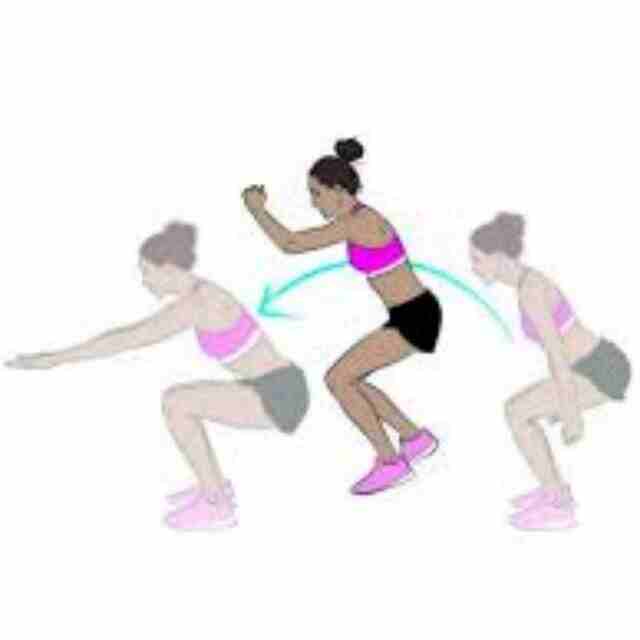
Leap frog jumps, also known as broad jumps, use powerful motions to strengthen the legs. This exercise is a fantastic substitute for the leg press since it combines a squat and complete lower-body extension.
Take care when performing broad jumps if you have joint pain. Your joints could be harmed by the high-impact force.
No equipment is required.
The quadriceps, hamstrings, glutes, and calves were used.
- Place your feet shoulder-width apart as you stand.
- Bend your knees and push your hips back to lower yourself into a squat. Behind you, swing your arms.
- Push your feet into the ground while swinging your arms forward. Go ahead and explode.
- Get on your feet. To absorb the force, flex your ankles, knees, and hips.
5. Bridge exercise

Your core is strengthened and stabilized by the bridge. It also works your thighs and butt, providing advantages comparable to those of machine leg presses.
Equipment required: mat
The quadriceps, glutes, hamstrings, and hips were used.
- Lie down on your back. Place your feet on the ground just below your knees while bending your knees. Additionally, you can rest your feet on a bench or exercise ball.
- Put your hands palms down at your sides.
- Tighten your buttocks and core.
- Raise your hips until your shoulders and knees form a straight line. Lower your hips after pausing.
Complex bridge
Hold a barbell or resistance band over your hips if a simple bridge is too simple.
Safety and Precautions
If your pelvic floor muscles are weak, stay away from the leg press because it puts a lot of strain on them. If you have a knee injury, you shouldn’t use this machine. Instead, follow your doctor’s or physical therapist’s recommendations for safer leg press alternatives or strengthening exercises.
If one or both of your knees hurt, don’t push through the discomfort. You will only get hurt if you push through. If you have back pain or an injury, you should avoid this exercise because it can put stress on your back.
FAQs
What does the leg press exercise?
The leg press specifically works the hamstring muscles in the back of the thighs, the quadriceps muscles in the front of the thighs, the calves, and the gluteal muscles in the buttocks in an integrated manner.
Does leg press build size?
Leg presses increase endurance, strength, and muscle mass.
Leg presses, like all resistance exercises, increase muscle mass by applying stress to the muscles.
Is leg press good for belly fat?
Not directly,
How leg exercises indirectly reduce belly fat
Boost calorie burn: The leg press uses a lot of energy to work your quadriceps, hamstrings, and glutes, three major leg muscle groups. Your body burns more calories overall as a result of this increased demand, which helps you lose fat all over.
Increase your metabolism. Your resting metabolic rate rises when you gain muscle through strength training exercises like the leg press. It means that you burn more calories even when you’re at rest, which eventually aids in the reduction of total body fat.
What are the disadvantages of a leg press machine?
The following are a few disadvantages of leg presses:
Limited muscle activation: Unlike squats, leg presses don’t engage your upper body and core muscles.
Equipment: To use a leg press machine, you must visit a gym.
Less useful: Squats more closely resemble daily motions than leg presses.
How heavy should I leg press?
For beginners: Turn on the light: The range of 60–120 pounds (27–54 kg) is a good place to start. Pay attention to form: Achieving a full range of motion without merely pushing the greatest amount of weight is the aim. As a guide, use bodyweight: Half of your body weight is a good place to start.
For lifters with experience: Make use of bodyweight ratios. These are more detailed and can direct your development: (1.75) times bodyweight for beginners, Intermediate: 2.75 times body weight, Advanced: four times the body weight, Elite: 5.25 times bodyweight.
What are the benefits of leg press?
Strengthens the main leg muscles: By focusing on the quadriceps, hamstrings, and glutes, the exercise increases the strength of the entire lower body.
Enhances muscle definition: The leg press helps improve the tone and definition of the muscles in the legs and glutes by promoting muscle growth.
Develops lower body power and endurance: Regular exercise increases leg power for improved athletic performance and muscle endurance, which is advantageous for tasks requiring extended standing or walking.
Provides a supported workout: For those who wish to concentrate on leg strength without the core and back engagement of a squat, the machine’s design provides support for your back.
Supports and stabilises joints: When done properly, the exercise can help strengthen knees that can support larger free weights, but it’s important to avoid locking your knees to avoid injury.
Effective for beginners: Leg presses are an easy and effective way for beginners to start developing lower-body strength because they are flexible and adjustable.
Can I skip squats and do leg press?
It can be tempting to select one exercise—typically the one you detest the most—and skip the other because leg presses and squats target similar muscles. That could be a poor decision. The exercises complement one another for the best possible muscle building and toning, even though they target the same areas.
References
- Downtheline, & Downtheline. (2016, August 23). 5 ways to leg press – simply gym. Simply Gym – Cutting Cost, Not Quality. https://simplygym.co.uk/5-ways-leg-press/
- Green, A. (2025, April 16). The beginner’s guide to the leg press machine. Asphalt Green. https://www.asphaltgreen.org/blog/the-beginners-guide-to-the-leg-press-machine/
- Nasm, B. W. (2025, November 3). How to do the leg press to build major lower body strength and size. Men’s Health. https://www.menshealth.com/fitness/a42443953/how-to-leg-press/
- Nunez, K. (2018, August 16). The best alternatives to the leg press. Healthline. https://www.healthline.com/health/leg-press-alternative
- Rogers, P. (2024, June 10). How to do the leg press. Verywell Fit. https://www.verywellfit.com/how-to-do-the-leg-press-3498610
- Wikipedia contributors. (2025, August 15). Leg press. Wikipedia. https://en.wikipedia.org/wiki/Leg_press#:~:text=The%20leg%20press%20is%20a,used%20to%20perform%20this%20exercise.