20 Best Oblique Muscle Strengthening Exercises
Oblique muscle strengthening exercises help improve the strength and stability of the core, especially the muscles located on the sides of the abdomen.
One of the main muscles in the abdomen is the obliques. Two types of obliques stretch diagonally from the ribs to the pelvis: internal and external. The rectus, transverse abdominals, and obliques comprise the abdominal wall. Together, these muscles regulate movement in the pelvis, rib cage, and spine.
Like the other core muscles, the obliques are crucial for daily motions.
When you examine the anatomy of the obliques, you can see that they play a role in stabilizing the pelvis by attaching to the rib cage and pelvis, so it’s important to make sure they’re strong and that they’re working as they should. They contribute to a robust core, which offers stability across the whole movement system.
Your oblique muscles enable you to twist your body from side to side and bend upward,
Developing a strong core helps improve posture, balance, and coordination, lowers the risk of injury, and enhances fitness and athletic performance. It’s not just about making your waist appear smaller. Your mobility and overall functioning will be enhanced by strengthening your obliques, which will likely also strengthen other muscles, such as the remaining core muscles.
Building a strong core, including the obliques, appears to be essential for the health of the low back. Resistance training decreased lower back pain in older persons. Having a strong core protects your spine.
How to Do Oblique-Strengthening Exercises?
You can actually do oblique-strengthening exercises every single day and not overtrain, despite the standard advice to strength train two to three times a week. It’s uncommon to strain your abdominal muscles to the point where you require a recovery day.
The best exercises for oblique muscles are listed below. Perform these exercises for 30 to 45 seconds each, pausing for no more than 30 seconds in between. Repeated for a total of two or three rounds.
To achieve visibly stronger muscles. Incorporating the following set of exercises into another routine three to five times a week.
1) Bird dog
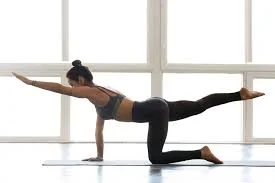
This exercise will strengthen your abs and challenge your balance.
It exercises the glutes and lats in addition to the obliques.
How to do it:
- Starting on all fours, align your hands with your shoulders and your knees with your hips.
- Inhale, tighten your core, and extend your right arm and left leg straight out so they are parallel to the floor.
- Make sure your lower back is stable,e and your hips stay square to the floor.
- Breathe out and start again. Continue with the right leg and left arm.
2) Heel tap

This workout works your obliques and is simply a side crunch on the floor.
How to do it:
- Lay on your back on the ground with your knees bent and your feet flat.
- Depending on your inclination, your arms should be at your sides, palms up or down.
- Inhale, then use your core to lift your head and upper back off the ground.
- Reach down to your left side and use your left hand to touch your heel. Consider this exercise as a side crunch rather than raising your upper body higher off the ground.
- Go back to the middle.
- On the right side, repeat.
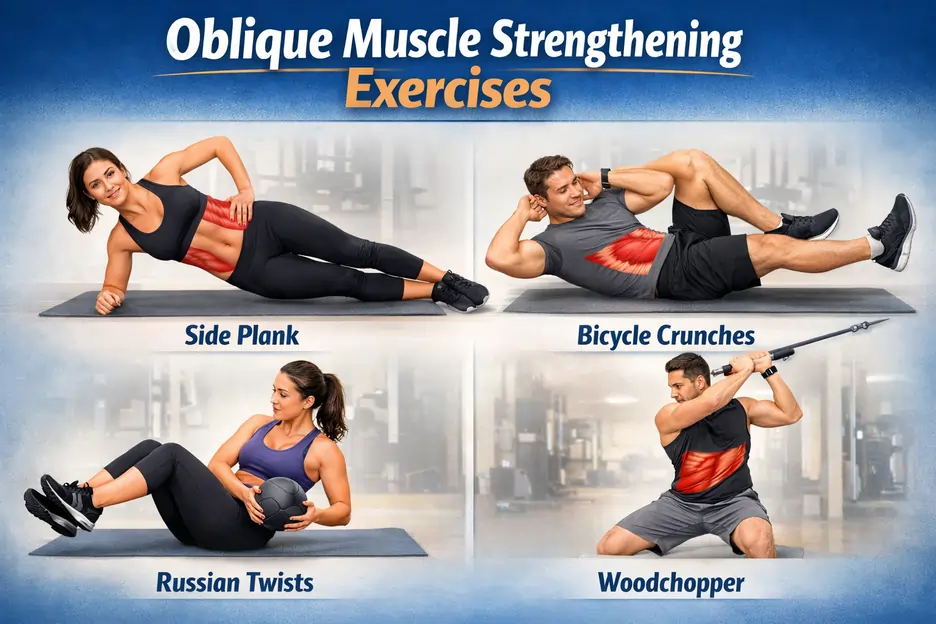
3) Side plank

Everyone loves to despise planks!
Whether you’re on your knees or your feet, this exercise targets your upper body, side abs, and the gluteus medius, a muscle in your buttocks that is essential for pelvic stability.
Other significant muscles used include the:
- Gluteus medius
- Shoulder
Side Plank How to do it:
- On your left side, lie on the ground.
- To support your upper body, stand up on your hand or forearm. Stack your right leg on top of your left while bending your knees at a 45-degree angle. If you are strong enough, you can also extend your legs and stack your feet.
- Your body should form a straight line from head to toe or from head to knee, depending on the layout you choose.
- Using your obliques, pull your right hip toward the sky while maintaining touch with your feet. Your right arm can stay on your side or extend overhead.
- Change sides once you’ve held for the necessary length of time.
4) Side plank with a reach-under

Add a reach-under to produce an even more twisting action to target those obliques.
Other significant muscles used include the:
- Gluteus medius
- Shoulder
How to do it:
- Place yourself on your left side on the ground.
- Your upper body can be supported by your hand or forearm.
- Bend your knees to a 45-degree angle and place your right leg over your left.
- While keeping foot contact, use your obliques to pull your right hip toward the sky.
- Lift your left arm above your head.
- Inhale, then stretch down and under the left side of your body to provide that twist.
- Raise your arm once more, then repeat.
5) Cross-body mountain climber

This twisting ab exercise will scorch your obliques. Another benefit is its scalability.
Place your feet on the ground rather than extending your legs if you have trouble keeping your lower back flush with the floor.
How to do it:
- Extend your legs on the surface of the table while maintaining your back on the ground.
- Flex your elbows and place your hands behind your head.
- After lifting your head, neck, and shoulders off the ground with your core, straighten your right leg by bringing your right elbow to your left knee.
- Turn to the opposite side, bending your right leg, straightening your left, and bringing your left elbow to your right knee while letting go a little.
6) Standing core stabilizer
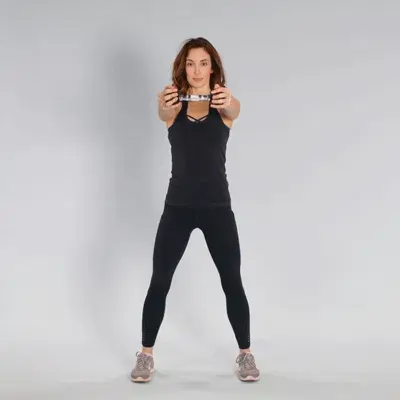
Don’t undervalue the advantages of this standing ab exercise. Make sure you rotate your complete torso, not just your arms, for the best results.
How to do it:
- Stretch your arms in front of you until your hands contact, stand straight, and place your feet shoulder-width apart.
- Bracing your core, begin to rotate your upper body to the left while your hands lead the way and your right toe pivots in response. Your eyes should follow this movement.
- Once you’ve returned to the center and completed the necessary amount of repetitions, repeat on the right side.
7) Wide side crunch

Incorporate leg conditioning into your side crunches with this exercise. But, since the focus is on the obliques, if your legs become fatigued, step out of the squat a little.
Additional muscles used are:
- Glutes
- Quadriceps
How to do it:
- With your toes pointed out, adopt a broad posture.
- Squat with your arms raised to your sides and your elbows bent at a 90-degree angle.
- Maintaining the squat position, bend to the side and bring your right elbow closer to your right knee.
8) Standing knee tuck extension
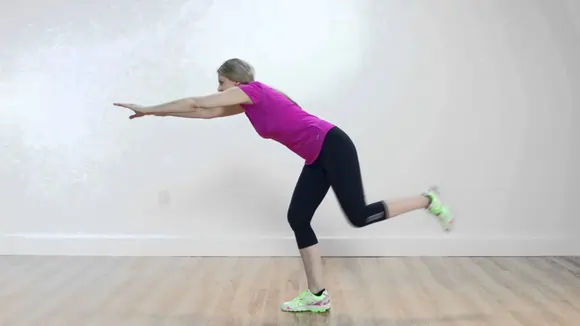
While doing side crunches, extend your knee tuck while standing.
Focus on the side bend and really stretch your elbow to your knee to get the most crunch for your money.
How to do it:
- Place your feet wider than shoulder-width apart, with your toes pointing out. Bend your elbows and place your hands behind your head.
- Bracing your core, raise your knee and descend your elbow at the same time, bending laterally at the waist.
- Return to the middle, then take the opposite action.
- Return to the center after crunching to the left.
9) Walking lunge with rotation
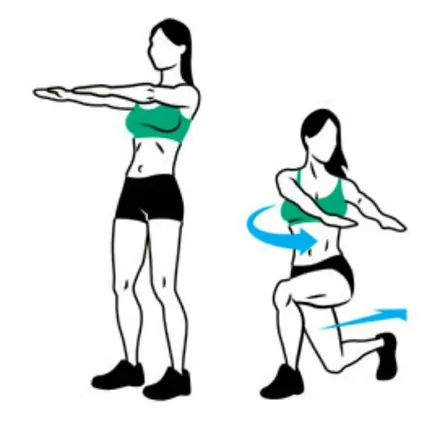
You should expect your obliques to fire when you incorporate a rotation into an activity.
Additional muscles used are:
- Hamstrings
- Glutes
- Quadriceps
How to do it:
- With your arms out in front of you and your elbows bent at a 90-degree angle, begin standing upright with your feet together.
- To strike the oblique, twist your torso over your left thigh and lunge forward with your left leg until your thigh hits parallel.
- Twist your torso back to the middle and stand up again.
- Repeat the motion by taking a step forward with your right foot
10) Side plank rotation

A challenge is created by adding a rotation, or moving your side planks from side to side.
Additionally, the following muscles were used:
- Delts
- Quads
How to do it:
- Put yourself in a high plank position with your neck neutral and your shoulders aligned with your wrists. Put your feet directly next to one another.
11) Hip dips
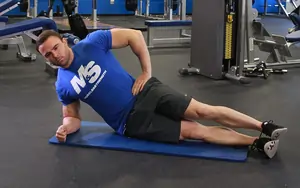
This technique is deceptively challenging; don’t push yourself; instead, move slowly and deliberately. It’s okay if you can’t lower your hip all the way to the floor!
Additionally, the following muscles were used:
- Delts
- Quads
How to do it:
- Form a forearm plank.
- Rotate your body to the right while bracing your core, bringing your right hip as near to the floor as possible.
- Return to the center and do it again on the other side.
12) Windshield wipers
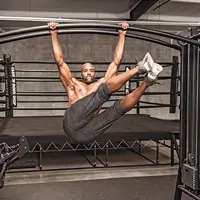
Imagine your legs moving back and forth from the middle of the car like this attachment.
You can stretch your legs if you feel comfortable doing so, but begin with your knees bent.
How to do it:
- Place your legs in the tabletop position and lie with your back flat on the ground. You should extend your arms perpendicularly to your body.
- With your core braced, gradually lower your knees to the right while keeping control throughout. If not, halt when your upper back begins to lift off the ground.
- Go back to the beginning, then do the opposite.
13) Woodchop

This twisting exercise with additional weight will engage your entire body, even though it’s the opposite direction of how you’d actually chop wood.
The following major muscles were also used:
- Delts
- Quads
How to do it:
- Hold a dumbbell by both ends to your right side of your body.
- Rotate your trunk to the right while squatting down a little.
- Stand up and twist your torso to the left to swing the dumbbell up and across your body in a controlled motion while maintaining your arms outstretched.
- Bring the dumbbell to the end over your left shoulder while pivoting on your right toe.
- Repeat on the opposite side after returning to the starting position and performing the required number of repetitions.
14) Oblique side bends

Drop as far to the side as you can while holding a weight!
How to do it:
- Maintain a straight posture while holding a dumbbell by your side with one hand. Although they shouldn’t touch, your feet should be near one another.
- Allow the dumbbell to descend toward the floor by bending sideways at the waist while bracing your core.
- Pull yourself back to the beginning using your oblique, then repeat for the required number of repetitions.
- Continue on the opposite side.
15) Russian twist
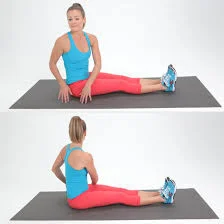
To do the Russian twist, core control is essential. If you require additional stability, place your heels on the ground here.
How to do it:
- With your feet flat on the ground and your knees bent, take a seat on the floor.
- Balance on your tailbone while leaning back and raising your feet off the ground.
- You can drop your arms to your right side by extending them and twisting your torso.
- Drop to the left and twist back.
- Raise your right hand off the floor and open your torso to the room while rotating into a side plank position.
- Your right arm should stay extended and follow your body.
- After pausing here, go back to the high plank and repeat on the opposite side.
16) Lunge with rotation and added weight
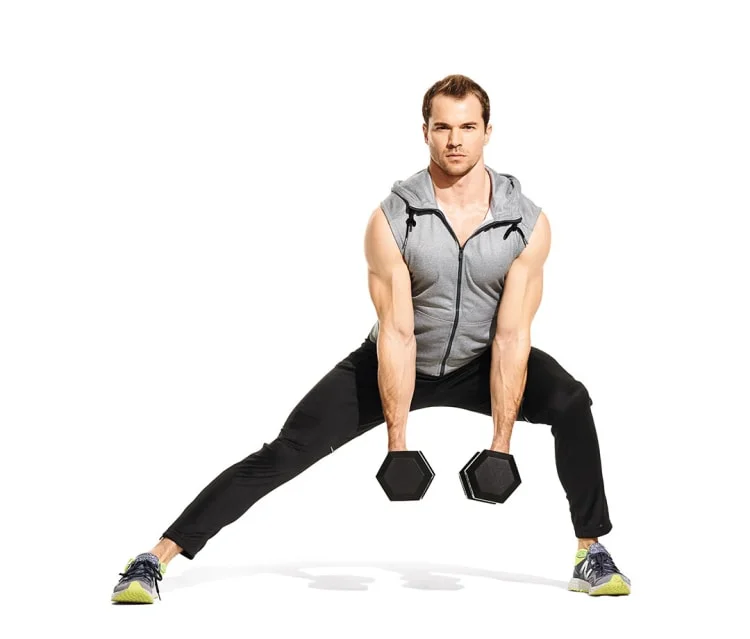
Additionally, the following muscles were used:
- Glutes
- Hamstrings
- Quadriceps
How to do it:
- Holding a dumbbell out in front of you with your arms outstretched, perform this lunge in the same manner as you would without weight, turning as you go.
17) Medicine ball side toss
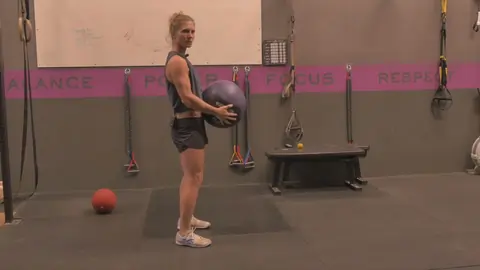
Medicine ball side toss
For this oblique-targeting exercise, place yourself next to a sturdy wall or with a partner.
Additionally, the following muscles were used:
- Deltoids
How to do it:
- Take a medicine ball and stand three to four feet away from a solid wall. Turn so that the wall is in front of your right side.
- Using both hands, grasp the medicine ball at the side of your left hip.
- Extend your arms as you propel the ball toward the wall while squatting down a little and twisting your torso.
- Toss the ball again right away after catching it, lowering it to hip level, and twisting your torso back to center.
- Switch sides once you’ve performed the necessary number of repetitions.
18) Oblique crunch
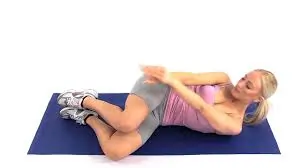
You can especially target those side abs with a typical oblique crunch.
How to do it:
- With your feet flat on the floor and your knees bent, take a seat on the ground.
- Bracing yourself with your left forearm, roll onto your left hip at a 45-degree angle.
- Raise your knees and feet off the floor and place your right hand behind your head.
- Bring your upper and lower bodies together as you crunch up.
- Repeat for the required number of repetitions after releasing back to the beginning.
- On the opposite side, repeat.
19) Single-arm toe touch
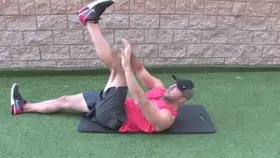
Use this move to hit your entire core. If you find it difficult to extend your legs, bend your knees and place your feet flat on the ground.
How to do it:
- With your arms by your sides and your legs extended in front of you, lie on your back.
- Lift your left leg and right arm while bracing your core, then spin to tap your left foot with your right hand.
- Repeat with the left and right legs after releasing the weight.
20) Single-leg side plank
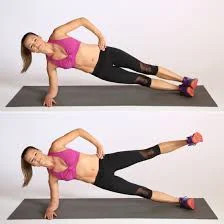
Take a side plank to the next level by balancing on one leg.
Additionally, the following muscles were used:
- Delts
- Quads
How to do it:
- Place yourself on your feet in a side plank position.
- Next, raise the upper leg while using the lower leg to support your weight.
Conclusion
There is an oblique workout for every level of fitness.
There are too many advantages to ignore while strengthening these muscles. So start crunching, bending, turning, and planking right now.’
FAQs
How do you strengthen your obliques?
Exercises that include lateral flexion, rotation, and stability, including side planks, Russian twists, cable woodchops, and bicycle crunches, are ideal for strengthening your obliques, or side abdominal muscles. To increase tension, perform these exercises slowly and deliberately, aiming for three sets of 10–15 repetitions or 30–60 second holds.
What happens if you have weak obliques?
Both lateral stability and rotational control depend on the internal and external obliques. Additionally, they have a significant impact on rib-to-pelvis mechanics and pelvic orientation. Weak obliques can cause the pelvis to move or rotate too much during walking.
Should I avoid oblique exercises?
In general, oblique exercises shouldn’t be avoided. For rotational strength, core stability, and lower back protection, strengthening your obliques is essential. Standard oblique training often tightens the waistline by increasing muscle rather than producing a blocky body, yet heavy, direct, and excessive training may increase thickness.
What are common mistakes in oblique exercises?
Practicing repetitions too rapidly and failing to pay attention to correct muscle activation are two of the most frequent faults made when practicing oblique crunches. Although doing so is a terrific way to complete more repetitions, each one is ineffective and defeats the exercise’s goal.
How long do oblique muscles take to heal?
Recovery from an oblique injury usually takes one to two weeks for minor strains, three to six weeks for moderate strains, and more than six to eight weeks for serious tearing. It might take up to 4–8 weeks for athletes, especially golfers and baseball players, to fully resume play. Physical treatment, rest, and progressive strengthening are all part of recovery.
Reference:
- Lawler, M. (2023, July 17). The 8 Best Exercises for Stronger Obliques. EverydayHealth.com. https://www.everydayhealth.com/fitness/the-best-exercises-for-stronger-obliques/
- 30 exercises to make the most of your oblique workout. (2020, September 1). Healthline. https://www.healthline.com/health/fitness-exercise/oblique-workout
- Physio, S. (n.d.). Top 5 Exercises for Oblique Strength – Surrey Physio. Surrey Physio. https://www.surreyphysio.co.uk/top-5/top-5-exercises-for-oblique-strength/