
Postpartum Core Recovery Exercises
Introduction
Postpartum Core Recovery Exercises are gentle, effective movements designed to help women regain strength, stability, and confidence after childbirth. These exercises focus on reactivating deep core muscles, improving posture, enhancing pelvic stability, and supporting overall recovery.
By progressing gradually and practicing consistently, new mothers can reduce discomfort, improve daily function, and build a strong foundation for returning to regular physical activity.
Postpartum Core Strength Phases: 1-4
If you would like to safely rebuild your core strength after giving birth, you should seek professional assistance as you return to and transition through postpartum core workouts. Every stage will build upon the one before it. Repeating a lesson until you feel prepared to go on to the next is the idea. If you’re successfully “bracing,” or contracting the deep abdominal muscles to activate the core muscles and protect against harm, and you’re not experiencing any discomfort, coning, or uterine prolapse, you may be ready.
Before starting any of her sessions, it’s advisable to check in with your healthcare professional. also reminds you that you are always free to change your mind.
Phase One: The initial stage is the most difficult. 360 breathing is the first step. Heel slides, articulated bridges, toe taps, leg extension, and modified dead bug are the next steps. points out that although core activity won’t burn as much as you would be accustomed to, it is still effective at this level.
Phase Two: All of the exercises in this phase stay on your back, but Robin starts layering in various movement patterns. Deep breathing is the first step in the exercise, which progresses to single-leg stretches, tabletop leg circles, modified dead bug, modified side plank, butterfly exercises with a miniband, wide leg heel taps, and glute bridge.
Phase Three: At this stage, part of the exercises are performed off your back, and the core is being tested more severely. Following deep breathing exercises, perform leg scissors, wide leg circles, bird dog, bear hover, and wide leg toe taps.
Phase 4: Phase 4 acts as a link to the remaining curriculum and strength classes. It is therefore the most difficult. After 360-degree deep breathing, the exercises include rolling plank, modified plank, full plank, alternating crunches, glute bridge, and one-legged glute bridge.
Postpartum Core Recovery Exercises
360 Diaphragmatic Breathing

Breathing
Postpartum exercises using 360 diaphragmatic breathing, a deep breathing method that causes your rib cage and abdomen to expand. Throughout pregnancy, this kind of deep breathing would have been advised. It may be done in the early postpartum period once you’ve been cleared for movement, and it’s one of the best, if not the best, techniques to close diastasis and re-strengthen the neural pathways of the core.
To begin this kind of breathing, place your hands around your lower rib cage, with your fingers in the front and your thumbs in the back position. You can also execute this exercise while seated.
Expand your rib cage 360 degrees by inhaling through your nose and pressing it into your palms in every direction.
Breathe out through your mouth as if you were blowing out a thousand birthday candles. Your body’s front and back become closer together when your rib cage contracts. It feels like someone is wrapping you in mummy tape rather than sucking in your tummy.
Continue for a few breaths.
Heel Slides

- With your feet firmly placed on the floor and your knees bent, lie on your back.
- Breathe out as you slowly extend one leg all the way flat, starting with the heel.
- As you carefully bring the heel back in, take a breath.
- For multiple repetitions, switch to the opposite leg.
Glute Bridge

- With your feet firmly placed on the floor and your knees bent, lie on your back.
- Push your lower back into the floor to tighten your abdominal and gluteal muscles.
- Gradually raise your hips off the floor until your knees and shoulders form a straight diagonal line.
- Hold your belly button against your spine for thirty seconds. Put your hands in a diamond shape on your lower abdomen, release your breath, and visualize your pelvic floor rising up and your hips attracting one another.
- As you lower your hips, tuck in even further, stopping midway to inhale again and exhale deeply for a total of two breaths.
- Do this multiple times.
Heel Taps

- Lie down on your back. Beginners might begin by placing both feet firmly on the ground.
- Tap your right heel lightly and slowly against the mat as you inhale.
- Using your abdominals, raise your leg back to the tabletop position as you exhale.
- For multiple repetitions, switch legs.
- Starting with both legs in the tabletop posture, level up by gradually tapping one heel at a time down to the ground while switching legs. Do this multiple times.
- Next, tap both heels to the ground simultaneously by lowering both legs at the same moment. Do this multiple times.
Modified Dead Bug
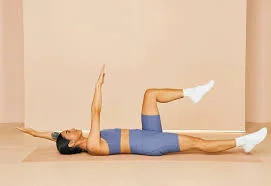
- Lie down on your back.
- Extend your arms so they point directly up to the ceiling while bringing your legs to a tabletop position.
- Only arm work is suitable for beginners. Take a breath and raise one arm at a time to the floor above your head.
- Breathe out as you bring your arm back to its initial position.
- Repeat with different arms many times.
If this seems too difficult, you can place both feet on the ground and raise one leg at a time into the tabletop while using the same arm as the leg (for example, both on the left or right side). Do this multiple times.
Just one leg should be extended out at a time. The job is harder the lower the outstretched leg is.
You can proceed to the typical dead bug after that, which seems safe—no coning or discomfort. Add alternate arm extensions to achieve this, extending the opposing arm and leg at the same time before switching to the other arm and leg (e.g., left arm, right leg, then switch).
Bird-Dog

- Start in the tabletop position on all fours with your hands under your shoulders and your knees under your hips.
- Maintain a neutral spine.
- Maintaining your shoulders and hips parallel to the floor, extend your left leg backward and your right arm forward.
- With your eyes fixed on the ground, tuck your chin into your chest.
- Return to your starting position after holding for a few seconds.
- Repeat with the left arm and right leg.
- Go back to where you were.
Postpartum Core Recovery Time Chart
It usually takes three to six months to rebuild core strength after pregnancy, and six to 12 months to return to pre-pregnancy shape.
Weeks 0-6 (Foundational healing): Your fascia is severely damaged,d and your internal tissues will take time to heal. • Focus on gentle breathing, pelvic floor engagement,nt and activation of your deep transverse abdominis (Tupler technique or diaphragmatic breathing). Forget heavy lifting or regular sit-ups.
Weeks 6–12 (Light strengthening): When you’ve been cleared by your doctor (or 8–12 weeks if you’ve had a C-section), you can start to add light resistance and Pilates-style movements. If you feel pain, leaking, or notice “coning” (doming) of your abdomen, stop.
Months 3-6 (Advancing impact): For most healthy women, this is the earliest time it is safe to introduce high-impact exercises, running, or full-load planks.
Months 6–12 (Full return): This is the usual time to regain all the strength, stability, and function you had before pregnancy.
Key Tips for Success
Consult a Specialist: A Pelvic Floor Physical Therapist is the gold standard for personalized assessment and safe scaling of exercise.
Forget Traditional Crunches: Sit-ups and full planks can actually stress the pelvic floor and make diastasis recti (abdominal separation) worse in the early stages.
Consistency is Key: Daily 10-15 minute sessions on breath and alignment are much more effective than high-intensity sporadic workouts.
How can I flatten my postpartum belly?
Getting your belly back to flat after having a baby takes a combination of core-strengthening exercises, a nutrient-dense diet, and time. Your body, uterus, and skin took 9 months to stretch, so give it at least 6 to 12 months to recover.
The best way to tone your midsection is a strategic, multi-step approach:
1. Treating Diastasis Recti (Abdominal Separation)
Diastasis recti happens when the left and right abdominal muscles separate,e and many women have this. Traditional crunches or sit-ups can actually make this worse.
Verify separation: Lie on your back, knees bent and feet flat on the floor. Position your fingers just above the belly button.
Hold your head up a little. If you can fit 2 or more finger widths in, work on deep core engagement first.
Rebuild from the inside out: Before trying planks or traditional ab workouts, work with a physical therapist or follow specialized postnatal programs that focus on strengthening your transverse abdominis (like deep breathing, pelvic tilts, and glute bridges).
2. Light Movement & Cardio
Crash diets don’t work. Focus on slow, steady weight loss.
Walking: Start with gentle stroller walks of 20-30 minutes to burn calories and boost your metabolism.
Postnatal Yoga/Pilates: These exercises are great for restoring pelvic floor strength, stretching tight muscles, and increasing core stability safely.
3. Nutrition and Recuperation
What you feed your body is just as important as how you move it:
Keep Hydrated: Drinking plenty of water helps with digestion and improves skin elasticity.
Get enough sleep: Not enough sleep increases cortisol (a stress hormone) that can cause belly fat storage. Rest when you can.
4. Utilize Breastfeeding
If you can breastfeed, it burns extra calories, and it helps your uterus shrink back to its normal size faster.
5. Support after birth
If your doctor says it’s okay, wearing a supportive postpartum belt or wrap immediately after birth may help compress the area, improve posture, and offer muscular support.
Mistakes to Avoid When Doing Postpartum Core Exercises
When it comes to postpartum core exercises, form and safety are more crucial than ever. It’s important to avoid committing the following two mistakes:
Rushing it: Women frequently make the mistake of going back to planking and crunching too quickly. As seen in Robin’s four-phase approach, these core exercises should be progressively increased.
Not going deep: Make sure that the deep core muscles are truly being activated and worked. Therefore, the 360 breathing truly targets the deeper abs rather than the superficial ones.
FAQs
How soon postpartum can you do core exercises?
As soon as you feel comfortable doing so, you can begin working out your abdominal muscles. Avoid crunches, sit-ups, and abdominal curls. Your scar may be compressed by these. For six weeks following delivery, refrain from lifting anything heavier than your infant.
Why is my core so weak postpartum?
The pelvic floor is put under a lot of pressure, the connective tissue thins, and the abdominal muscles stretch. Most people don’t receive the information or assistance they need to correctly repair and reconnect their core muscles after giving birth, whether vaginally or via vaginal birth.
Is 3 weeks postpartum too early to work out?
Three weeks after giving birth is too soon to be doing intense workouts, but just right for gentle healing. Instead of jumping back into any kind of structured exercise, heavy lifting, or high-impact activities, you should prioritize rest and safe, basic movements like breathing exercises and short walks.
The Timeline of Healing
Your body is still working hard to heal tissue and balance hormones.
Weeks 1-4: Complete focus on recovery, rest, and gentle mobility.
Weeks 4-6: Tissue strength,n s, and many OB/GYNs will give formal medical clearance at this time.
Weeks 12+: The general opinion among most experts is that you should hold off on intense cardio and heavy weightlifting until at least 12 weeks.
What is the hardest month of postpartum?
There is no “hardest” postpartum month because everyone’s experience is different. But the hardest times are the most universal and fall into two different phases,s depending on whether you’re in the acute physical recovery of the beginning, or the cumulative exhaustion and transition later on.
What are the 4 T’s of postpartum?
The “4 Ts” is a commonly used medical mnemonic to identify the four main causes of postpartum hemorrhage (PPH), or excessive bleeding after childbirth.
1. Thrombin
2. Tone
3. Trauma
4. Tissue
References
- Bunch, E. (1970, January 1). How to Safely Work Your Core After Pregnancy—Plus Why It’s so important. https://www.onepeloton.com/blog/postpartum-core-exercises
- Exercise plans 0 to 12 weeks after pregnancy. (n.d.). HSE.ie. https://www2.hse.ie/pregnancy-birth/birth/health-after-birth/exercise-0-12-weeks/
- Exercises after Pregnancy: 5 exercises you can do at home. (n.d.). ACOG. https://www.acog.org/womens-health/infographics/exercises-after-pregnancy
- Murphy, M., & Murphy, M. (2025, November 2). Safe core exercises for postnatal recovery | Mercy Physiotherapy. Mercy Physiotherapy » Excelling in Women’s Health. https://mercyphysio.com.au/safe-core-exercises-for-postnatal-recovery/
- Nichols, N. (n.d.). Progressive exercises for Post-Pregnancy. https://blog.nasm.org/progressive-exercises-for-post-pregnancy