
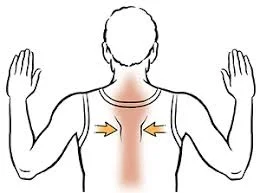
Shoulder Blade Squeeze Exercise
Introduction
Shoulder Blade Squeeze Exercise is a simple posture-correcting movement that strengthens the upper back and improves shoulder stability. It helps counter rounded shoulders, reduces neck and upper-back tension, and is especially beneficial for people who sit for long hours or work at a desk.
People who spend a lot of time at a desk or on a computer are frequently advised to do this exercise because it helps prevent the forward hunch and rounded shoulders that can result from extended sitting. (You have our attention, tech neck.) Those who participate in sports or other activities requiring strong, stable shoulders will also benefit from it.
Understand more about the likely benefits of scapular squeezes, how to incorporate them into your daily routine, and how to make them more or less difficult.
What are Scapular Squeezes?
The main goal of the scapular squeeze exercise, also known as “shoulder blade squeezes,” is to strengthen the muscles that lie between the shoulder blades. It’s an easy yet powerful exercise that can help you maintain a comfortable posture and improve the general health and function of your shoulders.
What muscles do scapular squeezes work?
The muscles that pull back the scapulae, or shoulder blades, are the main targets of scapular squeezes. These muscles include:
Rhomboids: which are situated between the inner border of the scapula and the spine. Retracting the scapulae is their main job.
Trapezius: Referred to as the “traps.” This big muscle is found in the neck and upper back. The muscle’s trapezoidal shape is caused by the wider end at the top and the narrower end at the bottom. The upper, middle, and lower trapezius are the three primary components of the trapezius muscle. The middle and lower trapezius are the main muscles targeted by scapular squeezes.
Scapular squeezes activate several stabilizing muscles, including the posterior deltoid (located at the back of the shoulders) and the deeper muscles of the spine, as well as the rhomboids and traps.
How to do the scapular blade squeeze exercise?

Relax Maintain the alignment of your hips, shoulders, and ears.
- With your palms facing forward and your elbows bent, raise your arms to shoulder height.
- Pull your shoulder blades together while keeping your posture straight.
- After five seconds of holding, let go.
- Twice a day, repeat three to five times.
Benefits of scapular squeezes
Exercises like scapular squeezes that strengthen the muscles between the shoulder blades can facilitate and ease daily tasks like:
Sitting up straight: It’s necessary to understand that the ideal posture does not exist. However, building strong back muscles can help guarantee that you can find a comfortable position for yourself, whether you’re standing or sitting.
Lifting and carrying: When lifting or carrying objects, having strong scapular muscles can help stabilize your shoulders and lower your risk of injury.
Pushing and pulling: Strong scapular muscles offer a stable foundation for tasks like pushing a shopping cart or opening heavy doors.
Doing overhead activities: Reaching up to grab items from a high shelf or doing overhead work (like painting) is made much easier with optimal shoulder strength.
Reducing pain and discomfort: Pain in the neck, shoulders, and upper back may be caused by weak scapular stabilizers. Discomfort in these areas can be prevented or lessened by strengthening these muscles.
Breathing: Unbelievably, respiratory function can be impacted by posture. Your lungs can expand more effectively when you are in a comfortable, upright position that suits you. Additionally, this can help in pain relief and relaxation.
As an extra bonus, scapular squeezes are a quick and simple exercise that you can do anywhere at any time. This makes them an excellent “movement snack” for your workday, especially if you work at a desk.
How does this exercise relate to arthritis?
Round shoulders can lead to tension and strain, especially in the upper neck and shoulders. This exercise specifically strengthens the muscles that keep our shoulders in proper alignment because excessive strain and tension over time may increase joint wear and contribute to rotator cuff imbalances and possible dysfunction.
This lessens the strain, lowers the risk of rotator cuff problems (muscle strains, bursitis, shoulder impingement, etc.), and eventually helps lower the likelihood of shoulder arthritis.
FAQs
Does squeezing shoulder blades improve posture?
Stretching and strengthening the muscles in the upper back, chest, and core are essential for correcting bad posture. Scapula squeezes, which involve squeezing your shoulder blades together for 30 seconds at a time, and rows, which involve pulling back your elbows like you’re rowing with a resistance band, are two exercises that strengthen your shoulders.
What are shoulder blade squeezes good for?
Enhances posture: This exercise helps counteract the hunched-over position that comes with sitting at a desk by strengthening the muscles that pull the shoulders back.
Reduces pain and stiffness: By lowering strain and tension, it can help ease pain and discomfort in the upper back, shoulders, and neck.
Strengthens upper back muscles: The rhomboids and middle trapezius muscles, which are essential for general upper back strength and function, are the focus of this exercise.
Strengthening the muscles that attach the shoulder blades to the rib cage improves shoulder stability and control when lifting, pushing, and pulling.
Contribution to injury prevention: Improved posture and shoulder stability can lower the chance of common problems like rotator cuff injuries and shoulder impingement.
Improves upper body strength: You can perform better in other upper-body exercises that require pulling motions, like pull-ups and rows, by strengthening these muscles.
Increases mobility: The exercise may help your shoulder girdle move more freely.
What muscle squeezes the shoulder blades together?
Rhomboids
The Rhomboids, the central back muscles, are especially worked by this exercise. In addition to holding those scapulae together, their function in the body is to maintain their attachment to the rib cage.
What are common mistakes in shoulder blade squeezes?
Typical Errors and Best Practices
Don’t shrug your shoulders, please.
Try not to forcefully pull the shoulders back, as this could result in back arching and excessive arm use. Instead, squeeze the muscles surrounding the shoulder blades in the mid-back.
Can shoulder blade squeezes cause pain?
Painful pinching inside your shoulder, particularly when you move it, is known as shoulder impingement. It occurs when your rotator cuff is compressed beneath the upper outer edge of your shoulder blade. Sometimes, medical professionals refer to it as shoulder impingement syndrome or impingement syndrome.
Which exercise is best for fixing posture?
To perform a glute bridge, lie on your back with your feet flat and your knees bent. Lift your hips to create a straight line from your shoulders to your knees after tightening your glutes and core. Take three deep breaths, hold, and then release. Do it again.
Cat-cow stretch: Get on all fours, placing your knees below your hips and your hands below your shoulders. Take a breath as you raise your head to the ceiling and lower your belly (cow). Breathe out as you lower your head, tuck your tailbone, and round your back toward the ceiling (cat). Repeat a few times.
Chin tucks: Align your head with your shoulders while sitting or standing. Make a “double chin” by pulling your chin straight back without lowering your head.
Planks: Maintain a straight body from head to heels by supporting your body with your forearms and toes. Hold this position while using your core.
When bench pressing, it is important to squeeze your shoulder blades.?
For this reason, we set the shoulder blades back and down during competition-style bench pressing and try to maintain them there throughout. It allows you to press the most weight as safely and effectively as possible while also reducing the range of motion and matching the natural scapular position at the bottom of the press.
How do you release tension in your shoulder blade?
Bring your fingertips to your shoulders while bending your elbows. Inhale deeply, then roll your shoulders forward as you exhale, using your elbows to create invisible circles. Repeat in the opposite direction after reversing the circles. Your muscles should start to release their tension.
References
- Lambert, P. (2025, April 4). Shoulder blade squeeze. The Arthritis Movement. https://www.arthritis.org.au/arthritis/arthritis-insights/moving-for-healthy-joints/exercise-shoulder-blade-squeeze/
- Scapular squeezes. (n.d.). [Video]. Hingehealth. https://www.hingehealth.com/gb/en/resources/articles/scapular-squeezes/
- Shoulder blade: exercises. (n.d.). https://myhealth.alberta.ca/Health/aftercareinformation/pages/conditions.aspx?hwid=abr7628
- Shoulder blade squeeze. (n.d.). Mayo Clinic. https://www.mayoclinic.org/img-20076263
- Shoulder squeeze Exercise | Saint Luke’s health System. (n.d.). https://www.saintlukeskc.org/health-library/shoulder-squeeze-exercise
- SHP – Tone Your Bones. (n.d.). Scapular squeezes. https://www.uab.edu/shp/toneyourbones/step-5-strength-balance-and-posture/posture/exercises/scapular-squeezes
- Shoulder squeeze exercise | Veterans Affairs. (n.d.). https://www.veteranshealthlibrary.va.gov/livingwith/backneck/NeckExercises/3,89941