Knee Range Of Motion Exercises
Introduction
Knee Range of Motion Exercises are simple, controlled movements designed to keep the knee joint flexible and moving freely. These exercises help reduce stiffness, improve bending and straightening of the knee, and support faster recovery after injury, surgery, or long periods of inactivity. Regular practice promotes better joint lubrication, decreases pain, and helps you return to daily activities with greater comfort and confidence.
These sets and reps are intended to serve as a guide; you can progress through them at your own pace, although you may want to perform fewer or more sets.
Strength: You can decrease the strain on your knee joint by strengthening the muscles that support it. Your knee joint can absorb shock better if you have strong muscles.
Flexibility: To restore range of motion and avoid injury, it’s essential to stretch the muscles you’ve strengthened.
Target Muscles: This conditioning program focuses on the following muscle groups:
- Quadriceps (front of the thigh)
- Hamstrings (back of the thigh)
- Abductors (outer thigh)
- Adductors (inner thigh)
- Gluteus medius and gluteus maximus (buttocks)
Knee Range Of Motion Exercises
Active Knee Slides

- Extending your leg in front of you while seated in a chair. To minimise friction while performing the exercise, place a plastic carrier bag below your operated foot.
- As far back as it feels comfortable, bend your knee. For 20 to 30 seconds, maintain this posture.
- At first, this will be tight and painful, but this is perfectly normal. The pain and mobility will gradually get better over time.
- Repeat five times.
- Four to five times a day, repeat.
Active Assisted Knee Slides

- For reduced friction during the exercise, place a plastic carrier or bin bag below your operated foot while sitting in a chair with your leg extended in front of you.
- As far back as you can, bend your knee. Press your knee back even more and place your non-operated foot in front of your ankle or shoe to extend the stretch. For 20 to 30 seconds, hold this.
- At first, this will be tight and painful, but this is perfectly normal. The pain and mobility will gradually get better over time.
- Repeat five times.
- Four to five times a day, repeat.
Static Quads
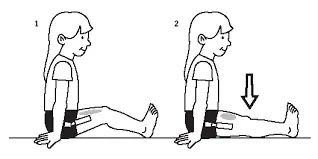
- Lying on your back. Sit for a long time with your leg extended straight.
- Push your knees firmly into the bed while pointing your toes up toward your shin.
- After ten seconds of holding, let go.
- Repeat six times.
- Four to five times a day, repeat.
Inner Range Quads

- Sit on your bed or couch for a long time with your leg out straight and a towel under your knees.
- Lift your foot off the bed by pulling your toes up toward your shin and firmly pressing your knees into the towel.
- Hold 10 seconds.
- Repeat six times.
Four to five times a day, repeat.
Straight Leg Raise

- Extend your operated leg straight while lying on your back.
- Bring your toes up to your shin.
- Raise the leg about 20 cm off the bed while maintaining a straight knee.
- Hold 10 seconds.
- Repeat five times.
- Four to five times a day, repeat.
Sitting Knee Hangs on Stool

- The leg to be worked out is supported by a chair while the person is seated.
- In this position, push your knee down to actively straighten your leg.
- Hold for 20 to 30 seconds.
- Five times over, repeat.
- Four to five times a day, repeat.
Prone Lying Knee Hangs off a Bed
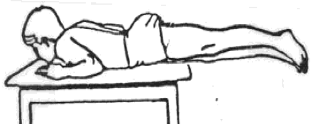
- Placing your feet over the edge of a bed while lying face down. Maintain a straight knee joint on the bed.
- Allow gravity and the weight of your feet to help you straighten your knees.
- Take a minute to relax in this position.
- Repeat as often as you can,
- four to five times a day.
Hamstring Stretch on Stairs

- Place your operated leg on a footstool or the bottom step of the stairs.
- Bring your toes up to your shin.
- In an attempt to straighten your knee, push the heel down into the step.
- Next, bend your upper body forward from your hips.
- The stretch behind your knee and thigh should be palpable.
- For 20 seconds, hold the stretch.
- Four to five times a day, repeat.
Knee to Wall Stretch on Stairs
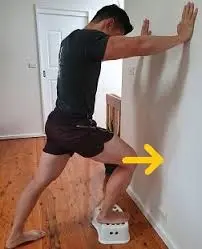
- Hold onto a stair or something similar for support as you stand.
- Put your operated foot on a footstool or the bottom step of the stairs.
- Push your knee over your toes while gradually shifting your weight.
- It’s important to maintain heel contact with the step while performing this exercise.
- For 20 seconds, hold.
- Four to five times a day, repeat.
Wall Squat Holds
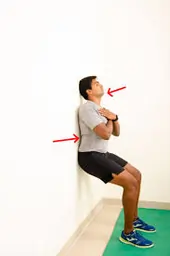
- Imagine a clock face and stand with your feet shoulder-width apart and your toes pointing slightly outward at a 10 to 2 position.
- If necessary, attach to a chair or other support for balance.
- Maintaining your back against the wall, slowly descend the wall.
- After five to ten seconds of pausing in the low-down squat position, return to the starting position without locking your knees.
- Repeat six times.
- Four to five times a day, repeat.
FAQs
How to improve the range of motion in the knee?
Heel slides, resistance band knee curls, wall slides, and seated hamstring stretches are the best knee flexion exercises. To increase knee bending ability, these exercises focus on the quadriceps, hamstrings, and calves.
What are ROM exercises for the knee?
Lie flat on your back without shoes on. Bend your knee as much as you can by slowly sliding your heel back. Hold this posture for ten seconds. Reverse: slowly extend your knee straight, then do it again.
How to treat knee pain in a child?
If a child has knee pain, treat it with the RICE method (Rest, Ice, Compression, Elevation), gentle stretches and massage, appropriate footwear or orthotics if necessary, and over-the-counter (OTC) pain relievers like ibuprofen (as directed by the dosage) for inflammation. If the child has persistent pain, significant swelling, or limping, see a doctor, as they may suggest physical therapy or address underlying issues like growth-related conditions.
At-home care (for minor injuries or pain)
The RICE Protocol: Use a compression bandage, elevate the leg, rest the knee, and apply ice (wrapped in a towel for 15 to 20 minutes).
Stretching and Massage: For growing pains or tight muscles, gentle quad/hamstring stretches and massage around the joint (avoiding the bones) can be beneficial.
Medication: Ibuprofen or acetaminophen can reduce pain and swelling, but make sure you follow the directions on the label and don’t take too much without first consulting a doctor.
Make sure your shoes are supportive; a doctor may recommend straps or orthotics.
Can knee ROM be fully restored?
Regaining the full functional range of motion through treatment is essential because of the complications that may arise after loss of knee flexion or extension. The use of sustained force for 10 to 45 minutes at a time to improve knee range of motion is supported by research.
What causes loss of range of motion in the knee?
Pain, stiffness, and decreased mobility are caused by cartilage loss, osteophyte (bone spur) formation, and joint space narrowing. Another common cause of restricted range of motion is meniscal tears, especially in the medial or lateral knee menisci. Trauma or degenerative changes may be the cause of these injuries.
What is the best exercise for knee pain?
Top 4 Knee Pain Relief Exercises.s The best exercises for knee pain concentrate on strengthening supporting muscles (quads, hamstrings, and hips) and enhancing stability with low-impact exercises, such as wall sits, glute bridges, straight leg raises, hamstring curls, side leg raises, and calf raises. High-impact exercises should be avoided, and customised programs should be guided by a physical therapist.
Exercises for Strengthening (10–15 reps, hold for 5 seconds)
Straight Leg Raises: While lying on your back, contract your thigh muscles, raise one leg six inches straight, hold it there, and then lower it.
Curl your hamstrings by standing, holding a chair, bending your knee to bring your heel close to your butt, holding, and then lowering.
Side Leg Raises: To strengthen your outer thigh and hip, lie on your side, raise your upper leg straight up, hold it, and then lower it.
Glute Bridges: Strengthen your legs and glutes by lying on your back with your knees bent, lifting your hips into a straight line from your shoulders to your knees, holding it, and then lowering it.
Calf raises involve standing, holding onto a chair, lifting onto the balls of your feet, holding, and then lowering.
Exercises for Stability and Support (Hold 5–30 seconds)
Wall Sits: To strengthen your quadriceps and stabilisers, lean back against a wall, slide down until your knees are bent at a 90-degree angle or less, hold, and then slide back up.
Calf Stretch (Wall): Turn to face a wall, take a step back, keep your heels flat, and lean in until your back calf starts to stretch.
How long does it take to regain the range of motion in the knee?
The objective for weeks two and three is to reach full knee extension and at least 100° knee flexion. Weeks 4-6: You should be getting close to or have reached a full knee flexion of 110–120°. The objective is to strengthen the lower extremity muscles with a functional range of motion at the knee joint during weeks six and up.
What vitamin deficiency causes knee pain?
Knee pain is associated with vitamin D deficiency. Maintaining healthy knees requires eating a balanced diet. Dietary changes can help prevent and manage knee pain. It is essential to understand how nutrition and knee health are related.
What is a home remedy for knee pain?
Use the RICE method (Rest, Ice, Compression, Elevation) for acute injuries, switch between heat and cold therapy, and try mild muscle-building exercises like swimming or walking to relieve knee pain at home. A healthy weight and good posture are essential for long-term relief, according to Max Healthcare, Manipal Hospitals, and Iodex. Natural remedies include turmeric/ginger tea, Epsom salt baths, and massaging with eucalyptus or mustard oil.
Quick Relief (RICE & Therapies)
Rest: Steer clear of knee-straining activities.
Ice: To reduce inflammation, apply towel-wrapped ice packs for 15 to 20 minutes at a time.
Compression: To support the knee and reduce swelling, apply an elastic bandage.
Elevation: Maintain your knee elevated above the level of your heart.
Heat: To ease tense muscles and enhance blood flow, use heating pads.
What is the common age for knee pain?
Your knees begin to show signs of years of use by your 40s and 50s. Even if you haven’t had an injury recently, soreness and stiffness can be caused by old injuries, daily stress, and early cartilage breakdown. Knees become less cushioned and more prone to pain and swelling in the cartilage.
References
- Comella, T. (2023, December 13). Improving the knee flexion range of motion. E3 Rehab. https://e3rehab.com/knee-flexion/
- Heel slides. (n.d.). [Video]. Hingehealth. https://www.hingehealth.com/gb/en/resources/articles/knee-mobility-exercises/
- Knee Conditioning Program – OrthoInfo – AAOS. (n.d.). https://orthoinfo.aaos.org/en/recovery/knee-conditioning-program/
- Musculoskeletal Physiotherapy OCATS. (n.d.). Post op knee mobility Exercises guidance. https://bridgewater.nhs.uk/wp-content/uploads/2020/12/Post-op-knee-range-of-motion-exercises-Patient-advice-sheet.pdf