

Eka Pada Bakasana (One-legged Crane Pose)
What is Eka Pada Bakasana?
Eka Pada Bakasana (One-Legged Crane Pose) strengthens the arms, core, and wrists while enhancing balance, focus, and flexibility.
Eka pada Bakasana is a balancing pose in which the upper arm balances the body in a forward bend. The asana’s ultimate shape demonstrates that the practitioner needs shoulder and wrist strength to maintain the pose for an extended period of time.
The Eka Pada Bakasana’s upright stance helps the practitioner’s body move in a calm and relaxed manner. In the end, this fosters a sense of spiritual belonging in the practitioners by strengthening their emotional and physical foundation.
Pada Eka Bakasana means “one,” “pada” means “leg,” “baka” means “crane” or “crow,” and “asana” means “pose.” This stance is sometimes referred to as “one-legged crane pose” or “one foot crow pose” in English. This is because one leg is extended back in the air, almost level with the floor, in the ultimate configuration of this stance. In this pose, the body resembles a one-legged still or meditating crane.
Muscle Work during Eka Pada Bakasana:
- Arms and Shoulders Muscles
- Biceps and Triceps Muscles
- Core Muscles
How to Perform?
- Start by placing your palms shoulder-distance apart as you enter Bakasana. The legs are positioned behind the upper arms with a space between the fingers, and the gaze is turned forward.
- Get your upper body ready for a weight shift as you approach the last pose of Bakasana by firmly grasping the floor, extending the forearms, and slightly bending the elbows inward.
- Lift the left leg from its position towards the middle of the torso after gradually shifting your weight more to the right arm. Then raise your leg into the air. The forwarding direction is still at the center of the look.
- This is the Eka Pada Bakasana’s last position. Without straining, hold here for as long as it feels comfortable. Bend and move the left leg closer to the middle of the torso to make a gradual return.
- Now, stabilize the shoulder and forearms and place them on the back of the left upper arm. Lastly, transition into Bakasana and then do the same pose with your left arm. Finally, to help the body relax, release it as well after entering Bakasana.
Health Benefits:
Enhances Core Muscle Strength:
The transverse abdominis, external obliques, pelvic floor muscles, and other key muscles are stabilized by consistent practice of Eka Pada Bakasana. In order to treat the ailment at hand, this also catches the surrounding muscles.
Enhances Focus:
Through the release of endorphins, the Eka Pada Bakasana practice enhances focus and concentration. This helps you better prioritize your tasks, filter out distractions, and focus on the current task.
Enhances the Breathing Pattern:
By promoting bronchodilation, inversion in Eka Pada Bakasana rectifies the irregular breathing pattern. As a result, alveolar perfusion may occur more effectively, and respiratory bronchioles may relax.
Forearms, shoulders, and wrists are strengthened:
The wrist, forearms, and shoulder are strengthened by the strain the body applies during Eka Pad Bakasana. By increasing blood circulation to those active locations, this improves the blood’s absorption of calcium.
The Navel Chakra is activated: Under the supervision of a skilled instructor, proper breathing and precise posture in Eka Pada Bakasana may activate the Navel Chakra. This gives the practitioner even more self-assurance, authority, and control.
Keep your nervous system in good condition: Regularly performing Eka Pada Bakasana and other yoga poses enhances neuromuscular and neurological function. Additionally, it calms the neurological system.
Therapeutic Benefits:
- The inversion in which the heart is positioned higher than the head is comparable to the Eka Pada Bakasana.
- Enhances blood circulation, which in turn strengthens the endocrine and neurological systems, resulting in a revitalizing and upbeat effect. In the end, beneficial for reducing headaches, depression, and tension and anxiety.
- Constipation, bloating, and irregular bowel movements are just a few of the digestive ailments that this pose helps people overcome.
- Stronger Peristalsis (the contraction of the muscles in your digestive tract) is stimulated by performing Eka Pada Bakasana.
- Digestive issues are further overcome by this. Additionally, inversion improves the stomach’s blood flow, which supports the digestive organs’ proper operation.
Beginner’s Advice:
Using a block to raise the body: Beginners who have weak shoulders and forearms can put blocks beneath their palms to raise their bodies higher in Eka Pada Bakasana. Blocks will provide the height required to stabilize the shoulder and forearms, which ultimately aids in completing the posture correctly.
Placing the block beneath the shin bone: When elevating the first leg into the air, practitioners who have a weak upper body may lose their balance with the other hand. As a result, one can keep the second leg on the back of the matching upper hand while placing a block vertically beneath the shin bone of the leg that is likewise raised. After that, elevate; this will make the pose less challenging.
Elbows wrapped with a strap: As they start to rise into the Eka Pada Bakasana, a practitioner who can’t keep their elbows closer in Bakasana may lose their balance or swing their elbows. Thus, the elbows can be held in place by putting a strap across them. This will maintain the pose’s strength.
Sequence Preparatory Pose:
Before practicing the One-Legged Crane Pose, the following positions must be completed:
Crane Pose Toes Wheel: This pose strengthens the quadriceps and calves. It strengthens the core. With the legs raised and the lower body positioned near the upper body, it allows the trainees to align their arm balance.
Crow Pose Block Flow: This flow aids students in comprehending the idea of raising the lower body while maintaining arm balance.
The Crane Pose Block (Bakasana Block): Helps the student develop arm balance. Placing the forehead of a learner on top of a block also helps. With the help of this method, the kids can maintain their balance without collapsing or tipping over.
Crane Pose Head Bolster: In order to improve arm strength and balance, the student can utilize the bolster as support in this pose. They can develop a deeper core strength thanks to the bolster assistance. Additionally, it instills confidence in the kids by providing a mental assurance of head safety.
Variations:
Eka Pada koundinyasana II:
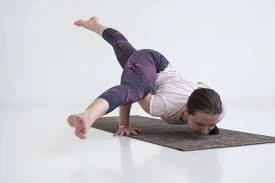
One leg is extended sideways at a 90-degree angle from the other leg, while the torso is raised on the palms in this version of Eka Pada Bakasana.
From downward dog, place one leg on the outside edge of your back arm and raise the other leg off the floor to enter this pose. Then, to reach the pose’s last position, extend the first sideways.
One-legged crane pose forearm balance:
The forearms of one hand lie next to the palm of the other in the one-legged crane pose, forearm balancing, but the body stays the same as in Eka Pada Bakasana.
With one leg in the air and the other on the hand, the palms support the full body weight in Eka Pada Bakasana. With a small modification, this stance is nearly identical to the base pose. Unlike in the Eka Pada Bakasana, the forearms lie on the floor instead of the palms.
Precautions:
- To properly distribute their bodyweight, practitioners should spread their palms widely apart. One risks falling if they practice with their palms too close together, since they may not be able to distribute the proper weight.
- When moving from Bakasana to the Eka Pada Bakasana, try not to flatten your upper back. When practicing this asana, one should circle their upper back during transitions because this could cause them to tumble.
- When entering and exiting the pose, practitioners should refrain from jerking their legs. This can cause the hand location to become confused. Therefore, one may land and take off more quickly by using their hamstrings and core muscles.
Conclusion:
One of the best asanas for developing the upper body is Eka Pada Bakasana, which is the more difficult variation of Bakasana. This asana technique enhances focus and breathing. Both are essential to the practice of meditation and pranayama. prepares for these practices as a result.
Because of this sophisticated method, it is best to become proficient in Bakasana before beginning Eka Pada Bakasana in order to prevent any mishaps.
FAQs
What is Eka Pada Bakasana?
With the hands and legs in a different configuration, One Legged Crane Pose Forearm Balance (Eka Pada Bakasana Salamba Forearm) is a creative and difficult version of the fundamental pose, Crane Pose (Bakasana). In this position, one leg is extended behind the other and resting on the upper arm.
What is the difference between Eka Pada 1 and 2?
The primary distinction between Eka Pada Koundinyasa 1 and 2 is the leg positioning: in Eka Pada Koundinyasana 1, your top leg lifts back, whereas in Eka Pada Koundinyasana 2, your bottom leg lifts back. This is even though both poses share a similar Chaturanga form for the upper body positioning.
What are the contraindications for Eka Pada Bakasana?
If you have a wrist, elbow, shoulder, neck, or knee ailment, you shouldn’t do Eka Pada Bakasana.
References:
- Eka Pada Bakasana (One-legged Crow Pose): Steps, Benefits, Precautions – Fitsri Yoga. https://www.fitsri.com/poses/eka-pada-bakasana
- One-Legged Crane Pose Yoga Pose (Eka Pada Bakasana). Tummee. https://www.tummee.com/yoga-poses/Eka Pada Bakasana


