Shoulder Range Of Motion Exercise
Introduction
An exercise conditioning program can help you regain your regular activities and lead a healthier, more active lifestyle after an injury or surgery. You can get back to sports and other hobbies by adhering to a structured conditioning program.
This program offers a variety of exercises for general conditioning. The program should be carried out under your doctor’s supervision to guarantee that it is both safe and beneficial for you. Consult with your doctor or physical therapist about which exercises will best help you achieve your rehabilitation goals.
Exercises with and without weights, as well as stretches like the cross-arm stretch, may help you increase shoulder mobility. Arm swings and rows are two examples of these.
Certain stretches and exercises can be particularly helpful if you have shoulder tightness, are healing from an injury, or just want to strengthen your shoulder muscles.
Your shoulder mobility and flexibility may improve if you incorporate shoulder-specific exercises and stretches into your overall exercise schedule. Additionally, these exercises may strengthen your shoulders, enhance shoulder function, and help prevent injury.
Learn more about the shoulder stretches and exercises that can improve your functional fitness and facilitate shoulder movement by reading on.
Strength: You can maintain the stability of your shoulder joint by strengthening the muscles that support it. Maintaining the strength of these muscles can help reduce shoulder pain and stop further damage.
Flexibility: To restore range of motion and avoid injury, it’s crucial to stretch the muscles you’ve strengthened. After strengthening exercises, gentle stretching can help keep your muscles long and flexible and reduce soreness.
Target Muscles: This conditioning program focuses on the following muscle groups:
- Deltoids (front, back, and over the shoulder)
- Rhomboid muscles (upper back)
- Teres muscles (supporting the shoulder joint)
- Supraspinatus (supporting the shoulder joint)
- Trapezius muscles (upper back)
- Infraspinatus (supporting the shoulder joint)
- Subscapularis (front of shoulder)
- Biceps (front of upper arm)
- Triceps (back of upper arm)
Program duration: Unless your doctor or physical therapist specifies otherwise, this shoulder conditioning program should be maintained for four to six weeks. These exercises can be continued as a maintenance program for shoulder health and protection for the rest of your life after you have recovered. Your shoulders’ strength and range of motion will be maintained if you perform the exercises two or three times a week.
Getting Started
Warm-up: Spend five to ten minutes engaging in low-impact activities, such as walking or stationary cycling, before beginning the subsequent exercises.
Stretch: Before beginning the strengthening exercises, perform the stretching exercises as a warm-up. To finish the program, repeat the stretching exercises after finishing the strengthening exercises.
Don’t avoid pain: You shouldn’t experience pain while exercising. If you experience any pain during exercise, speak with your physician or physical therapist.
Ask questions: Speak with your doctor or physical therapist if you are unsure about how to perform an exercise or how frequently to do it.
Shoulder range of motion exercises
1. Standing arm swings
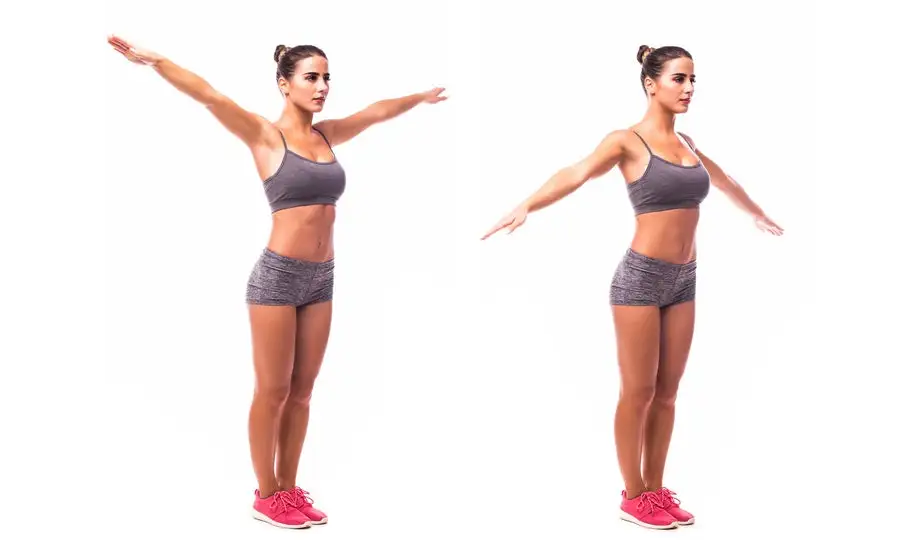
- This dynamic exercise is excellent for improving blood flow to the shoulder joint.
- Your shoulders and upper back will become more flexible and mobile if you perform this exercise as part of a warm-up before engaging in upper-body exercises.
- To complete this task:
- Keep your arms by your sides and take a proud stance.
- Swing your arms forward as high as you can while using your core. Be careful not to lift your shoulders.
- Repeat after returning your arms to the starting position.
- Spend 30 to 60 seconds performing this motion.
2. Shoulder pass-through

- The shoulder pass-through exercise works the shoulder’s surrounding muscles while also improving joint mobility.
- Holding a long stick, such as a broomstick or PVC pipe, is necessary for this exercise.
- To complete this task:
- Place your arms in front of your body and stand with your feet shoulder-width apart.
- Use an overhand grip to hold a stick, such as a PVC pipe or broomstick. You’ll have arms that are wider than your shoulders. Verify that the pipe or stick is parallel to the ground.
- With your arms straight, slowly raise the pipe or broomstick above your head while using your core. Go only as far as you feel comfortable.
- For a few seconds, maintain the pose.
- Go back to where you were.
- Do this five times.
3. High-to-low rows
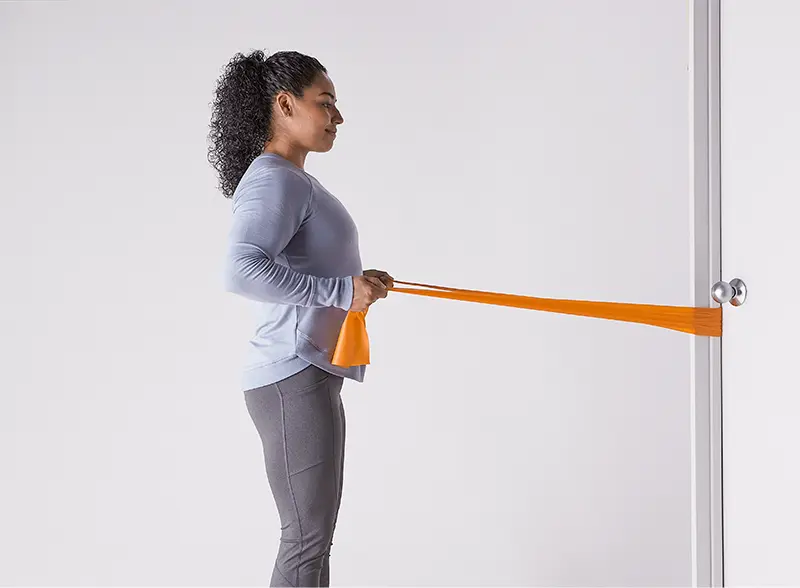
- Hi-to-low rows put a lot of strain on the thoracic and upper back muscles, which give the shoulder joint a lot of stability. A resistance band is needed for this exercise. You can use a cable machine at the gym to perform this exercise as well.
- To complete this task:
- A resistance band should be fastened above shoulder height to a sturdy object.
- Drop to one knee and use the other hand to grasp the band. You can place the other hand by your side.
- Maintaining a straight arm and torso, pull the band in the direction of your body. Squeeze your shoulder blades together.
- Perform two to three sets of ten repetitions on each side.
4. Reverse fly

- The reverse fly exercise, like the high-to-low rows, works the thoracic and upper back muscles that give the shoulder joint a lot of stability. A set of light dumbbells is needed for this exercise.
- To complete this task:
- Each hand should hold a dumbbell.
- Place your feet shoulder-width apart and bend your knees slightly.
- Bend forward at the waist while using your core. Maintain a straight back. You’ll extend your arms.
- Lift your arms off your body. Squeeze your shoulder blades together. When you reach shoulder height, stop.
- Repeat after slowly returning to the starting position.
- Perform three sets of ten reps.
5. Rotation with a dumbbell

- You can warm up your shoulder for overhead and throwing motions by rotating with a dumbbell. For the majority of athletes who extend their arms overhead and externally rotate during their sport, this is standard procedure, according to Snyder.
- To complete this task:
- Stand with your feet shoulder-width apart.
- Holding a light dumbbell.
- Lift your arm until your elbow reaches shoulder height. Your hand’s front will be pointing downward.
- To raise your hand toward the ceiling, rotate your shoulder to raise your arm and weight.
- Before switching sides, slowly go back to the beginning position and repeat.
- Perform 12 repetitions on each arm in two to three sets.
6. Cross-arm stretch

- Your back shoulders should feel quite stretched.
- To perform this stretch:
- Raise your right arm to just below shoulder height while standing with your feet slightly less than shoulder-width apart.
- Using your left hand to support your arm, place it on your right elbow and gently pull your right arm across your body.
- For up to 30 seconds, maintain this posture.
- On the other side, repeat.
- Repeat three to five times on each side.
7. Sleeper stretch

- When treating a shoulder injury or during rehabilitation, this stretch is frequently advised.
- For general health, you can perform this stretch on both sides, but if you have an injury, you should focus on the afflicted side.
- To perform this stretch:
- On the afflicted side, lie down. Select a side to begin with if you are pain-free. You should have your shoulder stacked beneath you.
- Bend this arm so that your fingers point toward the ceiling and extend your elbow straight out from your shoulder. This is where you start.
- Using the unaffected arm, gently guide this arm toward the floor. When the back of your afflicted shoulder starts to stretch, stop.
- For up to 30 seconds, maintain this posture.
- Before switching sides, perform three repetitions.
8. Doorway stretch

- If one side of your chest is more constricted than the other, the doorway stretch helps.
- This stretch improves shoulder range of motion and opens the pectoralis muscles in your chest.
- To perform this stretch:
- Make a 90-degree angle with your arms and elbows as you stand in a doorway. You should have a split stance.
- Raise your right arm to shoulder height and touch the doorway with your palm and forearm.
- Only go as far as it feels comfortable, as you gently lean into the stretch.
- For a maximum of 30 seconds, hold the stretch.
- Repeat after switching sides. Perform two or three times on each side.
9. Chest expansion

- Expanding your chest can help you open your chest, stretch your back muscles, and improve your shoulder range of motion. It can also aid in lung expansion, which improves oxygen uptake.
- To perform this stretch:
- Place your feet together and take a tall stance.
- With your arms behind your body, grasp the ends of a towel or exercise band in each hand.
- To open your chest and bring your shoulder blades together, use the towel or band. You’ll turn to face the ceiling as a result.
- For a maximum of 30 seconds, maintain this pose.
- Do this three to five times.
10. Child’s Pose

- Child’s Pose is a popular yoga pose that helps stretch your latissimus dorsi, or lat, muscles and open the shoulder joint into flexion, or forward bending. This pose is also beneficial for your lower back.
- To perform this stretch:
- On an exercise mat, kneel. Verify that your body is upright.
- Crawl your hands forward slowly until your arms are out in front of you. Don’t look up.
- Place your forehead on the floor and your torso on your thighs.
- Take three deep breaths while maintaining this posture.
- Do this three to five times.
Safety tips
Remember these suggestions to ensure the safety and efficacy of your shoulder mobility exercises.
- If you experience any pain, stop. While performing these stretches or exercises, a little discomfort is common, but you shouldn’t experience severe pain. If you feel pain, stop immediately.
- Don’t forget to breathe. Your shoulders, back, and other parts of your body can all feel less stressed and tense when you breathe. Maintaining proper breathing can also help you stretch or perform an exercise for longer.
- Take it slow at first. Don’t try to do too much too soon if you’re new to exercising or shoulder exercises. As you gain strength, gradually increase the number of exercises and stretches you perform.
- Consult your physician or physical therapist. Before performing shoulder mobility exercises and stretches, it’s important to consult your doctor or physical therapist if you’ve had shoulder surgery, an injury, or severe shoulder pain.
FAQs
How to improve the range of motion in the shoulder?
Detailed instructions
Allow your other arm to hang at your side.
Swing your arm back and forth gently. Repeat the exercise with your arm moving side to side, then in a circular motion.
With the other arm, repeat the entire process.
What is ROM exercise for the shoulder?
Exercises for the active range of motion (ROM) can enhance shoulder joint mobility. If you have a shoulder condition that limits your arm and shoulder range of motion, like shoulder pain, you may be prescribed these exercises.
What are the 4 exercises for shoulder day?
There is a commonality among the four primary shoulder exercises that most people perform: overhead press, side lateral raises, front delt raises, and dips.
What are the top 3 shoulder exercises?
The Overhead Press (Barbell/Dumbbell) for the front/overall, Dumbbell Lateral Raises for the side (medial), and Bent-Over Rear Delt Flies/Raises for the back (posterior) are the top three shoulder exercises that target all three heads of the deltoid, resulting in a powerful, well-balanced body.
Here’s why these are the best options:
Overhead Press (Barbell or Dumbbell): A basic compound lift that strengthens the triceps, upper chest, and anterior (front) deltoids, increasing total mass and pressing force.
The best isolation exercise for the medial (side) deltoids is the dumbbell lateral raise, which is essential for developing shoulder width and a “capped” appearance.
Bent-Over Rear Delt Fly/Raise: This technique, which balances shoulder development, enhances posture, and avoids imbalances, targets the posterior (rear) deltoids, which are frequently overlooked.
What are 5 examples of range of motion exercises?
A simple range-of-motion workout schedule could consist of:
Tilts and rotations of the neck.
Arm raises and shoulder circles.
Flexion and extension of the elbow.
Finger exercises and wrist rotations.
Knee and hip motions.
Foot flexion and ankle circles.
Which exercise is best for shoulder mobility?
Six Exercises for Shoulder Mobility
The needle is threaded. Place your knees below your hips and your palms beneath your shoulders to begin in a quadrupedal position.
Stretch your shoulders across your body. To begin, stand up.
Rigid rotations of the shoulders. Start by standing up.
YTWL.
Pec Stretch Doorway.
Stretch your triceps overhead.
What exercises increase ROM?
The general stretches and exercises listed below can enhance your range of motion and help your shoulders, lower back, hips, and core.
Stretching the shoulder wall
Shoulder rotation of the door frame
Superman (lower back)
(core) quadruped
Stretch your hips from knee to chest.
What is the 7-minute rotator cuff solution?
A quick and easy program called the 7-Minute Rotator Cuff Solution can help you avoid or recover from rotator cuff injuries. It explains how the shoulder functions, what can go wrong and why, along with what should be done (and not done) to reduce the likelihood that shoulder issues will arise in the first place.
What are the four types of range of motion?
1. AROM, or active range of motion
What it is: The patient uses their own muscles alone, without assistance, to move a body part through its range of motion.
As an illustration, raise your arm to grab something.
2. PROM, or passive range of motion
What it is: The patient’s limb is moved through the range of motion of the joint by a therapist or a machine.
For instance, a physical therapist might gently bend your elbow.
3. AAROM, or Active-Assisted Range of Motion
What it is: The patient completes the motion with assistance from a therapist, a strap, or another tool.
Example: Lifting your injured arm with the assistance of your good arm.
4. Range of Motion Resistance (RROM)
What it is: To develop strength, the patient moves a joint against an outside force or resistance, such as weights or bands.
For instance, using dumbbells to perform bicep curls.
References
- Comella, T. (2023, December 12). How to improve your shoulder range of motion. E3 Rehab. https://e3rehab.com/shoulder-range-of-motion/
- Dhruvi. (2025, September 8). Restoring Shoulder Range of Motion through Physiotherapy/Exercises. Alleviate Pain Clinic. https://alleviatepainclinic.com/vlog/restoring-shoulder-range-of-motion-through-physiotherapy-exercises/
- Lindberg, S. (2020, January 10). 10 Shoulder mobility exercises and stretches. Healthline. https://www.healthline.com/health/shoulder-mobility-exercises
- OCATS. (n.d.). Musculoskeletal Physiotherapy OCATS Health services at Wolves Shoulder ROM Exercises guidance. https://bridgewater.nhs.uk/wp-content/uploads/2020/12/Shoulder-range-of-motion-exercises-Patient-advice-sheet.pdf
- Rotator cuff and shoulder conditioning program – OrthoInfo – AAOS. (n.d.). https://orthoinfo.aaos.org/en/recovery/rotator-cuff-and-shoulder-conditioning-program/