

Facial Exercise After Stroke
Introduction
A stroke is a medical emergency that happens when something prevents your brain from getting enough blood flow. Strokes can be caused by bleeding in the brain or a narrowed blood vessel.
Your quality of life can be significantly affected by facial paralysis, which can affect everything from your ability to close your eyes to your ability to smile. The good news? Exercises for facial paralysis can speed healing, enhance symmetry, and restore muscular function.
These targeted movements improve blood circulation, stimulate the afflicted nerves, and retrain facial muscles.
Knowing Facial Paralysis and the Function of Exercise
The muscles that the facial nerve regulates become weak or immobile when it is injured, whether due to Bell’s palsy, stroke, trauma, or surgery. Asymmetry, drooping, and trouble with simple facial movements result from this.
There are several uses for facial exercises for facial paralysis:
- Avoid stiffness and muscle atrophy
- Retrain the neurological connections between the facial muscles and the brain.
- Boost control and coordination
- Increase blood flow to impacted areas
- Minimise the possibility of unintended muscular movements or synkinesis.
Symptoms and Causes
What are stroke symptoms?
Depending on which part of your brain is affected, a stroke can result in a variety of symptoms. Among the most typical symptoms are:
- Aphasia (difficulty speaking or total speech loss)
- Double vision or blurry vision (diplopia)
- Perplexity or agitation
- Coma
- Vertigo or dizziness
- Headaches (typically severe and abrupt)
- Loss of muscle control on one side of your face
- Clumsiness or loss of coordination (ataxia)
- Amnesia, or loss of memory
- Abrupt personality changes or mood swings
- Vomiting and nausea
- Stiffness in the neck
- Fainting or losing consciousness
- Seizures
- Speaking incoherently or slurred (dysarthria)
- Abrupt deterioration or loss of your senses (taste, smell, touch, hearing, and vision)
- One side of your face and body is weak or paralysed
How long does a stroke last?
As long as your brain isn’t receiving enough blood flow, a stroke will continue. If your brain cells are deprived of oxygen from new blood for an extended period of time, they will die. This may result in long-term impairments and other modifications to your body’s functionality.
Restoring your regular blood flow could lessen the degree of that irreversible harm. Time is therefore important when treating a stroke.
It’s typical for the effects to stay around even after treatment. For up to a year, symptoms and side effects can last.
What are the warning signs of a stroke?
Numerous symptoms can be caused by strokes. Remember to identify the warning signs of a stroke in yourself or a loved one:
equilibrium. Keep an eye out for an unexpected loss of equilibrium.
eyes. Watch out for abrupt changes in one or both eyes or visual loss.
face. Grin. One or both sides of the face should have a droop.
arms. Lift both arms. One arm will sag or drop in a way that it normally doesn’t if you or someone else is having a stroke.
Talk. You or someone else may struggle with word choice or slur their speech.
Time. Call for assistance right away because time is of the essence. Try to keep track of when symptoms begin by looking at your watch, phone, or a clock. Informing a medical professional about the onset of symptoms can help them determine the best course of action.
What causes strokes?
Strokes come in two types.
Ischemic strokes typically occur when a blood clot obstructs a blood artery that supplies blood to the brain. The following conditions may result in various types of clots:
- Atherosclerosis (hardened arteries)
- Atrial fibrillation (especially when sleep apnea causes it)
- Clotting disorders
- Heart defects.
- Microvascular ischemic disease
Hemorrhagic strokes occur when a blood artery in the brain ruptures or fractures. Among the causes are:
- Brain aneurysms
- Brain tumors
- High blood pressure (especially if it’s very high or you have it for a long time)
- Moyamoya disease (and any other condition that weakens blood vessels in your brain)
Stroke risk factors
Although anybody can have a stroke, certain groups are more susceptible than others, such as those who:
- Are older than 65.
- Smoking or using nicotine or other tobacco products (such as vaping)
- Use over-the-counter or recreational drugs
- Your risk of stroke may rise if you have any of the following medical conditions:
- Alcohol consumption disorder
- COVID-19
- Regular migraine attacks
- Hypertension, or elevated blood pressure
- Hyperlipidemia, or elevated cholesterol
- Diabetes type 2
Facial Exercise
Eyebrow Lift Exercise

This fundamental exercise helps you restore control over the movement of your eyebrows by focusing on the frontalis muscle.
How to carry out:
Just above each eyebrow, place your index finger.
Try to raise your eyebrows gently while using your fingers to provide a little resistance.
After five seconds of holding, let go.
Do this ten times, three times a day.
Expert advice: If you are initially unable to move the afflicted side at all, manually raise the eyebrow with your fingers while concentrating on the movement. This keeps the mind-muscle relationship intact.
Eye Closure Strengthening
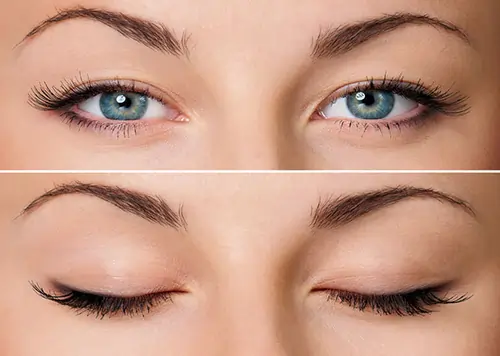
Dryness and discomfort might result from the inability of many patients with facial paralysis to completely seal the afflicted eye.
How to carry out:
Close both eyes gently as though you’re going to sleep; do not squeeze them tightly.
Hold for five seconds.
Open your eyes slowly.
Repeat ten to fifteen times, multiple times during the day.
Important note: Use lubricating drops and talk to your doctor about preventative steps to avoid corneal damage if you are unable to fully close your eye.
Nose Wrinkle Exercise
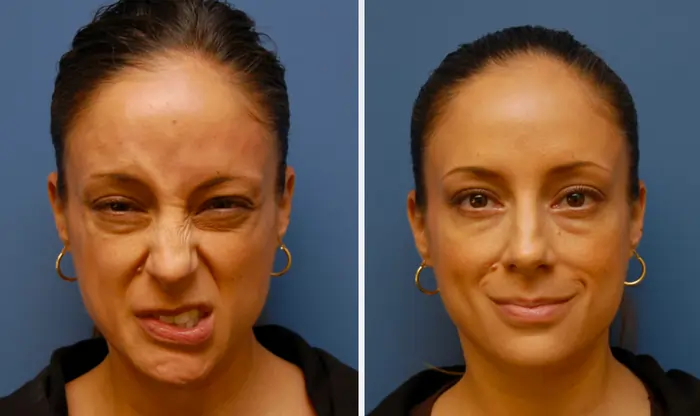
The muscles surrounding the nose and upper lip, which are frequently impacted by facial paralysis, are activated by this action.
How to carry out:
Make your nose wrinkle as though you’re smelling something disagreeable.
Make an effort to move both sides equally.
Hold for five seconds.
Unwind and repeat ten times.
Instead of emphasising speed, concentrate on deliberate, gradual movements. When it comes to facial nerve paralysis exercises, quality is more important than number.
Cheek Puff Exercise

This exercise aids in lip closure and strengthens the buccinator muscles in your cheeks.
How to carry out:
Inhale deeply and exhale air into both cheeks.
For five to ten seconds, hold the air in your cheeks.
Release the breath gradually.
Ten times over, repeat.
Variation: To give an additional challenge and strengthen different muscle areas, try shifting the air from one cheek to the other.
One of the main objectives of recovering from facial paralysis is frequently to restore your grin.
Smile Exercise

How to carry out:
Try to elevate all corners of your lips evenly as you smile gently.
Hold for five seconds.
Let your face completely relax.
Focus on symmetry as you repeat ten times.
As your strength increases, start with smaller movements and progressively expand the range. Steer clear of overworking the unaffected side since this can exacerbate asymmetry.
Lip Pucker Exercise

The orbicularis oris muscle, which surrounds your mouth, gets stronger with this workout.
How to carry out:
Pucker your lips as though you’re going to whistle or kiss.
Make an effort to make both sides of the movement symmetrical.
Hold for five seconds.
Unwind and repeat ten to fifteen times.
Advanced variation: To enhance muscular coordination, consider switching between a pucker and a broad smile after you’ve mastered the basic pucker.
Neck and Jaw Tension Release
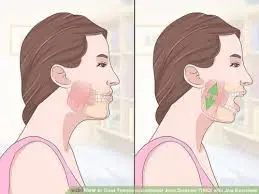
This exercise lessens compensatory tension that frequently arises after facial paralysis, even though it does not directly target facial muscles.
How to carry out:
Stretch the afflicted side while gently tilting your head in the direction of the unaffected side.
Hold for 15 to 20 seconds.
Tilt toward the direction of the afflicted side and return to the middle.
Make soft movements to open and close your jaw.
Five times, repeat the sequence.
This keeps the face mobile throughout the healing process and helps avoid stiffness.
Creating Your Exercise Routine
When doing exercises for facial paralysis, consistency is essential. This is an example of a daily schedule:
Ten minutes in the morning:
Ten repetitions of eyebrow lifts
15 repetitions of eye closure
Ten repetitions for nose wrinkles
10 minutes at noon:
Ten repetitions of cheek puffs
10 repetitions of the smile workout
15 repetitions of lip puckers
Ten minutes in the evening:
Do your morning routine again.
Add five repetitions of neck and jaw release.
Important Tips for Success
Do:
- To keep an eye on symmetry, do activities in front of a mirror.
- Increase the number of repetitions gradually at first.
- Maintain consistency in your everyday schedule.
- Recuperation may take weeks or months, so be patient.
- Take pictures to record your progress.
Don’t:
- Excessive strain or forceful motions
- Work out until you’re exhausted or in agony.
- Give preference to the strong side while ignoring the weak side.
- Even on days when you’re feeling down, skip your routine.
- Compare how long it took you to recover.
Complementary Treatments
Exercises for treating facial paralysis are the cornerstone of recovery, although they are most effective when paired with other therapies.
Physical therapy: Expert supervision guarantees the appropriate method
Massage: A light facial massage helps lessen stiffness and increase circulation.
In certain situations, electrical stimulation may aid in neuron regeneration.
Biofeedback: Aids in improving facial muscle control
Key Takeaways
Recovery from facial paralysis requires facial exercises that help retrain muscles and restore function.
Exercise should ideally be done under expert supervision and only after receiving medical clearance.
Exercise two to three times a day; consistency is more important than intensity.
Prioritise symmetry and deliberate motions over force or speed.
Timelines for recovery vary greatly; perseverance and patience are essential.
For best effects, combine exercise with other suggested therapies.
For best effects, combine exercise with other suggested therapies.
Track your development and modify your schedule as you get better.
Never work out while you’re in pain or really exhausted.
FAQs
Can your face get better after a stroke?
Although facial paralysis following a stroke can be a difficult condition, people can improve their quality of life and regain some control over their facial expressions with the correct care.
What is the best exercise after a stroke?
It is advised to perform range-of-motion exercises and stretches to increase flexibility and avoid contractures, which are a condition where the muscles become exceedingly rigid and tight after a stroke. For patients who are at risk of falling, balance and core exercises are advised.
How to regenerate facial nerves naturally?
Frequent exercise increases circulation, which aids in nourishing and repairing injured nerves. Additional alleviation may be obtained through alternative therapies like massage and acupuncture. Additionally, managing underlying illnesses that can impact long-term nerve function, like diabetes or autoimmune disorders, is essential.
Does a stroke always affect the face?
Since not all stroke instances result in facial palsy, it’s essential to be aware of all possible symptoms.
How long do facial exercises take to work?
Women who regularly followed a systematic facial exercise program for roughly 20 weeks (doing facial exercises for 20–30 minutes daily) were judged as looking slightly younger and having slightly fuller cheeks.
What heals the brain after a stroke?
Your brain can rewire itself, but severely injured or dead brain cells cannot regenerate. Walking, speaking, and swallowing can all be relearned as a result. We call this process “neuroplasticity.” It can last for years and start with a stroke.
Do facial exercises really work?
Facial exercises can help tone muscles, improve blood flow, and maybe even make the face look firmer and a little younger. Results usually take 20 weeks of daily practice without fail. But they won’t help you lose weight and might not even help you get rid of wrinkles.
How They Function
Toning the muscles: Exercises build and strengthen the muscles under the skin, which can help lift sagging skin and make areas like the cheeks look fuller.
Better Circulation: Moving your face regularly increases blood flow and oxygen to the skin, which could make it look younger and more radiant.
Lymphatic Drainage: Moving your face and getting a massage can help lymphatic drainage, which can make your face less puffy.
Limitations and a Reality Check
No Spot Reduction: Facial exercises can’t make you lose fat in your face. To lose fat in your face, you need to lose weight all over your body through diet and exercise.
Wrinkle Risk: Some experts say that working out facial muscles too much can make wrinkles worse because the muscles are attached directly to the skin.
Limited Evidence: Although preliminary studies indicate potential, comprehensive, long-term research is necessary to substantiate the anti-ageing assertions.
Common exercises
Cheek Lifter: Smile and make an “O” shape to lift your cheek muscles.
Eyebrow Lifter: Putting your fingers under your brow and pushing them down.
Smile Sculpting: Smiling without showing your teeth to make your cheek muscles stronger.
Which exercises increase blood flow in the face?
You can get a glowing, toned complexion by doing quick, daily exercises that stimulate skin cells and improve lymphatic flow. Face tapping, deep massage, and specific yoga poses like “fish face” or smiling widely for 30 to 60 seconds are some of the most important ones. These methods increase the amount of nutrients that skin cells get, lower stress, and stop skin from sagging.
Important Exercises for Blood Flow in the Face
Face Tapping: Lightly tap all over your face with your fingertips. This gets the blood flowing, increases collagen, and helps the lymphatic system drain.
The “Fish Face” and Smile: Make your lips look like a fish face, hold it there, and then smile as big as you can. This strengthens the muscles in your cheeks and increases blood flow.
Forehead Smoothing: To let go of tension, run your fingertips from the middle of your forehead to your temples.
Jawline Massage: Use your thumb and index finger to gently pinch the jawline from the chin to the earlobes.
Eye Circles: Put your index fingers on the outer corners of your eyes and move them in a circle around the eye socket.
Neck Release: To stretch your neck and jawline, lift your chin and pucker your lips like you’re going to kiss someone.
More tips for getting your blood flowing
Inversion Poses: To get more blood to your head, hang your head while bending forward or lift your legs up against a wall for 30 to 60 seconds.
Warm Water/Steaming: To promote sweating and widen blood vessels, use warm steam.
Frequent Exercise: To improve product absorption, do these exercises in the morning or just after applying skincare.
How to boost blood flow to the face?
To get a healthy glow on your face, do facial massages every day, use cold and hot water therapy, do face yoga, and do cardio exercises on a regular basis. Using jade rollers, caffeine-based products, and drinking enough water also help blood flow and make your skin less puffy.
Important Ways to Improve Blood Flow in the Face:
Techniques and massage for the face:
Manual Massage: Start in the middle of your face and use your fingertips to apply gentle, upward, and outward pressure toward your temples.
Knuckle Technique: Make loose fists and use your knuckles to draw small circles on the temples, medium circles on the cheeks, and firm circles along the jaw.
Tapping: Lightly tap your fingers on your face to get the blood flowing.
Use a facial roller or Gua Sha to help your blood vessels work better.
Yoga and exercises for the face:
Balloon Pose: Take a deep breath and move it around to stretch the muscles in your face.
Child’s Pose: Doing yoga poses upside down helps blood flow to the head.
Eye Pinch: Lightly pinch the eyebrows from the outside to the inside corners.
Temperature Therapy and Skin Care:
Hot and cold therapy: Use a warm compress or splash yourself with warm and cold water to get your body going.
Steam: Use facial steaming to make your pores bigger and get more blood to flow.
Active Ingredients: Use products with caffeine or niacinamide (Vitamin B3) to get your blood flowing.
Things You Do Every Day:
Exercise: To improve circulation overall, do at least 30 minutes of moderate cardiovascular exercise, such as jogging or brisk walking.
Hydration: Consume enough water to keep your blood volume and skin hydrated.
Steer clear of smoking: Nicotine damages arterial walls and limits blood flow.
Places Where Focused Massage Is Common:
Small circles on the temples.
Cheeks: Strokes that go up toward the ears.
Jawline: Push firmly along the jawline toward the ears.
Brow Line: Light pinching.
What are the disadvantages of facial exercises?
Doing too many facial exercises can make you look older by making wrinkles deeper, making skin sag, and putting strain on muscles. They need to be very consistent to avoid reversing results, and they can cause acne from too much touching, broken capillaries, or imbalances in the face. Using the wrong technique can stretch the skin instead of toning it.
The main problems with facial exercises are:
Worsening Wrinkles: Doing the same thing over and over can make fine lines worse, especially frown lines and brow furrows, instead of getting rid of them.
Skin Sagging: If you stretch your skin too much while working out, it can lose its elasticity, making it look looser and saggy instead of lifted.
Overusing and tiring out your facial muscles: Doing too much exercise on your facial muscles can make them tired, hurt, or lose their shape.
More breakouts and acne: When you touch and massage your face a lot, oil, bacteria, and dirt from your hands get on your skin.
Results that don’t last: Facial yoga is like exercise for the body; if you stop doing it, the results will go away.
Facial Imbalances: If you only work on one part of your face, like your jaw, it can cause muscle tension that can lead to problems like over-compaction or sagging in other areas.
Takes a lot of time: You have to stick to a daily routine to see results, which can take a long time.
References
- China Connection Global Healthcare. (n.d.). Stroke and exercise. https://karphysiotherapy.com/download-tips/Stroke_Exercise.pdf
- Facial Palsy UK. (2024, July 9). Management of Flaccid Facial Paralysis (Floppy Face) – Facial Palsy UK. https://www.facialpalsy.org.uk/support/self-help-videos/management-of-flaccid-facial-paralysis-floppy-face/
- Lopez, L., & Lopez, L. (2024, December 18). Facial Exercises for Those with Facial Droop. New York Facial Paralysis. https://www.newyorkfacialparalysis.com/blog/facial-exercises-for-those-with-facial-droop/
- Physiotherapy, H. (2025, December 17). 7 Effective facial exercises for Facial Paralysis recovery. Healyos Physiotherapy. https://www.healyos.com/facial-paralysis/facial-exercises-for-facial-paralysis/


