Strength Training Exercise At Home
Introduction
Strength training explained
It’s possible that you’ve heard the terms “resistance training” and “strength training” and are curious about their meanings. They are only a kind of workout that aims to improve the size, strength, power, and endurance of your muscles.
It’s simple to perform strength training at home. You can use ordinary objects, such as water bottles, or weights like dumbbells or resistance bands. Or utilise the weight of your own body.
Build your strength up slowly.
exercising for strength at least twice a week. Spread out the workouts so that you may rest for at least a full day in between.
The suggested 150 minutes per week of moderate-intensity aerobic activity, such as brisk walking, should be combined with strength training.
Before beginning an exercise schedule, you may wish to consult your physician. Start slowly and work your way up.
Increase the number, frequency, and repetition of the exercises in each session gradually as they get easier. Try to perform each exercise eight to fifteen times.
Strength training tips
- Holding your breath can raise your blood pressure, so avoid doing so.
- With each exercise’s effort, release your breath.
- If you are unable to speak regularly while performing the exercises, take a break.
- Make sure you move slowly and deliberately.
- For each exercise’s “lift” or “push,” count for two seconds.
- For each exercise’s “release,” count for two seconds.
- As needed, take a break in between exercises.
10 strength exercises you can do at home
Heel raises

- With your legs slightly apart, toes facing front, and equal weight on both feet, stand upright.
- If necessary, hold to a solid surface for support, such as a table or kitchen worktop.
- Lift your heels off the ground slowly so that your weight shifts forward onto your toes while maintaining a straight back and knees.
- Return your heels to the floor slowly. Do the workout eight to fifteen times.
- Advice: To make this workout easier, you can perform it while seated. Raise and drop your knees while lifting your heels off the ground, keeping your feet flat on the ground.
- Next, try performing this exercise with just one leg at a time. Hold your foot off the ground while standing on one leg and bending the other leg at the knee. Raise and lower the heel of the leg you are standing on while clinging to something for support.
Sit to stand

Look for a sturdy, upright chair, such as one for a dining table. To avoid resting on the back of the chair, take a seat slightly forward.
With your feet flat on the ground, bend your legs 90 degrees at the knee and place them shoulder-width apart.
- Gently get up from a seated position and then return to your seat.
- Do the workout eight to fifteen times.
- Advice: If you need assistance, place your hands on the chair armrests or the tops of your thighs. Try performing the exercise without using your hands as you gain strength.
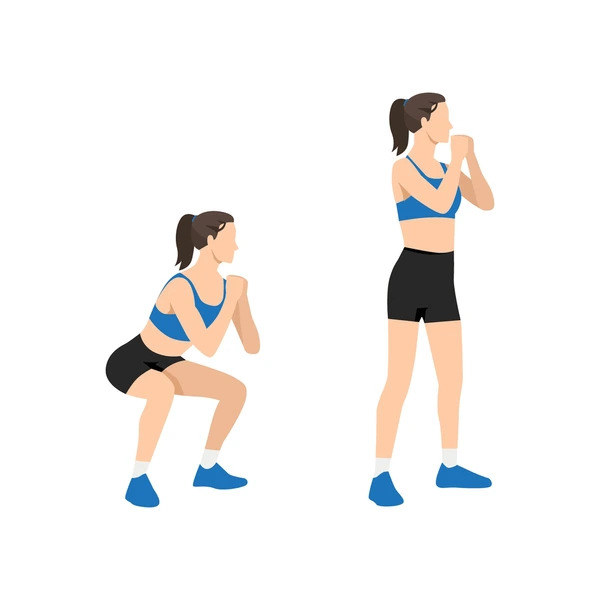
The next step is to squat, which involves lowering yourself from standing to the chair and then rising back up without sitting on it.
Standing side leg lifts

With your feet together and your toes facing forward, take a straight stance.
- If you need support, hold onto a sturdy surface like a table or kitchen countertop; if your balance is fine, place your hands on your hips.
- Lift one leg off the ground and out to the side while maintaining a straight posture and lifting it no more than 30 degrees.
- Return your leg to its initial position.
- For each leg, repeat eight to fifteen times.
- Advice: Avoid leaning away from the leg you are moving and maintain a tall posture.
Do this exercise while seated for a simpler version. One leg at a time, raise it slightly off the chair, extend the entire leg to one side, tap your foot on the ground, and then bring the leg back to its original position.
Split squats

- Hold onto a solid surface, such as a table or kitchen worktop, while standing straight. Make your body turn such that the support or worktop is on your side.
- With one foot, take a big stride back behind you, bend your back leg’s knee, and then lower your body, dipping your leg’s knee toward the ground while keeping your heel off the ground.
- One foot on the chair.
- Throughout the workout, maintain a straight back and an elevated chest.
- Go back to where you were.
- After eight to fifteen repetitions on the same leg, switch to the other leg and repeat the exercise.
- Advice: To begin, dip your knee a few inches toward the ground. As you gain strength, lower your knee until it almost touches the floor.
Glute bridges

Try this exercise only if you are comfortable getting off the ground. You can also perform this exercise while lying on a solid bed.
- With your arms by your sides, your feet flat on the floor or bed, and your knees bent up, lie on your back.
- Lift your buttocks off the ground by pushing your hips up and pushing down through your feet while maintaining touch with the floor with your shoulder blades.
- Slowly lower back down to the ground.
- Do the workout eight to fifteen times.
- Advice: Try elevating your bottom an inch or two off the floor when you initially begin this exercise.
- As you gain strength, lower your knee until it almost touches the floor.
Seated forward punches
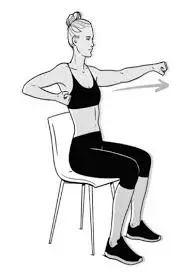
- Place your feet shoulder-width apart and flat on the floor while sitting upright on a sturdy chair (without utilising the back support).
- Hold your hands in front of your face in fists.
- Punch forward with one fist. Punch the other hand forward as you pull this one back in.
- Repeat eight to fifteen times with each fist, alternating between your left and right arms.
- Next, while performing this exercise, hold a small water bottle or an unopened food can in each hand. Next, try standing up and performing forward punches.
Seated biceps curls
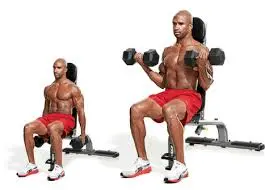
- Place your feet shoulder-width apart and flat on the floor while sitting upright on a sturdy chair (without utilising the back support).
- You can do with either a dumbbell or not.
- Place your hands on your thighs.
- Lower your hands back to the beginning position after bending your elbows to bring them closer to your shoulders.
- Either one arm at a time or both at once, repeat 8 to 15 times.
- Next, while performing this exercise, hold a small water bottle or an unopened food can in each hand. Next, try standing up and performing bicep curls.
Seated upright rows

- Place your feet shoulder-width apart and flat on the floor while sitting upright on a sturdy chair (without utilising the back support).
- Place your arms at your sides, straight.
- As you lift a shopping bag onto a table, bend your elbows up and out to the sides until your hands are just below your shoulders.
- Throughout the workout, maintain a relaxed posture in your shoulders and neck.
- Go back to where you were.
- Either one arm at a time or both at once, repeat 8 to 15 times.
- Next, while performing this exercise, hold a small water bottle or an unopened food can in each hand. Next, try standing up and performing upright rows.
Chair dips

- Place your feet flat on the floor, shoulder-width apart, and take a seat on a sturdy chair (preferably up against a wall).
- So that your fingers can grasp the chair seat, place your hands on the front edge of the chair.
- Keeping your knees and hips bent at a 90-degree angle, shuffle your bodyweight forward and step both feet a few inches away from the chair.
- Using your arms, raise your body off the chair.
- Bend your elbows and lower your buttocks a few inches off the chair.
- To raise your body back up so that your bottom is level with the chair, straighten your arms.
- Do this eight to fifteen times.
- Next step: You can sink your bottom lower and bend your elbows more as you gain strength. To increase the difficulty of the workout, you can also extend your legs.
Wall push-ups

Stand one arm’s length away from a wall and face it.
At shoulder height and somewhat wider than your shoulders, place your hands flat on the wall.
- Lean your body toward the wall while bending your elbows, then straighten your arms and push yourself back to the starting position.
- Throughout the exercise, maintain a straight back and knees while keeping your feet flat on the ground.
- Do this eight to fifteen times.
- The next step is to use a lower surface, like a table or kitchen worktop, which increases the effect of gravity and makes the exercise more difficult.
The benefits of strength training
Strengthening our muscles through strength training makes it easier for us to perform daily tasks like carrying heavy groceries. As we age, it helps slow down the loss of muscle and bone. Additionally, it enhances our balance, lowering the likelihood of falls.
In addition to improving mental health, including anxiety and depression, maintaining strong muscles can help reduce the risk of heart and circulatory diseases.
FAQs
Which exercise is best for strength at home?
The most successful at-home strength training includes compound, multi-joint movements using body weight, resistance bands, and/or dumbbells, 20-30 minutes 3-5 times per week. Build muscle with effective routines that target major muscle groups using exercises like squats, pushups, lunges, planks, and rows, emphasising controlled and consistent form.
Best Home-Based Strength Training Techniques
Bodyweight Training: Excellent for beginners, no equipment necessary for exercises such as planks, squats,s and pushups.
Resistance Bands/Tubes: Cheap, versatile, constant tension, often used for rows or pull-aparts.
Dumbbells: Great for targeting specific muscle groups, like shoulder presses and bicep curls.
Kettlebells: Dynamic and ergonomic movements for better functional strength.
Essential Exercises for Home Workouts
Lower Body: Squats, lunges, glute bridges & calf raises
Upper Body: Push-ups (or variations), rows with dumbbells/resistance bands, shoulder press, es and bicep curls.
Core: Planks, abdominals, crunches, mountain climbers
Suggested Routine Format
Warm-up: Do some dynamic moves like arm circles or knee hugs.
Training: 1-3 sets of 15-20 reps on bodyweight exercises, or until muscle fatigue on weighted exercises.
How often: 2-3 times per week to start, but increase to 5 for best results.
Tips: Keep the core engaged, maintain a consistent form, and use a wall or chair for support if needed.
What are the 7 types of strength?
In the fitness world, there are seven types of strength they are: Agile, Endurance, Explosive, Maximum, Relative, Speed, and Starting strength. These categories describe how muscles produce force in a variety of situations, from rapid movements to heavy lifting, enhancing overall athletic performance and physical longevity.
Agile Strength is the ability to slow down, change direction, and accelerate again with control and stability.
Strength endurance: The ability of muscles to repeatedly exert force for a long duration without fatigue (e.g., training with many repetitions).
Explosive strength: The ability to produce maximum force in a minimum amount of time (jumping or throwing).
Maximum Strength: The maximum force a muscle can exert in one effort, usually tested with a 1-rep max (1RM) in compound lifts.
Relative Strength:h The amount of force produced in relation to body weight. Often used to determine how strong someone is relative to their size.
Speed Strength: The ability to generate force rapidly. Focus on moving lighter weights rapidly.
Starting Strength: The capacity to produce force instantaneously from a dead stop, against inertia, with no prior momentum.
Training Approaches to These Strengths
Maximal/Relative: 90-100% 1RM, low reps (1-4), long rest.
Explosive/Speed: Olympic lifts, high velocity, plyo
Endurance: Low intensity, high volume
Agile: Lateral shuffles, agility ladders, farmer walks.
How should a beginner strength train?
For a total of three rounds, do ten repetitions of each exercise. On upper-body days, for instance, you would perform each exercise ten times, followed by two more rounds.
How to gain strength fast at home?
You can begin with a set of basic exercises like planks, squats, and push-ups. You can increase your sets and/or repetitions as you gain strength. For the first few days of strength training, for instance, begin with ten push-ups. Next, try to complete two sets of ten push-ups.
How often should I do strength training?
At least twice a week, perform strength training exercises for each of your main muscle groups. Use a weight or resistance level heavy enough to exhaust your muscles after 12 to 15 repetitions, and try to complete one set of each exercise.
What is 5 4 3 2 1 strength training?
A progressive exercise technique called 5-4-3-2-1 strength training involves reducing repetitions while raising resistance or intensity. For instance, you could complete five reps with a smaller weight, four with a higher weight, and finally one difficult rep.
How do I strength train at home?
Try bodyweight exercises (squats, pushups, planks) or some equipment like resistance bands and dumbbells. Work for at least 2 strength workouts per week. You can get a great strength workout at home. Focus on compound movements that work multiple muscles l, like lunges, rows, and glute bridges. Begin with 1-3 sets of 10-12 reps, increasing the weight or intensity over time to continue challenging your muscles.
No Equipment Core Bodyweight Exercises
These exercises build functional strength using your own body weight.
Squats – Good for legs and glutes. Sit back as if in a chair. Keep your back straight.
Push-ups work the chest, shoulders, and triceps. For an easier version, use your knees or a wall.
Glute Bridges: Great to target glutes, back, and hamstrings without any equipment.
Plank: A must-do exercise for building core stability and abdominal strength.
Lunges (or Side Lunges) – Build leg strength and improve balance.
Tricep Dips. Use a solid chair or the floor to work the back of the arms.
Supermans: Lie on your stomach and lift your arms and legs to strengthen your lower back.
Home Improvements You Can Do With Little Equipment
Resistance Bands – Perfect for resistance on exercises such as rows, bicep curls, and shoulder presses.
Dumbbells/Kettlebells: Perfect for compound lifts like the dumbbell floor press (chest), goblet squats, or overhead presses.
Household Items: If you don’t have weights, use filled water bottles, a backpack,s or soup cans to add resistance.
Effective At-Home Routine Rules
Warm-Up (5-10 mins): Light jogging in place, arm circles, or jumping jacks to get the blood pumping.
Workout (20-30 mins): Practice complex movements. Get the most out of your time with a circuit approach (moving from one exercise to the next with little rest).
Cool Down (5-10 mins): Gentle stretching to ease muscle tightness.
Keys to Success
Progressive Overload: As you get stronger, add more reps, more sets, shorter rest periods, or lift heavier weights.
First Form: Watch online tutorials to learn the right form and prevent injury.
Frequency: 2+ days per week with recovery days in between.
Variety: Switch up your exercises every few weeks to keep training fresh and challenging.
Will strength training lower blood sugar?
Yes. Weight lifting helps lower blood sugar levels both immediately and over the long term by improving insulin sensitivity and increasing glucose uptake by muscles. Muscles can use blood sugar for energy, and it also creates long-term storage capacity. So the blood sugar control improves for up to 24 hours after a workout.
Can I strength train every day?
You can strength train every day, but it’s generally not recommended for optimal results or safety. Muscles take 48 hours to recover,r so training every day should be limited to alternating muscle groups (upper body, lower body) to avoid burnout. Training hard and often for the entire body can lead to injury, overtraining, and fatigue.
What is the best diet for strength training?
The optimal diet for strength training emphasises high protein intake for repairing muscle, complex carbohydrates for energy, and healthy fats for hormone production. Key staples are chicken, eggs, fish, tofu, nuts, and whole grains, with meals timed around workouts to maximise recovery.
Core Dietary Principles
Protein Need: Needed to repair muscle damage and build new muscle tissue. Try to eat consistently throughout the day.
Calorie Surplus: For substantial muscle growth, it’s usually necessary to consume more calories than you expend, but emphasise nutrient-rich foods over sheer quantity.
Carbohydrates – Supply the energy required for high-intensity training. Replenish muscle glycogen stores.
Hydration: Water intake is important.
References
- Cronkleton, E. (2019, September 5). How to get a Full-Body Strength Training workout at home. Healthline. https://www.healthline.com/health/exercise-fitness/strength-training-at-home
- Cultivating Health. (2026, April 20). 3 simple exercises to start resistance training at home or in the gym to build strength | Cultivating Health. cultivating-health. https://health.ucdavis.edu/blog/cultivating-health/3-simple-exercises-to-start-resistance-training-at-home-or-in-the-gym-to-build-strength/2025/12
- Davis, N. (2026, January 3). 30 moves to make the most of your At-Home workout. Healthline. https://www.healthline.com/health/fitness-exercise/at-home-workouts#beginner-routine
- How to get a Full-Body workout at home without any equipment. (2025, October 28). TODAY.com. https://www.today.com/health/strength-training-exercises-your-home-workout-no-gym-needed-t192702
- Kamble, S. (2024, April 19). The best strength training exercises for beginners. GNC India. https://www.guardian.in/blogs/livewell/the-best-strength-training-exercises-for-beginners
- Physiologist, J. H. C. E. (2026, March 13). Strength exercises. British Heart Foundation. https://www.bhf.org.uk/informationsupport/heart-matters-magazine/activity/strength-exercises
- Website, N. (2024, March 5). Strength exercises. nhs.uk. https://www.nhs.uk/live-well/exercise/strength-exercises/