Seated Hip March Exercise
Introduction
The Seated Hip March Exercise is a simple and effective movement that helps strengthen the hip flexors, core muscles, and thighs while improving balance and coordination.
For people who are recovering from an injury or have restricted movement, seated marches are very helpful.
Seated marches can be made easier or more difficult in a few easy ways.
Have you ever had the sensation that your hips are getting tighter during an extended meeting? Or if you’re sitting at your desk and need a small “movement snack”? You might be able to solve some or all of your difficulties with seated marches.
In addition to increasing hip flexibility and range of motion, seated marches are a straightforward, hidden workout that works your quadriceps, core, and hip flexors, preventing and treating stiffness and joint and muscle discomfort.
Learn more about seated marches here, along with how to adapt the workout to your own needs.
What are seated marches?
The lower body muscles, especially the hip flexors, are the main focus of low-impact exercises like seated marches. This exercise is frequently advised for people who wish to be physically active but have mobility or balance problems or are healing from an injury.
What muscles do seated marches work?
Several lower-body muscular groups are targeted by seated marches, especially the following:
Hip flexors. These muscles are found at the front of your hip and help elevate your thigh toward your chest. The iliopsoas is the main hip flexor used in seated marches.
Quadriceps. The quadriceps, which are found at the front of your thigh, assist in lifting your leg and extending your knee.
Also, certain muscles might be used less:
The rear of your leg and buttocks are home to your hamstrings and glutes. During seated marches, these serve as a stabilizing force when you move your opposing leg.
Calves (soleus and gastrocnemius). These muscles may slightly tighten, especially when you lift your heels off the ground or push through your feet.
Benefits of seated marches
There are several advantages to seated marches, including:
- Increasing the strength of the lower body
- Increasing mobility
- Strengthen core muscles
- Beneficial to the cardiovascular system (when done quickly)
- helping in the recovery from surgery or trauma to the lower body
- Boosting stability and balance
These benefits facilitate daily activities such as getting out of bed, walking, running, climbing stairs, getting in and out of a car, bending down, and carrying objects from the ground, and maintaining a comfortable posture.
Another advantage is that you can covertly do seated marches whenever you’re seated, whether you’re traveling, working at a desk, or doing any number of other sedentary activities.
To do seated hip marches:

- Elevate one knee toward the ceiling while seated comfortably in a chair.
- Hold your knee as high as it feels comfortable for a short while.
- Return your foot to the floor with ease.
- You may be using your core and hip muscles throughout each repeat.
Seated Hip March Modifications:
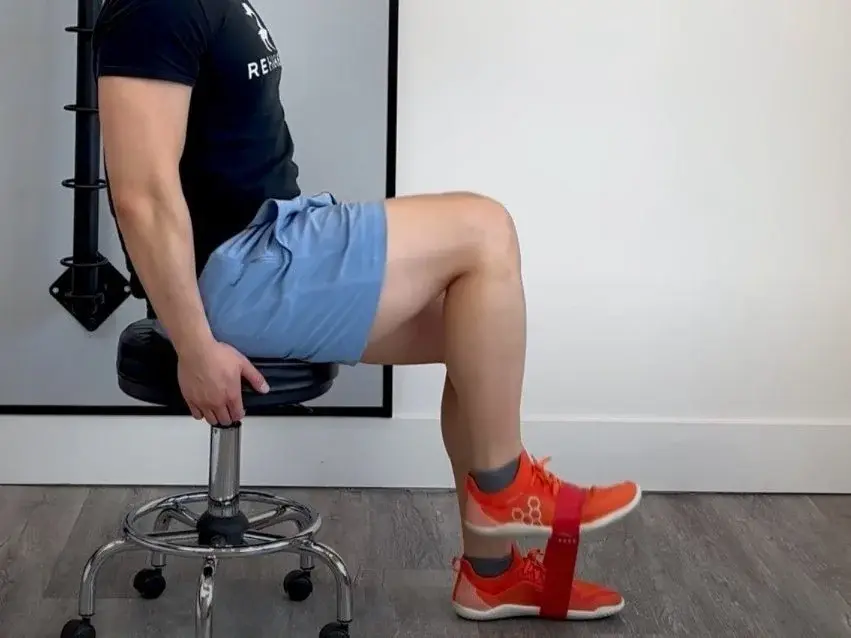
- Preparation: Sit upright on the front edge of a sturdy chair with feet flat on the floor, with a neutral spine. Wrap a resistance band around your feet or your thighs, slightly above your knees.
- Brace: Engage your core muscles to stabilize your torso.
- March: Gradually raise one knee towards your chest while resisting the pull of the band.
- Hold: To increase engagement, hold the lifted position for 1 to 2 seconds. Return your foot to the starting position slowly and gently.
- Alternate with the other leg. Aim for 2-3 sets of 10-15 repetitions per leg.
FAQs
What muscles do hip marches work?
Several lower-body muscle groups are targeted during seated marches, especially the hip flexors. Your thigh can be raised toward your chest with the support of these muscles, located at the front of your hip. The iliopsoas is the main hip flexor used in seated marches.
Can hip lifts help with lower back pain?
A useful, low-risk method to enhance hip extension and relieve low back pain associated with extended sitting and “stuck” hips is to perform hip flexor stretches.
Are marches a good exercise?
Marching is a flexible workout that enhances coordination, hip strength, and core stability. It works well for a variety of people, from those in early-stage rehabilitation to older persons working on balance and walking confidence.
What is seated marching good for?
Seated marching is a super accessible, low-impact activity that develops lower-body strength, increases cardiovascular circulation, and enhances core stability without putting stress on the joints. It’s a perfect movement for seniors, beginners, or those recovering from injury.
Strengthens the lower body: targets the quadriceps, hamstrings, and, most importantly, the hip flexors. These muscles play a role in everyday activities like climbing stairs and getting up.
Enhances Circulation: Helps promote healthy blood flow through the legs and reduces stiffness, which is very beneficial for those with sedentary lifestyles.
Engages the Core: Makes you sit up straight and hold your abdominal muscles tight, which builds core strength and improves posture.
Joint Friendly: Offers the benefits of standing or walking without stressing your knees and lower back.
What are the benefits of the marching exercise?
Marching is a versatile low-impact activity that strengthens the lower body, engages the core, and promotes cardiovascular health. Performed standing or sitting, it is a safe way to improve balance, joint flexibility, and coordination with little stress on the knees and back.
Advantages of Marching
Strengthens Lower Body & Core: Lifting your knees involves your hip flexors, quadriceps, and abdominal muscles, which are beneficial for everyday activities like climbing stairs and standing safely.
Improves Balance and Stability: Marching improves proprioception (body awareness) and pelvic stability by shifting weight from one foot to the other, which can help prevent falls.
Boosts Circulation & Heart Health: Marching gets your heart pumping and increases blood flow throughout your body.
Supports Joint Health: The controlled, repetitive motion of cycling helps preserve the mobility of your hip, knee, and ankle joints without the high impact of running.
Very Easy to Use: No equipment required, and can be safely adapted for any fitness level, including seated marching for seniors or injury recovery.
Why are marches important?
Marching develops immediate obedience, physical coordination, and unit cohesion. In the military and law enforcement, synchronized movement allows large groups to move efficiently, respond instinctively to commands, and develop a deep sense of camaraderie. But not just in operations, it is a powerful symbol of readiness and pride.
1. Military & Defense
Discipline & Muscle Memory: Marching teaches you to react instantly to commands. In high-stress environments, soldiers learn to react before they think. This is very important.
Efficiency: It is still the most efficient way to move large numbers of troops over long distances, saving energy and keeping formations.
Morale: Synchronised movements and chants in time create esprit de corps, uniting people as one supportive group.
2. Education & Youth Development:
Teamwork March-pasts are used to teach students co-operation and synchronized movement in schools and scouting programs.
Focus & Respect: Specific drill commands help students develop an increased sense of responsibility, respect for authority, and improved physical coordination.
3. The Protests and the Community
Social Cohesion: Marching bands are a living example of teamwork in a community and require a great deal of cooperation and discipline.
Civil Action: Marches and rallies bring people together physically to safely express grievances, raise public awareness, and build solidarity in large groups.
4. Fitness and Physical Health
Mobility: Marching in place is a functional exercise that improves balance, leg mobility, and cardiovascular health.
Fall Prevention: Regular marching exercises activate core and leg muscles, which are widely known by health professionals to help reduce fall risks in older adults.
What are the three types of marching?
Marching can be done in three main ways: military style, corps style, and traditional style. The earliest marching bands were traditionally military bands. These bands typically use percussion, woodwinds, and brass as their instruments.
Is marching a better exercise than walking?
Approximately 304 kcal are burned during an hour of regular walking at 5 km/h. Marching in place for an hour burns about 258 kcal. That is a 15% difference, which is real but not deadly. One requirement is that you must be moving, rather than just shifting your weight.
Can hip rotation help with lower back pain?
Research shows that increasing hip rotation and extension can lessen lumbar spine strain and enhance functional movement patterns. Targeted hip mobility and strengthening exercises are a beneficial part of low back pain rehabilitation programs, according to clinical data.
What are the signs of weak hips?
Weak hips set off a chain of compensations throughout the rest of your body. The most common signs and symptoms are chronic pain in the lower back or knees, knees caving inwards when squatting, difficulty climbing stairs, and an uneven walking pattern (hip drop).
Here are some telltale signs and a simple at-home test to check your hip strength:
6 Signs Your Hips Are Weak (Above)
Lower Back & Knee Pain: When your hip stabilizers fail, your lower back and knees take on the extra load and overcompensate, resulting in chronic aches.
Knee Collapse: When you run, squat,t or lunge, your knees bow inward (valgus collapse).
Uneven walking pattern: When you walk, your pelvis drops to one side, or you lean heavily over each foot as you plant it (called a Trendelenburg gait).
Trouble with Stairs or Chairs: Experiencing a lot of fatigue, or having to use your hands to push yourself up when getting out of a chair or going up stairs.
Balance Problems: Difficulty standing comfortably and stably on one leg.
No Progress in Leg Workouts: Not being able to go heavier in lunges, deadlifts, or hip thrusts, or even keeping good form.
The At-Home Hip Flexor Assessment
Do this movement to know how strong your hip flexors are in a snap.
Sit on the floor with the lower back flat against the wall.
Lift the opposite foot slightly off the ground and bring one thigh up towards your chest.
Hold this position for at least 15 seconds. If you can’t keep the leg up or you get cramping, it’s a sign of weakness.
Does marching strengthen legs?
It works your core, hip flexors, and quadriceps. To a lesser degree, it also engages the glutes and hamstrings. Additionally, marching improves strength and balance and is a useful recovery exercise for ankle and knee diseases.
References
- Global Health Spine and Laser Center – Exercise. (n.d.). https://ghspineandlasercentre.com/exercise/seated-hip-march
- Seated March. (n.d.). [Video]. Hingehealth. https://www.hingehealth.com/gb/en/resources/articles/seated-marches/
- Seated workout demo. (2021, November 17). Arthritis Foundation. https://www.arthritis.org/health-wellness/healthy-living/physical-activity/getting-started/your-exercise-solution/combined-movements/seated-workout
- Song, D. (2023, January 10). Seated Hip March — rehab hero. Rehab Hero. https://www.rehabhero.ca/exercise/seated-hip-march
- White, A. (2025, April 20). 3 ways to do a sitting abductor exercise – WikiHow. wikiHow. https://www.wikihow.com/Do-a-Sitting-Abductor-Exercise