
Gomukhasana (Cow Face Pose)
What Is the Gomukhasana (Cow Face Pose)?
Gomukhasana (Cow Face Pose) is a seated yoga posture that deeply stretches the hips, thighs, shoulders, and chest. Named for its resemblance to a cow’s face, this pose helps improve posture, enhances flexibility in the lower body, and releases tension in the upper back and shoulders.
This position provides several opportunities to play with the body’s symmetry. Take note of the difference in sensation between the right and left knees when you cross one over the other. In a similar vein, you may quickly determine whether one shoulder is tighter than the other by looking at the arm posture.
In Gomukhasna, you should also be mindful of the length and posture of your head, neck, and back. You can work on lengthening the spine from the base of your neck to the top of your head. Students often bend their necks and tilt their heads sideways when placing their upper arms close to their faces. Remember to maintain a straight spine.
Which Muscles are Used in the Gomukhasana (Cow Face Pose)?
- Rotator Cuff Muscles
- Pectoralis major and minor
- Latissimus dorsi
- Rhomboids
- Trapezius
- Biceps
- Triceps
- Forearm Muscles
- Gluteus maximus, medius, and minimus
- Hip flexors
- Adductors
- Quadriceps
- Hamstrings
- Calves
- Core muscles
- Erector Spinae
Benefits of the Gomukhasana (Cow Face Pose):
- Improves the alignment of your spine and overall posture.
- Stretching the intercostal muscles boosts lung capacity.
- Enhances the capacity for both diaphragmatic and abdominal breathing.
- It strengthens the muscles in your spine, shoulder joints, triceps, thighs, hips, and chest.
- Improves stiff shoulder suppleness.
Preparatory Poses for the Cow Face Pose (Gomukhasana)?
- Baddha Konasana (Bound Angle Position)
- Garudasana (Eagle Position)
- Supta Baddha Konasana (Reclining Bound Angle Position)
- Supta Virasana
- Supta Padangusthasana
- Upavistha Konasana
- Virasana
- Sun Salutation (Surya Namaskar)
- Baddha Konasana (Bound Angle Position)
- Dhanurasana (Bow Position)
Video of Gomukhasana (Cow Face Pose)
How to do a Gomukhasana (Cow Face Pose)?
- Start with Dandasana, or the staff posture.
- Bending the right knee is necessary. After flowing behind your right knee, move your left foot to the outside of your right hip.
- You have grounded your sitting bones.
- Relax your spine while breathing and extend your arms to the sides, palms facing front.
- Invert your right shoulder, palm towards the wall behind you, and thumb pointing down.
- Bend the elbow and reach down for the right fingers, hooking them together if they are within reach.
- Your right knee is now positioned on top of your left elbow, which is now facing upward.
- Squeeze your shoulder blades gently into your back ribs while stretching your upper body.
- Breathe deeply a few times.
- Remember to swap your arms and legs. Regardless of which knee is on top, the elbow on the other side is pointing up.
Following poses for the Gomukhasana (Cow Face Pose)?
Stretch your legs out in front of you after completing Gomukhasana to help with foot realignment.
After that, extend your legs, shoulders, hips, and lower back in Seated Forward Bend Position(Paschimottanasana).
There are several techniques to do gomukhasana. While sitting in Gomukhasana (Cow Face Position Variation Side Twist), you can do the pose with your arms in Gomukhasana (Cow Face Position with Eagle Arms), with your upper body reaching for the ground with your face (see Cow Face Position Eagle Arms Forward Twist), or with side bends. With these variants, the arms and hips will be considerably more exposed.
- Purvottanasana (Upward Plank Position)
- Paschimottanasana (Seated Forward Bend)
- Dandasana (Staff Pose)
- Ardha Matsyendrasana
- Bharadvajasana
- Garudasana
- Marichyasana III
- Padmasana
- Paschimottanasana
- Upavistha Konasana
What are some beginner’s tips for Gomukhasana (Cow Face Pose)?
- Start on all fours, cross your legs, and if you have trouble getting into the posture, bring your left knee to the inner of your right knee.
- Get on your hands and knees and move your left knee to the underside of your right knee if you have trouble entering the posture. Do not forget to keep your spine long.
- You can maintain your lower leg out in front of you or attempt a different hip-opening posture, such as the Pigeon pose.
- Just point your fingertips at one another, hold onto your top, or, if they don’t meet, use a strap. If you can’t reach both hands at the same time, use your upper hand to grab the strap with your lower hand.
Breath Awareness in Gomukhasana (Cow Face Pose)
Bring your feet deep into the posture and inspire and cross your legs to lengthen your spine in Gomukhasana. Stretch your arms past yourself while holding your palms and then releasing the other arm to re-inspire. With each breath, stretch deeper into the pose and release the body’s attachment to the inspiration.
Variation of Gomukhasana (Cow Face Pose)?
To maximise the benefits of the gomukhasana practice, try these tweaks or variations:
- Position your arms in front of you, on the ground, or on your knees to offer support while moving. Another approach is to pray in an adjusted position, hands behind the back.
- Keep your knees off if their stiffness prevents you from massaging them on one another.
- If you have tight hips, use them to balance your posture. The off-the-floor side can be effectively promoted with a blanket.
- If your legs are too large, practice this exercise with one leg straight in front of you and the other bent over the top, with your heel near your opposite hip.
- For a more modern take on Gomukhasana, you can fold around and direct your breasts down to your thighs. It will extend your hips, triceps, and shoulders significantly.
- In this posture, twisting forward lengthens the stretch. As a result, instead of utilising your knees, rest your weight on your sitting bones. Come out as you inspire. Sit on a block to give your legs more space to enter the posture and to help guide your lower back into a neutral position.
- If you have difficulty holding your hands, a strap might help you reach further.
The following well-known versions of the yoga pose are based on the Cow Face Position (Gomukhasana):
- Shoelace Position
- Cow Face Position Arms Close Up
- Half Cow Face Position Variation Forward Bend
- Cow Face Position with Eagle Arms
- Half Cow Face Position Variation
- Shoelace Position Variation Forward Bend
- Revolved Shoelace Position
- Cow Face Position Variation Side Stretch
- Cow Face Position Straps
- Cow Face Position Eagle Arms Forward Bend
What are the Types of Cow Face Pose?
- Tied Cow Face Position (Baddha Hasta Gomukhasana)
Tied Cow Face Position (Baddha Hasta Gomukhasana)
What is the Tied Cow Face Position?
The Sanskrit word Baddha Hasta Gomukhasana (Tied Cow Face Position) translates to “Teased Cow Face Position.” Baddha means knotted, Hasta means arm, Go signifies cow, and Mukh represents the face, according to Baddha Hasta Gomukhasana.
How to Perform Tied Cow Face Position?
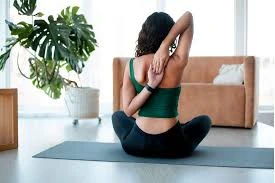
- Twist your left leg while sitting in the asana position, with the left foot on the floor above the right knee. After bending and twisting the right leg, the right heel should rest on the floor near the left buttock. Position the right knee to rest on the left. Stretch your palm over your head, then fold it and push it on the back of your right arm. Starting at the bottom, extend your left arm past your back. Hold both hands together and extend your fingers.
- Keep your head, neck, and spine straight while practicing the asana. Instead of applying pressure on the inside of the elevated arm, place it on the back of the head. Take deep breaths, relax, and close your eyes.
- To release from the asana position, take a deep breath and place your hands at your sides. Your lower leg should be facing you. Return to a seated position by adjusting the opposing leg. Exercise on the other side.
What are the Modifications in Cow Face Pose?
Let’s reverse this position or look for alternative, more straightforward solutions:
- A high-quality blanket placed under the buttocks can help reduce hip and lower back discomfort.
- To make it simpler to overlap your thighs, drop your knees, and sit on a block underneath.
- If your elbows aren’t strong and flexible enough to keep your palms behind you and interlocked, a yoga elastic band or strap will help.
- The Cow Face Pose requires balance on both sides of the body; thus, alignment is essential. Some positions, such as gomukhasana, can help balance the two sides of the body; thus, it is vital to train on the weaker side.
- Hold your palms together behind your head to keep it from falling. Make sure the chin is aligned with the chest and collarbone.
- Slowly fold each leg independently, taking care not to overlap the thighs. After several repetitions, move on to the complete position, starting with just one leg and one elbow folded.
Contraindications for the Gomukhasana (Cow Face Pose):
Avoid striking the cow face posture in the following scenarios:
- If there was injury to any soft tissues, including muscles, ligaments, or tendons.
- If you have a ripped thigh,
- If your haemorrhoids, often known as piles, are bleeding,
- If you’ve been diagnosed with spine arthritis, sometimes called spondylitis,
- In the event that your shoulders are frozen, aching, or uncomfortable
- If you are experiencing knee issues
What Common Errors Occur in Cow Face Pose?
- Maintain a stance that is more subdued than perverse.
- Do not clasp your hands together.
- When you hold your hands together, your ribs should not be visible.
- Instead, try lowering your tailbone to the ground and stretching your lower back.
- When you bend your upper body, round your back as well.
- Spread your collarbones instead.
FAQs
What are the benefits of the cow face pose?
Extends your intercostal muscles, which expands your lung capacity. improves the ability to breathe via the diaphragm and the abdomen. enhances the suppleness of tight shoulders. enhances the strength of your triceps, thighs, hips, chest, shoulder joints, and spine.
Why am I unable to achieve the cow face pose?
People with tight upper back, shoulder, and chest muscles may find it difficult or impossible to completely extend their arms and hands when they initially approach Cow Face. In this case, it is best to alter the stance.
Is Cow Face Pose a hip opener?
The piriformis, gluteal, hamstring, and thigh muscles are all stretched in Cow Face Pose, a deep hip opening. The pelvis needs to be properly adjusted to avoid disturbing the pelvic rhythm because the legs are not equal.
What is the spiritual purpose behind the Cow Face Pose?
This is similar to striking a balance between creation (the root) and understanding what this creation means in order to go forward on the spiritual path (the crown).
References:
- EkhartYoga. (2021, March 31). How to do Cow Face Pose or Gomukhasana – Ekhart Yoga. Ekhart Yoga. https://www.ekhartyoga.com/resources/yoga-poses/cow-face-pose
- Gomukhasana (Cow Face Pose) Modifications | Tummee.com. (n.d.). Tummee.com. https://www.tummee.com/yoga-poses/cow-face-pose/modifications
- SR, V. (2024, August 21). How to Do a Cow Face Yoga Pose. WebMD. https://www.webmd.com/fitness-exercise/how-to-do-cow-face-yoga-pose
- Mandial, D. (2024, May 22). Gomukhasana (Cow Face Pose) – Step-by-Step Guide, Benefits and Precautions. Truemeds. https://www.truemeds.in/blog/gomukhasana-step-by-step-guide-benefits-and-precautions
- Sorathiya, D. (2024, October 2). Gomukhasana (Cow Face Pose) – Benefits, How to do? Mobile Physiotherapy Clinic. https://mobilephysiotherapyclinic.in/gomukhasana-yoga-pose/