
12 Best Calf Workouts
Introduction
Strong calves are essential for balance, stability, and power in walking, running, and jumping. The best calf workouts target the gastrocnemius and soleus muscles to improve strength, endurance, and definition.
Calf Muscles
Strong calf muscles are necessary for anybody, not just professional football players. Strong lower-leg muscles make movement easier and improve your mood.
Gastrocnemius Muscle
This powerful muscle at the back of your leg gives your calf its circular shape. It runs across to your heel rather than towards the back of your knee. It allows you to stand up straighter and improves your posture. It also enables you to mobilize yourself to walk, run, or jump.
It is a long and flat muscle that helps maintain bones and balance. It mostly comprises slow-twitch muscle fibres, which offer endurance rather than a burst of energy. Your body relies on slow-twitch fibres for most daily actions.
Plantaris Muscle
It is also known as an auxiliary muscle. It links the gastrocnemius and soleus muscles. Its primary job is to assist other muscles in operating properly, particularly around the knee and ankle.
These three muscles form the triceps surae.
So, why do they matter? Strong leg muscles can enhance your:
- Flexibility
- Posture
- Balance
Best Exercises for Calf Workouts:
Here are the greatest calf workouts for adding shape to your legs. Consider including intense cardio exercises, such as sprint and jump rope workouts, to help create stronger, more muscular calves. Such workouts induce micro-tears in the muscle fibre, causing the body to transfer blood and nutrients to the cells that require them, resulting in larger and stronger calves.
Jumping Jack
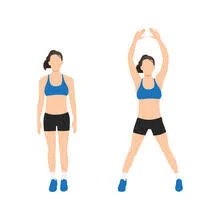
- Start with feet together on the floor.
- Keep your arm by your side.
- While clapping your hands overhead, leap and spread your legs wider than shoulder-width apart.
- Leap and put your hands and feet back where they were.
Seal Jump
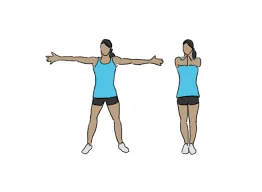
- Perform jumping jacks, but instead of bouncing your feet, stretch your arms out to the sides.
- After that, release a jump when you clap your hands together in front of you.
Seated Calf Raise (Toes Out)

- Start by taking a seat on the calf raiser.
- Place the dumbbells on your thighs.
- Place your foot on the block.
- You should have your toes turned out around 15 degrees and your knees bent 90 degrees.
- Next, extend your calves by letting your heels rest on the floor.
- Now, elevate your heels as high as possible while pressing the balls of your feet into the platform.
Seated Calf Raise (Toes Neutral)

- Start by taking a seat on the calf raiser.
- Place the dumbbells on your thighs.
- Place your foot on the block.
- You should have your toes pointing straight forward and your knees bent 90 degrees.
- Permit your heels to drop to the surface once your calves start to stretch.
Seated Calf Raise (Toes In)
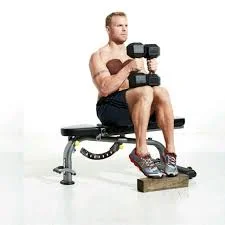
- Start by taking a seat on the calf raiser.
- Place the dumbbells on your thighs.
- Place your foot on the block.
- Your knees should be bent 90 degrees, with your toes turned 15 degrees inward.
- As soon as your calves begin to stretch, release your heels to the ground.
- Now, elevate your heels as high as possible while pressing the balls of your feet into the platform.
Single-Leg Calf Raise

- Start with one leg upon a block or step.
- Allow your body to fall to the floor while stretching your calf.
- Hold for one second before pressing the ball of your foot into the surface and elevating your heel.
- For two seconds, maintain the highest position.
Tiptoe Walk
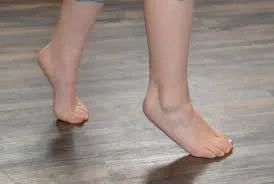
- Walk while standing on your tiptoes.
- Never let your heels contact the floor.
- If practicable, perform this calf exercise barefoot to maximise muscle activation.
Jumping Calf Raise

- Start by standing straight.
- Place your feet on the floor.
- Jump, but just utilise your calves to propel you up.
- Land lightly and absorb the power by lowering into a half squat.
- Attempt to land gently.
Standing Calf Raise

- Use a standing calf raiser or hold a dumbbell in one hand while standing on a block or step. For support, use your free hand to grab anything strong.
- When you lower your heels to the ground, your calves should feel stretched.
- The balls of your feet should be driven against the footplate while you contract your calves and lift your heels as high as possible.
- Maintain control of the decline during each repetition.
Bosu Ball Squat
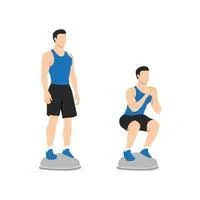
- Stand carefully on the ball and find your equilibrium.
- Slowly lower yourself into a squat while maintaining control.
- Gradually elevate yourself. That is one rep.
Farmer’s Walk
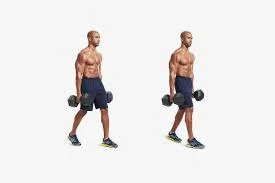
- Take a weight in each hand while standing upright.
- Keep your chest up.
- Pull back your shoulder blades.
- Do not weight on your thighs.
- Walk ahead. To better activate your calves, walk on your toes rather than choppy heel-to-toe strides.
Towel Stretch

- A hand towel is required for this stretching exercise.
- Sit with straight legs.
- Wrap a hand towel around one foot’s ball. Hold both ends of the cloth.
- Pull the cloth towards your body while keeping your legs straight. Hold this posture for 30 seconds. Then unwind for 30 seconds.
- Perform 3 times.
- Do the same opposite side.
Significance of calf strengthening exercises:
Exercises that strengthen the calf muscles can help with everyday duties and may also help treat and prevent several issues. Here’s more on the advantages.
Better balance. Calf muscles serve an important function in maintaining balance and preventing falls.
Enhanced mobility. By promoting effective mobility, calf strength enables you to engage in leisure activities and walk farther.
Injury prevention. Dr. Bullis says that having strong and flexible calves helps avoid common ailments such as Achilles tendonitis, calf strains, ankle sprains, plantar fasciitis, hamstring difficulties, and a variety of knee injuries.
A comfortable posture. Although there is no such thing as ideal posture, your calf muscles enable you to stand and move without fatigue.
Efficient circulation. Dr. Bullis says that calf muscles operate like a muscular pump to promote circulation.
Improved athletic performance. Running, leaping, and making quick direction changes all demand muscular calves.
Functional independence. If you have a powerful calf, you can do all of your everyday tasks. Maintaining strong calves can help you stay independent as you age by allowing you to carry out your daily tasks with ease and safety.
Calf-Building Sports:
Calves can be toned and strengthened through a variety of sports. For example:
Running, walking, and hiking
These are excellent calf-strengthening workouts, particularly when performed upwards. The more elevation, the more effort your calf muscles must put out.
Running sports
To reverse direction or accelerate rapidly, you must sprint, bounce, and push off your calf muscles in sports like basketball, tennis, and soccer. This makes them stronger over time.
Step class.
Any dancing lesson will work out your lower legs.
Swimming
Additionally, you won’t overstress your muscles and joints because it is low-impact. Swimming is a healthy approach to strengthen your calves, particularly if you are recuperating from an injury.
Aside from calf workouts, you should review your nutrition and physical activity.
Safety Guidelines for Calf Exercises:
Follow these guidelines to make your calf-strengthening workouts successful and safe.
Create a schedule. To gain strength and see results, repeat these exercises two or three times each week.
Stay hydrated. Drinking enough water throughout the day is essential for muscular function and flexibility. It also aids with joint cushioning.
Do not hurry. Move gently through each exercise to ensure proper body alignment. Then, descend back down for a leisurely four-count. Remembering quietly may help you stay concentrated and present.
Ask for assistance. If you’re new to working out, speak with a trainer or another fitness professional. They can check how much weight you may safely utilise. Whenever considering strength training, it’s normally suggested to do 8-12 repetitions of each exercise across one to three sets. Even though your muscles will be exhausted, you should be able to complete it. If not, you may need to modify your workouts or the weights you’re using to meet your fitness level and prevent injury.
Expand on your progress. Each of the two weeks, for example, raise your weight by 10% to 15%.
Be wary of previous injuries. Have you previously suffered a foot, ankle, or calf muscle injury? Check with your doctor before beginning an exercise that may reawaken a painful region. Certain workouts may not be appropriate for your health or physical condition.
Summary
Calf muscles that are in good shape are necessary for maintaining balance and posture, as well as avoiding injuries. A basic exercise that works your lower legs is the calf raise. Many sports, such as hiking, swimming, and tennis, may also provide excellent exercise. Seek counsel from your doctor and a fitness specialist at a gym to assure your safety.
FAQs
What is the greatest exercise for calves?
SIT-TO-STAND CALF RAISE.
TOE TOUCH FARMER’S WALK.
DUMBBELL CALF HOPS.
1-½ CALF RAISES.
SINGLE-LEG CALF RAISES.
SPRINTER CALF RAISE.
SPRINTER CALF JUMPS.
SINGLE-LEG STEP RAISES.
What exactly do weak calves do?
Weak calves may not offer adequate shock absorption, resulting in greater impact pressures on the feet and lower limbs, which can cause discomfort and damage.
Does walking increase the size of calves?
Going for walks as you become older is a great method to begin active without putting too much strain on your joints. A frequent stroll also prevents your calf muscles from growing huge and thick. Walking on an even surface might help you get slimmer calf muscles by keeping them from becoming larger.
Do squats strengthen calves?
Do squats work the calves? Squats work the calves, but only to a certain extent; if you want huge, muscular calves, you’ll need to do more than just squats! Focussing on your calves may assist improve your squat. For example, improving ankle mobility can aid in achieving higher squat depth.
What is an appropriate calf size?
Calf circumference also indicates proper muscle mass. It might suggest a decrease in muscle mass owing to inactivity. A measurement of greater than 31 cm is regarded as normal.
Referances
- Taylor, R. B. (2025, January 2). Best exercises for strengthening calf muscles. WebMD. https://www.webmd.com/fitness-exercise/strengthening-calf-muscles
- CSCS, D. O., & Tomko, J. (2025, March 13). The best exercises to build massive calf muscles. Men’s Health. https://www.menshealth.com/fitness/a27800284/best-calf-exercises/
- PharmD, J. C. (2023, August 31). Calf stretches and how to do them. https://www.medicalnewstoday.com/articles/calf-stretches