
Hip Adductor Strengthening Exercises
Introduction:
Adductor exercises target numerous small muscles in the inner thigh that are crucial for pulling the thighs together, maintaining balance and support, and ensuring proper hip alignment. The majority of people should only think about doing hip adductor exercises when they see the machine at the gym, but we’re here to change that.
Strengthening the adductor muscles is vital for increasing mobility and flexibility, improving stability, and preventing leg injuries. Strong abductors are essential for athletic performance, preserving mobility, and preventing injuries as you age.
What Exactly are the Adductor Muscles?
Your inner thigh consists of five muscles.
The adductor brevis, the smallest of the hip adductors, is a triangle muscle that sits after the adductor longus and before the adductor magnus.
Function: Hip flexion, External rotations.
Adductor Longus: It is a triangular muscle.
Function: Hip adduction, Flexion, Extension.
Adductor Magnus: It is the Largest muscle.
Function: Hip Extension, Flexion.
Gracilis: One of the weakest hip adductor muscles, located most superficially. It overlies the other adductor muscles.
Function: Hip internal rotations, flexion.
Pectineus: This is a short muscle.
Function: Hip flexion, adduction.
What Makes the Hip abductors and adductors Different?
Many individuals are confused about the distinction between hip abductors and hip adductors, although they serve opposing functions in the body. The thighs are opened away from the body by the hip abductor muscles, as was previously explained. In contrast, the hip adductors pull the thighs together in the middle of the body.
Advantages of Hip Adductor Muscle Exercises for Health:
The hip adductors are typically ignored when it comes to strength training, but this is a mistake. Groin injuries are a possibility if you don’t strengthen these muscles.
Hip adductor exercise has the following advantages:
Better Balance: Better Balance exercises help you improve your balance by keeping your body straight during unexpected lateral motions. Unilateral movement is used in several hip adductor exercises to target the small muscles and enhance balance.
Enhanced Rotational Power: Strong hip adductors enable our bodies to generate greater rotational power. These adductor muscles play a major role in supporting internal hip rotation, which is necessary for certain sports like baseball and tennis.
Boost Hip Extension: Hip extension is vital in some of the larger compound movements, such as squats and deadlifts. Including hip adductor exercises in your regular training program will enhance your lifts, raise sports performance, and make daily life simpler.
Reduce the Risk of Injury: A groin pull is a frequent ailment in both sports and average people. Strengthening and extending the adductor muscles might reduce your chances of getting this ailment.
Athletes, in particular, depend on this muscle group to help in explosive actions like jumping, sprinting, and rapidly moving from side to side.
Hip Adductor Strengthening Exercises
Stretching exercises for the hip adductor muscles:
Adductor Lunge Stretch

How to Do Stretching:
- Start with the lunge position.
- Kneeling on the floor.
- The outer shoulder should be brought to the inner of the lead knee as you bend forward.
- Then, while lunging ahead, allow your hips to slide forward.
- It’s done at home as well.
- You could see a stretch on the inner of the advancing leg.
- Hold for 5-10 seconds.
- Perform 10 to 12 repetitions.
Standing Lateral Lunge Adductor Stretch

How to Do a Stretch:
- Take a broad stance.
- Now, bend your knees and turn your hips to one side.
- Throughout the stretch, keep your posterior pelvis tilted.
- The opposing thigh may be affected by the stress.
- Hold for 5-10 seconds, then release.
- You may improve your holding time as you continue.
- Repeat this adductor stretch 4-5 times.
Butterfly Stretch

How to Do Stretching:
- Start with a sitting position.
- Legs are in an outward position.
- The right knee should be bent such that the soles of your left and right feet contact.
- The elbow rests on your knee.
- Keep your back straight.
- Your elbows can be lightly placed on the knees to exert slight pressure on the inner thigh.
- You may feel your groin being pulled and strained.
- Maintain the butterfly pose for 20–30 seconds.
- Release and repeat 2-3 times.
Adductor AIS Release

How to Do Stretching:
- Start in supine position.
- Place a resistance band over the foot.
- Then actively move your foot sideways.
- The foot should then be gently moved outward using the resistance strap.
- The adductors feel stretched.
- Hold for 5 to 10 seconds.
- Perform 8 to 10 repetitions.
Supine Wall Stretch

How to Do Stretching:
- Start in supine position.
- One leg raised against a wall.
- In order to keep your hamstrings stretched comfortably, move as close to the wall as you can.
- Keep your leg straight.
- After that, gradually split it open until the inside of your leg starts to expand.
- Hold for 15 to 30 seconds.
- Relax and repeat three times.
Standing Adductor Stretch

How to Do Stretching:
- Start by putting your feet about three feet apart.
- After that, shift the weight to one side while keeping your knee bent.
- A stretch will be felt on the inner of your thigh if you keep the opposing knee straight.
- Hold for 15 to 30 seconds.
- Relax and repeat on the opposite side.
Kneeling adductor stretch

How to Do Stretching:
- Begin by kneeling.
- Straighten your left leg to the side.
- Keep one leg on the floor.
- The inside portion of the left thigh was noticeably stiff.
- After 8–10 seconds of pause, release the stretch and assume the posture again.
- Repeat 8 to 10 times.
Half-kneeling adductor dips

How to Do Stretching:
- Start with your foot on the floor.
- The other leg remains on the ground, but one leg is raised.
- To the greatest extent feasible, extend your left leg out to the side.
- Maintaining your hands on your hips.
- Then drop down to your left leg and ascend.
- The tension may be felt in the inner thigh, especially on the right side.
- Repeat 8 to 10 times.
Frogger stretch

How to Do Stretching:
- Start by putting your forearms and knees on the floor and separating your knees and feet.
- Reposition the buttocks against the heels to feel the strain in the inner thighs.
- Hold for 10-15 times.
- Repeat 8 to 10 times.
Lateral squat

How to Do Stretching:
- Start with a standing position.
- Your feet should be apart.
- Squat down while extending the other leg to the side and maintaining the other leg straight.
- Drop as much as possible while maintaining a straight right leg.
- Hold for 10-15 sec.
- After that, return to the beginning position.
Crossover Stretch

How to Do Stretching:
- Start with supine lying.
- After that, cross your legs.
- Next, use your right leg to extend as far as you can.
- After that, repeat with the opposing foot.
- You can start gently and gradually increase your stride as you grow more comfortable with the action.
- Repeat it 5-10 times.
Seated Adductor Stretch

How to Do Stretching:
- Start with a sitting position.
- When seated, straighten your legs out to the side.
- To minimise joint pain, do not overuse this position.
- Many individuals find that merely sitting in this position provides an inner thigh stretch.
- Stay there for around 10 to 15 seconds. Breathe normally.
Reclining angle bound pose

For people who spend most of their days sitting, this is the ideal stretch.
How to Do Stretching:
- On the ground, assume a supine position.
- Bring your soles inward until their borders touch, bending both knees.
- Next, lower the knees to the ground.
- It could be beneficial to stretch the groin muscle.
- Hold for 10- 15 seconds.
- Repeat 3–4 times.
Squatting Groin Stretch

How to Do Stretching:
- First, take a standing position.
- Begin by squatting lightly until your knees are straight over your ankles and bent at a 90-degree angle.
- The hips may be expanded by placing your hands on top of your inner thighs and gently pressing outward.
- The inside of your leg will then feel stretched.
- Hold for 20-30 seconds.
Frog Squat With Arm Raise

How to Do Stretching:
- At a 45-degree angle, point your toes out while maintaining a shoulder-width distance between your feet.
- Keep your back straight and brace your core. This is where you start.
- Bend your knees.
- Next, lower your hips to the ground.
- Maintain your thighs parallel to the floor.
- Do 10- 12 reps.
Runner’s Lunge
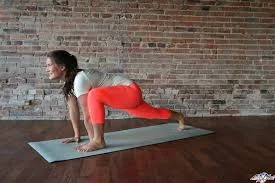
How to Do Stretching:
- Start with all four on the mat.
- Plant your fingertips softly into the floor while extending your right leg behind you, keeping the knee resting or slightly raised.
- You should point your right heel towards the back of the room.
- Advance your left foot till it aligns with your left hand.
- Keep your head up.
- Press your hips into the floor.
- Then go to the opposite sides.
Hip Adductor Muscle Strengthening Exercises:
Standing Leg Circles

How should it be done?
- Stand with your feet hip-width apart.
- Raise the left leg off the ground.
- While keeping your right leg balanced, draw a little circle with your left leg.
- Repeat 10 to 20 times.
- Note: If you have a balance difficulty, stand near a support that will assist you in keeping your body up by grabbing onto anything.
Side-Lying Hip Adduction

How should it be done?
- To elevate your leg off the floor, simply focus on engaging the hip adductor muscles.
- Start with supine lying.
- The higher leg should then stay straight as the other leg is lowered.
- After that, the upper leg raises it as high as you can.
- Slowly return to your starting location.
- Perform 10-25 reps.
Standing Side Leg Raise

How do I do it?
- This bodyweight exercise targets both hip adductors and hip abductors by maintaining an isometric grip on the opposite leg while in the air.
- Start with standing.
- Both legs should be apart.
- After that, raise your right leg.
- Hold for 4-6 seconds.
- After that, the left leg was elevated.
- Perform 10-12 reps.
- Note: To make this workout more difficult, strap ankle weights to each leg.
Sumo Squat

How should it be done?
- This squatting version targets the lower-limb muscular groups as well as the inner thighs.
- Maintain a straight back during exercises.
- Even though the sumo squat has a shorter range of motion than a standard squat, it is nevertheless a useful exercise that can be integrated into regular exercises.
- To accomplish this exercise, place your feet more than shoulder width apart and point them outward.
- Lower and lift your thighs till they are parallel to the floor after you have straightened your back and elevated your chest.
- Get back to where you started by pushing yourself through the ground.
Cross Scissors

How should it be done?
- This is an excellent exercise for simultaneously exercising the hip adductor and core muscles.
- Cross scissors are difficult to master because you must maintain a compressed stance throughout the manoeuvre.
- Maintain this posture by crossing your legs in front of you, requiring all of your stabilising muscles to contract.
- For this exercise, start in supine and brace yourself by placing your hands on the floor behind you.
- Lift your leg off the floor in front of you at a 30 to 40 degree angle while crossing the other leg over it.
- Your core muscles may be engaged throughout the action. In a semi-V “V” stance, shift your legs out to the sides and then bring them back closed while crossing the other leg across.
- Do 10-20 Reps.
Dumbbell Side Lunge

How should it be done?
- Carry a dumbbell to chest level.
- Stand with your shoulders hip-width apart.
- To ensure that your foot is securely planted on the ground and your thighs are parallel to the floor, take a large step to the side and lower your hip down and back.
- Apply pressure through your flexed foot to go back to the beginning position.
- Repeat 10-15 times.
Cable Hip Adductor

How should it be done?
- You may observe that ladies at the gym perform this exercise while males do not.
- It is important to remove the stigma that cable hip adductions are not primarily used; everyone should be performing this exercise to strengthen the adductors and lower the risk of injury.
- Before completing this exercise, make sure you’ve warmed up with some dynamic stretches. Then, start with less weight and more repetitions until you’re comfortable enough to raise the weight.
- Locate a strap attachment that may be fastened to the ankle closest to the pulley.
- The pulley should be positioned at calf level.
- Stand to one side of the pulley.
- Prepare yourself by pressing your hand against the machine in a safe spot that won’t pinch your fingers. Your active leg may be raised off the floor towards the pulley.
- Reach towards the centre of your body and drag your leg away from the pulley.
- Complete the prescribed number of reps.
- Exercise may also be performed using the same approach by connecting a resistance band to a permanent anchor point.
Seated Hip Adduction

- The only thing left to do when you sit is draw your thighs together, since the hip adductor muscles are isolated by the sitting hip adduction.
- After you’ve completed the larger complex movements like squatting, add the Seated Hip Adduction exercise to your leg day at the conclusion.
- While sitting in the machine, be sure your back is against the backrest.
- Make sure the breadth of the knee pads is comfortable so that you may stretch the inner thighs without overstretching the adductors.
- Set up a lightweight for the first time so you don’t overdo it.
- As you release your breath, squeeze your thighs together before your knees touch in the middle of your body.
- Slowly return to the original position.
- Complete the maximum number of repeats.
Standing banded adduction

How should it be done?
- Start with a standing position.
- Wrap a resistance band around the ankle.
- Start this exercise by standing erect and bringing a banded leg nearer your body’s midline until your inner thighs flex nicely.
- Controlfully release your leg back to the side.
- Do 10-20 reps.
Seated banded adduction

How should it be done?
- A resistance band should be wrapped around a strong anchor in order to perform the Seated Banded Adduction Exercise.
- Place yourselves on either side of the bench, backs to the resistance band and anchor point.
- The internal foot should be inserted via the resistance band, which is located exactly behind the knee. Give the leg permission to be drawn to the anchor point by the resistance band.
- When your adductor muscle is contracted, your leg will move closer to the centre of your body.
- Repeat this for each leg.
- Perform 2–3 sets of 12-15 repetitions.
When didn’t you complete this exercise?
- If your healthcare practitioner suggested that you rest.
- If you already suffer from knee and back discomfort.
- If your lower-limb bone has recently shattered.
- If you experience discomfort throughout this workout.
Summary
The muscles on your inner thighs that accelerate your legs towards the centre of your body are called adductors.
Their primary roles include maintaining stability throughout regular tasks and facilitating explosive actions such as jumping and sprinting in sports.
When training your adductors, warm up properly, increase resistance and range of motion gradually, and focus on muscle contraction to maximise effectiveness and reduce damage.
If you want to increase your hip muscle strength, mobility, or athletic performance, incorporating some adductor strengthening exercises into your workout routine might be beneficial.
FAQs
Why should you strengthen your hip adductors?
Adductors are essential for hip stability and pelvic rotational control, hence, they have applications outside ‘cutting’ sports. Long-distance running, for example, necessitates excellent hip and pelvic control.
How can the patient know if their hip adductors are weak?
The legs pointing outward during a squat may indicate hip adductor weakness, according to Laudner. This occurs when the opposing hip muscles are stronger than the hip adductors.
What is the reason for weakened hip adductor muscles?
It is caused by prolonged sitting. Osteoarthritis may induce muscular weakness.
Do weak glutes result in tight adductors?
Tight hamstrings and adductors can result from weak or limited glutes, causing conditions such as anterior knee soreness, ACL injuries, low back pain, hamstring strains, hip impingement, and ankle sprains.
Can the adductor muscles be worked by walking?
Walking not only has several health advantages, but it also works multiple distinct muscle groups. The quadriceps, hamstrings, calf muscles, and hip adductors are the main muscles used while walking.
What happens to a patient with weaker hip abductors?
Weakness of the hip abductors has been linked to shin splints and foot hyperpronation, or flat feet. A lower arch is the result of increased pressure on the inside of the foot caused by gluteus medius weakness.
How does the patient decide whether his adductors are tight?
The most frequent symptom of a tight adductor, sometimes referred to as a groin pull, is pain in the medial thigh where the strain is located. Acute injuries provide severe pain, but chronic conditions cause duller pain.
Referances
- Cscs, D. P. R. (2023, May 19). Hip exercises for building adductor strength and preventing injury. Healthline. https://www.healthline.com/health/adductor-exercises#bottom-line
- Prajapati, N. (2023a, January 16). Hip adductor muscles strengthening exercises: Benefits, How to do? Samarpan Physiotherapy Clinic. https://samarpanphysioclinic.com/hip-adductor-muscles-strengthening-exercises/#When_did_the_patient_not_do_this_exercise
- Valand, B. (2025, March 10). Adductor muscle exercises – Health Benefits, How to do? Samarpan Physiotherapy Clinic. https://samarpanphysioclinic.com/adductor-muscle-exercises/