
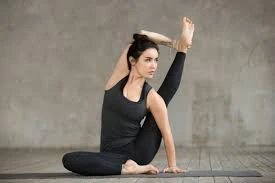
Compass Pose (Parivrtta Surya Yantrasana)
What is Compass Pose?
Compass Pose (Parivrtta Surya Yantrasana) is an advanced seated yoga posture that deeply stretches the hamstrings, hips, shoulders, and spine while improving flexibility and balance. It encourages spinal rotation, opens the chest, and helps build strength, focus, and body awareness.
This stance benefits the body both physically and spiritually, acting as a full-body workout. The English translation of the Sanskrit word Parivrtta Surya Yantrasana is “rotated solar instrument pose.” In this context, “revolved” refers to the twisted or revolved torso, and “solar instrument” refers to a compass.
The symbolic meaning of the compass posture is further explained by the fact that the body in this pose represents a compass that leads the practitioner closer to their physical and spiritual practices.
Muscle Work During Compass Pose:
- Arms Muscles
- Shoulders Muscles
- Middle Back Muscles
- Biceps and Triceps Muscles
- Core (Abs) Muscles
- Gluteus Muscle
- Hamstrings Muscle
- Hip Muscles
- Neck Muscles
- Pelvic Muscle
- Psoas Muscle
- Quadriceps Muscle
How to Perform?
- Start by positioning the right leg above the left while sitting in ardha padmasana.
- Raise your right leg and wrap your left arm around your shin, and your right arm over your right foot.
- Draw the right leg outside while gripping the foot with the right hand as you open your hips.
- Raising the right leg now, place the right knee over the right shoulder.
- Stretch the left arm behind the head and grasp the right foot with the left hand.
- Press the right hand to the ground beneath the right leg as you extend your right arm.
- Straighten the right leg upward with pointed toes and active arches by lifting the right knee from the right shoulder and grasping the foot with the left hand.
- Twist the neck and body to the left while reclining slightly to the right.
- Aim to see beyond the left triceps.
- To exit the pose, bend your right knee after holding it for three to five breaths. Change the leg position and repeat.
Benefits:
Makes the arms stronger:
The muscles in the shoulders, arms, and wrists are stretched when the body is balanced, and the arms are extended to grasp the raised leg. The arm muscles are toned and strengthened by it.
Increases the flexibility of the spine:
The back muscles are stretched by the torso and neck’s twisting motion and the preservation of the back’s integrity. It enhances the blood flow to all of the back muscles. Increasing the spinal column’s flexibility in the process.
Hip flexors are open:
A great hip-opener is Parivrtta Surya Yantrasana. It intensifies the hip stretch and stretches the hamstring and gluteus maximus muscles. It increases hip flexibility and opens the psoas muscles.
Make your limbs stronger:
Holding this stance completely tones the leg muscles. Ankles, calves, knees, and thighs are all stretched. When reaching the final position, even the arches are triggered. As a result, it strengthens the leg muscles and gets them ready for more difficult poses.
Strengthens the digestive system:
The body is stretched and twisted while the abdominal organs are massaged and squeezed. In the end, it increases blood flow to the digestive tract and increases the secretion of digestive fluids and enzymes. As a result, it makes digestion easier.
Stimulates the reproductive system:
The groins are opened, the pelvic floor muscles are stretched, and new blood is supplied to the reproductive organs by folding one leg, stretching the knee, and raising the other above the head.
Preparatory Pose:
- Head-To-Knee Pose (Janu Sirsasana)
- Standing Forward Bend (Uttanasana)
- Wide-Legged Forward Bend (Prasarita Padottanasana)
- Lizard Pose (Uttana Pristhasana)
Beginner’s Advice:
- Use a yoga strap if you find it too difficult to stretch your leg in the compass pose by holding the raised foot with a different hand.
- To extend the leg upward, put a strap around the foot and grasp it with your hand. This will lengthen the hand and enable the stretch.
Props and Modifications:
Beginners may find Compass Pose difficult; some adjustments make it easier:
Use of Props: One helpful tool is a yoga strap. To make extra room and gently progress into the pose without straining, place the strap around the foot of the outstretched leg.
Bent Knee: Maintain a bent knee rather than fully stretching the leg behind your head. This lessens the stretch’s intensity, which facilitates the pose’s stability and comfort.
Support for the Hips: Elevating the hips with a folded blanket or a yoga block might make it simpler to reach the extended leg and preserve correct posture.
Variations:
Standing compass pose:

Tadasana serves as the foundation for this advanced variant, which is done while standing. Next, tuck the right shoulder beneath the right knee by folding the torso forward. Clasp the right wrist with the left hand behind the back after passing the left arm around the back. Now, while maintaining a straight back, raise and extend your right leg.
Reclining compass pose:

To perform this position, raise the right leg and tuck the knee into the matching shoulder while sitting with the left leg stretched straight. Put both hands behind your back on the ground. The next step is to raise the hips off the ground, lean back, bend the left knee, and extend the right leg on the back.
Infinity Pose:

Sitting in a straddle position, bend one knee towards the chest to achieve the infinity posture. Now extend the top hand from behind the head to grasp the foot as you bend laterally towards the extended leg. Try to grasp the bent shin with the lower hand while twisting the torso to look upward.
Contraindications:
- If you have a back, neck, or knee injury, stay out of this pose.
- Don’t attempt it if you have a dislocated hip or shoulder or a hamstring or groin injury.
- If you have sciatica or a slipped disc, avoid this practice.
- Parivrtta Surya Yantrasana should be avoided by women both during pregnancy and after giving birth.
Conclusion:
Parivrtta Surya Yantrasana is a sophisticated technique that expands the mind and body on several levels. However, the toning and massaging results are well worth the investment.
So without further ado, practise this pose to enhance your yogic path and bring in both physical and spiritual advantages.
FAQs
What should I avoid in Compass Pose?
If you have any problems with your hips, hamstrings, shoulders, or arms, you should avoid this pose. This pose should be avoided if you have herniated discs or sciatica.
How to do the Compass Pose yoga?
Sit in Bound Angle Pose to begin.
Take a breath and raise the left leg with both hands.
Breathe out and align your left hand with your hip on the ground.
Take a breath, then slowly raise the left leg diagonally while pulling the right arm behind the head.
What are the common mistakes in the Compass Pose Yoga?
Rolling back: Avoid lifting the leg by leaning too far back.
Forcing: To keep alignment, stop at a stretch rather than a pain.
Over-twisting: Avoid squeezing the spine and maintain an open chest.
What is the compass pose in asana?
The Sanskrit terms Surya, which means Sun, Yantra, which means Instrument, and Asana, which means Pose, make up Surya Yantrasana (Compass Pose). Another name for it is Sundial Pose. In this stance, the body acts as a compass, leading the practitioner closer to their true self. A potent indicator of space and time is the vertical leg.
Is Compass Pose good for beginners?
Although it’s regarded as an advanced position, novices can work towards it with props and preliminary stretches.
How does Compass Pose improve balance?
Compass Pose requires a lot of flexibility and deep hip flexion of the extended leg, yet it is rather achievable because the body is oriented with the head up and bottom down. The raised leg moves closer to the body when the pelvis tilts laterally, lessening strain and enhancing alignment.
What are the mental benefits of a Compass Pose?
By practicing this stance, you can learn to create space inside challenges and develop patience and presence. Compass Pose is a rewarding way to experiment with depth, alignment, and grace in your sitting practice, despite its advanced nature.
References:
- Compass Pose (Parivrtta Surya Yantrasana): How to Do, Benefits, Variation – Fitsri Yoga. https://www.fitsri.com/poses/compass-pose
- Compass Pose Yoga Pose (Parivrtta Surya Yantrasana). Tummee. https://www.tummee.com/yoga-poses/Parivrtta Surya Yantrasana.
- Vikasa. (2024, August 30). Compass Pose : Everything you need to know. VIKASA. https://vikasa.com/2024/08/23/compass-pose-everything-your-need-to-know/