

How to Do Lateral Raise Exercise the Right Way
Introduction
Lateral Raise Exercise is a popular shoulder isolation movement that primarily targets the lateral (side) deltoid muscles. It helps build shoulder width, improve upper-body aesthetics, and enhance shoulder strength and stability when performed with proper form.
- Also referred to as side raises and lateral raises.
- Targets: Shoulders, particularly the anterior and lateral heads of the deltoid
- Equipment Required: Dumbbells
- Level: Beginner
An accurate shoulder-strengthening exercise that isolates the lateral head of the deltoid muscle is the lateral raise. The exercise can help you build stronger, wider shoulders if you do it regularly. To abduct your arms (lift the weights out and away from your body) until they form a “T” shape at your shoulders, all you need is a pair of light dumbbells and sufficient shoulder flexibility.
In general, lateral raises should be included in upper-body strength training schedules and done following shoulder compound exercises like push-ups, pull-ups, incline dumbbell presses, and shoulder presses. Dumbbell front raises and lateral raises are comparable.
What are Lateral Raises?
The lateral deltoid muscles, which are essential for shoulder abduction and rotation, are the focus of lateral raises, a basic strength training exercise. Lifting weights or resistance out to the sides until they reach shoulder height while forming a “T” with your body is known as a lateral raise. This exercise is flexible and adaptable to different fitness levels and preferences because it can be performed with a variety of equipment, such as dumbbells, resistance bands, cables, and kettlebells.
The main objective of lateral raises is to increase shoulder muscle hypertrophy and growth, which improves shoulder range of motion and stability. You can develop stronger, more defined shoulders that are better suited for more difficult compound exercises by incorporating lateral raises into your fitness routine regularly.
What Muscles Do Lateral Raises Work?
Let’s start with some shoulder anatomy: Several muscles surround the ball-and-socket joint that is your shoulder. The deltoid, a triangle-shaped muscle that covers the uppermost portion of the outside of your arm like a cap, is what most people mean when they discuss their shoulder muscles. The anterior (front), lateral (middle or medial), and posterior (rear) sections make up its three divisions.
The lateral deltoid muscles are the main muscles used in lateral raises. Because it is an isolation exercise, “it only concentrates on your lateral deltoids and optimizes increasing strength in this area.”
Though to a far lesser extent than the lateral deltoid, a few other muscles also participate. You’ll use your upper traps and front deltoids, which are back muscles that extend from your neck to your shoulder.
Step-by-Step Instructions for Lateral Raises
A set of dumbbells and enough room to raise your arms in a “T” shape out to each side are all you need to perform lateral raises.

Step 1
Starting Position: Stand with the dumbbells in your hands in a closed, neutral grip (palms facing your body, thumbs around the handles). With your elbows outstretched or slightly bent, place the dumbbells next to your thighs. To stabilize your body, take a split stance or put your feet slightly wider than hip-width apart.
Step 2
Throughout the exercise, depress and retract your scapulae (pull your shoulders down and back) and stiffen your torso by contracting your abdominal and core muscles (“bracing”). Your head and spine should be in alignment.
Step 3: Upward Phase: Slowly raise the dumbbells to your sides after exhaling. Your upper arms and elbows should rise in coordination, just ahead of your dumbbells and forearms. Rotate your arms slightly upward so that the front edge of the dumbbells points slightly upward as you reach shoulder level, which is between 60 and 70 degrees. Raise the dumbbells until your arms are roughly parallel to the floor and level with your shoulders. Keep your wrists neutral (don’t flex or extend them) and your torso upright (don’t arch your lower back).
Step 4: Downward Phase: Take a breath and slowly return the dumbbells to your beginning position while maintaining a neutral grip and slightly extended elbows. As your arms reach the 60–70 degree mark, lower the dumbbells and rotate them slightly downward while maintaining your foot, torso, shoulder, and wrist positions.
The slight external rotation that is started at the 60–70 degree mark can reduce the possibility of impingement in the shoulder joint because this exercise typically places the arms into internal rotation during the lift.
Common Mistakes with Lateral Raises
Although the side lateral raise is a simple exercise to learn, there is nearly always room for error because it uses free weights. Examine your form and keep away from using too-heavy dumbbells, as this nearly always results in performance errors.
- Using Too Much Weight: Excessive weight can lead to poor form, needless strain on the shoulder joints, and an increased risk of injury.
- Ignoring Core Engagement: Your body may sway or lean forward if you don’t engage your core, which puts undue strain on your lower back.
- Not Keeping Elbows Slightly Bent: Straight arms can cause jerking or swinging motions, which put stress on the shoulder joints and decrease the activation of muscles.
- Inaccurate Muscle Targeting: For maximum muscle growth and hypertrophy, make sure you are concentrating on the lateral deltoids.
- Rushing the Movement: To maintain correct form and efficiently target the shoulder muscles, perform the exercise with slow, intentional movements.
Selecting Too Much Weight
An isolation exercise that targets a particular muscle group is the lateral raise. Additionally, you target each side of your body separately (unilaterally) because you’re using dumbbells. Because of these two factors, you should choose a lighter weight than you might for exercises like the dumbbell shoulder press or incline dumbbell press.
Start with light dumbbells and make adjustments as necessary if you’re new to lateral raises. Starting with a lighter weight and gradually increasing it is always preferable. Using too much weight increases your chances of performing the exercise incorrectly or with incorrect momentum, which could lead to injuries.
Using Momentum to Swing the Dumbbells
When lifting excessively heavy dumbbells, people nearly always use momentum to swing the dumbbells upward. This can involve jerking the weights up and out to the sides while bouncing with the knees and tilting the torso forward and backward.
There are several issues with this kind of momentum-generating motion. First, you no longer effectively target the targeted muscle group with your lateral raises. You wind up using your back and legs to push the weight upward rather than isolating the lateral head of the deltoid. In fact, this will keep you from achieving your ideal gains in strength and hypertrophy.
Second, you have less control over the weight when you toss the weights up and down, which increases your risk of injury. To get the best results, slow down, choose a lighter weight, and pay attention to form.
Dropping Your Head Forward
Extending your neck forward or lowering your chin toward your chest during lateral raises is another frequent error. When you’re using too much weight or are getting close to the end of a set, and your shoulders are tired, this usually occurs.
To avoid neck strain and make sure you’re focusing on the lateral head of the deltoid rather than letting your back muscles, particularly your trapezius, take over, maintain proper posture throughout lateral raises by keeping your neck and spine in a neutral alignment.
As you complete the exercise, keep an eye on yourself in the mirror. This action alone can help address the issue because it guarantees that you are looking forward and up rather than down.
Using Your Trapezius to Power the Movement
Once more, poor weight selection is the root cause of nearly all lateral raise errors. Instead of using the deltoids, the proper muscle group, to power through the exercise, you will use other muscles.
The most frequent perpetrators? The upper back’s trapezius muscle (or “traps”). If you begin the exercise by pulling the dumbbells up and away from your sides by shrugging your shoulders, you will see this. As you lift, keep an eye out for any shrugging motion. If in doubt, use lighter dumbbells instead of heavier ones.
Modifications and Variations
Need a Modification?
Bending your elbows before performing the exercise is the simplest way to modify lateral raises. This form of the bent-arm lateral raise “shortens the lever” throughout the exercise, bringing the weight closer to your torso. Keep your elbows bent at a 90-degree angle while performing it as you would the standard lateral raises.
This exercise can also be performed with lighter weights or no weight at all.
Up for a Challenge?
The kettlebell lateral raise is an advanced variation of the lateral raise. Just replace your dumbbells with kettlebells. Dumbbells and kettlebells differ in the way their weight is distributed.
When you hold the weight in the center of a dumbbell, which has an equal weight distribution throughout, the weight you are lifting is balanced. In contrast, the weight distribution of kettlebells is uneven, with the bell portion heavily outweighing the handle. When performing lateral raises with kettlebells, you must use your shoulders to control the awkward weight distribution while lifting through the entire range of motion.
1. Alternating Lateral Raise

Changing sides would be a good adjustment. As a result, the exercise becomes unilateral, putting more strain on your core to prevent you from bending to one side. Focusing on one arm at a time is also beneficial.
Keep your feet shoulder-width apart. With your palms facing your body, hold a dumbbell in each hand by your sides.
Exhale and slowly raise the right dumbbell out to the side, leading with your elbow, until your elbow is about shoulder height while maintaining a slightly bent elbow and an active core.
Take a breath, then carefully return the weight to the beginning position.
On the opposite side, repeat. One representative is that.
2. Thumbs-Up Grip
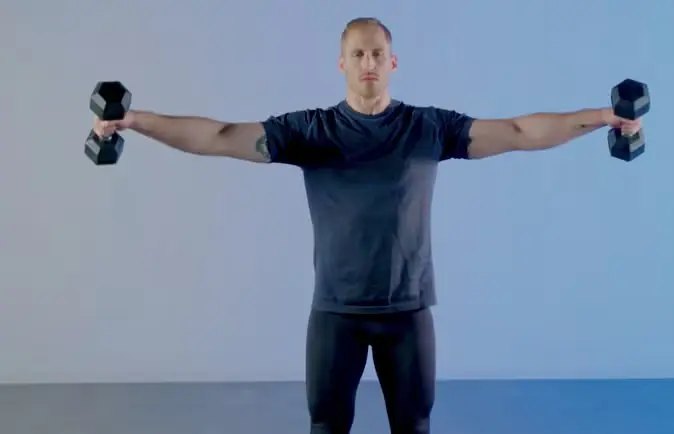
Trying a thumbs-up grip in place of the conventional grip with palms facing down. “This can help engage different muscles within the shoulder complex,” focusing on the front deltoid in particular.
Keep your feet shoulder-width apart. With your palms facing forward, hold a dumbbell by your sides in each hand.
Exhale and slowly raise the dumbbells to the side, stopping just before they reach shoulder height, while maintaining a slightly bent elbow and a tight core.
Take a breath, then carefully return the weight to the beginning position. An example is that.
3. Seated Lateral Raises

Seated lateral raises are a better way to isolate the shoulder muscles and get out of momentum.
With your feet flat on the ground, take a tall seat on a chair or bench. With your palms facing your body, hold a dumbbell in each hand by your sides.
Exhale and gradually raise the dumbbells out to the sides, leading with your elbow, until your elbow reaches shoulder height while maintaining a slightly bent elbow and an engaged core.
Take a breath, then carefully return the weight to the beginning position. One representative is that.
4. Bent-Arm Lateral Raise
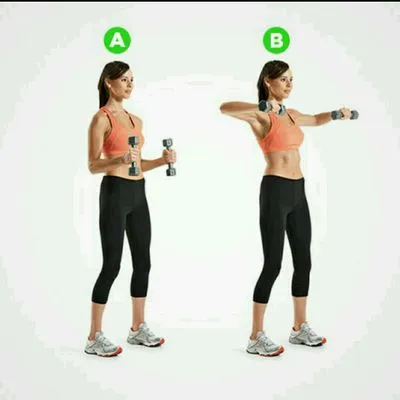
According to research, this variation of the exercise works your medial deltoids as well as your triceps, front deltoid, and upper traps. It’s also simpler for beginners to gain strength because the weight is closer to their bodies.
As you stand, place your feet shoulder-width apart and slightly bend your knees. With your arms by your sides, elbows bent at a 90-degree angle, forearms parallel to the floor, and palms facing one another, hold a dumbbell in each hand.
Exhale and slowly raise your arms up and out to the sides, stopping just before your elbows reach shoulder height, while maintaining a 90-degree bent elbow and a tight core. Your palms should be facing the floor at the peak of the exercise.
Take a breath, then carefully return the weight to the beginning position. One representative is that.
5. Banded Lateral Raises

Not a single dumbbell? Experiment with lateral raises using a long resistance band, which has been shown to activate your medial deltoids just as well as dumbbells. If the length of your band is insufficient to execute the following move, stand on one end and raise one arm at a time.
With a long resistance band looped beneath the middle of each foot, stand with your feet hip-width apart. Using both hands, grasp one end of the band.
Exhale to lift the ends of the band out to either side while maintaining a slightly bent knee, a tight core, and a tall chest.
When you can no longer stretch the band or when your elbows are at shoulder height, stop.
Take a breath and carefully lower your hands to your sides. One representative is that.
Dumbbell Lateral Raise Tips
- Make sure each repetition is controlled and slow. Since this is an isolation exercise, the goal should be to work the muscle correctly rather than to move as much weight as you can.
- Avoid raising your arms too high; shoulder height is sufficient.
- If you experience shoulder pain during the exercise, you might want to try one of the following adjustments:
- Raise your pinkies just a little bit above your thumbs. Assume you are drinking a cup of water.
- With your thumbs pointing away from your body, turn your palms forward. As a result, the shoulder will be more externally rotated, and the shoulder joint may become slightly more flexible.
Benefits of Lateral Raises
One shoulder exercise that focuses on the deltoid muscles is the side lateral raise. Each of the three different points (called “heads”) that make up the deltoid muscle group has its own muscle fibers. After fusion, the three deltoid heads attach to the humerus, the upper arm bone.
You can isolate this muscle group by performing side lateral raises, which mainly target the lateral head of the deltoid in addition to the anterior and posterior heads. In particular, one of the greatest exercises for strengthening the lateral head of the delts is the lateral raise.
Regularly performing lateral raises can help you develop lateral deltoid muscle hypertrophy, which will give you the appearance of stronger, wider shoulders.
In addition to improving your outward appearance, the exercise strengthens your shoulders on its own. This can help address possible differences in strength between your left and right sides.
Additionally, an entire strength-training program that targets all three heads of the deltoid (as well as the stabilizing muscles of the rotator cuff) can help you maintain the health of this weak joint because the shoulder joint is the least stable in the body. Lateral raises can serve as one component of a broad shoulder exercise program. Strong and flexible shoulders are essential for preventing minor discomfort or possible injuries.
1. Lateral Raises Target Your Shoulders and Upper Back
The capacity of lateral raises to efficiently target the shoulders and upper back is one of their primary advantages. This exercise is essential for general upper-body strength because the deltoid muscles attach to the upper arm. The deltoid muscles, especially the medial deltoid, which gives the shoulders their rounded shape, are the focus of this exercise. The trapezius and rhomboid muscles, which are important in supporting the shoulder blades and preserving proper posture, are also worked during lateral raises in addition to the deltoids.
Lateral raises support overall upper body strength and help develop well-defined, toned shoulders by strengthening these muscles.
2. They Work Your Middle and Lower Traps
Lateral raises work the middle and lower trapezius muscles, also known as the “traps,” in addition to your shoulders. The rotator cuff muscle, in addition to the traps, is essential for shoulder stability during lateral raises. These muscles are essential for maintaining correct shoulder alignment because they stabilize your shoulder blades. The middle and lower traps are important for maintaining balance and avoiding shoulder imbalances, but they are frequently overlooked in favor of concentrating on the upper traps.
By strengthening these frequently ignored muscles, lateral raises can improve posture and lower your risk of injury.
3. Core Stabilization is Key
The activation of your core muscles is one of the unknown advantages of lateral raises. You must use your core to stabilize your body and keep good posture to complete the exercise correctly. This suggests that your core is working to keep you steady and stop any needless movement, even though your shoulders are doing the majority of the work.
Lateral raises are a great addition to any strength-training technique because they activate the core, which can help increase overall core strength.
4. Great for Building Muscle.
As an isolation exercise, lateral raises concentrate on strengthening particular muscles, in this case, the upper back and deltoids. For strengthening the deltoid muscles and improving shoulder definition, the side lateral raise works especially well. Compound exercises like squats and deadlifts are more effective for losing fat than these exercises, even though they are a great way to gain muscle and improve shoulder definition. For a complete fitness schedule that encourages both strength and fat loss, lateral raises work best when combined with other exercises and cardio.
5. Military presses can be safely replaced with lateral raises.
The military press is a common shoulder exercise, but if done incorrectly or with too much weight, it can put a lot of strain on the shoulder joints. Military presses can be replaced with lateral raises, which are a great way to develop and strengthen shoulder muscles without putting undue strain on the joints.
Lateral raises are a safer option for people with shoulder sensitivity or prior injuries because they isolate the deltoid muscles, allowing you to develop shoulder strength in a more controlled and less joint-intensive way.
6. They Strengthen Your Shoulders.
The fact that lateral raises are a low-impact exercise is another important advantage. Lateral raises are perfect for people recovering from injuries or those with joint issues because they don’t put too much strain on the shoulder joints as heavy compound lifts do. Lateral raises can help strengthen the shoulders while lowering the risk of injury if done correctly and with controlled movement.
Because of this, they are a fantastic addition to rehabilitation programs or for people who want to gain strength without overloading their joints.
7. They Can Improve Your Posture
Many of us spend a lot of time using computers or sitting at desks, which frequently results in bad posture and rounded shoulders. By strengthening the shoulders and upper back, two areas essential for maintaining good posture, lateral raises can help fight this. You can strengthen the muscles that pull your shoulders back and support a more upright posture by regularly performing lateral raises.
In addition to improving your appearance, better posture lowers your risk of developing neck and back pain from slouching or twisted spines.
8. Good Form is Crucial for Maximum Benefits
Maintaining proper form is important for getting the most out of lateral raises. Shoulder strain or injury can result from improper form. When performing lateral raises, keep the following points in mind:
- Shoulders back and down: Keep your shoulders back and keep yourself from hunching over in the direction of your ears.
- Core tight: To keep your body from swaying during the exercise, contract your core.
- Elbows slightly bent: To lessen the strain on your joints, keep your elbows slightly bent as you raise the weights.
- Raise to shoulder height: To prevent overstressing the shoulder joint, raise your arms only to shoulder height.
- Elbows reach shoulder height: To maintain correct form and maximize muscle engagement, make sure your elbows are at shoulder height.
You can maximize muscle activation and reduce the chance of injury by concentrating on good technique.
9. Effective for Shoulder Definition and Shape
One of the best exercises for shaping and defining the shoulders is the lateral raise. Lateral raises contribute to the “cap” appearance that gives shoulders a more rounded and muscular appearance by focusing on the medial deltoid. Those who want to tone and sculpt their shoulders without gaining bulk will find this exercise particularly beneficial.
Lateral raises are a useful technique for developing a well-defined upper body, whether your goal is to strengthen your shoulders for functional fitness or to improve your physique for aesthetic reasons.
10. Safe for Most People, With Proper Form
Most people can safely perform lateral raises as long as they use the right form and don’t use too much weight. However, it’s important to speak with an expert before adding lateral raises to your routine if you already have shoulder injuries, such as rotator cuff problems or shoulder impingements. Lateral raises with light to moderate weights and controlled movements are safe for people with healthy shoulders.
You can learn the form by starting with lighter weights and working your way up to heavier ones. As with any exercise, it’s very important to pay attention to your body and make necessary adjustments to avoid getting hurt.
Safety and Precautions
When performing lateral raises, it’s best to keep your arms at a 90-degree angle to avoid injury. Another important factor in avoiding injuries is choosing the right weight.
Although lateral raises are usually safe, reduce your repetitions if you experience any sudden or severe pain. To see if the bent-arm modification helps, you might want to give it another go.
Conclusion
Lateral raises provide a variety of advantages, from better posture and core stability to muscle toning and definition, making them a great exercise for the shoulders and upper back. They are excellent for strengthening the shoulders and enhancing the appearance of the upper body, but they might not be the best exercise for losing fat. You can lower your risk of shoulder injuries and build stronger, more defined shoulders and upper back muscles by including lateral raises in your strength-training schedule.
As with any exercise, using the right form is essential to getting the most out of it and reducing the chance of injury. As you advance, progressively increase the load while starting with lighter weights and concentrating on technique. You can get the strong, well-rounded shoulders you’ve been aiming for by performing lateral raises consistently and with careful attention to detail.
FAQs
Is the lateral raise back or chest?
The trapezius, or upper back, supports and stabilizes the lateral raise, an isolation strength training exercise that targets the shoulders, particularly the lateral deltoid. Lifting weights out to the side and away from your body is part of this exercise.
Is 3 sets enough for lateral raises?
For side lateral raises, three or four sets of ten to fifteen repetitions is a good range. “A great way to get a bigger bang for your buck is to perform two sets of exercises back-to-back, such as lat raises with a compound shoulder exercise.”
Which muscles do lateral raises work?
The main muscles used
The primary muscle that lifts the arm out to the side (shoulder abduction) is the lateral deltoid, also known as the medial delts.
Stabilizing and Secondary Muscles
Trapezius (Traps): Assists in elevating and stabilizing the shoulder blade; however, you should minimize its use to concentrate on the delts.
During the movement, the rotator cuff (such as the supraspinatus) stabilizes the shoulder joint.
The muscle below the armpit that helps raise the arm is called the serratus anterior.
Use your core muscles to keep your posture level and raised.
Is a 10 kg lateral raise good?
Intermediate/Advanced: For cable lateral raises, 10 kg is often listed as an intermediate or advanced weight by strength standards, signifying strong strength.
Muscle Growth: Because you’re creating tension, 10 kg is effective for hypertrophy (muscle growth) if it enables you to perform reps to or close to muscle failure (8–15 reps).
Progressive Overload: For lateral raises, which target a smaller muscle group, going from lighter weights to 10 kg is a big leap, making it extremely difficult.
What are the disadvantages of lateral raises?
Lateral Dumbbell Raises with thumbs down or palms down.
The rotator cuff muscles may be more compressed against the shoulder’s bony surface in this position. To lessen the chance of this shoulder compression, try to keep your hands “thumbs up.”
Is there a better exercise than lateral raises?
Many of the advantages of lateral raises also apply to upright rows. A few additional advantages are: Your shoulders will appear larger with all-around strength. Stronger trap muscles to aid in additional workouts.
Can I do lateral raises every day?
Why Daily Muscle Repair May Not Be the Best Option: Daily stress blocks healing, while strength training causes microtears.
Pain, tiredness, and stunted growth can result from overtraining.
Maladaptation: Prolonged tiredness can impede advancement.
What are the mistakes for lateral raises?
Avoid These Lateral Raise Mistakes
Keep your core active and concentrate on slow, thoughtful movements. Avoid using your hands to guide movements. You are not performing this exercise correctly if your hands are raised higher than your elbows. This mistake reduces your range of motion and releases tension from your deltoids.
Can I grow my shoulders faster?
The Secret to Having Wider Shoulders Is Side Delts
Growing the side delts is the key to getting wider shoulders from the front and back view, even though the front and rear delts are useful for building overall shoulder mass. I also used a lot of recent, amazing studies to help me choose the best side delt exercises.
Can dumbbell exercises burn fat?
Exercises using a single dumbbell can promote core activation and correct muscular imbalances. Exercises aim to increase heart rate and incorporate resistance exercises, which promote calorie expenditure and muscle preservation, in order to achieve a lean physique while enhancing fat loss.
References
- Ascm-Cep, L. W. M. (2024, June 7). How to do lateral raises. Verywell Fit. https://www.verywellfit.com/side-lateral-raise-4588211
- How to do lateral raises | Lateral raise variations. (n.d.). PureGym. https://www.puregym.com/exercises/arms-and-shoulders/lateral-raises/
- Mastering the Lateral Raise Exercise | Gym Professor blog. (2024, June 24). https://www.thegymrevolution.co.uk/blog/2024/06/24/mastering-the-lateral-raise-exercise/?srsltid=AfmBOorihhJ2d9xjk6HstAwqsgTdsoNXTD0ia2Mp7fiaDnHEq4RzTZcX
- Mazzo, L. (1970, January 1). Dumbbell lateral raises are a simple (But easy to mess up) move. Here’s how to do them right. https://www.onepeloton.com/blog/lateral-raises
- Shoulder Exercises | Lateral raise. (n.d.). https://www.acefitness.org/resources/everyone/exercise-library/26/lateral-raise/?srsltid=AfmBOoo6oGDNrMy52dDs0Z-x1jsXIsjnCWXj4PYPNA3oLBk7y8RLi0u4
- Thomsen, A. (2023, June 15). The top 10 benefits of lateral raises. ASFA. https://www.americansportandfitness.com/blogs/fitness-blog/the-top-10-benefits-of-lateral-raises?srsltid=AfmBOopABzLW0Q9YvrLZPAdw5U5VxaY63qk3eOql-45KfybiBsEDTehq