
Eka Pada Galavasana (Flying Pigeon Pose)
What is Eka Pada Galavasana?
Eka Pada Galavasana, or Flying Pigeon Pose, is an advanced arm balance that blends hip opening, core stability, and upper-body strength. It challenges focus and balance while deepening the stretch in the glutes and outer hips, making it a powerful test of both strength and flexibility.
It is said that the stance Eka Pada Galavasana is a more difficult version of the Pigeon pose. In this instance, the legs are maintained in a manner akin to that of the half pigeon pose. The body is then raised off the ground using pigeon legs.
Muscle Work During Eka Pada Galavasana:
- Arms Muscles
- Shoulder Muscles
- Biceps and Triceps Muscles
- Core Muscle
- Hip Muscles
How to Perform?
- Enter Tadasana first. feet apart with hip spacing and hands next to the hips.
- Now, microbend your knees to lower your pelvis. Spread your fingers and firmly plant your feet on the ground. In this instance, the body is in the chair position.
- Next, place your right foot on your left thigh by lifting it with one hand and balancing it with the other. With your hands facing one another, raise your arms.
- Now take a breath, exhale, and lean forward such that your hands are parallel and your sternum meets your right calf. Look at the ground.
- Reach the floor from here, then put your palms there. Place your right foot next to your left triceps and your right ankle beneath your left armpit. Raise the shin of your right leg as high as you can beneath your right arm.
- Now lean forward by squeezing your elbows. Next, raise your left foot off the ground while bending your elbows slightly. With the foot facing upward, try to bring the left foot towards the glutes.
- Spread your fingers gradually to bend forward a little more deeply. Next, with the right foot resting on the left triceps, straighten the left leg up and point in the same direction.
- Continue in this position for as long as it seems comfortable, then gradually return the left leg to exit the pose. Return on both legs after leaning back with the left foot on the ground. To enter Tadasana, raise your pelvis and drop your hands; then, relax.
Benefits:
Strengthens Core and Upper Body Muscles:
The flying pigeon position exercise puts a great deal of strain on the body’s upper structure. This damages the muscles, which then rebuild themselves stronger following rest. The pressure improves the bones’ ability to absorb calcium from the blood. They get stronger and more substantial as a result. Therefore, performing this pose on a regular basis strengthens the musculoskeletal framework that supports the development of the upper body.
Increase Mental Concentration:
The difficult pose Eka Pada Galavasana stimulates sweat glands and boosts oxygen intake, which causes the heart to pump blood more quickly.
Preserves Heart and Lung Health:
Because of stronger and more effective myocardial contraction, better blood perfusion of tissues and organs, and higher oxygen delivery, the heart pumps blood into the circulation more effectively when in the flying pigeon stance.
Encourages Women’s General Health:
Frequent practice controls the practitioners’ metabolism. Abdominal fat, blood lipid resistance, blood glucose, and insulin resistance are all improved as a result of this. But it also boosts sex hormone-binding globulin (SHBG), lowers testosterone levels and the Free Androgen Index (FAI), and enhances ovulation and fertility during the menstrual cycle. Thus, it encourages general health.
Overcomes Anxiety and Stress:
Frequent Flying Pigeon pose practice lowers blood levels of stress chemicals like cortisol and adrenaline. But it also increases the brain’s synthesis of endorphins, which are the body’s natural analgesics and mood enhancers. Thus, worry and stress are eliminated.
Therapeutic Benefits:
Beneficial to the muscles of the pelvic floor: The bladder, uterus, and bowel are supported by the pelvic floor muscles, which weaken as a result of obesity, childbirth, and persistent constipation. Urinary and reproductive issues, such as urine leakage and delayed ejaculation, are caused by this.
The pelvic floor muscles are strengthened by performing the Flying Pigeon pose regularly. This encourages regular ejaculation and stops pee from leaking during coughing or sneezing.
Encourages hip joint relaxation: Opens Tight hip muscles are the result of inactivity and extended sitting. This makes you less flexible and puts you in danger of getting hurt. The groin and pelvic area are stretched when performing the flying pigeon pose. This encourages hip extension, which is essential for running and jumping. Additionally, it facilitates the complete flexion needed for heavy lifting and squatting.
Beginners Advice:
- When raising the back leg, practitioners should refrain from lowering their head. A fall by the head could result from this gravitational force towards the ground. Therefore, practitioners can balance their centre of gravity by using the weight of their body and back leg. This will prevent the head from being compressed and eventually falling forward.
- The flying pigeon stance may be tough for beginners who have never practiced balancing. The wrist’s lack of strength and flexibility may be the cause of this.
Preparatory Poses:
- Supta Kapotasana (Reclining Pigeon Pose)
- Eka Pada Rajakapotasana (One-Legged King Pigeon Pose)
- Bakasana (Crow Pose)
Variations:
One-Legged Revolved flying Pigeon Pose (Eka Danda Galvasana):
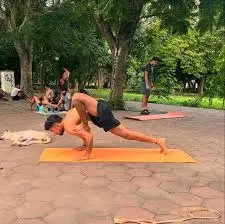
Here, the other legs are bent back, and the limbs on the same side are put on the corresponding hand’s triceps. In contrast, the left leg stays straight up in the air while the right foot is positioned on the left-hand triceps in the flying pigeon pose.
The initial version of the flying pose is the one-legged flying pigeon pose. The body is supported by both palms in this position. With the torso twisted to the left, the left leg is positioned on the left leg’s triceps, while the right leg stays straight behind and looks forward.
One-Legged Crow Pose (Eka Pada Bakasana):
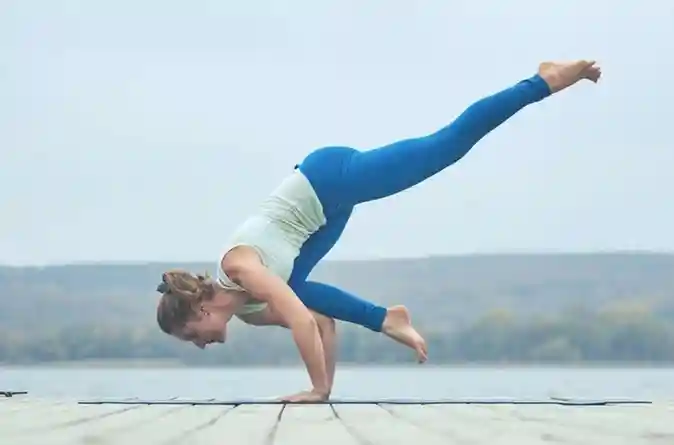
This is an additional variant of the Flying Pigeon stance. The practitioner’s left leg rests on their left upper hand in this hand-balancing stance. The head looks down at the floor, and the right leg stays upright.
The Flying Pigeon pose involves placing the right foot on the right triceps and the right ankle under the right armpit. While the torso is balanced on the floor, the left leg is raised towards the ceiling. In the one-legged crow stance, on the other hand, the left knee rests on the left upper hand while the right leg remains elevated.
Precautions:
- When elevating the right leg to place it on the left thigh after chair pose, practitioners should refrain from utilizing both hands. One could fall to any side due to an imbalance in the flying pigeon position.
- Lengthen your spine as you raise your body off the ground such that your right foot is securely over your left triceps and your right ankle is under your armpit. This will keep the leg from slipping while maintaining hand balance.
- It takes hand and shoulder strength to raise the left leg higher in the air. Mishaps could arise from improper hand placement. Therefore, before taking off in a flying pigeon stance, one should be mindful of their upper body strength.
Contraindications:
- This asana is avoided by practitioners who suffer from sciatic nerve disorders. Additionally, avoid the practice if you have injuries to your hands, feet, hips, neck, legs, knees, spine, or ankles.
- This pose should be avoided by women who are pregnant, menstruating, or have just undergone abdominal, waist, or any other important joint surgery.
- When performing the Flying Pigeon Pose, one should return right away if they have headaches or lightheadedness.
Conclusion:
An excellent pose for strengthening the upper body is the flying pigeon pose. Additionally, this increases pelvic flexibility, which benefits reproductive and urinary diseases. The Ajna chakra is activated by proper alignment, which further opens the practitioner’s spiritual viewpoint on the universe.
One of the more difficult poses is this one, which is best done under the guidance of a qualified yoga instructor. Anyone may, however, adjust to this stance with practice.
FAQs
What are the benefits of the Flying Pigeon Pose?
strengthens the shoulders, arms, wrists, and core.
stretches the glutes and opens out the hips and inner thighs.
enhances equilibrium.
increases self-assurance and aids in conquering obstacles and fears.
What is the Galavasana pose?
Advanced yoga practitioners enjoy practicing the arm-balancing stance known as Eka Pada Galvasana (Flying Pigeon stance). Sufficient flexibility, skill, and mental and physical strength are necessary for the position. This asana’s name comes from Sanskrit.
How to do Eka Pada Galavasana?
Cow or cat Eka pada galavasana, like the crow position, calls for you to circle your lower back as you enter the pose, much like in a cat stretch. To further stretch your lower back, press your hands forward and downward as you circle up into the cat stretch during your warm-up, as if you were pushing the floor away from you.
How long should you hold the Flying Pigeon Pose?
Take three to four deep breaths to relax. Inhale to stand up in Tadasana (Mountain Pose), then repeat the previous steps to return to the practice with the right leg folded and stay balanced for at least two to three breaths in Flying Pigeon Pose.
What are the modifications for the flying pigeon pose?
Eka Pada Galavasana, or Flying Pigeon Pose
First modification: Take a stand on a block.
Modification 2: Put a block on your back shin.
Modification 3: Bend your back knee while practicing.
Does the flying pigeon pose require flexibility?
Eka Pada Galavasana, also called the Flying Pigeon Pose, is a difficult yoga pose that is a member of the arm balance family. This pose requires a lot of hip flexibility since it combines the dynamics of balancing on one’s hands with folding the other leg in the pigeon stance position.
References:
- Eka Pada Galavasana (Flying Pigeon Pose): Steps, Benefits, Precautions – Fitsri Yoga. https://www.fitsri.com/poses/eka-pada-galavasana
- Flying Pigeon Pose Yoga Pose (Eka Pada Galavasana). Tummee. https://www.tummee.com/yoga-poses/Eka Pada Galavasana