
Core Exercises
Core Exercises are workouts that strengthen the muscles of the abdomen, lower back, and pelvis. They improve stability, posture, and balance, supporting overall body strength and movement.
Introduction
The core is in the center of our bodies and keeps the trunk stable while the arms and legs move during functional movements. When we look at it this way, we can see that the core really consists of:
- Hip-stabilizing muscles.
- The chain of muscles on the front, sides, and back of the body that support the torso.
- The shoulder’s stabilizer muscles.
The core’s function of protecting the spine from excessive strain and transferring force from the lower body to the upper body and vice versa is what makes it so important.
We can avoid injuries and perform at our best when we have a strong, stable core.
When we move, run, jump, throw, lift objects, and transfer force throughout our entire bodies, we should ideally create 360 degrees of stiffness around the spine to protect the back.
When the muscles in our shoulders, hips, and torso cooperate, we accomplish this.
Exercises to strengthen each of the core muscles include planks, crunches, and bridges. A person’s mobility, stability of the spine and trunk, and ability to support daily activities can all be enhanced by exercising these muscles.
A lot of everyday activities require the use of your core, such as pushing a grocery cart or putting on shoes. Additionally, it impacts your stability, posture, and balance.
Despite what many people think, your core is more than just your abdominal muscles. It also includes the muscles surrounding your pelvis and in your back.
Your trunk, or core, consists of your:
- Erector spinae: Three back muscles that extend up your trunk are called the erector spinae. It facilitates sideways bending, head rotation, and standing up straight after bending over.
- Rectus abdominis: The rectus abdominis is an abdominal muscle that is used when you bend forward.
- Obliques: Your trunk can be bent or rotated with the aid of your external and internal obliques.
- Transverse abdominis: Your pelvis is stabilized by the transverse abdominis, which encircles the front and side of your trunk.
- Multifidus: Your spine is supported by the multifidus in your back.
Your core also consists of the following muscles:
- Pelvic floor
- Diaphragm
- Glutes
Maintaining the strength of these muscles improves your overall fitness, supports your spine, and stabilizes your body.
Best Core Exercises Video
Beginner moves
- Start with these beginner exercises if you’ve never worked out before or haven’t done so in a while.
- Consulting with a personal trainer about the proper amount of repetitions and sets for your individual fitness level and goals could also be a good idea.
- You’ll hear the phrase “tighten your core” throughout these exercises, but how can you tell if you’re doing it?
- Breathing deeply while visualizing your belly button moving closer to your spine is a good way to begin. For a few seconds, keep your muscles taut in that position.
- When you engage or tighten your core, it feels like your stomach muscles are strengthened.
Core Exercises mentioned below
1. Plank

Plank Steps:
- Start with the basic plank position. From head to toe, your torso will be in a straight line. Keep your shoulders and hips from sagging or drooping. Additionally, avoid hanging your head or arching your back.
- Warm up by maintaining control of the plank for at least 60 seconds. Drop to your knees, take a small break, and keep going until you’ve finished a full minute if you begin to move or lose form.
- Add a few arm and leg lifts for the next 60 seconds if the basic plank is too simple. Lift one arm for ten seconds every fifteen seconds, then switch to the other side. Next, move on to the legs. Repeat with the other leg after lifting the toes five to ten inches off the ground and holding them there for fifteen seconds.
2 . Side Plank

- Move on to the side plank after having completed the basic plank for one to two minutes. Because it works the lateral core stabilizers, such as the obliques and transverse abdominis, the side plank is crucial for an effective warm-up. Additionally, it can help increase the hip and knee joints’ lateral stability.
- For athletes who don’t perform lateral movements in sports, this helps avoid or reduce knee pain. For example, you will not frequently use your lateral stabilizers if you just run, ride a bike, or use equipment like elliptical trainers. Side planks can help maintain the strength and balance of lateral muscles and function as a warm-up for more complex core exercises.
- With your torso in a straight line from head to feet, perform side planks as shown. Before switching sides, hold the position for 30 to 60 seconds while keeping control. If you start to shake, lose your balance, or your hips sag, pause, take a brief break, and then come back.
- If the simple side plank is too simple, you can make it more challenging by extending your upper leg five to ten inches above your lower leg and holding it there for ten seconds without losing your balance. Repeat after lowering it for five seconds. Remember both sides.
3. Bicycle Crunch

- Bicycle crunches are a good way to target the rectus abdominis and obliques as you progress into more difficult core exercises. It is the top exercise for strengthening and strengthening your abdominal muscles.
- Although the bicycle crunch is simple, many people perform it incorrectly. To do it correctly, keep your lower back pressed to the floor while lying flat on a yoga mat. Keep your hands behind your head so they don’t strain your neck.
- As shown, raise your knees to a 45-degree angle and slowly pedal like a bicycle. Touch your right elbow to your left knee after touching your left elbow to your right knee. Use a slow, deliberate motion when performing the ab exercise. Do ten to twenty-five repetitions on each side.
4. V-Sit Core Exercise
- The rectus abdominis, external obliques, and internal obliques are all worked during the V-sit, a difficult but powerful advanced core exercise. The hip flexors are also worked during this exercise.
- Start sitting on a mat, contract your core, and raise your legs to a 45-degree angle as shown in the V-sit. As much as you can, extend your arms forward or up toward your shins.
- Hold the position for a few seconds with a strong spine and proper core posture. Take a break and repeat a few times. Hold the position for a longer period of time as you gain strength.
5. Seated Twists with Medicine Ball
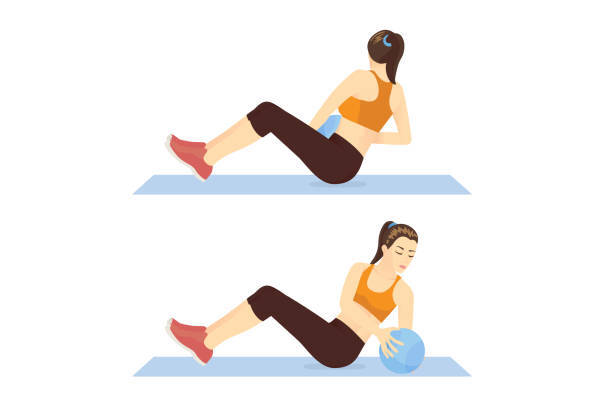
- An advanced core exercise that targets the rectus abdominis and the external and internal obliques is the seated twist with a medicine ball.
- You get started by holding a medicine ball firmly in front of you with both hands while sitting at a 45-degree angle. Engage your core, twist slowly from your torso to your right, and tap the medicine ball on the floor next to you to begin the exercise.
- Next, quickly but carefully twist your torso, contract your abs, and touch the medicine ball on the opposite side. Rest after 10–20 repetitions.
- A medicine ball is a necessary piece of equipment for more complex core exercises, but selecting the correct one is essential for the best possible conditioning. Your form will suffer if it’s too heavy, and you might begin to sway or rock back and forth. Always begin with a lighter medicine ball and increase it once you have a firm form.
6. Plank on an Exercise Ball
- An advanced core exercise on an unstable surface that requires you to dynamically engage more abdominal muscles throughout your entire core, from your neck to your toes, is the plank on an exercise ball.
- In order to keep a good posture, you will continuously adjust your core stabilizers and activate your abs much more.
- Make small clockwise and counterclockwise circles with your upper body to increase the burn. Hold for 30 to 60 seconds. Repeat after resting.
7. Ab Hold
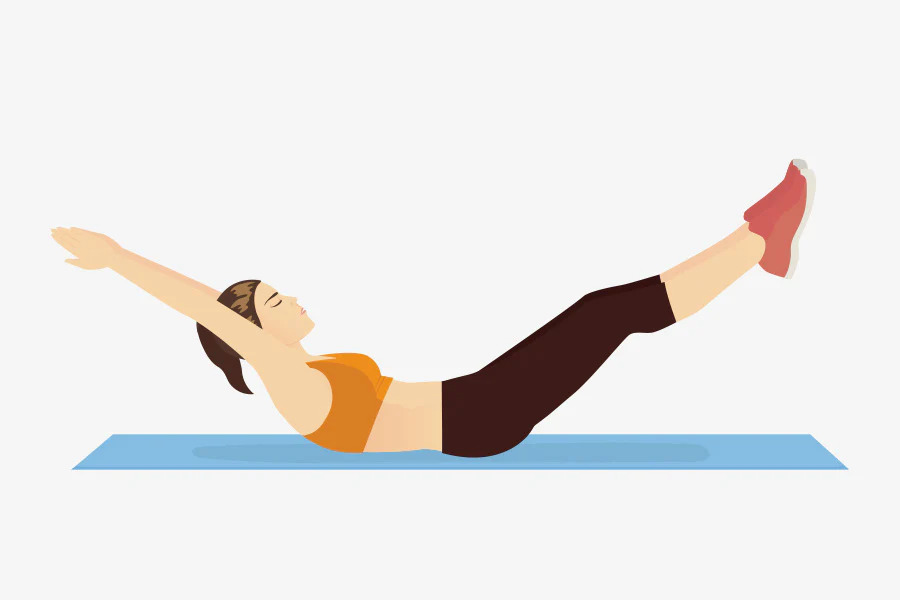
- For an advanced core exercise that seems simple, try the basic ab hold. A yoga mat is all you need.
- Start on the floor with your knees slightly bent and your heels on the mat (slightly easier) or with your feet outstretched (more difficult). Lift your upper body until your shoulders are a few inches off the ground by using your core. Hold without moving.
- Put your hands behind your head with your elbows to the side when you first attempt this advanced core exercise. As your strength increases, extend your arms palms up along your sides and maintain that position for up to one minute. We, well, not at all. It’s a good one.
8. Bridge

- This pose strengthens your thighs and butt while strengthening your core by using your glutes to raise your hips.
- Get started by lying on your back. Place your feet hip-width apart on the floor while bending your knees. Put your hands palms down at your sides.
- Tighten your glutes and core.
- Lift your hips until your knees and shoulders line up.
- Hold for ten to thirty seconds.
- Do this three to five times.
Why you should strengthen your core muscles
Core exercises improve your balance and stability.
The center of your body is your core. It covers your stomach, hips, lower back, and pelvis. Sometimes the muscles in the stomach are referred to as the abs. Your core muscles are trained to function effectively through core exercises. Better balance and steadiness, or stability, result from this. Whether you’re playing or engaging in everyday activities, stability is essential. In actuality, stable core muscles are essential for the majority of sports and other physical activities.
Core exercises don’t need equipment or a gym membership
A core exercise is any exercise that requires the coordinated use of your back and stomach muscles. For example, you can train and strengthen many of your muscles, including your core muscles, by using free weights while maintaining a stable core.
Your core is strengthened and stabilized by traditional core exercises. Planks, sit-ups, and fitness ball exercises are examples of traditional core exercises.
Another traditional core exercise is a bridge. Bend your knees while lying on your back to perform a bridge. Maintain a neutral back that is neither arched nor pressed against the ground. Don’t tilt your hips. Tighten your stomach muscles. Lift your hips off the ground until they are in line with your shoulders and knees. Maintain your form while holding for three deep breaths.
Core exercises can help tone your abs.
Do you want your stomach muscles to be more defined? Exercises for the core are essential. Although burning fat in your stomach requires aerobic activity, core exercises can tone and strengthen the underlying muscles.
Most physical activities become easier through strong core muscles.
Several activities are made easier by having strong core muscles. Strong core muscles make it simpler to bend over to tie your shoes, pull a glass from the top shelf, and swing a golf club. Runners and other athletes benefit from having strong core muscles. This is due to the fact that weak core muscles can result in increased fatigue, decreased stamina, and injuries.
You may be more prone to poor posture, lower back pain, and muscle injuries if your core muscles are weak. Increasing the strength of your core muscles may improve your back pain and reduce your chance of falling.
You can achieve your health goals with core exercises.
The majority of fitness programs consist of strength training and aerobic exercise. However, a complete fitness program must include core exercises.
You can achieve your fitness objectives with a program that involves core exercises. Whether you’ve been an athlete for a long time or are just starting, make sure your fitness program is complete.
Can Your Deep Core Be Targeted?
It takes some practice to “find it” or feel the connection to these particular muscles, but you can target your deep core.
One of the best ways to get ready for any type of exercise is to use your warm-up as a chance to work your deep core. They continue, “Isolation exercises like a hollow body hold or a dead bug are great for tapping into your transverse abdominis, multifidus, and diaphragm.”
Consider working with a physical therapist to target your pelvic floor if you’re having trouble coordinating with your deep core during exercise.
The Benefits of Deep Core Exercises
Deep core work should be prioritized for a number of reasons. These include better posture, a lower risk of lower back pain, improved athletic performance, and better general stability and balance.
Deep core exercises help maintain the alignment of your spine and make sure your body’s muscles function in a balanced manner.
Additionally, they claim that deep core exercises “contribute to improved breathing control and aerobic capacity, reduced injury risk during activities, and better bladder control.”
Deep core exercises are beneficial for all athletes, but runners, cyclists, and lifters stand to gain the most. “While lifters need a strong core for heavy lifting and injury prevention during compound movements, runners and cyclists depend on core stability for efficient movement.”
FAQs
What is the most effective core exercise?
There isn’t just one “most effective” core exercise. In different ways, planks, crunches, and bridges all aid in strengthening and engaging the core muscles. Your mobility, level of fitness, and existing muscle deficiencies will determine which core exercise is best for you.
What is the fastest way to build your core?
Core muscle development can be supported by regular exercise, enough sleep, and a nutritious, healthy diet. Seeking quick fixes is not as important as being consistent and exercising safely.
How can I tone my core fast?
The word “tone” is frequently used to refer to specific exercises that increase muscle strength in a single area and reduce body fat. This is deceptive. A person must increase target muscle mass and decrease total body fat in order to “tone” a body area. Targeted exercises cannot be used to target fat loss in a particular area.
What is core exercise?
The goal of core exercises is to strengthen the muscles in your midsection, including your back, pelvic floor, and abs.
Together, these muscles support and regulate your spine and pelvis, which is necessary for almost all bodily motions.
In addition to improving posture and balance, a strong core can lower the chance of back pain and injury.
Does core burn belly fat?
Your abs can be toned with core exercises.
Although burning fat in your stomach requires aerobic activity, core exercises can tone and strengthen the underlying muscles.
Is 20 minutes of core enough?
For most people, 10 to 30 minutes of focused ab work is sufficient. Beyond this, it’s more beneficial to concentrate on other muscles or exercises that indirectly work the core, like farmer’s carries or deadlifts.
Is it OK to do core exercises every day?
Yes,
Full-body training: Daily core exercises may not be the best option if your core is only one component of a full-body workout. However, since it doesn’t overwork a single muscle group, a daily regimen that includes core work along with other exercises can still be helpful.
When to take a rest
Intensive exercise: Like other muscles, your core requires time to recover and rebuild after high-intensity, muscle-building exercises.
Pay attention to your body: Take a break if you experience extreme pain or soreness. Injury could result from pushing through.
References
- Davies, D., & Neudecker, K. (2025, February 4). The 24 best core Exercises for building strength, stability and a mean Six-Pack. Men’s Health. https://www.menshealth.com/uk/fitness/a34037742/best-core-exercises/
- Harvard Health. (2021, April 1). The best core exercises for older adults. https://www.health.harvard.edu/staying-healthy/the-best-core-exercises-for-older-adults
- Nunez, K. (2024, April 24). The best core exercises for all fitness levels. Healthline. https://www.healthline.com/health/best-core-exercises
- Sparacino, A. (1970, January 1). 7 exercises to target those deep, deep core muscles. https://www.onepeloton.com/blog/deep-core-exercises
- Why your core muscles matter. (n.d.). Mayo Clinic. https://www.mayoclinic.org/healthy-lifestyle/fitness/in-depth/core-exercises/art-20044751