Exercise To Improve Walking Speed
Introduction
Walking speed is an important indicator of overall health, mobility, and independence. Whether you’re recovering from an injury, managing a neurological or orthopedic condition, or simply looking to move more efficiently, improving your walking speed can enhance your quality of life. A faster, more confident walking pace is often associated with better balance, stronger muscles, and improved cardiovascular fitness.
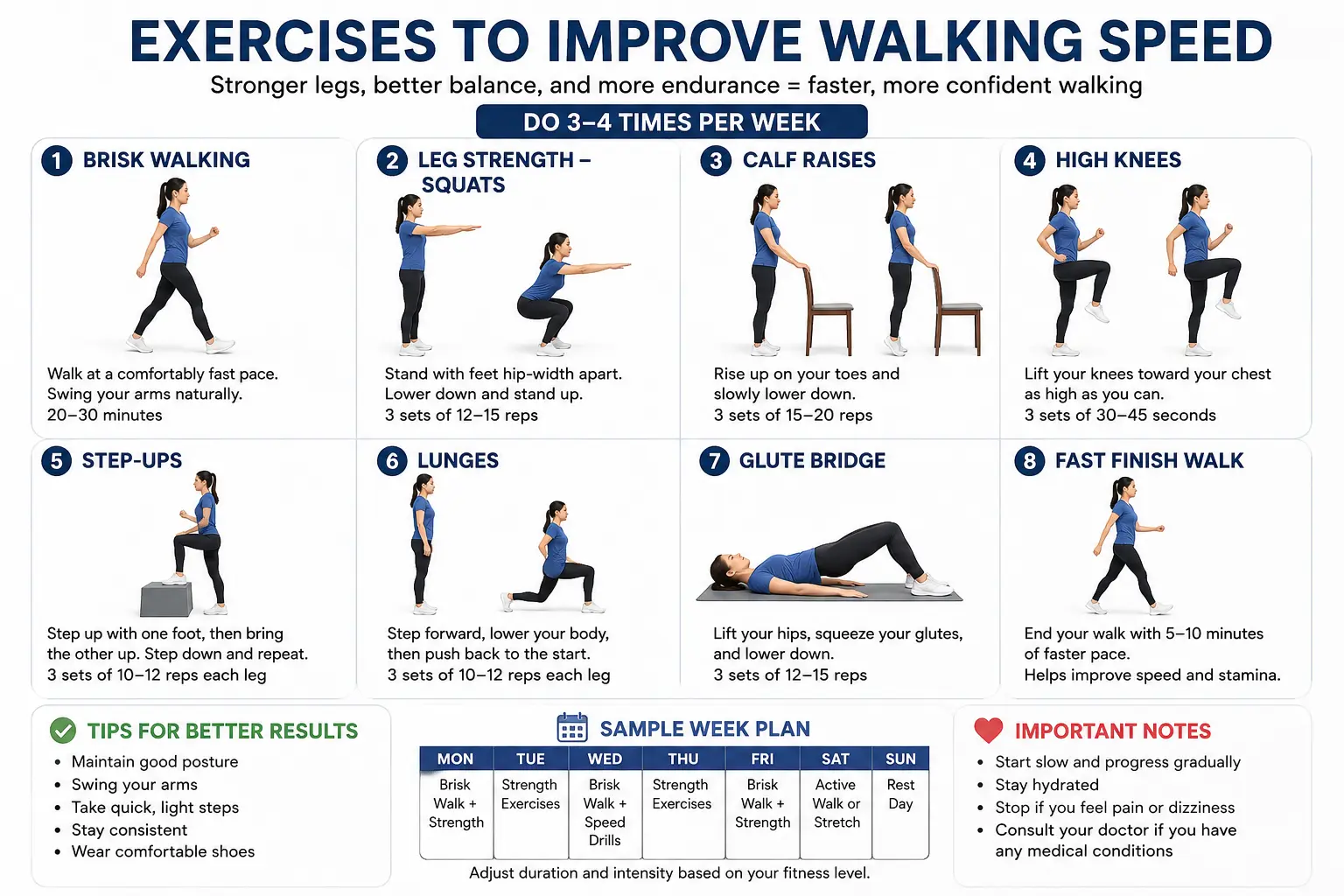
The key to increasing walking speed is strengthening the muscles involved in walking, improving balance, and practicing proper gait mechanics. Exercises such as brisk walking, squats, calf raises, step-ups, lunges, glute bridges, and high-knee marching help build leg strength, stability, and endurance. Consistent practice also improves coordination, allowing you to take smoother, more efficient steps.
Before starting any exercise program, perform a short warm-up for 5–10 minutes and wear supportive footwear. Begin at a comfortable intensity and gradually increase the number of repetitions, duration, or walking pace as your fitness improves. If you experience pain, dizziness, or shortness of breath, stop exercising and consult a healthcare professional.
Practicing these exercises three to five times per week, combined with regular walking, can gradually improve your speed, confidence, and overall mobility. You can get the best outcomes and lower your risk of falls or accidents by being consistent and maintaining good posture throughout each exercise.
Exercises to Improve Walking Speed
Squat
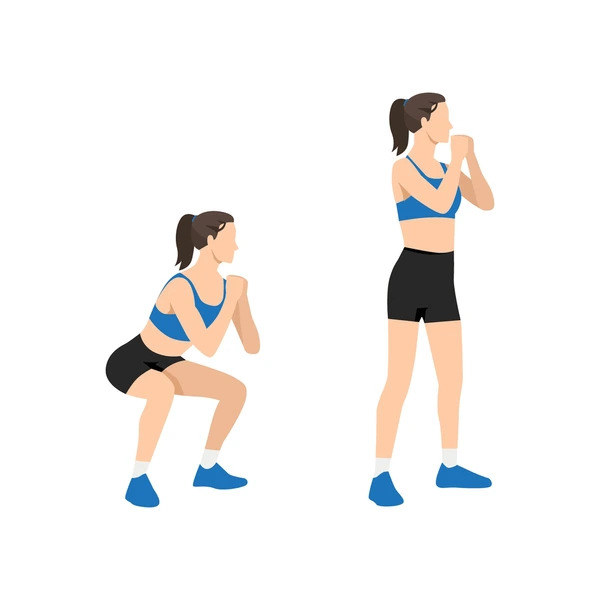
The squat works your quadriceps, hamstrings, glutes, and other large muscles in your legs.
Start the squat by activating the front core muscles, which cause the pelvis to tilt toward the front ribs and the torso to tip forward as you sit the hips backward (like sitting on the loo).
With your weight equally distributed throughout your entire foot, slowly lower your leg to a 90-degree position utilizing your glutes.
Using the glutes, return to standing while maintaining a straight spine and tucked pelvis. Power through the entire foot, including the big toe, and maintain an erect head.
Perform 10–15 reps in each set.
Lunges

Lunges help you prepare for climbing rocky routes and uneven terrain by strengthening your glutes, hamstrings, quadriceps, and core. You can increase the strength of your backpack by adding weight once you’ve mastered the fundamentals. Lunges will prepare your legs for even the most demanding undertakings, like climbing a mountain peak or going to Everest Base Camp.
Take a large stride forward with your left foot while standing with your feet together, your core tight, your spine extended, and your chest raised.
You’re on your right back toe. On the right leg, repeat. Continue switching.
Start with ten to twelve lunges on each leg and work your way up to three sets.
Perform Walking Lunges: Walking lunges are similar to normal lunges, except you continue to walk (go ahead) while switching legs. Focus on proper technique, engaging the core and glutes with each lunge.
See a licensed trainer or physiotherapist for assistance if you’re unsure of how to perform them. For a lifetime of healthy hiking knees, it will be a wise purchase. Perform 10–15 repetitions on each side.
High Step Up

Increasing the height of the step creates further instability, requiring the stabilizer muscles to cooperate in order to maintain your balance.
This exercise is utilized on rocky, uneven terrain and offers a terrific stretch for the hamstrings.
If you don’t have a step-up box, drive forward with one foot on a platform that is just above your knee. After that, reverse the motion and control the fall to prevent the leg from being startled. It’s more difficult than it appears.
For each leg, perform ten repetitions.
Burpees

Although it requires a strong core, this advanced compound workout is excellent for increasing strength, endurance, and agility, making you a wonderful adventure addict. Place your arms by your sides, your feet shoulder-width apart, and your weight equally distributed.
Put your hands on the floor in front of you after lowering your body into a squat. Engage your core strength by shifting your weight onto your hands as you jump back and land gently on the balls of your feet in a plank position.
Jump your feet back to where they came from in a squat behind your hands, then stretch your arms aloft as you explosively jump up into the air. As soon as you land, get ready for the next burpee.
Remember that quality is more important than quantity as you begin with five and work your way up to twenty.
Mountain Climber

This exercise burns your heart while strengthening your legs and core.
Begin on a plank.
Send your knee back out to the plank position after bending it in toward your nose and crunching it into your core. On the other leg, repeat. To raise your heart rate, keep switching legs at a faster pace. Work your way up to a minute, starting with 20 seconds.
You don’t need any equipment to perform these workouts, which are a terrific way to get ready for whatever your next walking vacation may bring.
How do I increase my walking speed?
To walk faster, think shorter, quicker steps, not overstriding. Keep your elbows bent at a 90-degree angle, push off your toes with force, and maintain proper posture. There are several lower-body interval training exercises.
Apply these practical and applicable techniques to speed up your speed permanently:
Increase Cadence, Don’t Overstride: Take smaller steps (but more often). Count your steps for one minute; try to get over 135.
Use a Dynamic Arm Swing: Bend your elbows to about 90 degrees and swing them in close to your body. Your legs naturally sync with your arm turnover, which gives you more forward momentum.
Push Off the Toes: At the end of a step, push off with your trailing foot so that the ball of your foot carries the weight.
Posture check: Chin parallel to the ground, eyes about 10 to 20 feet in front of you, core engaged so you don’t slump.
Include Interval Training: Change up your normal pace with 30- to 60-second bursts of fast walking at your maximum effort. This gets your cardiovascular system used to going faster.
Strength Workout: Strengthen your glutes, quads, and calves with exercises like squats, lunges, and calf raises. The stronger your legs, the easier it is to get off and go.
Can walking improve blood circulation?
As you walk, your leg muscles contract rhythmically and act as a “second heart,” squeezing the veins and helping to push the blood back up to your heart and preventing it from pooling.
Regular walking can do wonders for your heart in a few important ways:
Activates Muscle Pumps: With each step, the calf and thigh muscles compress veins, actively encouraging blood flow upwards and reducing swelling.
Releases Nitric Oxide: Exercise prompts your arteries to release nitric oxide, which relaxes blood vessel walls and opens them up for smoother, unimpeded flow.
Lowers Blood Pressure: A moderate pace of regular walking helps to strengthen the heart muscle, enabling it to pump blood more efficiently and with less effort.
Builds Capillaries: Over time, your body responds to regular exercise by increasing its network of microscopic capillaries, giving more oxygen and nutrients directly to your muscles.
Is it better to walk faster or longer?
As a general rule, the faster you walk, the greater the health and longevity benefits. Increasing your intensity raises your heart rate, improves your cardiovascular fitness, and burns more calories per minute. Ultimately, the best approach depends on your fitness goals:
For a longer life and a healthier heart, walk quicker. Research indicates that a brisk walk for 15 minutes a day (at a pace where you can talk but not sing) reduces the risk of mortality by 20%.
Walk more. For building endurance and protecting joints. Slower, longer walks build stamina, burn fat, and are much kinder to the knees and hips, reducing your injury risk.
For best results with both, use ranges. Enjoy the benefits of both intensity and duration by alternating 3 to 5 minutes of brisk walking with 3 minutes of slower walking.
What is the Japanese walking method?
Japanese walking method (Interval Walking Training or IWT) is a technique of alternating between fast, brisk walking for three minutes and slow walking for three minutes over a period of 30 minutes. It stresses maintaining an upright stance, managing breathing, and taking slow, steady steps to improve cardiovascular health, reduce blood pressure,e and burn more fat than steady-paced walks.
How to do the 3-3-3 Method
Warm-up: Walk at a slow, comfortable pace for 3 to 5 minutes to get your muscles and joints ready.
Fast Interval: Walk briskly for 3 minutes at about 70% of maximum effort (you should be breathing hard but able to hold a short conversation).
Slow Interval: Drop your effort to an easy, comfortable pace for 3 minutes to allow your heart rate to recover (around 40% effort).
Run through the fast and slow intervals five times for a total of a 30-minute workout.
Cool down: Finish with 3 to 5 minutes of slow walking and gentle stretching.
Why People Use This
Time-efficient.
Gentle on Joints: Walking intervals are a low-impact way to get your heart and muscles working without the pounding of high-impact workouts like running or jumping.
Metabolic Boost: The constant speed change keeps your blood sugar in check and builds leg strength in your lower part of the body faster than simple walking.
Benefits of Walking Faster
It’s a good idea to explain why you would want to walk more quickly before discussing the methods! Here are some excellent reasons to speed up the following:
Shorter Workouts
At a certain distance, complete your walking exercise more quickly. You will finish sooner if you choose the same path each time. You will be walking farther and burning more calories if you walk for a certain period of time.
Increased Intensity
Raise your heart rate to the level required for intense or moderate-intensity activity. This will bring you a better fitness boost from your walking activity and increase your cardio. cardiovascular health.
Burn More Calories
Walking a greater distance in a shorter amount of time or walking faster, which works more muscles, will increase the number of calories you burn.
Improve Pace
You might be able to surpass your walking friends and family and finish walking races and charity walks faster.
How to Walk Faster
Start progressively picking up the pace of your workout over time, and make sure you’re doing so safely and without injury by following the right procedures. Upgrading your shoes and correcting your stride. To find out how fast you are today and what your heart rate is at your fastest walking pace, take some baseline measurements. A lot of smartwatches can compute heart rate and mileage at the same time.
Measure Your Baseline
To find out how fast you are today and what your heart rate is at your fastest walking pace, take some baseline measures. A lot of smartwatches can compute heart rate and mileage at the same time.
You can also time yourself over a measured mile. A bike odometer, auto odometer, or GPS can be used to measure out a mile or kilometer to walk, or you can utilize a local track. To get ready to walk at your fastest pace, warm up with a five- to ten-minute walk. To attain a decent average, time yourself two or three times over this mile. In order to know where you are starting and incorporate speed into your workouts, you should also measure your baseline. Here’s how to deal with each of those issues. At the conclusion of a mile, take your pulse to determine your heart rate.
Upgrade Your Shoes
You may be moving more slowly because of your shoes. To walk more quickly, make sure you’re wearing the proper shoes. These must be lightweight and flexible. The distance you plan to walk will determine how much padding you need; longer walks require more cushioning. You should discover how to choose the proper shoes for faster walking so that you can be sure you have the best ones.
How to Address Your Form
By following a few essential best practices, you may guarantee correct form and placement.
Arm Motion
You can increase your walking speed by using your arms more. On the other hand, you may slow down using certain arm motions.
- The level of the level of the level of your breast.
- Instead of crossing your torso as your arm moves forward, keep it traveling straight forward. It’s similar to reaching out to shake hands. Another option is to visualize a back-and-forth choo-choo train action. You can slow down and lose energy by swinging your arms across your body.
- Make a 90-degree bend with your elbows.
- Avoid overdoing the backward motion of your arm to the point of bending.
- As they swing forth and back, keep your elbows tight to your torso. Keep them from winging out to the sides.
- Relax your hands. Then, without clenching them forcefully, close them into a half-closed curl. Carrying anything in your hands is not advised.
- Your arms will function in opposition to your legs. Your right foot is your right back when you’re right.
Head and Torso Position
Walking comfortably and easily depends greatly on how you hold your body. You will be able to avoid, and you will be able to avoid, and you will be able to be able to be able to be able to avoid.
- Appropriate Head and Torso Position
- Avoid sitting back on your hips or leaning back.
- Avoid bending forward (some coaches advise against this, but most walkers wind up bending forward too much).
- Look 20 feet ahead and keep your eyes focused.
- Maintain your chin elevated and level with the floor.
- Shake your shoulder.
- Maintain solid, active abdominal muscles.
- Take a straight stance.
- Consider being tall. However, do not let the natural curves in the arch.
- When you walk, your head should stay level.
- As you walk, your hips will move from front to back. Avoid wasting motion by swaying from side to side.
Foot Motion
Using your heel and ankle to roll through the step and forcefully push off at the end of your stride, your feet will actively participate.
- Before the rest of your foot touches the ground, your heel should.
- As your foot advances and lands on your heel, maintain a flexed ankle.
- Your foot travels beneath your body as it rolls from heel to toe.
- Your foot rolls from heel to toe as soon as your heel touches the ground.
- The push-off in the rear that occurs when your foot is behind your body is the power part of your step. Your opposing leg is in front, and your heel is hitting the ground as you push off with your back foot.
- Getting a proper push-off with your back leg will give you the strength and speed of your step.
Why Your Stride Is Important
To walk quicker, you will be taking more steps in a shorter length of time rather than taking unnecessarily long steps. When attempting to walk more quickly, many people make the mistake of overstriding. Rather, you’ll learn how to use your natural stride, length length length length length, but you will remain using your natural stride.
- Then, your ankle flexes and your knee straightens so your heel is ready to touch the ground on your forward stride.
- Instead of taking longer steps, fast walkers take more, smaller ones.
- Your heel should land near the front of your body.
- At the same moment, your back leg is rolling through the step and preparing for a powerful push-off with the toe.
- To provide a complete push-off with your toes, try to maintain your back foot on the ground for a longer period of time.
- With each stride, your hips should naturally rotate from front to back rather than side to side. Your right hip will advance along with your right leg, and your left hip will follow your left leg. It’s not overt. Avoid attempting to increase hip mobility.
- With your toe pushing off, you want your stride to be longer behind your body. The Forward foot should be closer in front.
How to Build Speed
During your walking exercises, use your rapid walking method. Warming up would be a decent beginning point for a time.
You don’t have any length. This time.
You can start using the new strategy for speed workouts once you have increased your fast-walking time to 20 to 30 minutes. One workout to include is the economic workout.
- Warm up slowly for ten minutes.
- After 30 seconds, slow down for two minutes at a leisurely pace.
- Eight to twelve times, repeat the 30-second speed/two-minute rest.
- You should also do a range of exercises to increase your aerobic capacity and endurance so you can walk faster for longer periods of time. Additionally, keep in mind that it’s crucial to take easy and rest days in between to avoid burnout and injuries. It’s a good idea to aim for three speed sessions per week. Avoid doing more than four.
FAQs
3-3-3 rule of walking?
The “3-3-3 rule” (also known as the Japanese walking method or Interval Walking Training) is a fitness routine that involves alternating 3 minutes of brisk, high-intensity walking with 3 minutes of slower, low-intensity walking. You do this cycle 5 times for a total of 30 minutes of exercise.
The method, developed by researchers at Japan’s Shinshu University, is designed to boost muscle strength and lower blood pressure without the joint stress of running, while maximizing cardiovascular health.
Here is how to run the routine:
The High Intensity Phase (3 minutes): Go about 70% to 85% max effort. You should be breathing hard and have trouble talking, but not be completely out of breath.
The Low-Intensity Phase (3 minutes): To recuperate and catch your breath, walk at a comfortable, moderate pace while reducing your effort to around 40% of your maximum.
The Routine: Cycle through this 6-minute pattern five times to finish a 30-minute workout.
It is advised to perform this exercise at least four or five days a week in order to maximize the benefits of the 3-3-3 rule.
Is walking 2km in 30 minutes good?
It corresponds to a comfortable, leisurely to moderate pace of approximately 4 km/h. For beginners, senior citizens, or people recuperating from an accident, it is an excellent place to start.
How many km is 10,000 steps walking?
10,000 steps is typically equivalent to 7.5 to 8 kilometers (or around 4.5 to 5 miles) of walking. Your height, stride length, and walking speed all affect the precise distance.
For the majority of adults:
Average stride length: 0.75 to 0.8 meters
Time needed to finish: Walking continuously for one hour and thirty to one hour and forty minutes.
Is walking 4 km in 40 minutes good?
The average person can walk 4 km in 40–60 minutes. It takes sixty minutes at a slow speed of four kilometers per hour. 48 minutes at a modest speed of 5 km/h. About forty minutes at a fast speed of six kilometers per hour.
What is the 6 minute walk rule?
One popular exercise or stress test is the six-minute walk test (6MWT). This test asks you to report how you feel and how far you can walk in six minutes. You describe how difficult it is and whether you have trouble breathing. The test measures your degree of effort and, frequently, your oxygen saturation level while exercising.
References:
- Dowell, A. (2026, May 21). How to increase your walking pace. PowerStep. https://powerstep.com/blogs/news/how-to-increase-your-walking-pace?srsltid=AfmBOopNLUkbD3eV6y-BrOPYWjac4tZu-y0_Oh47aBPY1tnNsKRan-4T
- Interval walking: Health benefits of the “Japanese walking Method” | Brown University Health. (n.d.). Brown University Health. https://www.brownhealth.org/be-well/interval-walking-health-benefits-japanese-walking-method
- Portal, M. O. A. (2014, September 21). Walking speed, part 2: What can you do to improve walking speed? Default. https://www.mcmasteroptimalaging.org/blog/detail/blog/2014/09/21/walking-speed-part-2-what-can-you-do-to-improve-walking-speed
- Raskin, D. (2026, March 19). How to walk faster so you gain miles and fitness. Runner’s World. https://www.runnersworld.com/training/a70759744/how-to-walk-faster/
- Scotto, F. (2003). Yves Bonnefoy, poesia come dono. Poesia: Mensile Internazionale Di Cultura Poetica, 16(175), 7–17. https://doi.org/10.1007/s13670-013-0059-0
- Try these simple tips to add Cross-Training to your workout. (2025, June 3). [Video]. TODAY.com. https://www.today.com/health/diet-fitness/cross-training-plan-walkers-improve-strength-mobility-rcna207310
- Website, N. (2025, March 24). Walking for health. nhs.uk. https://www.nhs.uk/live-well/exercise/walking-for-health/