Fall Recovery Training Exercise
Introduction
Fall Recovery Training Exercises are designed to help individuals safely recover after a fall and improve their ability to get back up independently. These exercises are especially beneficial for older adults, people recovering from injuries, individuals with neurological conditions, and anyone with reduced strength, balance, or mobility. Falls are among the leading causes of injury worldwide, making fall-recovery training an important part of rehabilitation and fall-prevention programs.
The main goal of fall recovery training is to build confidence, improve coordination, strengthen muscles, and teach safe techniques for moving from the floor to a standing or seated position. Regular practice can reduce the fear of falling, which often limits physical activity and leads to further weakness and balance problems. By learning the correct movement patterns, individuals can respond more effectively if a fall occurs, minimizing panic and reducing the risk of additional injury.
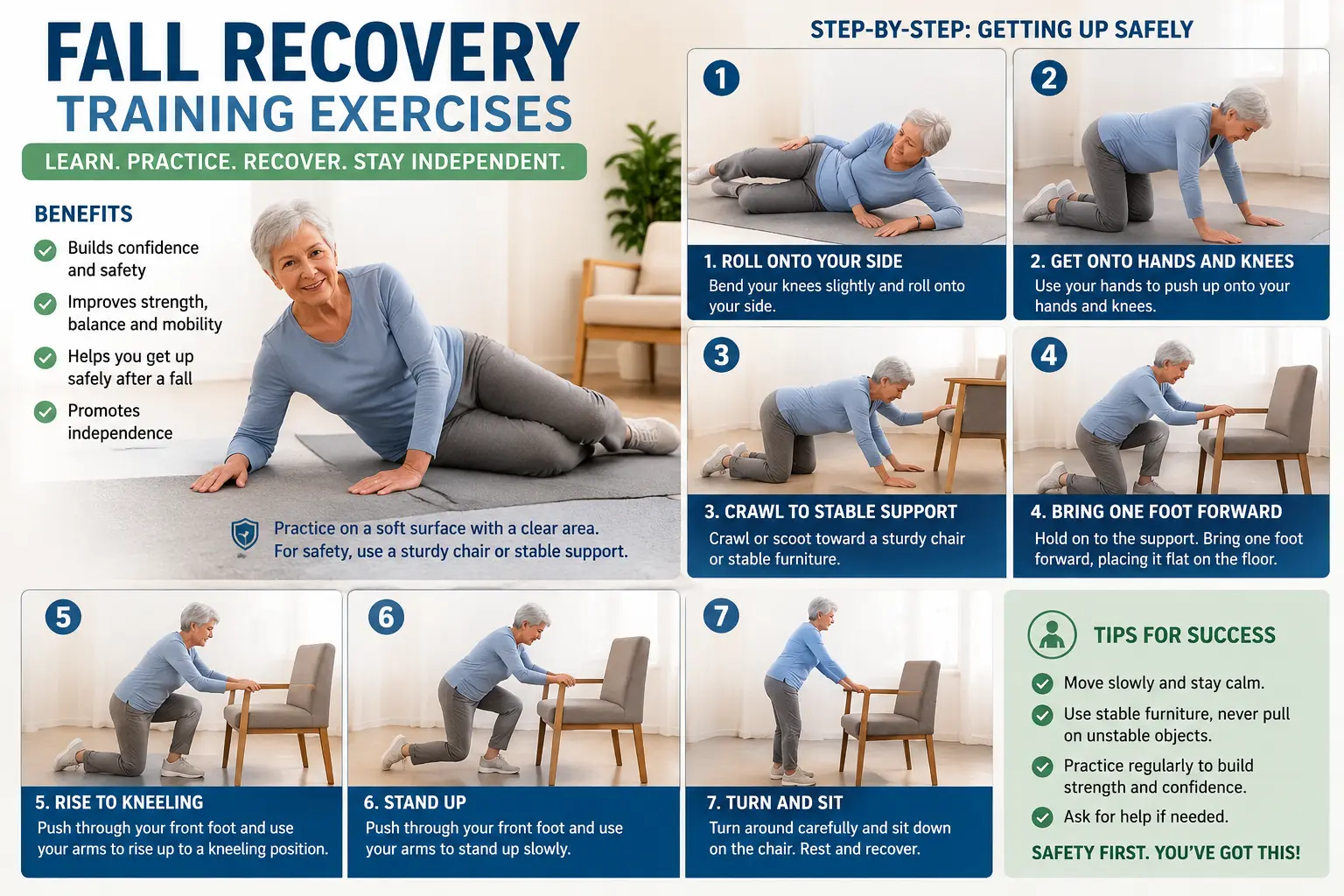
These exercises may include practicing rolling onto one side, moving into a hands-and-knees position, crawling to a stable support, and using a chair or sturdy furniture to stand up safely. They also focus on improving leg strength, core stability, flexibility, and balance, all of which contribute to safer mobility in daily life.
It is important to perform fall-recovery exercises under the guidance of a physiotherapist or other trained healthcare professional, especially for beginners or individuals with medical conditions. As strength and confidence improve, these techniques can become an essential life skill, helping people maintain independence, reduce injury risk, and continue participating in everyday activities with greater safety and confidence.
Fall Recovery Training Exercise
Sit-to-Stand Exercise

The sit-to-stand exercise enhances balance, body mechanics, and leg strength—all of which are critical for lowering the risk of falls.
- 1. To begin, take a seat on a sturdy, standard-height chair that won’t roll or slide.
- Place a solid surface, like a countertop, in front of you so you may grab onto it for support if you start to feel unstable while standing. Move your buttocks to the front of the seat by scooting forward.
- 2. Shift your entire weight forward by leaning your chest forward over your toes. Gently raise yourself to a stable standing position by contracting your gluteal muscles.
- 3. Return to the starting position slowly, then repeat ten times.
- 4. If you need assistance standing or sitting, put your hands on the chair’s armrests or seat and push through them. The aim is to avoid using your hands at all.
Twice a day, complete ten repetitions.
Stop and consult your physician or physical therapist if you get pain in your knees, back, or hips.
Feet apart and Feet together
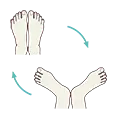
Place your feet shoulder-width apart, keep your eyes open, and remain still for ten seconds, gradually increasing to thirty.
Just keep doing this exercise until you can perform it with little assistance or swaying if you regularly find yourself grabbing for the wall or counter or wobbling. Proceed to the following exercise if you are able to maintain this posture for thirty seconds.
Work your way up to 30 seconds by standing with your feet together, keeping your eyes open, and holding still for 10 seconds.
Proceed to the next exercise once you can perform this one for 30 seconds with little assistance or nervousness.
Toe Stand

To strengthen the muscles in your ankles and calves:
- For balance, cling to a sturdy object, such as the back of a chair.
- Maintain a straight back while bending both knees slightly.
- Slowly lower your heels to the floor.
- Ten to fifteen times, repeat.
Knee Curl

To strengthen the muscles in your lower back and buttocks:
- For balance, cling to a sturdy object, such as the back of a chair.
- Maintain a straight back, place your feet shoulder-width apart, and bend both knees slightly.
- Bend your knee and bring your heel to your buttocks after lifting one leg straight back behind you.
- Return to a standing position by slowly lowering your leg.
- For each leg, repeat 10 to 15 times.
Fall Risks
Fall risk in older persons is typically associated with several factors, such as:
- Issues with walking and/or balance. Changes in vision, vestibular issues, and changed foot sensation can all have an impact on balance.
- The use of numerous drugs.
- Orthostatic hypotension, which occurs when blood pressure falls when standing, is an example of positional low blood pressure.
- Problems with feet and shoes
- Falls frequently happen in a dark bedroom at night while getting up fast and tripping on the way to the bathroom, or in the bathroom when sitting or standing from the toilet or shower.
Additional Steps to Prevent Falls
Recall that discussing fall prevention with your physician or physical therapist is important.
- Discuss drugs and modifications in your exercise routine.
- If you fall, let your doctor know.
- Request assistance from a friend or relative to check your house for trip risks.
How to heal faster after a fall?
Getting up quickly from a fall requires careful, step-by-step attention to evaluate damage and promote fast healing. The quickest way to bounce back is to stay put immediately after the fall, apply the R.I.C.E. method for minor soft-tissue injuries,ies and get an early assessment to decrease the risk of escalation.
1. Action & Evaluation (Immediate)
Pause and breathe. Don’t get up right away. A minute of lying still takes the shock out and prevents aggravating a possible injury.
Pain assessment: Be alert for severe pain, dizziness,s or numbness in your body.
Safe to get up: If you are not injured, roll to your side, push yourself up on your hands and knees, es and crawl to a sturdy piece of furniture (heavy chair or couch). Use it to stabilize yourself as you slowly take a step forward, kneel, then push yourself up to stand.
Get help: If you can’t safely get up, yell, push a personal emergency response button, or call 911. In the meantime, find a blanket in the area or crawl onto a softer rug to keep warm.
2. Dealing with minor bruises and sprains
For minor aches, sprains,s and bruises, speed up the healing process with the proven R.I.C.E. method:
Rest. Restrict motion and activity in the involved area during the first 24 to 48 hours.
Ice: Use a cold compress on the affected area for 15 to 20 minutes at a time, several times a day, to help control swelling and inflammation.
Compression: Wrap the bruised or sprained area with an elastic medical bandage, but don’t make it too tight.Elevation:n Elevate the injured extremity on pillows so that it is higher than your heart to prevent fluid accumulation.
3. Professional medical assessment
See your doctor: Even a minor fall can result in internal injuries and delayed soreness. A doctor can rule out fractures, concussions, or deep tissue tears.
Physical Therapy: If you’re struggling with ongoing problems with mobility, a physical therapist can help you with specific exercises to build muscles, improve balance, and get moving comfortably again.
When to get emergency care immediately: Call 911 or go to an urgent care center if you have severe, unmanageable pain; can’t put any weight on the affected limb; see a deformity in the limb; hit your head and feel confused or nauseous; feel dizzy for a long time.
What to do after a fall in the elderly?
If an elderly person falls, stay calm and check for injuries before moving him or her. If they are unconscious, confused, bleeding heavily, or in severe pain, call 911 immediately. If they are not injured and can get up,p help them slowly using strong furniture for support.
Here are some important steps to ensure their safety:
1. Evaluate the Situation
First, hold still: Encourage them to take deep breaths and rest for a few moments to get over the initial shock.
Check for injury: Ask where it hurts. Look for cuts, bruises, or swelling, or any obvious deformities (such as a foot that is turned out or a shorter limb).
When to call 911: Don’t move the person if they have pain in the head, neck, or back, can’t move, are bleeding a lot, or are confused.
2. When They Can’t Get Up (Waiting for Help)
Request for Help: Call for help with a personal medical alarm, cell phone, or smart device (e.g., “Hey Siri” or “Okay Google”).
Keep them warm – cover them with a towel, jacket, or blanket.
Avoid stiffness: Encourage them to gently move their non-injured joints every 30 minutes until help arrives.
3. If they can safely stand up
Never try to lift a senior completely upright by yourself; you could hurt yourself and the senior. Rather, guide them through the following steps:
Roll over on their side and sleep.
Gradually push up onto the hands and knees.
Place the strongest leg flat on the floor, grab the furniture, and push up to a half-standing position.
Change around, sit down slowly, and recover.
4. Follow-Up Post-Fall
See a doctor: Even if they feel fine, always schedule a visit with their primary care doctor. They need to be checked for underlying injuries such as hairline fractures or delayed head trauma.
What is the cause? Talk about why the fall happened. It may be related to tripping hazards in the home, but more often than not it’s related to medication side effects, dehydration, or problems with vision.
Preventing future falls: Look for safety hazards in their home (loose rugs, poor lighting) and talk to their doctor about balance exercises, vision checks, or mobility aids.
FAQs
What are the 5 P’s of fall?
The 5 P’s of fall prevention is a practical, patient-centered framework used by caregivers and healthcare professionals to anticipate and manage patients’ most common needs, drastically reducing the risk of accidental falls.
The 5 P’s: Pain: Ascertain if the patient is in any pain and treat this immediately so that the patient is not tempted to move unassisted to find relief.
Potty: Help with the toilet, commode, or urinal. Rushing to the bathroom is a frequent cause of falls.
Position: Ensure the patient is sitting or lying in a comfortable, safe position and that any support devices required (e.g., orthotics) are applied correctly.
Periphery / Placement:t Ensure that essential personal items (call light, phone, water, glasses, and reading material) are within easy arm’s reach to avoid dangerous stretching or reaching.
Pump: Verify that all medical devices, such as IV pumps and monitors, are correctly plugged in, operational, and do not pose a trip hazard.
Does lifting weights help bone density?
Yes. Weight lifting is effective in boosting bone density. Lifting puts your muscles into action, pulling on your bones and creating mechanical stress. It stimulates the bone-building cells (osteoblasts) to lay down new tissue, so your skeleton becomes thicker and stronger over time.
What vitamin helps rebuild bone after a fracture?
Exercises that stress strength training and balance can lower the chance of falling, even though falls cannot be totally prevented.
Can exercise reduce my fall risk?
For the first 72 hours, ice for 20 minutes every hour. In fact, applying ice for an extended period of time reverses its effects and may worsen edema. Frostbite can happen if chemical ice packs are applied directly to the skin. Heat will worsen swelling, so avoid using it for the first 72 hours.
How do you reduce inflammation after a fall?
If you have a stress fracture, a fractured bone, or have had a joint replacement, make sure you receive enough calcium and vitamin D to strengthen your bones because these nutrients are linked to healthy bones. The finest sources of calcium and vitamin D are low-fat dairy foods.
References
- Comeau, K. (2025, December 1). How to get up from the floor after a fall: Safe techniques you can practice now. Propel Physiotherapy. https://propelphysiotherapy.com/injury-prevention/how-to-get-up-after-you-fall/
- Exercises to help prevent falls: MedlinePlus Medical Encyclopedia. (n.d.). https://medlineplus.gov/ency/patientinstructions/000493.htm
- Kevin. (2024, July 11). 5 Strength training exercises to prevent falls. Motiv8 Fitness Gym Waterford. https://motiv8.ie/strength-training-fall-prevention/
- St. Andrew’s Resources for Senior System. (2024, May 23). Fall Recovery Guide for Seniors. St. Andrew’s. https://standrews1.com/blog/fall-recovery-guide-for-seniors/
- Unknown. (n.d.). I have fallen, and I can get up. https://www.o3a.org/files/2019/03/I_Have_Fallen_and_I_CAN_Get_up.pdf
- Vital Home Health Services. (2025, November 24). Simple Fall Prevention Exercises for Seniors to do at Home. https://vitalhomehealth.com.au/simple-fall-prevention-exercises-for-seniors-to-do-at-home/