How to Gain Muscle at Home Without Equipment
Introduction
These days, “lift heavy” seems to be the solution to everything, doesn’t it?
Although weightlifting has many advantages, particularly for women, it is not necessary to develop strength and body shape. For a lot of individuals, using their own body weight to work out is sufficient.
We’ve compiled a list of body-burning exercises that don’t require weights, whether you work out at home or want to take a break from the dumbbells.
Practice your program two or three times a week to see results. Find out how many sets and repetitions each move requires by reading on. Additionally, don’t let the lack of equipment deceive you. You will still put in a lot of effort with this combination of bodyweight, plyometric, and cardio activities.
Muscle Gain Exercise
The warm-up
Before you begin, warm up. Walking or jogging at a fast pace for five minutes will suffice. To reduce pain, stretch or use a foam roll afterward.
Rotational jacks

Rotational jacks, a variation on the jumping jack, are an excellent way to start a workout. They will warm your muscles and increase your heart rate.
Instructions:
- Start with your knees relaxed and your stance broad. Make sure your arms are parallel to the ground by extending them straight out at your sides.
- Hinge forward at the hips and turn your body so that your right hand contacts the floor while keeping your arms straight and your head and neck still.
- Bring your feet together after returning to the beginning posture.
- Jump your feet out again right away, bend forward once more, and turn to the left while putting your hand on the ground.
- Go back to the beginning. Twist to the right once again after jumping your feet together.
- Perform three sets of 12–15 reps.
Plank reach-unders

Planks are a simple yet challenging workout that helps the entire body. Your core is further targeted by adding the reach-under.
Instructions:
- Put your hands in a high plank stance.
- Make sure your lower back doesn’t slump and that your core is braced. Your spine and neck should be in a neutral position.
- Raise your right hand off the floor and return it to your left thigh while tapping it with your fingers. Go back to a plank.
- Return to a plank, tap your right thigh, and repeat with your left hand.
- Finish three sets of twenty taps in total.
Step-ups

Your lower body will be burned by step-ups. They’re also excellent for improving stability and balance.
Instructions:
- Step with your feet together or begin standing in front of a bench that is knee height.
- Push through your heel and raise your left knee as you step onto the bench with your right foot.
- Step back off the bench by lowering your left leg.
- Perform 10–15 repetitions with your right leg, then switch and lead with your left leg for another 10–15 repetitions.
- Finish the three sets.
Mountain climbers

If you can perform a few sets of mountain climbers, there’s no need for weights. Your muscles and lungs will burn if you support your own body weight in addition to the knee thrust.
Instructions:
- Put your arms out in a high plank position.
- Drive your right knee up toward your chest while using your core and maintaining a neutral neck and spine. As soon as you extend it, raise your left knee to your chest.
- Repeat as quickly as you can while keeping proper form for 30 seconds.
- Finish all three sets.
Squat jumps
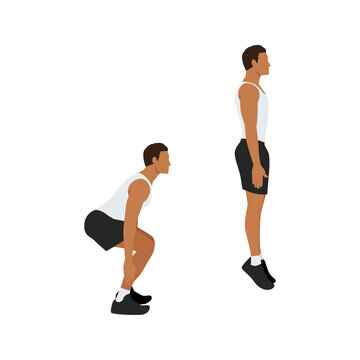
Exercises known as plyometrics call on your muscles to use a lot of force in a little amount of time. One of the best examples is the squat jump. With just a couple sets of them, you’ll get a lot for your money. Be cautious if your joints are sensitive because they have a heavy impact.
Instructions:
- With your hands together in front of you and your arms bent, lower yourself into a squat.
- Leap high, push through, and land back on the balls of your feet.
- Once you’re back on the ground, squat down and do it again.
- Perform three sets of ten to twelve repetitions.
Burpees

Instructions:
- To begin, stand upright with your arms by your sides and your feet shoulder-width apart.
- Put your hands out in front of you as you begin to squat. As soon as they touch the floor, lift your legs straight back to form a high plank.
- If required, place your feet outside your hands after bringing them as close to your hands as you can.
- Get to your feet and perform a jump squat right away.
- Once you’ve landed, extend your legs once again.
- continued with steps 3–4.
- Start with 15 repetitions.
Standing side hops

A comprehensive workout program should include lateral (side-to-side) movements. Hip and ankle mobility is greatly enhanced by standing side hops.
Instructions:
- With your feet together and your arms bent at a 90-degree angle at your sides, begin standing. You should have soft knees.
- Jumping to the right while keeping your feet together, taking off and landing on the balls of your feet.
- Jump back to the left as soon as you touch down.
- For three sets, repeat 20 reps.
Pullups

Even experienced exercisers find it difficult to perform a normal pull-up. However, the reward is worthwhile. You can still benefit from using a pull-up band.
Instructions:
- Place your hands slightly wider than shoulder-width apart while standing below a pull-up bar.
- Pull yourself up by bending your arms and drawing your elbows toward the floor after lifting your feet off the ground and hanging from your arms.
Squat pulses
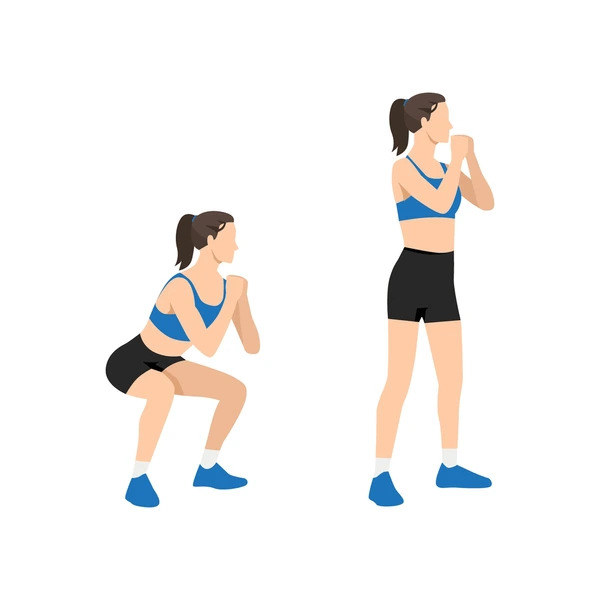
Time under stress, or the amount of work your muscle does throughout a workout, is increased when you hold a squat position and pulse there. Experience the burn!
Instructions:
- Put your hands together in front of you and squat down.
- Push through your heels and raise yourself a little, then lower yourself back down.
- For thirty seconds, repeat.
- Finish the three sets.
Flutter kicks

Flutter kicks focus on your hips as well as your core. You’ll be feeling it the next day after three sets of them.
Instructions:
- Make a 90-degree angle with your body by lying on your back on a mat with your legs up in the air.
- Keeping your lower back in contact with the ground, slowly lower your right leg as far as it will go.
- Return your right leg to start, and lower your
- left leg down the same way.
- Perform three sets of 20 total repetitions.
Pushups

Pushups are fundamental but not easy; they call for core and lower body stability in addition to upper body strength. They’re a universal workout that can be easily adjusted (drop to your knees or perform off an elevated surface like a bench).
Instructions:
- With your palms right under your shoulders, your neck neutral, and your pelvis tucked in, begin in the plank position. Additionally, be careful to move your shoulders between each other.
- Bend your elbows while keeping them tucked under your body to start lowering your body while maintaining a flat back, and support your core. Reduce your height till your chest touches the ground.
- As soon as possible, raise your body back to the beginning position by extending your elbows.
- For three sets, repeat as many times as you can.
Broad jumps
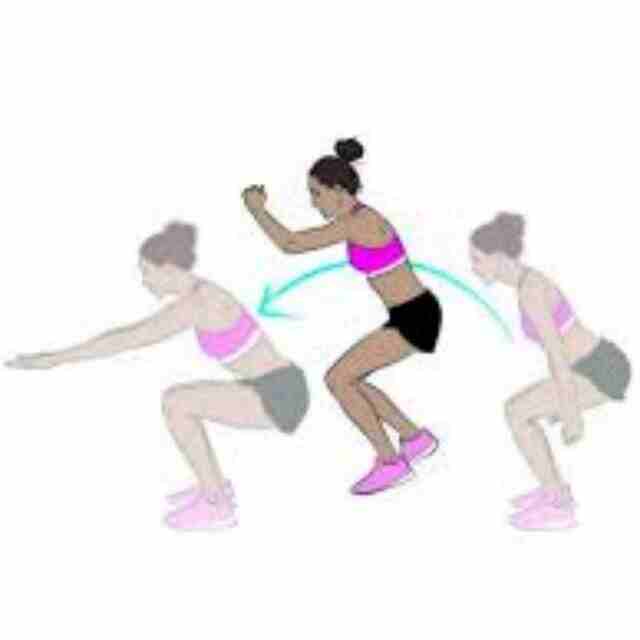
Broad jumps are another high-impact move that burns a lot of energy since they need a lot of effort (see a theme here?).
Instructions:
- Place your arms at your sides and stand with your feet shoulder-width apart.
- Use the explosive energy from your half-squat to jump forward while simultaneously throwing your arms forward.
- Place your weight slightly forward and land with a gentle foot.
- Perform three sets of ten repetitions.
Split squats

Your body’s major muscles, the glutes, quadriceps, and hamstrings, will benefit greatly from any exercise. Split squats are exactly that.
Instructions:
- To create a staggered stance, take a big step forward with your left foot. Evenly divide your weight between the two feet.
- Lower your body until your left knee makes a 90-degree angle while bending your knees.
- Repeat 12 times with a push-up. Repeat after switching legs.
FAQs
At what age is it hardest to gain muscle?
There is no difference in the rates of muscle growth between individuals aged 18 and 39, according to research. In their late 30s and early 40s, many professional bodybuilders and athletes achieve their physical peak. With regular exercise, you can successfully gain muscle throughout your 40s.
What foods ruin muscle gain?
Sadly, a lot of highly processed and packaged foods, including desserts, candies, and doughnuts, won’t provide you with the best energy to build muscle. When concentrating on growing muscle, these can be avoided. Alcohol can hinder rather than improve physical performance, which has been demonstrated to impede recovery.
How bad is muscle death?
However, an uncommon illness known as rhabdomyolysis can cause muscle death and breakdown in a small number of people in need. Kidney failure and even death may follow from the toxins that the body experiences when the muscles deteriorate.
What is the best vitamin for muscle regeneration?
B6 vitamin
When it comes to muscle regeneration and bodybuilding, the B vitamin family is a major contributor. You should consume adequate amounts of this vitamin since it can assist the body’s natural production of nitric oxide, which can support endurance and performance, as well as the formation of red blood cells.
What drink builds muscle fast?
One scoop of whey protein can be mixed with water and consumed without any preparation. It rapidly digests, creates over 20 different types of amino acids, and helps construct new muscle fibres, which promotes optimal recovery and muscular growth.
Is it possible to build muscle at home without equipment?
Absolutely yes, you can build muscle at home without equipment. You can get great muscle growth by doing bodyweight exercises and using progressive overload, which is the process of constantly making your workouts harder over time.
Top Strategies for Growth at Home
To grow muscle without weights, you have to stimulate your muscles differently:
Progressive Overload: As you get better at a bodyweight exercise, you need to make it harder. You can do this by slowing down your movements (i.e., 3 seconds to get down), pausing at the bottom of a movement, or adding reps.
Advanced Variation: Develop more advanced variations of basic movements. For example, progress from regular push-ups to decline or one-arm push-ups.
Nutrition: Sufficient protein for muscle building. Aim for about 1.6 to 2.2 grams.
Is it possible to build muscle without weights?
Sure, you can totally build muscle without weights. For muscle growth (hypertrophy), your muscles need the right mix of mechanical tension, muscle damage,e and metabolic stress. Since you’re not adding external weight, you just have to push your body in other ways to stimulate that growth.
1. Use Progressive Overload
You need to make your bodyweight exercises harder and harder over time, just like you would add weight to a barbell.
Use More Challenging Variants: Move up from regular pushups to decline or one-arm pushups. Instead of regular squats, do pistol squats (squats on one leg).
Add Reps & Sets: If you can do 15 reps of an exercise easily, then you’re not building muscle anymore, you’re building endurance. The goal should be 3 to 4 sets of 8 to 12 hard reps.
2. Control your pace
Slow down your movements to make your muscles work harder without the added weight.
Eccentric (Lowering) Phase: Take 3 to 4 seconds to lower yourself (i., squat or push-up).
Concentric (Lifting) Phase: Explosively lift or push over 1-2 seconds.
Isometric Holds: Pause for 2 to 3 seconds at the bottom of the movement for a serious muscle burn.
3. Focus on Main Bodyweight Exercises
You won’t be isolating muscles with dumbbells, so compound movements will be your best friend to hit multiple muscle groups.
Chest, Shoulders & Triceps: Push-up, pike push-up, and chair dip.
Back Biceps: Pull-ups, chin-ups, inverted rows (you can do these using a doorway pull-up bar or a sturdy table).
Legs & Glutes: Lunges, step-ups, wall sits, and bodyweight squats.
4. Fine-tune Your Nutrition
Exercise breaks down muscle, but the right fuel can build it up.
Eat more calories than you burn: Your body needs energy to build muscle.
Focus on protein: Aim for roughly 1.6 to 2.2 grams of protein per kilogram of body weight to help muscles repair.
What is the 3 3 3 rule for workouts?
Enter the “3-3-3 rule,” a wildly popular minimalist fitness framework that makes exercise realistic and sustainable. This can mean two things: a weekly split (for workout frequency) or an exercise structure (for individual workouts).
1. The Weekly Split (Frequency Emphasis)
This setup gives you a balance of time, so you don’t overtrain or burn out.
Strength Training – 3 x week: Builds muscle and protects joints (e.g., weights, bodyweight circuits, resistance bands).
3 days of Cardio: Raise your heart rate and increase your stamina (such as running, cycling, dancing, swimming).
3 Days Rest / Active Recovery: Allows your muscles to recover (i.e, light walking, yoga, stretching).
Note: There are 9 focus days and only 7 days in a week, so you will often be combining short days.
For example, you could do a 20-minute strength circuit, followed by a 10-minute walk for active recovery.
2. The Exercise Session (Focus on Simplicity)
This structure simplifies your gym time by only focusing on three foundational elements.
3 Exercises per workout: Stick to the big movements: squats, pushups, lunges.
3 Sets Per Exercise: Each exercise is performed 3 times.
3 Repetitions / Minutes Do 3 sets (commonly understood to mean working for a certain period of time, such as 45 seconds on, 15 seconds off).
Sample 3-3-3 Session
Here’s an example of a 30-minute typical full-body strength routine that uses this method:
Goblet Squats – 3 sets of 10 reps
Dumbbell Chest Press – 3 x 10 reps
Planks: 3 sets of 45 seconds each.
What muscle is hardest to grow?
The calves are the one muscle that is the hardest for most lifters to grow. They have a high ratio of slow-twitch muscle fibers that are fatigue-resistant because they are constantly used for walking and standing.
Some of the other notoriously resistant muscles are:
ABDOMINALS: These need very low body fat to show and often have strict anatomical growth limits.
Forearms: Like calves, forearms are heavily conditioned due to the daily gripping and carrying. Targeted hypertrophy is difficult.
Upper Chest: The clavicular head (upper pec) is a stubborn muscle because it is often neglected when flat bench pressing.
Rear Deltoids: “Small, under-trained muscle that needs perfect isolation form and is easily overshadowed by larger back muscles.
Overcoming the Challenge:
Full Range of Motion: Stretch the calf out at the bottom of each rep.
High Frequency & Volume: These muscles respond best to training three to four times a week due to their rapid recovery.
Heavy, Controlled Eccentrics: Instead of bouncing, concentrate on slow descending phases and pause at the bottom of movements.
At what age do you gain muscle the fastest?
Muscles grow fastest from late teens to mid-20s (ages 17–25). This is your physiological “prime” powered by peak testosterone levels, high growth hormone production, and fast rates of cellular repair.
The main stages of muscle development are:
Teens to Mid-20s: The absolute fastest time to build muscle. Rapid hypertrophy and recovery due to high levels of natural hormonal output and metabolic rates
Mid-20s to mid-30s Muscle maturity and maximum overall strength generally reside here. Natural growth hormone levels decline a bit, but the body is still highly responsive to resistance training.
Age 40 and Beyond: After age 30, muscle mass decreases by about 3% to 5% per decade, and muscles become less efficient at synthesizing protein (called anabolic resistance).
How to get a curvy body?
In order to develop a curvy, hourglass figure, you must build muscle in your lower body (glutes and thighs) and upper body (shoulders and lats), while keeping your core toned. The most effective strategy is a mix of targeted strength workouts and a balanced diet emphasizing your natural silhouette.
Purpose Driven Strength Training
To build muscle, weight lifting will create curves, not just cardio. Try 3-4 weight-lifting sessions a week.
Lower Body: Widen your hips by building your glutes and thighs. Include compound movements such as Squats, Hip Thrusts, and Deadlifts.
Upper Body: Make your shoulders and back wider to create a V-taper, which makes your waist look smaller by comparison. Try Lat Pulldowns, Shoulder Presses
Core: Work on deep core exercises to keep your midsection toned instead of bulky.
References
- Cronkleton, E. (2026, May 14). How to get a Full-Body Strength Training workout at home. Healthline. https://www.healthline.com/health/exercise-fitness/strength-training-at-home
- Davies, D., Hayes, A., & Neudecker, K. (2025, May 7). 32 bodyweight exercises to pack on muscle at home. Men’s Health. https://www.menshealth.com/uk/building-muscle/a756325/10-best-bodyweight-exercises-for-men/
- Davis, N. (2020, May 29). 13 Body-Burning moves that require no weights. Healthline. https://www.healthline.com/health/fitness-nutrition/no-weight-workout
- Kamb, S., & Kamb, S. (2026, March 13). Bodyweight workout for beginners (20-minute at-home routine). Nerd Fitness. https://www.nerdfitness.com/blog/beginner-body-weight-workout-burn-fat-build-muscle/
- MSc, U. T. B. (2026, May 16). Building Muscles Without Weights? Yes, it is Possible! Muscle & Motion | Visual Anatomy & Biomechanics. https://www.muscleandmotion.com/blog/building-muscles-without-weights/
- Physiologist, J. H. C. E. (2026, March 13). Strength exercises. British Heart Foundation. https://www.bhf.org.uk/informationsupport/heart-matters-magazine/activity/strength-exercises