
Prasarita Padottanasana
What is Prasarita Padottanasana?
Prasarita Padottanasana, also known as the Intense Leg Stretch position, is a standing position suitable for beginners that consists of an inversion and forward stretch. Beginner-level forward bending poses like Wide-Legged Forward Bend provide a deep stretch in the hips and hamstrings, along with an incredible expansion of the torso.
The practice may seem profound and soothing after a long series of standing poses or after jogging, walking, or cycling. In addition to many other full inversion poses, it is a useful preposition for headstand, shoulder stand, and handstand.
Among the many advantages of this pose is the strengthening of the leg muscles. Additionally, it stretches the lower back, hamstrings, hips, calves, and knees—all of which are crucial for preserving elasticity and flexibility.
Because you need to tighten these muscles to maintain your body’s bend and balance, it’s also a posture to strengthen your core. The nicest thing about this pose is that it is adaptable and suitable for various types of exercisers, thanks to its three additional modifications.
The fact that this stance is not one of the conventional hatha yoga poses will be interesting. It first appeared in the Iyengar style of yoga and was later used as a transition posture in Ashtanga, vinyasa, and power yoga.
Muscle Work During Prasarita Padottanasana:
- Lower Back Muscles
- Core Muscles
- Gluteus Muscle
- Hamstring Muscle
- Hip Muscle
- Pelvic Muscle
How to Perform Prasarita Padottanasana?
- With your hands on your waist, stand erect and tall on the ground in Tadasana, also known as Mountain Pose.
- Place your feet three to four feet apart. Spread your weight equally across all of your feet’s corners while keeping your feet parallel to one another.
- Turn your heels slightly outward and your toes slightly inward to line the edges of your feet with the edges of your mat.
- Stretch upward through the crown of your head to lengthen your body.
- Rather than arching your lower back, gently bend from your hips.
- Keeping your back long and your chest open, place your hands on the floor or blocks beneath your shoulders. With the fingertips pointing forward, the palms should line up with the feet.
- Press into the feet and extend the legs to bring the hips closer to the ceiling.
- Stretch your body further inward as you exhale, strengthening your abdominal muscles and bringing your stomach closer.
- Both the palms and the top of the head should be on the ground. Keep your body weight on your legs rather than the crown of your head.
- For at least ten to fifteen seconds, maintain this posture.
- Raising your head off the floor and then slowly lifting your torso are the initial steps in releasing the pose. Bring your feet together slowly, then return to Tadasana.
Benefits:
- Stretches the muscles in the lower back and opens the hips.
- Tones the lower back muscles and relieves hip tension and stiffness.
- Enhances the spine’s range of motion, flexibility, and length.
- Improves digestion and metabolism by toning and massaging the muscles of the trunk and abdominal organs.
- When the legs are stretched wide, the hips, hamstrings, and quadriceps become more elastic, strong, and mobile.
- Enhances the flexibility of the calf and ankle muscles while toning and strengthening them.
- Uses the inversion to improve blood flow to the head.
- Reduces tension, stiffness, and stress in the shoulders and neck.
- Enhances the prana flow, which decreases.
- Encourages concentration and focus since you need to make sure your body is stable and balanced.
- Delivers a profound sense of contentment and relaxation while calming the neurological system.
- Improves blood flow to the brain, which reduces anger, worry, and sadness.
Beginner’s Advice:
- Your height and stability determine how far apart your legs should be. To determine the optimal position, try a variety of distance modifications. You might not be stable in this position if you stretch your legs too far.
- It’s far more important to extend your body than to put your head on the ground. You should cease bending as soon as you feel your back curving.
- If your lower back or the backs of your legs feel tight, bend your knees as much as you need to.
- You can bend your body halfway so that your torso is parallel to the floor if your lower back or hips are tight and stiff.
- You can rest the crown of your head on a cushion, a stack of folded blankets, or a yoga block if you are a beginner and find it difficult to put your head on the floor.
- You can also put your hands on blanket stacks and yoga blocks.
- This pose tends to lead shoulders to drop, so make sure your shoulder blades are pulled together and down your back.
- After bending, make sure your feet, palms, and head are all in alignment.
Modifications:
- Hands on Blocks: Place your hands on yoga blocks to raise the floor.
- Microbend your knees: To ease hamstring strain and safeguard your joints.
- Support for the Wall: Practice facing a wall and using it for support or balance.
- Greater or Reduced Position: Adapt the stance to your comfort level and degree of flexibility.
Variations:
Prasarita Padottanasana B:
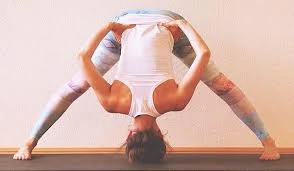
Lift your hands off the ground and place them on your waist after entering Prasarita Padottanasana A. With your hands positioned so that your elbows point forward or in the same direction as your toes, rotate your shoulder outward.
If your shoulders are too tight for you to reach your hands to your waist, you can alternatively use a strap.
This version opens your chest even more and provides your shoulders with more flexibility.
Prasarita Padottanasana C:
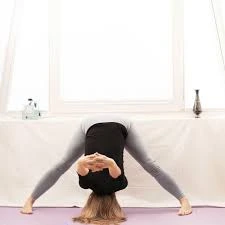
Once you reach the last pose of Prasarita Padottanasana A, raise your hands off the floor and turn your shoulder so that your arms are behind you. Point your fingers in the same direction as your toes while interlocking them.
If your shoulder, upper back, and chest permit, try bringing the hands closer to the floor. You can either keep them lifted or try to bring them closer to your hips.
This variant expands the chest and increases the stretch in your upper back and shoulders. The upper arm muscles will be targeted by positioning the arms towards the ground or the hips.
Prasarita Padottanasana D:

Once you are in Prasarita Padottanasana A, grasp your big toes with your palms. Using the thumb and the first two fingers, grasp the big toe.
To grip the toes, simply extend the space between your arms while maintaining the original attitude. Maintain a stacked elbow position on the wrists.
Your shoulders, upper back, upper arms, and chest will all get more stretch from this variant.
Precautions and Contraindications:
- Instead of bending from the waist, bend from the hips.
- This pose puts a lot of strain on the abdomen, so do it on an empty stomach. Wait at least three to four hours before striking this stance if you’ve already eaten.
- Keep your head off the ground. Just place it on the ground.
- Do not do this position if you have recently been injured, sprained, or had surgery on your hips, thighs, back, neck, ankles, wrists, or knees.
- If you experience headaches, migraines, vertigo, or high blood pressure, avoid doing this inversion stance.
- People who have fibromyalgia or arthritis in the lower body should not execute this pose or proceed with extreme caution.
- People with scoliosis, kyphosis, advanced cervical and lumbar spondylosis, herniated discs, and other spinal problems should avoid this position due to the deep extension of the spine.
- If you have heart disease or have had heart surgery, it is crucial to avoid such excessive inversions.
- This pose should be avoided by pregnant women who are far along in their pregnancy.
Common Mistakes:
- Rounding the Back: Prior to profoundly folding, concentrate on stretching the spine.
- Locking the Knees: Use your thigh muscles or maintain a little bend.
- Sinking into the Heels: To be balanced, keep your weight slightly front.
- Allowing the Head to Hang Too Early: Maintain alignment and control throughout the fold
- Forcing the Fold: Allow time, breath, and gravity to determine the depth.
FAQs
What is a wide-legged forward bend in yoga called?
Padottanasana Prasarita. Prasarita Padottanasana, also known as Wide Stance Forward Bend (IAST: Prasārita Pādottānāsana), is a standing forward bend pose used in modern yoga.
What is the wide-legged forward fold pose good for?
Wide-Legged Forward Fold Pose’s Advantages:
Reduces tension.
Eases lower back tension.
Allows your hips to open.
Relieves tension in your shoulders and neck.
Stretches your inner legs, particularly your hamstrings, and your back.
Makes your core stronger.
What are the limitations of Prasarita Padottanasana?
Prasarita Padottanasana ABCD contraindications:
Spinal damage (avoidable since the spine is getting longer), Heart disorders or prior cardiac surgery (avoid because of the inverted nature), High blood pressure (use a chair and avoid lowering your head by keeping your spine parallel to the floor).
What are common mistakes in Prasarita Padottanasana?
Typical Errors to Avoid When Rounding the Back: Before profoundly folding, concentrate on lengthening through the spine.
Locking the Knees: Use your thigh muscles or maintain a little bend.
Sinking into the Heels: To keep your balance, keep your weight slightly forward.
How does one feel after performing prasarita padottanasana?
Calms the Mind and Lowers Stress: Prasarita Padottanasana and other forward folds are inherently calming. This inverted posture, in which the head is positioned towards the chest, can have a calming effect on your nervous system and induce introspection and serenity.
What are the benefits of wide wide-legged forward bend?
The Wide-Legged Forward Bend can help relieve lower back pain by stretching the ankles, calves, hamstrings, groin, and lower back. You can experiment with different hand positions, adjust the width of your feet, and twist it.
What muscles does Prasarita Padottanasana stretch?
The hips and legs, particularly the hamstrings and calves, are deeply stretched by Prasarita Padottanasana I. For those with a shorter backline, this is fantastic. As the primary area of muscle activity in this position, the knees and legs gain strength and stability.
References:
- Wide-Legged Forward Bend (Prasarita Padottanasana): How to Do, Variations, & Benefits – Fitsri Yoga. https://www.fitsri.com/poses/wide-legged-forward-bend
- Wide-Legged Forward Bend Pose Yoga Pose (Prasarita Padottanasana). Tummee. https://www.tummee.com/yoga-poses/Prasarita Padottanasana
- YogaRenew. (2025, November 11). How to – Prasarita Padottanasana (Wide-Legged Forward fold). https://www.yogarenewteachertraining.com/yoga-poses/standing-wide-legged-forward-fold/