Broad Jumps
Introduction:
Broad Jumps Exercise is a powerful plyometric exercise that helps improve lower-body strength, explosive power, balance, and coordination.
Explosive exercises like broad jumps can be utilised to improve cardiovascular fitness, strength, power, and coordination. It’s a more difficult version of the squat leap that works the muscles in the arms and upper body in addition to the lower body, which includes the glutes, hamstrings, quadriceps, and calves.
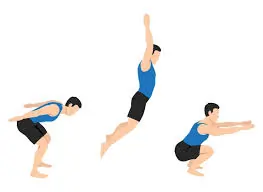
Squatting down and then leaping as far forward as you can while landing in the bottom of the squat stance is the broad jump. This dynamic exercise is great for people who want to improve their sports performance because it uses a lot of energy and can enhance explosive movements and reaction times.
Muscle Work During Broad Jumps:
- Gluteus Maximus Muscle
- Quadriceps Muscle
- Hamstring Muscle
- Calves
- Core Muscles
How to Perform?
- Take a shoulder-width stance and stand tall. The most effective way to jump is from this foot stance.
- Bend at the knee and press your hips back to start squatting. To avoid your knees sinking in, push them outward when you bend.
- To generate momentum, swing your arms back and then forward as your thighs reach parallel to the floor. Push through both feet simultaneously to move ahead. You will travel farther if you use more force.
- As you descend, bend your knees to reach the bottom of the squat.
- Push the ground away with both feet to stand again, being careful to drive through the entire foot rather than just the heels.
- To prevent locking your legs out, keep your knees slightly bent while you stand tall. Squeeze your glutes gently, but do not thrust your hips forward, as this might cause lower back discomfort.
Benefits:
- Explosive Power: Using dynamic jumping techniques, it develops fast-twitch muscle fibres.
- Cardiovascular Fitness: Rapidly increases heart rate, improving endurance and stamina.
- Strength and speed: Combined for significant calorie burn in metabolic conditioning.
- Core Stability: Needs control when jumping and landing.
- Balance and coordination: It improves movement patterns that support running, sprinting, and agility-based sports.
- Gamification: It is a mental challenge and a way to make your workouts more engaging because it covers ground.
Beginner’s Advice:
Compared to other squat variations, broad hops are a high-impact, high-energy exercise that places greater strain on the knees and hips. We would advise switching to a different squat variant or changing your broad jump by landing on the balls of your feet rather than jumping into the air if you are recovering from an injury or are prone to pain in these areas.
If you’re new to squats, focus on mastering the bodyweight squat or goblet squat to gain muscle and protect your joints. This will enable you to execute broad jumps with strength and force.
Modification:
- We must leap forward in space to perform broad jumps. There are other ways to engage multiple muscle groups at once if this seems too difficult or too intense for you.
- Try a jump squat if you’re looking for a change. You’ll still be following similar motions and exerting all of your energy to launch yourself off the ground.
- The change is just a jump in place, which will require less energy than moving forward and minimise the effect on the joints.
- Maintain a straight posture with your arms by your sides and your feet hip-width apart. Stretch your arms behind your back while bending your knees.
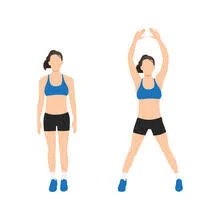
- Before leaping off the ground, shift your weight to the balls of your feet. Before landing on the ground, leap straight up into the air, straighten your legs, and raise your arms above your head.
Exercises that will help you perform broad jumps:
Squat:

Squat steps:
Bend your knees and sit your hips back while standing with your feet shoulder-width apart. With your thighs parallel to the floor, bend until you are in a squat. For balance, extend your arms in front of you. After a few moments of holding, push yourself back up to the beginning position with your glutes. Ten times over, repeat.
Calf Raises:

Place your feet shoulder-width apart and keep your arms by your sides. To make things harder, hold a weight in each hand. By pushing up through your toes and shifting your weight onto the balls of your feet, use your calves to lift your heels off the ground. Put your heels back on the floor. Ten times over, repeat.
Forward and backward Jumps:
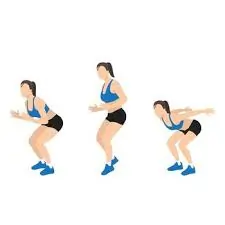
Place your feet hip-width apart as you stand. Stretch your arms behind you and bend at the knees. Swing your arms up toward the sky to gain velocity as you leap forward a few steps. Bend your knees and gently land. Leap back a few steps using the same motions. Do this ten times, front and back.
Arm swings:

To perform a half-squat, bend your knees. Make sure to keep your arm muscles active as you swing both arms back, forward, and up over your head in an exaggerated manner (rather than swinging them casually). You can practise controlling your arms while using them for momentum, just like you would in a broad jump, by doing this.
Common Mistakes:
It’s crucial to keep in mind that jumping, in general, and broad jumps in particular, are high-impact exercises that are taxing on the knees and other joints. Therefore, I would suggest sticking with the modification or just doing squats if you have problems with your knees, hips, or ankles.
Because they require a lot of energy, broad jumps can be challenging for beginners or for people who aren’t used to engaging multiple muscle groups simultaneously. Many of my clients have swung their arms excessively, causing them to lose control.
Additionally, I’ve witnessed folks manoeuvre with insufficient vigour, simply making a slight forward leap. It’s crucial to give it your best and get off the ground, even though it takes practice to figure out what feels right. Remember these pointers to steer clear of these typical blunders:
- To keep momentum going, swing your arms, but don’t let them get out of control.
- To ensure that your upper and lower bodies remain coordinated, keep your body moving in a controlled manner while using your core.
- When you jump forward, use all of your might to explode off the ground and land with your knees bent. Avoid locking your knees!
FAQs
Are broad jumps good for you?
One of the best full-body exercises you can incorporate into your own training is the broad jump. This exercise burns a ton of calories and develops explosiveness, power, and coordination. It’s a fantastic technique for developing strength and endurance, and it’s also an athletic test.
Are broad jumps bad for the knees?
Jumps, particularly broad and multi-response jumps, are taxing on the knees. Multiple jumps executed quickly, one after another, are known as multi-response jumps. Fatigue and a breakdown in technique are more often the issue here than the jump itself.
Are broad jumps safe for beginners?
For young athletes, the wide jump is a safe and efficient approach to practise explosiveness and compete with one another. To attain a complete extension from the ankles, knees, and—most importantly—hips, they must be taught to press their feet deeper and deeper into the earth.
What are common broad jump mistakes?
The Burpee Broad Jump has an incomplete hip extension. You may either keep jumping short or drive your hips to full extension; either way, your glutes are either working nonstop or are asleep.
Do broad jumps build muscle?
Over time, broad jumps contribute to our increased strength and power. The exercise develops the core, engages the upper body, and tones the lower body from the calves to the glutes. The exercise helps us become more coordinated because it works multiple muscle groups.
References:
- This high-impact cardio exercise will work every single muscle group – 2022/www.today.com/health/diet-fitness/broad-jumps-exercise-rcna12075
- Broad Jumps- Pure Gym/www.puregym.com/exercises/plyometrics/jumps/broad-jumps