
Single Leg Deadlift
Introduction:
Single Leg Deadlift is a powerful unilateral exercise that targets the glutes, hamstrings, and core while improving balance and stability.
High levels of balance, coordination, and unilateral leg strength are necessary for single-leg deadlifts, which are an intermediate to advanced type of deadlift. This exercise works the erector spinae and core muscles in addition to the hamstrings and glutes.
Reducing muscular imbalances and increasing general strength can be achieved by unilateral training, which involves working out one side of the body before switching to the other.
Exercises that train the body unilaterally can lower injury risk and work well for bilateral lifts. In this case, the single-leg deadlift will improve other deadlift variations, such as the sumo or conventional deadlift. Our stronger side can frequently take over and make up for the weaker side during large movements like deadlifts or squats. This increases the likelihood of muscle imbalances, which can impede development and result in harm.
Although they require less load than other deadlifts, single-leg deadlifts can be performed with dumbbells, kettlebells, or barbells. While traditional deadlifts and other bilateral variations tend to emphasise strength and power, the single-leg deadlift calls for greater stability, control, and mind-to-muscle connection. Choosing a lesser weight and concentrating on control is preferable to using greater weights with bad form.
Muscle Work During Single Leg Deadlift:
- Hamstrings Muscle
- Glutes Muscle
- Lower Back Muscle
- Core Muscle
How to Perform?
- Place your feet hip-width apart as you stand. Place your weight on your right leg while bending your right knee gently.
- In the direction of the wall behind you, kick your left foot. Reach your hands forward toward the wall in front of you while doing this until your left leg and upper body are in a single line, roughly parallel to the floor.
- Lower your left foot and lift your chest to get back to standing with your arms by your sides. (Optional: As demonstrated above, add a knee drive with your left leg to propel your right arm forward in a running motion.)
- One rep, that is. Do three sets of 8–12 repetitions on each side.
Equipment used for the Single Deadlift:
Your Body Weight: As mentioned above, bodyweight single-leg deadlifts are an excellent warm-up or for novices.
Resistance Band: Hold onto the other side of a resistance band with one or both hands while looping the other side or end under the foot of your standing leg. Another option is to secure a band to a railing, door, or wall in front of you.
Dumbbell(s): One or two dumbbells can be used for single-leg deadlifts, as demonstrated below.
Kettlebell: If you enjoy kettlebell training, try a kettlebell single-leg deadlift. You can use two kettlebells, one in each hand, or a single bell in the hand on the side of your raised leg.
Cable Machine: If you’re at the gym, you can use a cable machine to perform single-leg deadlifts. Holding the handle on the same side as the leg extending backward, set the anchor point to the lowest setting.
Differences Between Romanian Deadlift and Single Leg Deadlift:
According to Peloton coach Jess Sims, Romanian deadlifts, also known as RDLs, are bilateral, meaning they engage both legs simultaneously. On the other hand, single-leg deadlifts are performed on just one leg, as the name suggests.
Because RDLs don’t need balance, you should be able to lift more weight than with a single-leg deadlift. However, RDLs don’t strengthen your foot, ankle, and hip stabiliser muscles as much as single-leg deadlifts because they don’t present a balance difficulty.
Benefits:
- Although single-leg deadlifts might seem like a move for elite athletes, everyone who wishes to move properly throughout their life can benefit from practicing these vital skills.
- For the general public, single-leg deadlifts are an excellent way to practise balancing and lifting objects off the ground. She frequently employs them with clients recuperating from foot, ankle, knee, and hip problems because they strengthen the stabilisers in these areas.
- They are also beneficial because they only work one side of the body at a time, making them unilateral exercises. Because it reveals deficiencies and areas where your body may be overcompensating—that is, when your stronger side essentially takes up the slack for the weaker side and is therefore frequently overworked and prone to injury—unilateral activity is crucial to incorporate into your exercise regimen.
- Single-leg deadlifts are particularly beneficial for runners. You never run on both legs at once; it’s important to work each leg separately.
Tips for Beginners:
Learn the hinge first. Before attempting the single-leg variant, make sure you know how to execute a Romanian deadlift or hip hinge. To properly recruit your glutes and hamstrings, you must move at the hip joint rather than arching or rounding your back.
Remain square. Avoid letting your hip rotate open as you tilt forward; instead, maintain your shoulders, ribs, and hips parallel to the floor. Try focusing your attention on a single spot on the floor that is one or two feet ahead of you if your hips are tilting as a result of your inability to balance. As an alternative, you might rest one hand on a wall or bench for support.
Begin softly. Even if your leg isn’t parallel, you can still benefit from a single-leg deadlift. Start with a limited range of motion to become accustomed to your body’s position in space as you’re strengthening and improving your balance, then progressively expand it.
Adapt your depth appropriately. When doing single-leg deadlifts, you should stop and raise yourself back up when you reach the lowest position you can while maintaining a flat back or when you are unable to maintain your balance and must use your other foot for support. When utilising weights, begin by lowering the weight to your knee and, as you become comfortable with the movement, work your way up to mid-shin.
Variations:
Kickstand or Staggered-Stance Deadlift:
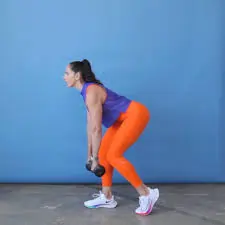
- Place your feet hip-width apart to begin standing. With your right leg gently bent, shift your weight into it. Balance on your toes and place your left foot slightly behind you. With your hands facing your body, hold a dumbbell in each hand in front of your hips.
- Hinge at your hips to push your glutes backward while maintaining a flat back, a long neck, and an engaged core. Lower the dumbbells along your right leg while bending your right knee until they reach shin height or your right hamstring starts to stretch.
- Squeeze your right glute and raise your chest to restart after pausing and exhaling.
Dumbbell Single-Leg Deadlift:
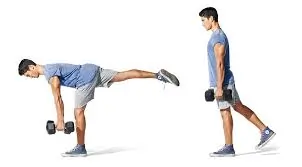
- Place your feet hip-width apart as you stand. With your right leg gently bent, shift your weight into it. With your hands facing your body, hold a dumbbell in each hand in front of your hips.
- Maintaining your hips straight to the floor, raise your left leg behind you while lowering the dumbbells along your right leg, while maintaining an engaged core.
- When the dumbbells are at shin height, stop until your left leg and torso are parallel to the floor or you feel a stretch in your right hamstring.
- Squeeze your right glute, drop your left leg, and raise your chest and dumbbells to begin again, always maintaining the weights close to your body. Pause, then release your breath.
Contralateral Single-Leg Deadlift:
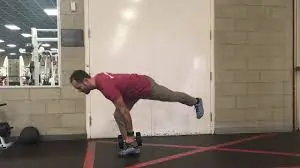
- Place your feet hip-width apart to begin standing. With your right leg gently bent, shift your weight into it. With your palm facing your body, hold a dumbbell in front of your pelvis with your left hand. For balance, extend your right arm out to the side.
- Maintaining your hips straight to the floor, raise your left leg behind you while lowering the dumbbell along your right leg, while maintaining an engaged core.
- When the dumbbell is at shin height, stop until your left leg and torso are parallel to the floor or you feel a stretch in your right hamstring.
- Keep the weight close to your body at all times while you clench your right glute, lower your left leg, lift your chest, and return to the beginning by pausing and then exhaling.
Common Mistakes:
Doing single-leg deadlifts before one is ready is a common mistake, according to Jess. To effectively enter and exit this posture without rounding your back, you must possess a certain amount of flexibility. Practice single-leg deadlifts with a restricted range of motion, staggered-stance deadlifts, and classic RDLs until you master them.
According to Jess, bending too much at the knees will alter the muscles used. In a similar vein, Archambault suggests keeping the standing leg slightly bent rather than locking out the knee.
Lastly, Jess advises against opening your hips to the side. This would indicate that your standing leg’s hamstring is not being worked adequately, which is just where you want to feel the burn.
FAQs
What are single-leg deadlifts good for?
A unilateral exercise that mainly targets the posterior chain muscles, which include the hamstrings, glutes, and lower back, is the single-leg deadlift. Additionally, they use the obliques and abdominals, two core muscles, to keep the movement stable and balanced.
Is the single-leg deadlift better than squats?
Overall, I think squats and deadlifts are better than any single-leg exercise. A single-leg deadlift requires a completely different form than a standard deadlift. Additionally, utilising one leg instead of two does not put more strain on the back. It’s similar to performing a deadlift with just one arm.
How many single-leg deadlifts should I do?
You should use a light weight for single-leg deadlifts in order to keep your balance, thus you should be able to push yourself to do 6–12 repetitions. As an alternative, you might aim for high repetitions in the range of 15 to 20 if you’re improving your muscle endurance.
In comparison to a regular deadlift, how much should you lift with a one-leg deadlift?
Since you can only use one side of your body for power, and greater balance and coordination are required, the load you can lift with a single-leg deadlift will be significantly less than with a normal deadlift. Choose a weight that will allow you to maintain your balance while still experiencing hamstring and gluteal tightness.
What is the most common injury from deadlifting?
Deadlifting has the same risk of injury as any other lifting activity. Strains to the muscles and ligaments are the most frequent injuries. These typically occur when lifting is done improperly or when the weight is excessively heavy.
References:
- Single-Leg Deadlift | Technique, Benefits, and variations – 2024 – Perez Grande/www.kettlebellkings.com/blogs/default-blog/single-leg-deadlift?srsltid=AfmBOoou7gdsC6i9-Mf3XOHJAVu-RwrLFOtSkRbnDincKIxT4PwzSSND
- How to do a Single-Leg deadlift—and why they’re a functional strength staple – 2025 – Mazzo/www.onepeloton.com/blog/single-leg-deadlift
- How to do single leg deadlifts/www.puregym.com/exercises/legs/hamstring-exercises/deadlifts/single-leg-deadlift