

Triceps Strength: The Benefits And Progression Of Ring Dips
Introduction
Ring dips are an advanced bodyweight exercise that significantly enhances triceps strength while also engaging the chest, shoulders, and core.
The majority of strong forearm movements are produced by the triceps brachii and biceps brachii. The single muscle on the posterior upper arm is the triceps, a structure with three heads. Although the three heads originate from different places, they are connected to the olecranon process of the ulna by a single tendon. Every head comes from a different place:
Long head: the lower border of the scapula’s glenoid cavity
Posterior humerus and lateral head
The distal two-thirds of the posterior humerus make up the short head.
The primary elbow extensor is the triceps brachii. While elbow extension is the primary function of the triceps, other upper-body actions also include the muscle. For instance, the long head extends the arm at the shoulder since it comes from the scapula. Triceps exercises include push-ups, shoulder presses, dips, and bench presses. To put it another way, the triceps brachii will be activated during upper body pushing and elbow extension exercises.
To “target” the triceps—more accurately to train certain heads—bodybuilders use separate exercises. For elbow extension exercises, it is essential to keep in mind that all three heads will be “used.” Because muscles function as a unit, they cannot be turned on or off like a light switch. All three heads are activated in the majority of triceps brachii movements; home activities may be more difficult for some heads than others, particularly when the grip and arm position alter.
The exercises that follow combine both conventional and cutting-edge functional movement routines. The resistance either moves through, against, or with gravity, which is why the three isolation workouts were decided. Your client’s training schedule and fitness objectives will determine the quantity of sets, repetitions, tempo, and length of recovery intervals.
Triceps Strength Exercises
Cable Rope Extension
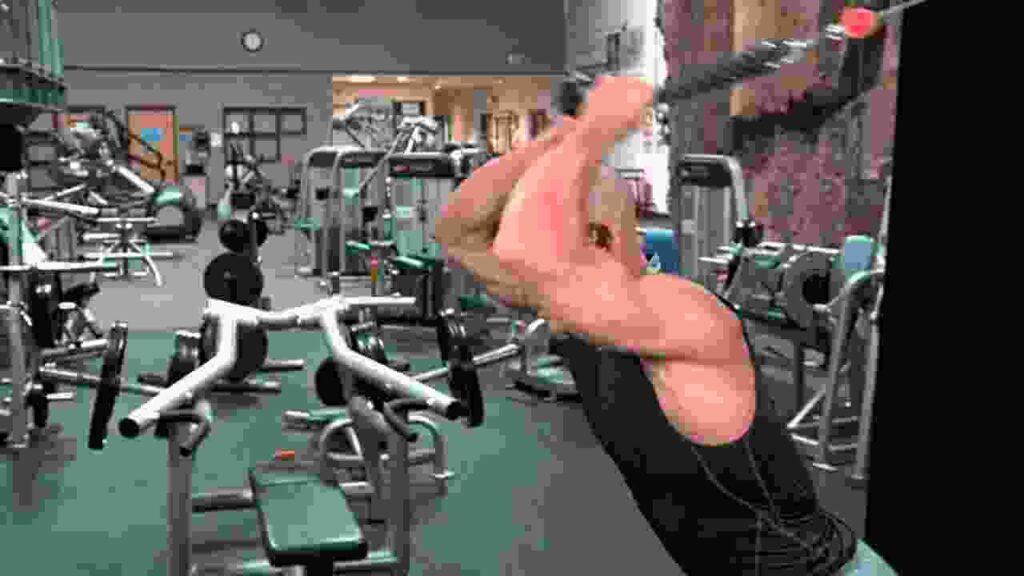
First, adjust the cable’s weight and height. To keep your spine neutral when in a split-foot stance, slightly bend forward from your hips. With your elbows bent, raise the rope above your head. At full arm extension, divide the rope by extending your elbows. Maintaining stress on the cable, return to the overhead position and repeat.
Bench Dips With Rotation
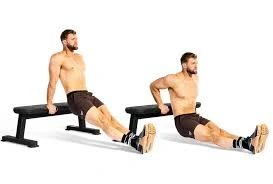
With your fingers pointing down, position your palms next to your hips while seated on a bench. Bent knees make this pose simpler than straight legs. Raise your hips off the bench and lower your body until your elbows are 90 degrees bent.
Return the arms to their initial position. After extending your arms, reach your right hand across your body’s midline. In order to engage your core muscles, you should rotate from the torso. It will stabilise the left arm. Reach the left hand across the body’s midline after returning the right hand to the bench and dipping it. Both isometric and isotonic muscle stimulation are used in this workout.
2-4 Push-ups

Put your body in a plank position. Elevate the push-up on a bench if necessary. For two counts, lower your body toward the floor. Your hands at your shoulder level. This exercise will engage the triceps more when the elbows are closer to the body.
Skull Crushers
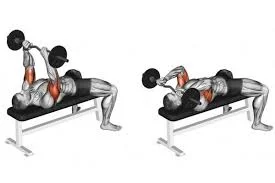
You can use a weighted barbell or a heavy dumbbell for this workout. Bring the weight over your shoulders while lying on a bench. Make a 90-degree angle at the elbow by lowering the hands toward the forehead. Repeat after extending the arms to the beginning position.
Cable Press-downs
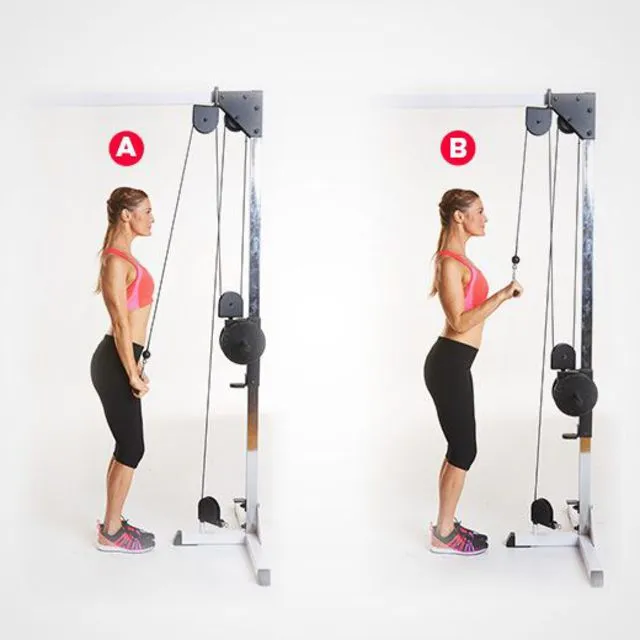
Use a flat bar on the cable for this workout. First, adjust the cable’s weight and height. To provide resistance on the bar during the workout, the cable should be adjusted to a specific height. With the arms at a 90-degree angle, place the elbows beneath the shoulders. Press the bar down toward the hips while extending your arms.
What are ring-dips?
One of the most difficult training activities you may do on gymnastic rings is the ring-dip. In addition to having incredible strength to complete a set of dips, you also need to maintain your balance at all times, which calls for excellent control over your own strength and the right body type to perform ring-dips correctly.
In general, ring dips are an excellent workout to improve the flexibility of your shoulders and triceps. It basically includes using gymnastic rings for dipping. Because of the rings’ instability, it is regarded as an extremely difficult workout and a goal for many people who are gaining muscle and strength.
Muscle Worked in Ring-Dips
Ring dips are a challenging workout that most beginners find challenging. This is mostly because gymnastic rings are unstable, which basically requires you to constantly engage your muscles to stabilise yourself on the rings.
For instance, relying too much on ligaments combined with a lack of muscle and strength control frequently leads to serious injuries, which can be prevented if you can strengthen your joint muscles. Additionally, ring dips are a fantastic technique to improve your gymnastic ring skills if you plan to execute more gymnastic exercises in the future.
What are the benefits of doing ring-dips?
Ring dips are excellent for joint health, body control, and improving your gymnastic abilities in addition to strengthening the muscles in your arms, shoulders, and chest. Your body might develop damage resistance around your joints by performing ring dips.
This is because the exercise applies stress to your joints, which leads to the development of stronger muscles as well as improved body and strength control. Gymnastic ring exercises significantly rely on your strength, control, and ability to control movements made while on the rings.
It might be difficult for someone who is not familiar with them to gain a strong grip on the rings and maintain a straight posture. Ring dips are an excellent method to increase your control and skill, which makes them ideal for both cardio exercises and gymnastic ring workouts.
Executing ring-dips the right way
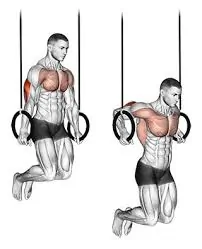
In order to ensure that your feet do not touch the floor during the workout, you must first adjust the height of the rings. To begin the workout, position yourself above the rings with your legs bent or straight, your arms extended, and supporting your body on them.
Another name for this is the “support hold” stance. Bend your elbows and keep your hands and shoulders close to your body as you lower yourself to begin. To avoid losing your posture, you must maintain control of these movements.
To prevent losing your posture and stopping the workout in the middle, it is necessary to have a firm grasp on both rings. Make sure your body is moving straight up and back down if you want to engage your triceps more. When executing the exercise, keep in mind that the more you lean forward, the more your chest muscles will be used.
How to make ring-dips easier?
We recommend considering the following to make ring-dips easier:
To begin the workout, make sure the rings are shoulder-width apart and that you have a firm grasp on both of them. Next, start with your arms outstretched and press down into the rings, as we have already discussed. At this moment, your elbows should go back, and your chest should lean forward.
Excellent physical control and a firm hold on the rings are necessary for this. At that point, your shoulders should drop behind your elbows. Maintaining proper posture during the workout requires that your hands stay close to your body. When your arms are fully stretched on the rings, you complete the exercise by returning to the starting support hold position.
Additionally, you can always decide to utilise resistance bands to ease your way in if completing ring-dips is too difficult at first. Before beginning a set of ring-dips, just put up a band over the bar where the rings are fixed and insert your knees into it. Your muscles should find it easier to support your body while you dip on the rings as a result. Another name for this is a band-assisted support hold position. Once you start to gain a stronger grip on things, you can progressively try to dip without using the rings.
Doing negative ring-dips is another piece of advice. This reduces the effort on your arms and shoulders to maintain your position during the entire exercise by having you fully descend from the gymnastic rings after each repetition. This is really helpful if you want to experiment and go gently until you feel more comfortable performing ring-dips without assistance.
Progression Of Ring Dips
Ring Support Hold
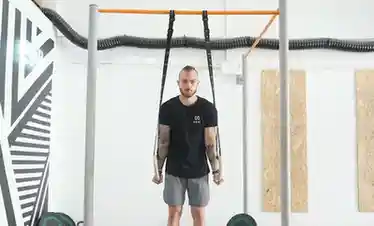
- Pinned out elbows. Lift your chest. Present your palms.
- Alright, so ring support holds are a very difficult workout.
- Be prepared if you are inexperienced with rings.
- how essential it is to have the rings externally rotated, and your elbows punch out forcefully.
- This is essential since it’s the shoulder’s safest position.
- Have faith that your body will seek out methods to facilitate it:
- Put your feet together.
- Put your legs behind your back.
- Shoulders and hands dive in
- Avoid doing any of those things.
- Four sets
- 10–15 seconds of ring support
Bottom Ring Dip Position Hold
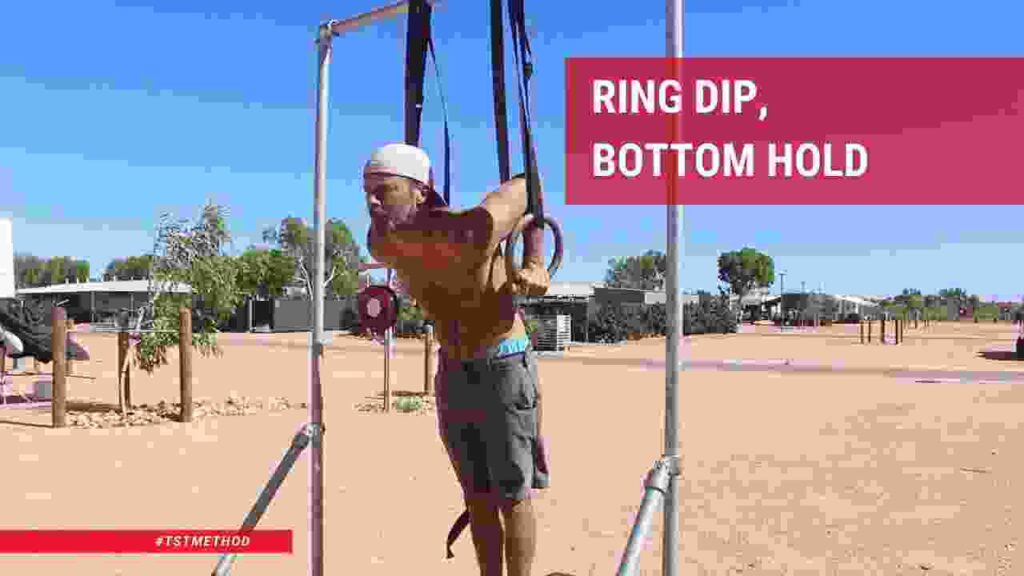
- To reach the bottom of the dip, you must commit oneself.
- Your shoulders will flare up if you only go halfway down, which will be more harmful than beneficial.
- Decide to descend all the way to the bottom of the dip position.
Conclusion
Are you prepared to perform ring-dips at this point? If so, be sure to start with the band-assisted support posture and attempt some of the assistance exercises we covered in this article. For many people, mastering dips is still a hard exercise.
Therefore, some initial support is anticipated. Regardless of how you start, keep in mind to enjoy yourself on the rings and avoid overdoing it to the point of damage. Being safe now is always superior to being hurtful later.
FAQs
How do I strengthen my triceps?
To effectively strengthen your triceps, do both compound movements like close-grip bench presses and dips and isolation exercises like cable pushdowns, skullcrushers, and overhead extensions. Train your triceps two to three times a week, with 8 to 12 reps per set. To get the most out of the exercise, keep your elbows tucked in and move slowly.
The Best Exercises for Building Stronger Triceps
These exercises work all three heads of the triceps (long, lateral, and medial) to help them grow and get stronger:
Cable Pushdowns (with a straight bar or rope): This is a basic exercise that focuses on keeping your elbows close to your sides and controlling the weight to work your triceps.
Skullcrushers (EZ Bar or Dumbbell): To work the long head of the triceps, lie on a bench and lower the weight toward your forehead while keeping your elbows pointing forward.
The close-grip bench press is a hard compound lift that works the triceps more than the chest.
Overhead Triceps Extensions: This exercise, which can be done standing or sitting with a dumbbell or cable, stretches the long head of the triceps the most.
Triceps Kickbacks: With dumbbells in your hands and your hips bent, focus on locking your arm behind your body to create the most tension.
Best Results: Training Tips
Best Frequency: Train your triceps twice a week to make them bigger.
Repetition Range: To failure, use a mix of heavy weights (6–8 reps) and moderate weights (8–12 reps).
Form Focus: To avoid using your traps or delts, keep your shoulders back and your chest up.
Time Under Tension: Don’t swing the weight. Move slowly and carefully, especially during the extension phase.
Elbow Position: To get the most out of isolation, keep your elbows still and tucked in while doing kickbacks and pushdowns.
Tricep Exercises You Can Do at Home
Push-Ups for the Triceps (Diamond Push-Ups): Put your hands close together right under your chest and keep your elbows close to your body.
Bench Dips: To do dips, use a strong chair or couch.
Side Lying Tricep Press: Lie on your side and use one arm to lift your body.
Resistance Band Pushdowns: Use a high-tension elastic band to simulate cable pushdowns.
Do triceps help with throwing?
The triceps brachii may play a significant role in valgus resistance by isolating the UCL from overuse. Particularly for athletes recovering from UCL injuries or high-velocity throwers, targeted triceps strengthening may lower the possibility of elbow problems.
Can weak triceps cause shoulder pain?
A weak long head of the triceps can lead to improper scapular alignment, which can cause shoulder pain, reduced throwing velocity, or restricted range of motion. Thus, the surrounding joints and muscles may compensate, leading to systemic issues in the shoulder area.
How to get insanely strong triceps?
Overhead Tricep Extension.
Tricep Dips.
Skull Crushers.
Tricep Pushdown.
Close-Grip Bench Press.
Diamond Push Ups.
Why is my dominant tricep weaker?
Your body grows more adept at using that dominant side over time—not because it is fundamentally stronger, but rather because it has had more practice. This is a perfectly normal neuromuscular adaptation.
Are triceps 70% of your arm?
Yes, the triceps make up about 65% to 70% of all the muscle in the upper arm. The triceps, which have three heads (long, lateral, and medial), are the main muscles that make up the arm. They make up about two-thirds of the arm and are the main reason why the arm gets bigger, thicker, and fuller.
Why Triceps Make Your Arms Grow:
Huge Structure: The triceps have three big heads, while the biceps only have two. This means that the triceps are naturally bigger and can grow more.
The “Horseshoe” Look: To get the thick “horseshoe” look on the back of the arm, you need to train all three heads of the triceps properly.
Main Training Focus: Training the triceps is a better way to get bigger arms than just doing curls.
The best exercises for growing your triceps are:
Long Head: Overhead extensions (very effective because they stretch).
Lateral Head: Weighted dips and tricep pushdowns.
Medial Head: Reverse pushdowns and close-grip bench press.
How do I target all 3 tricep heads?
To work all three heads of the triceps (long, lateral, and medial), do compound pushing exercises along with exercises that extend the arms overhead and down. Close-Grip Bench Press or Dips (lateral/medial), Overhead Extensions (long head), and Cable Pushdowns (medial/lateral) are some of the most important movements.
Overhead Extensions (Dumbbell or Cable) and Skull Crushers are the best exercises for the long head (inner/back).
Cable rope pushdowns, weighted dips, and close-grip bench presses are all good for the lateral head (outer/horseshoe).
Diamond Pushups, Reverse Grip Pushdowns, and Cable Kickbacks work the medial head (lower/deep).
A Sample Workout Structure
Weighted dips or close-grip bench press (3 sets of 6 to 10 reps) are examples of compound heavy.
Overhead Extension: Use dumbbells or cables to do 3 sets of 10–15 reps.
Cable Isolation: Reverse Grip Pushdown or Cable Rope Pushdown (3 sets, 12–15 repetitions).
Advice for Optimal Activation
Elbow Position: To preserve joints during heavy presses, keep your elbows tucked in.
Pay Attention to the Long Head. It works best when the arms are overhead because it crosses the shoulder joint.
Full Range: For full development, make sure you stretch and contract completely (lockout).
What two tricep exercises should I do?
Tricep Dips: Lower and raise your body between parallel bars to activate your triceps. For good form, keep your shoulders down, your chest straight, and your elbows tight to your body.
Push-ups: Lower and raise the body from a regular plank posture to strengthen the shoulders, chest, and triceps.
Which nerve causes tricep weakness?
Damage to the radial nerve, which runs down the arm and regulates movement of the triceps muscle at the rear of the upper arm, results in radial neuropathy. the capacity to bend the fingers and wrist back.
What are the signs of overtraining muscles?
Stiffness and soreness in the muscles.
Unexpected weight increase or loss.
Fear.
Inadequate sleep or feeling exhausted upon waking.
getting colds and other mild illnesses more frequently.
Can a 70-year-old build muscle?
Research consistently shows that with appropriate exercise, people in their 70s, 80s, and even 90s can significantly increase muscle strength, improve mobility and balance, enhance cardiovascular fitness, and significantly improve quality of life.
References
- 6 exercises for stronger triceps. (2023, February 27). https://www.acefitness.org/resources/pros/expert-articles/6112/6-exercises-for-stronger-triceps/?srsltid=AfmBOoqsBMjkSEzLeVDMEZa2lX452L7T9hIx41AMYGYOTIEW-wfhOP9B
- 8 triceps exercises for building strong arms, according to trainers. (n.d.). Nike.com. https://www.nike.com/a/best-exercises-for-triceps
- Apps, B. (2020, January 31). Progressions & Regressions: Ring Dips. Bulldog Gear. https://bulldoggear.com/blogs/news/progressions-regressions-ring-dips?srsltid=AfmBOoqxlWxrbOhiP1zVt7CqOp-fSgRr_I6R51GCEcfOV7i2cOICMgsF
- & Dip, P. (2023, August 2). Ring dips – how to do them and the top tips. Pullup & Dip. https://www.pullup-dip.com/blogs/training-camp/how-to-do-ring-dips
- Andres, K. (2022, January 7). Ring dips. K Squared Fitness. https://ksquaredfitness.com/ring-dips/
- CrossFit | The Ring Dip. (n.d.). https://www.crossfit.com/essentials/the-ring-dip


