15 Best Exercise For Shoulder Pain
Shoulder pain is a common issue caused by poor posture, overuse, or injuries such as rotator cuff strains or impingement. The best exercises for shoulder pain focus on gentle mobility, strengthening the rotator cuff, and improving shoulder stability to relieve discomfort and restore function.
Introduction
Shoulder pain is frequent and can be caused by several things, especially injuries, excessive usage, or other illnesses. Every day, causes of pain, which can range from acute to chronic, involve frozen shoulder, bursitis, arthritic conditions, tendinitis, and rotator cuff injuries—activities like carrying heavy objects (heavy school bags), or even sleeping positions.
Along with some broad therapy options, this page indicates some of the usual causes of shoulder pain. Additional details regarding your shoulder problems might be obtained from your physician.
Anatomy Of the Shoulder Joint
The shoulder joint is a ball-and-socket joint. There are three bones mentioned:
- The Humerus
- The Scapula
- The clavicle
A structure of muscles and tendons supports the arm bones in the inferior part of the shoulder socket. The term “rotator cuff” refers to these tissues. They are connected to the upper portion of the humerus.
Common Causes of Shoulder Pain
The most frequent cause of shoulder pain is rotator cuff tendon compression beneath the shoulder’s bony structure.
Destruction or inflammation develops in the tendons. Alternative names for this condition include bursitis and rotator cuff tendinitis.
Rotator Cuff injuries
- Tendinitis: Inflammation of the rotator cuff tendons.
- Tear: Tendon tear (Partial or complete).
Frozen Shoulder
- Shoulder joint stiffness and soreness that frequently starts slowly and gets worse over time.
Shoulder Impingement
- It happens when shoulder movements lead the rotator cuff’s tendons to become pinched.
Bursitis
- Inflammation of the bursa.
Shoulder Instability
- When the shoulder is lax and has the potential to slip or dislocate.
Arthritis
- Osteoarthritis: Degenerative changes of the shoulder joint.
- Rheumatoid Arthritis: An Autoimmune condition affecting joints.
Labral Tears
- Damage to the labrum and cartilage.
Fracture
- Scapular, humeral, and clavicle bone fractures.
Nerves issue
- Brachial plexus injury
- Referred Pain: Shoulder pain is based on complications with the neck (cervical spine).
Thoracic Outlet Syndrome
- Nerve or blood vessel irritation between the collarbone and the first rib.
Symptoms of Shoulder Pain
Depending on the aetiology, shoulder pain may be associated with several symptoms. Common symptoms include:
- Pain (Sharp, dull, or throbbing) at rest or during movements.
- Restricted range of movement and stiffness (difficulty moving the arm)
- Swelling around the shoulder
- Tenderness while touching the shoulder
- Weakness in the arm or shoulder muscles
- Sounds that pop, click, or grind when the shoulder is moved.
- Radiating Pain into the neck, upper back, or posterior aspect of the arm
- Tingling or numbness
- Limited range of motion
Mobility and Strengthening Exercise for Shoulder Pain
Arm circles

- An efficient way to increase mobility and warm up the shoulder joints is by doing arm circles. Pain in the shoulders and strain may be alleviated by performing arm circles.
- Raise the arms and extend them sideways so that the body forms a T.
- Use your arms to make tiny, circling motions.
- Rotation in a different manner after ten to fifteen seconds of repetition.
Child Pose

- Make the alignment between the hips and knees.
- Move forward at the hips and sit back on the heels so that the stomach rests on the buttocks.
- Reach your arms in front of your upper body while keeping your forehead firmly on the surface of the ground.
- For 30 seconds, maintain this posture.
Wand Exercise
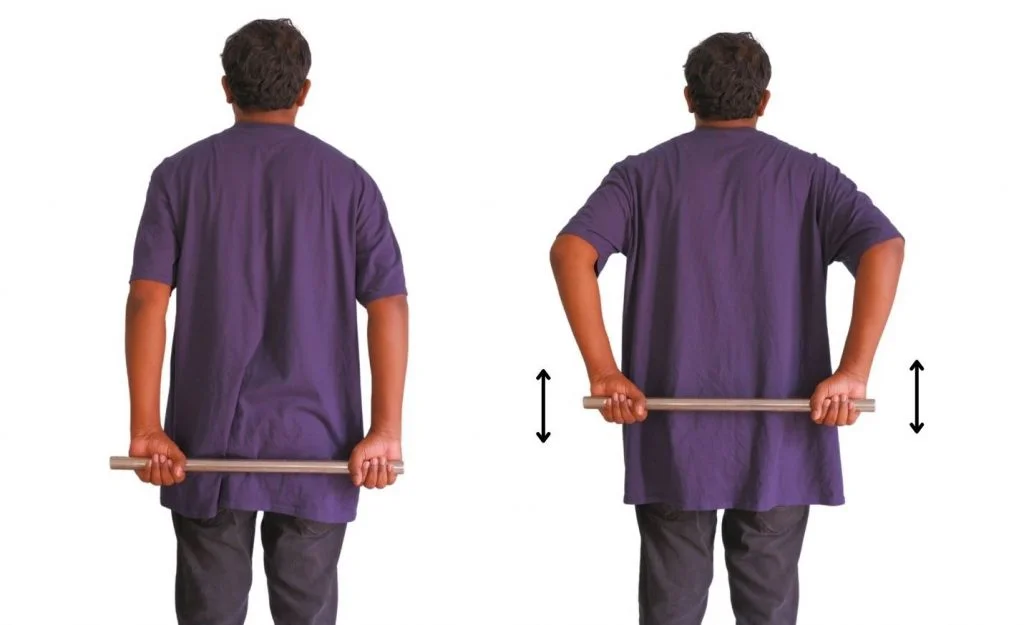
- Shoulder Abduction: The shoulder abduction movement is performed while holding the wand with both hands. Perform it eight times. Hold for 12 seconds. Finish both sets. Do this twice a day.
- Shoulder Flexion: While standing, lift the stick with both arms until your unaffected arm pulls up your affected arm. Do this eight times, holding for 12 seconds. Complete both sets. Do this two times a day.
- Shoulder Rotation: Hold the handheld instrument in your hand while standing with your elbow flexed. While your healthy arm does almost all the work, the damaged one should barely relax.
- Hold each exercise for 12 seconds for nine or ten repetitions.
Pendulum Exercise
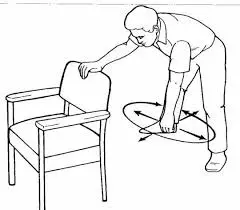
- Make sure your arm swings down by stooping at the waist. For support, you can use Plinth.
- Move your arm in a clockwise motion and an anticlockwise motion. Avoid a narrow base of support. To make your arm move in the exact opposite direction, reverse the motion you are making.
- Take a stoop position, and your arms should be relaxed. Swing your arm back and forth. Let your arm swing freely. Keep your arm relaxed and maintain a stoop position at the waist. You should add weight.
- You may want to rest against a table or chair for support. Swing your arm back and forth. Relax your arm. Swing without limitation.
Resistance band stretch for shoulders

- Wrap your fingers around a yellow or red elasticated resistance band, inwardly, and hold it in your hands. Elbow flexion at 90 degrees ensures alignment between your hand and shoulder.
- Pull the band to the maximum comfortable point while maintaining the same elbow posture at your sides, then hold it there for ten counts. Reorganise your hands about your shoulders gradually. Do this ten times. Try to complete this workout three times every day.
Crossover Arm Stretch
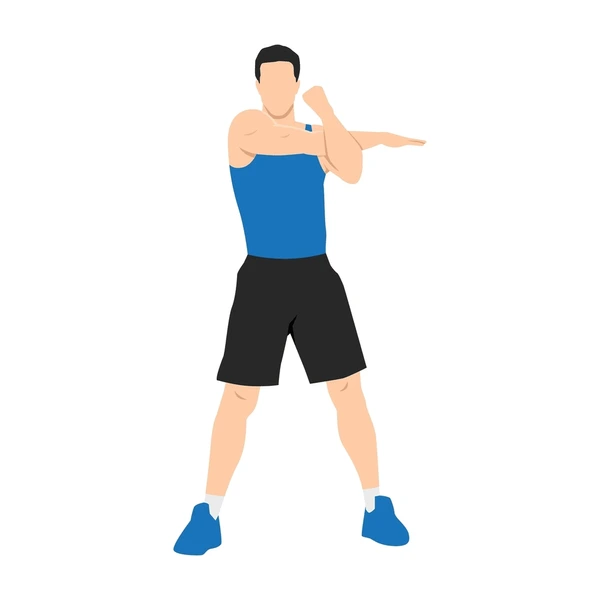
- Holding at your upper arm, progressively drop your shoulders and bring one arm as far across your chest as you can.
- Do the same with the opposite arm.
Pectoralis Stretch or doorway stretch
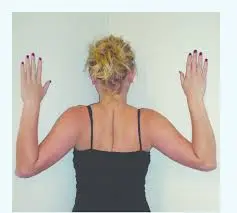
- Clasp your hands behind your back.
- Sustain the stretch by lifting and straightening your arms slightly and expanding your chest.
Shoulder blade squeeze
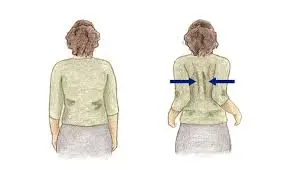
- Put your arms by your sides and sit or stand up straight.
- Pull your scapulae (shoulder blades) back and down gently, as though you were trying to fit a pencil between them. A light squeeze will be enough for this movement; it should not be pushed or overloaded.
- Hold this posture for five to ten seconds. A slight strain across your shoulder blades should be felt.
Lateral raises

- Start with a standing position, keep your base of support wide for proper alignment, and start with a minimum weight example, 500 g.
- Do not forget to use your core muscles.
- Lower the weights to the sides carefully.
- Do not forget to use your core muscles.
- Lower the weights to the sides carefully.
- Do this exercise between three and four times a week for two sets of 12 to 15 repetitions each.
Wall Slide
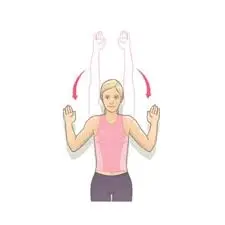
- Take a standing position with wall support.
- Elevate your arms till the wall is pressing up against your shoulder blades. The inner surfaces of your hands should face the wall, and your thumbs should be at head height.
- The angle at which your knees are bent is 45 degrees; any further lowering would put more strain on them. Your arms should extend straight above your head while maintaining against the wall, while you bend your knees and straighten your elbows.
Isometric Shoulder Flexion

- Start with a standing position.
- Make a fist with your elbow bent on the part of the shoulder you wish to work up.
- Apply pressure to the towel.
- Hold for 5 seconds, then slowly release.
Isometric Shoulder Extension

- Get up and stand in front of the wall to begin.
- Hold your hand down close to your hip while maintaining a straight elbow.
- Press your fist carefully against the wall behind you. You should not move very much while exercising.
- Maintaining the hold is very necessary while doing isometric exercise and then releasing it.
Isometric Shoulder Abduction
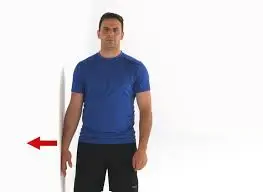
- Position yourself approximately six inches away from a wall, but make sure your upper body is parallel to it.
- You must put the shoulder you want to work out near the wall.
- Press your fist on the wall. For some extra comfort, you might want to use a folding towel.
- Release the strain on the wall.
Isometric Shoulder External Rotation

- Maintain your position six inches away from a wall, parallel to it.
- The shoulder that is nearest to the wall is the one on which you are working out.
- As if you were spinning your arm outwards, make a fist, elbows with 90-degree flexion, and apply force with your hand on the wall.
- If needed, add a little padding with a tiny towel.
- Apply Pressure against the wall for approximately five seconds.
- Release the strain on the wall gradually.
- If your pain worsens throughout your exercise routine, stop.
Isometric Shoulder Internal Rotation

- Face toward a door frame or a wall’s outside corner with your upper body in that posture. The corner or door opening
- As if you were trying to turn your hand inward into your pelvic region, flex your elbow 90 degrees, close a fist, and softly press into the door jamb or corner wall.
- It is compulsory to hold the movement while exercising, which increases strength.
Dignosis
Finding the aetiology is aided by a comprehensive clinical evaluation. During a physical examination and medical history review, a doctor may ask the patient to do several specific motions to evaluate the injury.
Additionally, if they require more information, they might order imaging and lab tests.
It might not be necessary to see a doctor right away if the pain is not extreme. Resting to see whether or not
The pain goes gone is what some folks would rather do. It is important to see a doctor for more evaluation if the discomfort does not go away.
- intense pain
- sudden swelling
- Weakness of the shoulder and arm muscles
- Inability to use the shoulder
- deformity
Treatment
Typically, treatment consists of resting and avoiding activities that make the feeling of pain worse.
A physician can also advise applying compression to the area to prevent swelling and providing heat or ice to the injury to relieve pain. Shoulder flexibility as well as power are enhanced by physical therapy.
You can get the right alignment of the body and support with devices and slings. Slings can be useful in treating shoulder fractures, dislocations, and separations. A physician will realign the bones before putting on a sling.
To relieve pain and inflammation, doctors may prescribe medications. To treat shoulder discomfort, doctors can also prescribe drugs and administer numbing agents or steroids straight into the shoulder.
For instance, severe rotator cuff tears or recurrent displacements may necessitate an early surgical consultation rather than a trial of at-home care; rotator cuff tears and adhesive capsulitis, for instance, can occasionally worsen with medicine and rest.
Orthosis For Shoulder Pain
Common Conditions Treated with Shoulder Orthosis:
- Rotator cuff injuries (tears, strains)
- Shoulder dislocations or subluxations
- Frozen shoulder (adhesive capsulitis)
- Post-surgical immobilization
- Shoulder instability
- Arthritis or bursitis
- Tendonitis
Types of Shoulder Orthosis:
Shoulder Immobiliser:
- Limits all motion.
- Used for dislocations or surgery.
- Maintains the shoulder alignment.
Shoulder Sling with Abduction Pillow:
- Keep your arm away from your body.
- Frequently used for rotator cuff surgery.
Compression Shoulder Brace (Neoprene or Elastic):
- Offers mild to moderate assistance.
- Enhances circulation and minimises inflammation.
- Perfect for early-stage injuries or persistent pain.
Clavicle Brace or Figure-of-Eight Brace:
- Primarily used for collarbone (clavicle) injuries.
- Helps align and stabilise the upper shoulder and neck.
Functional Shoulder Brace:
- Allows limited motion during rehab.
- Used in athletes or active individuals returning to sports.
Prevention of Shoulder Pain
Preventing shoulder Pain involves a mix of postures, strengthening exercises, and avoiding overuse.
- Posture Correction: Keep your shoulders relaxed while sitting or using your phone. Avoid poor posture while activity.
- Use an ergonomic set-up: Strengthening exercise. Focus on strengthening the scapular muscles(rotator cuff muscles) and scapular stabilisers (serratus anterior and trapezius)
- Stretching and mobility: The Pectoralis muscles stretch regularly. Shoulder mobility exercises such as the wand exercise, pendulum and towel stretch.
- Avoid Overuse: Do not repeat the same shoulder-intensive movements without rest.
- Take breaks and mix up your movements, especially in sports or jobs involving lifting.
- Sleep Position: When you sleep, remember not to put any pressure on the problematic shoulder.
- Use a firm type of pillow to keep the spine aligned(avoid hard and soft pillows).
Home Remedies For Shoulder Pain
In general, you can reduce your risk of getting arthritis by:
- Staying away from tobacco products. Your provider can provide details about support services and quit smoking guidance if you use tobacco products.
- Participating in non-weight-bearing, low-impact exercise. Maintain a healthy weight. Eating a nutritious diet, like the one offered by the Mediterranean diet.
- Decrease your chance of suffering joint damage. Decrease activities that could injure your shoulder. Consult your physician as soon as complications appear. Early detection of your shoulder issue can help you learn how to alleviate pain, modify or avoid specific activities, and prevent additional cartilage damage.
Risk factors
Those who participate in sports and other high-risk activities are more prone to developing shoulder pain, which can also lead to injury and strain.
Risk factors for shoulder pain include:
- Overusing your shoulder muscles is caused by your job.
- Performing sports like basketball, softball, baseball, football, gymnastics, or climbing
- Considering a history of gallbladder, liver, heart, or spine injuries
- Being older: as soft tissues like cartilage and tendons can deteriorate with time, it is more likely to occur after the age of 60.
FAQ
What are the best exercises for shoulder pain?
Wand exercise
Rope and pulley
Pendulum exercise
Wall slide
Finger ladder
Internal rotation with the theraband
Thoracic rotation
Chest Expansion
How to sleep with shoulder pain?
Examples of How to Sleep When Experiencing Shoulder Pain.
Maybe consider resting on your stomach or side instead of sleeping on your front. This certainly leads to pain for all kinds of shoulder impingement discomfort is frequently linked to rotator cuff issues; in such a case, you should take care to avoid other damage.
Is shoulder pain a symptom of anything?
A common symptom with multiple potential explanations is a shoulder ache. Your arms can move because of your shoulders. It is more sensitive to injury because of its broad range of motion. The most typical causes include muscular strains, dislocations, and arthritis.
When to apply ice or heat?
Ice is typically used to reduce swelling and inflammation in newly acquired or mild and acute injuries; heat is more beneficial for relaxing muscles and also increases the blood flow. For the first 72 hours after injury, ice is the most effective treatment; but, heat can be applied later to encourage circulation and relaxation.
How can you determine whether shoulder discomfort is joint or muscle-related?
Joint pain usually takes longer to go away than muscle pain, and it may also be accompanied by oedema around the joints. Because joint pain penetrates deeper than a muscular injury, it is likely to persist even while you are at rest.
What are isometrics for the shoulders?
Muscle-tightening exercises that don’t involve joint movement are known as isometric exercises. They increase circulation to develop and heal muscles with the least amount of joint aggravation.
How to increase shoulder ROM?
As far as it is comfortable, slowly extend your hands diagonally. Maintaining proper posture while sitting up straight and placing your thumb forward on a table towel. Simply expand the palm as far as it feels appropriate in a sideways motion. Return to the starting position slowly and perfectly.
Refrencess
References
- Shoulder pain and common shoulder problems – OrthoInfo – AAOS. (n.d.). https://orthoinfo.aaos.org/en/diseases–onditions/shoulder-pain-and-common-shoulder-problems/
- Wand exercises for shoulder recovery. (n.d.). https://www.dallasspine.com/blog/wand-exercises-for-shoulder-recovery
- Health Information Translations. (2013). Pendulum exercises for shoulder. https://www.meganwolfmd.com/pdf/shoulder/pendulum-exercises.pdf
- Doorway pectoral stretch (Flexibility). (n.d.). Saint Luke’s Health System. https://www.saintlukeskc.org/health-library/doorway-pectoral-stretch-flexibility
- Pt, B. S. (2023, January 16). Isometric shoulder exercises. Verywell Health. https://www.verywellhealth.com/isometric-shoulder-exercises-2696516