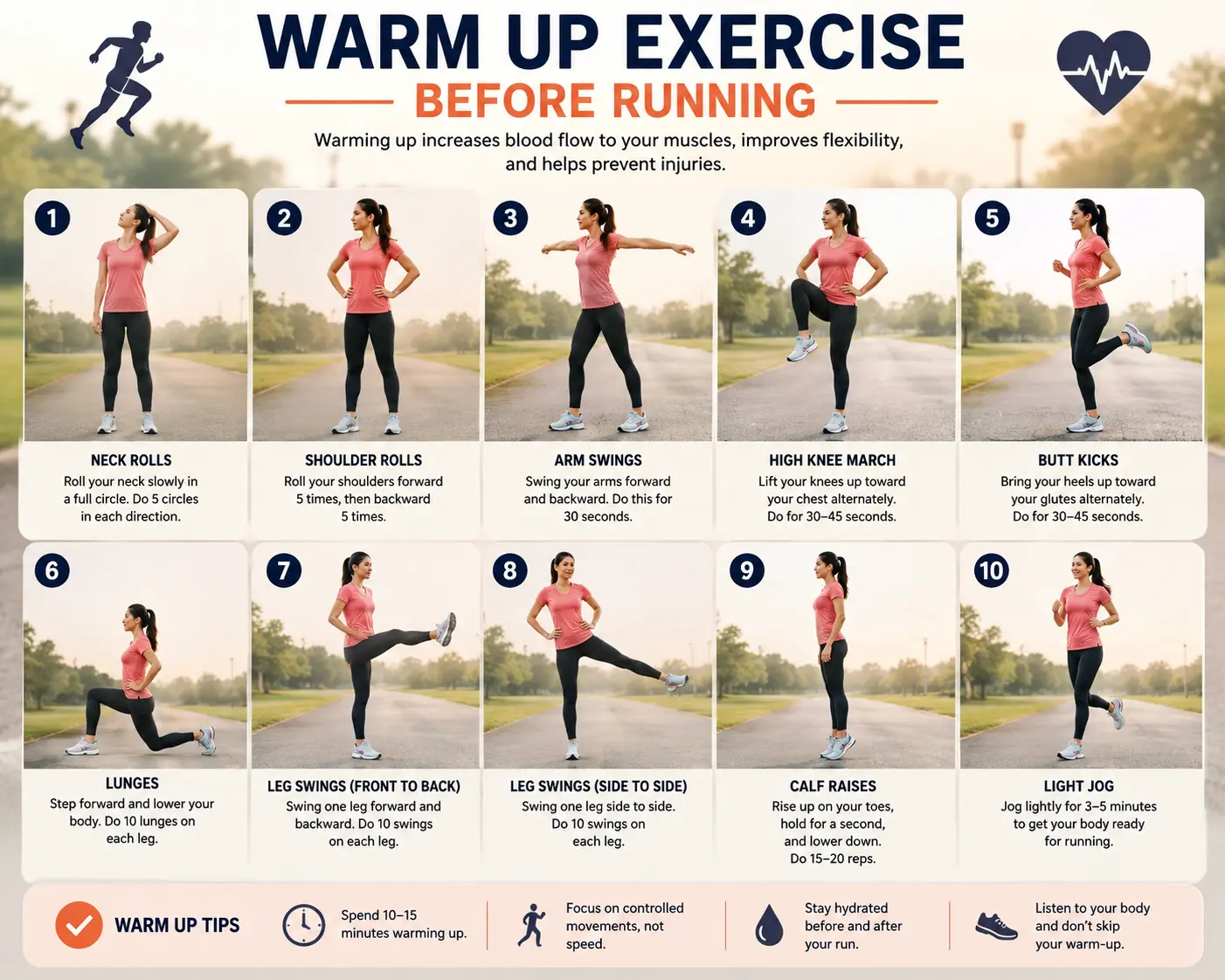
Warm Up Exercise Before Running
Introduction
Before you hit the road or treadmill, warming up is one of the most important steps you can take to improve your running performance and reduce the risk of injury. A proper warm-up gradually increases your heart rate, boosts blood circulation, and prepares your muscles, joints, and nervous system for the demands of running. Instead of starting with static stretches, runners benefit more from dynamic warm-up exercises that mimic the movements used during a run.
Dynamic exercises such as high knees, butt kicks, leg swings, walking lunges, arm circles, and light jogging help activate major muscle groups, improve joint mobility, and increase flexibility. These movements enhance coordination, balance, and running efficiency while reducing muscle stiffness. Spending just 5–10 minutes on a warm-up can make your run feel smoother, more comfortable, and more enjoyable.
Whether you’re a beginner, recreational jogger, or experienced athlete, a consistent pre-run warm-up routine can improve speed, endurance, and overall performance. It also reduces the risk of common running injuries, such as muscle strains, shin splints, and knee pain, by preparing your body for impact and movement.
In this guide, you’ll discover essential warm-up exercises before running that are simple, effective, and suitable for all fitness levels. Perform these exercises before every run to activate your body, enhance mobility, and get the most out of your workout. A few minutes of preparation can make a significant difference in your running experience, helping you stay healthy, perform better, and enjoy every step of your journey.
What you need to get started
Isn’t running easy? With just a pair of shoes, you can leave the house. Not so quickly, that is.
While a decent pair of running shoes is definitely necessary, you may also improve the effectiveness and enjoyment of your training with other necessary equipment. Let’s be honest, you are more likely to continue an activity if you find it enjoyable.
Invest in a good pair of running shoes.
It takes more than just a pair of Vans or Converse to hit the street. You need shoes made especially for running in order to minimize injuries and improve comfort.
A podiatrist or a running specialty store is the best place to get fitted for shoes. If that isn’t feasible, get a pair of running shoes that suit your demands by doing some research.
Opt for comfortable, sweat-wicking clothing
.
Comfort matters most when it comes to clothing. Wear lightweight shirts, shorts, and pants that are appropriate for physical activity.
Look for fabrics that wick away perspiration and take the weather into account. In the winter, wearing layers keeps you warm and enables you to take off clothes as needed as the temperature rises.
Use technology to track your progress.
Fitness and activity trackers such as Fitbit, Garmin, and others can help you stay motivated and focused on your running objectives.
Numerous wearable devices are capable of monitoring:
How far have you run?
How many steps have you run?
Your heart rate, your running speed, and the number of calories you have expended
Create a running playlist.
Running while listening to your favorite music is a terrific way to keep inspired. Make a playlist of the songs that will most likely keep you going.
Having said that, use your headphones sensibly. In order to maintain alertness and awareness of your surroundings, you might wish to utilize just one earphone.
Warm Up Exercise Before Running
Dead bug Exercise

In order to run with a firm, healthy posture, awaken your muscles. It will increase your speed, ease the strain on your lower back, and maintain the health of your lower body. While preparing for your opposing arm and leg swings, this workout warms your core.
Dead bug Exercise steps:
Procedure:
- With your arms and legs up, lie face-up on the ground.
- Place your lower back on the ground. Your core should be functioning. For the duration of the exercise, maintain this back position.
- Keeping your lower back on the ground, extend one leg in front of you and the opposing arm behind you as far as is comfortable. After pausing, elevate your arm and leg back toward the ceiling by contracting your core. Repeat with the leg and arm on the other side. One representative, that is.
Side squat

Moving forward is the essence of running. However, sideways exercises target your side glutes, which are crucial for maintaining the health of your hips, knees, and even ankles. This multitasking workout works your hips, knees, and ankles in addition to activating them. This is unquestionably my favorite running warm-up exercise.
- Place your feet about twice shoulder-width apart and stand erect.
- Make sure you’re not arching through your lower back by bracing your core to tuck your tailbone slightly.
- Lower your torso to that side as much as is comfortable or until your thigh is parallel to the floor by pushing your hips back behind you and bending one knee.
- To return to the wide stance, pause and then gradually push through the heel of your bent leg. (During the activity, your feet will remain stationary.)
- On the other side, repeat. One representative, that is.
Shoulder squeeze
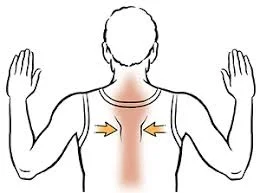
When you run, your upper back muscles are surprisingly important. They maintain your shoulders braced and your arms swinging. Above all, they facilitate simpler breathing. You know how you instinctively want to put your arms over your head to breathe in more air when you’re feeling breathless? A similar thing happens when you keep your upper back muscles active, allowing your lungs to take in more air with each breath.
Procedure:
- As if you were going to perform the chicken dance, stand with your hands by your shoulders, elbows bent, and feet together. Get your core ready.
- Squeeze your shoulder blades down and together as firmly as you can, fighting the impulse to shake your body or arch your back. Your muscles should be stretched and working at the same time.
- Squeeze for a few seconds, then let go. One representative, that is.
Reverse lunge with overhead reach

This dynamic warm-up exercise opens up your chest, strengthens your quadriceps, glutes, and hamstrings, and gently stretches your hip flexors. This dynamic stretch will feel amazing if, like me, you work out after spending the entire day on a computer.
Procedure:
- With your arms by your sides and your feet hip-width apart, take a tall stance. Get your core ready.
- Step one foot behind you and drop yourself into a lunge without arching your lower back. Make sure both of your hips are facing forward and avoid cocking them. The hips of your rear leg should feel stretched.
- Scoop your arms in front of you and then raise them toward the ceiling at the same time.
- After pausing, step your rear foot forward by pressing through your front heel. Bring your arms down.
- On the other side, repeat. One representative, that is.
Forward leg swing

Your hip is worked through its whole range of motion, both forward and backward, with this exercise. It’s an excellent method for releasing tension in your body’s biggest joint.
- Place your feet together next to a solid object. For balance, place one hand on it. Lift one foot slightly off the ground.
- Swing your leg straight out in front of you and back behind you as far as is comfortable, keeping your core braced and moving with control.
- One representative, that is. After completing all the reps, switch legs.
Sideways leg swing

Your inner and outer thighs are stretched and activated by this dynamic drill. Additionally, you may sense that your standing leg’s side glutes are keeping you balanced. It’s a positive thing.
- Place your feet together and turn to face a solid object. For balance, place one or both hands on it. Lift one foot slightly off the ground.
- Swing your leg straight out to your side and then as far in front of your body as is comfortable while maintaining a braced core.
- One representative, that is. After completing all the reps, switch legs.
Beginner’s training routine
- Monday: Use a walk/run approach to run two miles at a moderate pace. Run for one minute and stroll for one minute to complete the first mile. Run for ninety seconds and stroll for one minute to complete the second mile.
- Tuesday: Concentrate on strength training for the entire body.
- Wednesday should be used as an active rest day. Go for a stroll or engage in some gentle stretching and yoga.
- Thursday: Use a walk/run approach to run two miles at a moderate pace. Aim to run a little faster than you did the last time. Run for one minute and stroll for one minute to complete the first mile. Run for ninety seconds and stroll for one minute to complete the second mile.
- Friday: Concentrate on strength training for the entire body.
- Saturday: Engage in 30 to 60 minutes of aerobic activity, such as swimming, cycling, or walking.
- Sunday: Make it a day of active relaxation. Go for a stroll or engage in some gentle stretching and yoga.
What are the 4 types of warm-ups?
A good warm-up consists of 4 different types that help to gradually raise your body temperature, joint mobility, and prepare your muscles and mind for exercise.
1. Pulse Raiser (Warmup)
What it is: Light cardio exercise meant to increase heart rate, breathing rate, a nd internal body temperature.
Examples would be slow jogging, jumping rope, cycling, or brisk walking.
2. Stretching dynamically
What it is: Controlled, dynamic movements that take your joints through their full range of motion. It relaxes tight muscles without overstretching.
Examples: arm circles, leg swings, torso twists, and walking lunges.
3. Skill Rehearsal (Sport Specific Warm-up)
What it is: Workouts that closely mimic the specific movements and muscles you will be using in your primary workout or sport to maximize neuromuscular coordination.
Examples include shadow boxing for a combat sport, dribbling drills for basketball, or light swings with a bat for baseball.
4. Passive heating
What it is: Raising body and muscle temperature by an external means rather than by activity. This is often used by athletes to keep warm between an active warm-up and a performance.
Examples: sauna, bath, massage.
What should I not do before running?
Avoid eating heavy or high-fiber foods before a run, don’t do static stretching, and don’t drink a lot of water at one time. These errors cause intense cramping in the stomach, weakness, and muscle strain. Do dynamic warm-ups, light hydration, and simple carbs instead.
Never-Do List for Pre-Runs
Eat foods high in fat, heavy, or high in fiber: Avoid eating big meals, dairy products, fried foods, and high-fiber foods within 2 hours of your run. The body shunts blood away from the legs and into digestion,n leading to severe cramping or “runner’s trots”.
Static Stretching: Stretching for 30 seconds or more before a run can temporarily decrease muscle elasticity and strength. This slows you down and actually increases your risk of injury.
Liquids at the Finish Line: Drinking liters of water right before you lace up your shoes leaves your stomach sloshy and bloated. Running coaches advise you to keep yourself hydrated throughout the day rather than just at the last minute.
Forget the Bathroom: Always stop in the bathroom to empty your bladder and bowels before you go, even if you don’t feel a pressing need. Running with a full bladder is not only very uncomfortable but also puts more strain on your core.
Wear Brand New Shoes: Don’t unbox a brand-new pair of running shoes on the day of a race or a long run. Always break them in with a few short, easy runs, so the materials will stretch to your feet.
Go Unsocked: Don’t run in sandals or without socks, even in hot weather. Always wear functional, breathable running socks to prevent painful blisters and chafing.
Caffeine Overkill: Taking 3 to 6 mg of caffeine per kilogram of body weight can improve performance, but too much caffeine can lead to a rapid heartbeat, nervousness, and a sudden need to go to the bathroom.
Dynamic Warm-ups: Spend 5 to 10 minutes doing dynamic stretches such as leg swings, butt kicks, and high knees to warm up your muscles and get your joints moving smoothly.
Eat Easily Digestible Carbs: If you need fuel before a morning or long run, go with quick-energy carbohydrates such as a banana, plain bagel, or a handful of oats, eaten 1 to 2 hours ahead.
Split Long Runs into Smaller Bites: Instead of consuming too much food before the run, if you are increasing your endurance, don’t forget to add water and lighter bites.
What are the 7 principles of fitness?
The seven principles of fitness are fundamental guidelines to help you exercise safely and effectively. They are Progression, Overload, Specificity, Reversibility, Individuality, Adaptation,n and Recovery. Following these principles ensures continual improvement and helps prevent injury and plateauing.
1. The Principle of Overload
If you want any physical benefit, you have to make your body work harder than it usually does. You put stress on your system to adapt and become even stronger.
2. Law of progressio. The application of the load should be gradual. If the difficulty level jumps up suddenly, the risk of injury or exhaustion is high. Slow, gradual increases in weight, duration, or speed will bring steady gains.
3. The principle of specificity
Your body becomes specifically adapted to the kind of stress you put on it. Running or swimming is best if you want to improve your cardiovascular health. If you want to build upper-body strength, resistance training is a must.
4. Reversibility Principle
If you stop exercising or drastically reduce your training, the physiological adaptations your body made will eventually reverse, and you’ll lose fitness.
5. Individuality Principle
People don’t all respond to the same exercise in the same way. Genetics, age, diet, and experience level are all factors in how fast you see results and what type of training is best suited for you.
6. Law of Adaptation
Your body will adapt and get used to what you ask of it if you give it enough time to do so. Once your body adjusts to a certain routine, you must change your workout ( apply overload ) if you want to keep progressing.
7. The Recovery Principle
When you work out, your muscles and cardiovascular systems don’t grow—they rebuild and repair themselves during the rest periods. Allow 24 to 48 hours of rest between hard training sessions, or you will overtrain and risk injury.
How to train for a 5K
Going all out may be enticing, but it’s not the greatest way to begin.
Based on the observation that many novices put in excessive miles in the early stages of their training.
“I’ve seen more new runners injured in training than in the race, and those extra miles can take their toll,” increasing your weekly distance by no more than 10% at a time to prevent this.
4, 6, 8, and 10-week cycles are used in a lot of novice online 5K training programs.
You can begin by adding the following to the above-mentioned sample training plan:
Weeks 1-2: Adhere to the above-mentioned sample training schedule.
Weeks 3–4: Replace Saturday’s aerobic day with a 3-mile run. Today, go for a walk or run.
Weeks 5–6: Replace Saturday’s aerobic day with a 3-mile run. Try to walk as little as possible when running.
How to stay motivated
Like many other pursuits, running has a honeymoon phase during which everything feels fantastic, and you can’t wait to put on your shoes and go for a run.
After that, you might notice that your enthusiasm begins to fade. It’s useful to know how to avoid burnout, whether you’re already having trouble staying motivated or you want to get ahead of it.
Keep it simple: The first rule for maintaining motivation, particularly at first, is to keep things simple. Follow a fitness regimen that calls for running two days a week.
Gradually increase the number of miles you run: You can change your running schedule from two to three days as you acquire confidence and stamina. You can also increase the number of miles you run on a given day, but don’t do so at the same time.
Run beside a companion: Try asking a friend, relative, or running group for assistance if you need some accountability to stay motivated. Getting together with people who have similar objectives can give you more energy.
Establish and monitor goals: Setting objectives and pushing yourself to achieve them might help you stay motivated. Reward yourself when you accomplish your objective, then establish a new one.
Track your development: Monitoring your running progress can encourage and inspire you to accomplish new objectives. You can record your weekly mileage, running speed, or caloric expenditure with an activity tracker.
How to stay safe while you run
Meals and hydration: Maintaining a regular running schedule necessitates adequate nutrition in the form of meals and drinks, ideally water. Make sure you stay hydrated by consuming liquids prior to, during, and following your run.
Hearing what’s going on around you—whether it’s automobiles, cyclists, or other runners—is essential to being safe, whether you wear headphones or just one. If you wish to listen to music, you can either use your phone’s speaker instead of headphones or wear just one pair.
When you ask an experienced runner about their biggest training error, you’ll probably hear that they ran too much too soon. Slow and steady wins the race. Increasing mileage gradually over time is crucial, whether you’re running for a race or as part of a general fitness regimen.
For general fitness, cross-train: You shouldn’t limit your workout to running alone. Cross-training is crucial for improving your running performance and lowering your chance of injury. Yoga, cycling, swimming, and strength training are great additions to your weekly workouts. Strength training should be done two days a week, concentrating on the main muscular groups.
Stretching before and after your run: Set aside five to ten minutes to stretch both before and after your run. Before working out, concentrate on dynamic stretches; later, concentrate on static stretches like the quad stretch.
Rest up: Rest days help you improve as a runner in addition to aiding in your recovery. Overtraining syndrome (OTS) can be avoided with the use of active rest days and total rest days.
FAQs
What should I do 30 minutes before running?
A light, easily digested food should ideally be consumed half an hour to an hour before running. This makes it possible for your body to absorb the nutrients and gives you an easily accessible energy source without making your run uncomfortable.
What is the 10-minute rule of running?
“The 10-Minute Rule” is one of my favorite pieces of advice to impart to people. I advise them to try moving for ten minutes if they are feeling demotivated or de-energized. They can quit and give it a break for the day if, at the conclusion of those ten minutes, they are feeling unfavorable.
What is the 10-10-10 rule for running?
The 10-10-10 rule (or 10-10-10 method) is a popular marathon pacing strategy that’s designed to help runners avoid burning out early, conserve energy for the backstretch, and run a negative split. It divides the 26.2-mile race into three separate pacing zones:
First 10 Miles (Controlled): Run conservatively, about 10 to 20 seconds slower per mile than goal race pace. The idea is to be very relaxed and to save glycogen.
Miles 10 to 20 (Steady) Run a bit faster and get comfortable with your goal marathon pace. Find your rhythm and get into the pace you trained for.
Final 10K (Push) ~6.2 miles to go, push as hard as you can.n Use the energy you have to speed up and finish strong.
Why 10-10-10 Strategy?
Many marathoners make the mistake of running the first half of the race too fast, depleting their energy stores, which causes them to “hit the wall” around mile 20 10-10-10 method makes sure that you save enough physical and mental energy for the hardest part of the race.
Top Tips for Success
Fuel Early: Don’t wait to eat or drink until you are thirsty or hungry. Begin your fueling strategy around mile 4 or 5 and stick with it.
Don’t Start Too Fast: The first 10 miles should be rather easy. Don’t panic if you’re running slower than your goal pace at the beginning or try to “make up time.”
Write it down. For easy on-the-go reference, write your precise pace goals for each of the three phases on a wristband or on your race bib.
Is 2.5 km jogging good?
A great run of 2.5 km (about 1.5 miles)! It’s a fantastic, very achievable distance for beginners, keeping general fitness or getting a quick workout in.
Your run compares against your pace and goals:
For Health & Beginners: Whether you’re working on a running routine or just keeping fit, comfortably running 2.5 km (with or without walking breaks) is a good goal. It burns between 150 and 200 calories, keeps your heart rate up, and lowers your risk of injury.
Pace & Speed: A normal beginner will run at about 6 to 8 minutes per kilometer, so a 2.5 km run should take you about 15 to 20 minutes.
Next Steps: Your best tool is consistency if you find that 2.5 km is beginning to seem manageable. Try adhering to a planned starter program, such as the well-liked NHS Couch to 5K Plan, to increase your distance and safely progress to a full 5K.
What to eat immediately before a run?
What should I eat before a run? Pay attention to quickly absorbed carbs that provide energy. You can fuel your run with foods like fruit, bread, a tiny smoothie, or a few dates.
Can an unfit person run 10k?
Even while it is possible to run a 10-kilometer course without any formal training, some people may find it very challenging, particularly if they lead a sedentary lifestyle. After the first seven minutes (or less, results may vary), their bodies may start to scream in agony. The finest aspect? You won’t anticipate it.
What exercises help you run faster?
Focus on developing explosive power, strengthening your core, and improving your stride mechanics if you want to run faster. To significantly increase your speed and running efficiency, combine strength, plyometric, and drill-based exercises.
References
- How to Warm Up Before Running | ASICS (n.d.). https://www.asics.com/nz/en-nz/blog/article/how-to-warm-up-before-running?srsltid=AfmBOooNCqvMRcG939E8bsGOjpZ28RZSFBODFgAgQjh9OytCzqqyumbC
- MacMillan, C. (2021, February 12). How to Stretch Before a Run—Properly. Yale Medicine. https://www.yalemedicine.org/news/how-to-stretch-before-run
- On. (n.d.). Warm-ups and cool-downs for runners. On Shop. https://www.on.com/en-in/stories/warm-ups-and-cool-downs-for-runners?srsltid=AfmBOooge11AvirjBKLqM3mePfA1WYnG5MNUtpp4T-MDypBQG–O0LKc
- Peloton, L. M. A. (2024, April 11). 8 Must-Try Warm-Up moves for a stronger, faster run. https://www.onepeloton.com/blog/running-warmup-exercises
- Warm-up exercises for runners. (2023, October 17). PureGym. https://www.puregym.com/blog/best-warm-up-exercises-for-runners/
- Website, N. (2024, February 15). How to warm up before exercising. nhs.uk. https://www.nhs.uk/live-well/exercise/how-to-warm-up-before-exercising/