
Chest Fly Exercise
Introduction:
Chest Fly Exercise is an effective upper-body strength exercise that targets the pectoral (chest) muscles while also engaging the shoulders and arms. It helps improve chest strength, muscle definition, and upper-body stability, and can be performed using dumbbells, cables, or machines as part of a balanced strength-training routine.
The pectoralis major, pectoralis minor, deltoids, triceps, and biceps are all targeted by the chest fly, an isolation exercise, although the pectorals are the main focus. The chest fly not only strengthens the muscles in the chest but also opens up the shoulders and chest, which can improve range of motion, ease stiffness, and correct bad posture.
If you want to increase the size of your chest, incorporate chest flyes into your program. The bench press is excellent for developing strength and power. You might wish to add a few variations because they work the muscles slightly differently. This works well as a finisher for solitary exercises.
Muscle Work During Chest Fly:
- Chest Muscles
- Shoulders Muscles
- Triceps Muscle
Chest Opener: Your chest muscles can be opened up with the dumbbell chest fly. Chest openers may improve range of motion, ease upper body tension, and lessen upper back pain.
Use lesser weights or no weights at all when performing dumbbell chest flies to strengthen your chest muscles. This might assist you in using the entire range of motion without going overboard. An injury could result from going too far.
Scapular Retraction: Exercises for scapular retraction may help you develop stronger shoulders and better posture.
A few times a week, doing chest dumbbell flies can aid with shoulder retraction and open up the chest and shoulder area.
How to Perform?
- On a bench with a flat inclination, lie flat on your back. On either side of the seat, plant your feet firmly on the ground.
- You can pick up the two dumbbells from the floor and hold one in each hand, or you can ask a spotter to give them to you.
- Raise your arms over your head so they are outstretched but not locked out. Your hands and dumbbells should be facing each other, and your elbow should be slightly bent.
- Take a breath, then slowly descend the dumbbells in an arc until they align with your chest. You won’t be shut out, but your arms will be extended to the sides. Avoid lowering your arms below your shoulders.
- Breathe out, then slowly raise the dumbbells in the same arc motion.
- Do ten to fifteen repetitions. Take a nap. Perform three sets in total.
Benefits:
- A dumbbell fly primarily targets your chest, but it also works the muscles in your arms, shoulders, and back, which are utilised to help stabilise the weight during the exercise.
- The larger pectoralis major and the smaller pectoralis minor, which, when completely grown, can give you the “chest separation” look that most people aim for, are both worked by dumbbell flyes.
- In addition to improving your physical appearance, having a stronger chest will aid you with everyday tasks and boost your athletic performance.
Advice for Beginners:
- While performing the exercise, picture yourself attempting to embrace a tree.
- Avoid over-recruiting the forearms and biceps by not squeezing the dumbbell handles too tightly, since this will decrease the activation of the pecs.
- To maintain consistent tension on the targeted muscle areas, avoid contacting or smashing the dumbbells together at the peak of each repetition.
- Never reduce the weight to the point where you get any kind of pain or pressure at the front of your shoulder joint, and always maintain a tiny bend in your elbows.
- Make sure your shoulder blades are somewhat retracted and try to keep the shoulder girdle “packed” if you’re experiencing pain in the shoulder joint itself, particularly in the front.
- Just concentrate on keeping your elbows bent and engaging your pecs while maintaining your feet flat on the ground.
- Make sure to keep your abs taut and prevent your lower back from arching too much.
Variations:
Incline bench dumbbell chest fly:
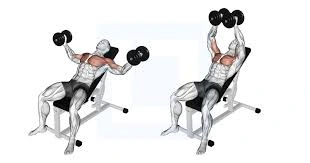
- On an incline bench that has been lowered to a 30-degree angle, begin with your back flat. Each hand should hold one dumbbell.
- With your elbows bent and pointing out, begin with your arms at chest height at your sides.
- Breathe out slowly and raise your arms above your chest.
- Take a breath and return to the beginning posture by slowly lowering your arms to your sides.
- Keep applying pressure.
- Do ten to fifteen repetitions. Do three sets.
Standing chest fly:

- Place your feet in a split stance and bend your knees slightly. Each hand should hold the resistance bands.
- With your palms facing each other, raise your arms straight in front of you to chest level.
- Stretch your arms out to the sides until they are fully extended. Throughout, keep your arms at chest level.
- Return them to the centre. Ten to fifteen times, repeat. Do three sets.
Progression:
Try increasing the weight of the dumbbells you use every week or every other week as you get better at the dumbbell chest fly workout. Try adding two to three pounds every week.
For an additional challenge, you may try doing a dumbbell chest fly on an exercise ball. This is more difficult since you have to use your core to keep your body still during the exercise.
You could eventually want to switch to doing bench presses in the gym or using a cable pull machine.
If feasible, have a competent personal trainer observe you and instruct you on how to perform these exercises effectively. You can make the most of the exercise and even avoid injury by using proper technique.
Common Mistakes:
Avoid locking your arms:
Ensure that your elbows remain bent. Never lock your arms out or completely straighten them since doing so puts more strain on your elbows and shoulder joints, increasing your risk of injury.
To properly work your chest during the exercise, keep your elbows slightly bent.
Excessive stretching:
Hyperextending your arms and extending dumbbell flyes too far at the bottom of the exercise might potentially injure you and lessen the amount of work your chest does.
When you’re lying on the bench, keep your elbows in line with your torso and avoid letting them drop too far when you’re in the start position.
Select the appropriate weight:
Compared to other chest exercises, you don’t have to raise nearly as much weight. Ego-lifting is not appropriate in this situation.
Choose a weight that suits you; it shouldn’t be too heavy or too light.
FAQs
What are the benefits of the chest fly?
It targets the front deltoid muscles on both sides of your body as well as the pectoralis major and minor. In order to stabilise your shoulders, arms, and spine, performing the cable chest fly correctly also engages the triceps, biceps, and core in addition to the lateral and rear deltoid.
What are the benefits of lying chest fly?
One exercise that might help build the shoulders and chest is the dumbbell chest fly. Lying on your back on a level or inclined bench is a frequent way to accomplish it. A dumbbell fly standing variation is also available.
What does the chest fly grow?
The pectoralis muscles are the main players in the chest fly. Peak contractions in these chest muscles occur when you stretch your arms out to the sides and squeeze them together. Chest flyes exercise the pecs with a variety of motions, whether your objectives are strength, muscle growth, or body contouring.
Is the chest fly better than the bench press?
The authors advise using barbell bench presses rather than dumbbell flyes if the main goal of the exercise is to maximise mechanical stress (i.e., loading) and prime mover muscle activity.
Does chest fly make the chest bigger?
Making sure the technique is correct is crucial when performing chest flies since they can help your chest grow to new heights. Your chest may definitely improve if you follow Arnold’s lead and achieve that deep stretch.
References:
- How to do a chest fly | Chest fly variations. (n.d.). PureGym. https://www.puregym.com/exercises/chest/chest-fly/
- Chertoff, J. (2023a, April 11). How (and why) to do a dumbbell chest fly. Healthline. https://www.healthline.com/health/exercise-fitness/dumbbell-chest-fly#how-to
- Speakman, D. (2020, September 23). How to do Dumbbell Flyes | Benefits & Technique – MYPROTEIN. MYPROTEINTM. https://www.myprotein.co.in/blog/training/how-to-do-dumbbell-flyes-benefits-technique/


