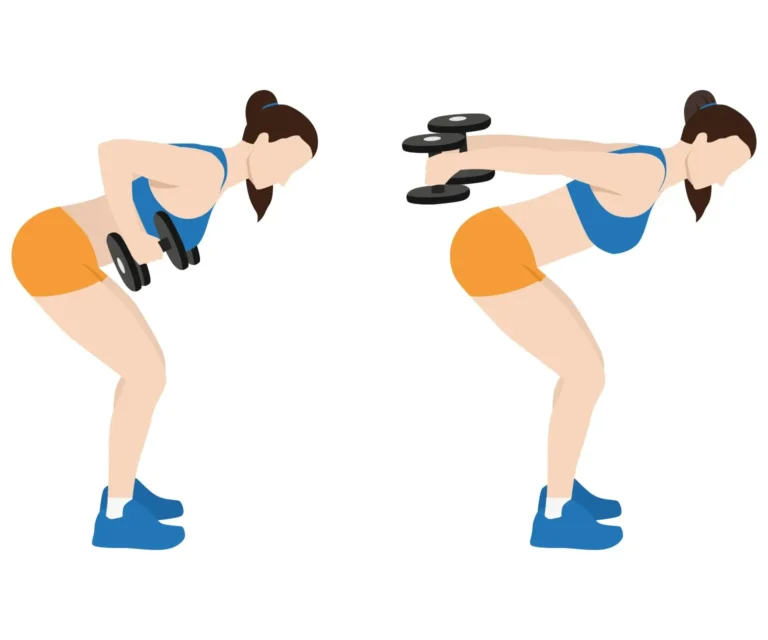
Plyometric Exercises
Introduction
Plyometric exercises are high-intensity movements that involve rapid stretching and contracting of muscles to build explosive power, speed, and strength.
Squat jumps, box jumps, depth drops, and skips are examples of common exercises that use the stretch-shortening cycle (SSC) to improve athletic performance. Start with low-impact exercises, use soft landing surfaces, concentrate on technique, and include appropriate warm-ups and rest intervals for safe and efficient training.
Exercises that allow a muscle to produce its maximum force in a brief amount of time are known as plyometrics. In order to increase physical capacity, such as musculotendinous stiffness and power, plyometric training consists of a series of explosive body weight resistance exercises that use the muscle fiber’s stretch-shortening cycle (SSC).
[1]. It is a rapid, forceful movement that starts with the muscle tendon unit being pre-stretched and ends with a stronger concentric contraction. A key component of plyometric exercise is the rapid shortening and lengthening of muscles during the SSC.
[2]. The muscle-tendon unit’s capacity to generate maximum force in the shortest amount of time is greatly improved by the SSC process. Plyometric exercises are being used as a link between pure strength and sport-related power and speed because of these advantages. One common training method for enhancing athletic performance is plyometric exercise.
Exercise protocols after musculoskeletal injuries from sports are constantly changing as our understanding of rehabilitation science grows. Particularly in the final stages of rehabilitation, which include power development, performance improvement, and a safe return to activity, rehabilitation programs have undergone significant change. Plyometric exercises, one of the many kinds of exercises available, help build power, which serves as a basis for the athlete to hone their sport-specific skills. Thus, the goal of this clinical commentary is to give a general overview of plyometrics, covering its definition, phases, physiological, mechanical, and neurophysiological foundations, as well as clinical recommendations and contraindications for putting plyometric programs into practice.
The number of strength and conditioning programs is equal to the number of clinicians who create them. Over the past few years, rehabilitation programs have undergone significant change. Plyometric exercise ought to be a crucial component of any program, regardless of its goal, be it performance improvement, strength and conditioning, or the final stages of rehabilitation.
Power development, a key element of performance-based rehabilitation programs, is often addressed with plyometric exercises. Sports physical therapists help athletes avoid injuries, recover from injuries quickly so they can resume their activities, improve their strength and conditioning, and enhance their athletic performance. As a result, there is a growing need to advance performance as soon as possible.
All of the previously mentioned benefits can be obtained by integrating plyometrics into an exercise program. During the performance phase of rehabilitation, there is a significant need to build power, as sports and athletics exert enormous forces on the extremities. The SAID (Specific Adaptation to Imposed Demands) principle and the specificity of rehabilitation both suggest that periodization programs, along with conditioning and performance programs, must be included in the final stages of rehabilitation.
Among the many different kinds of exercises that are available, plyometrics help with the development of power, which serves as a basis for the athlete to hone their sport-specific skills. Thus, the goal of this clinical commentary is to give a general overview of plyometrics, covering its definition, phases, physiological, mechanical, and neurophysiological foundations, as well as clinical recommendations and contraindications for putting plyometric programs into practice.
Thus, the goal of this clinical commentary is to give a general overview of plyometrics, covering its definition, phases, physiological, mechanical, and neurophysiological foundations, as well as clinical recommendations and contraindications for putting plyometric programs into practice.
What kind of exercise are plyometric moves?
- Since plyometric exercises focus on performing explosive movements at maximum effort (or nearly so), they are primarily power exercises. Because plyometric exercises require a lot of muscle effort to execute properly, they are also an excellent way to test your strength. Additionally, because plyometric exercises are high-intensity and will quickly cause you to lose your breath, they can also be considered cardio.
- People might now question whether plyometric exercises are an isometric method. The solution? Not at all. This is because plyometric exercises include rapid motions as well as contractions of the concentric (shortening) and eccentric (lengthening) muscles. In contrast, muscles remain extremely still during an isometric exercise.
Phases of Plyometrics
What justifies the use of plyometric exercises for sports performance improvement or rehabilitation? The plyometric concept is used in both lower extremity (LE) and upper extremity (UE) sports as a component of functional movement patterns and skill during competition. Plyometric training makes use of the stretch-shortening cycle (SSC), which consists of an eccentric lengthening movement followed by a concentric shortening movement.
Eccentric Pre‐Stretch
The eccentric pre-stretch phase has also been referred to as ready, pre-loading, pre-setting, preparatory, facilitatory, potentiation, counter-force, and counter-movement. The muscle spindle of the muscle tendon unit and the non-contractile tissue (series elastic components [SEC] and parallel elastic components[PEC]) within the muscle are stretched during the eccentric pre-stretch phase of a plyometric exercise.
This activation of the muscle’s component elements is referred to as the neurophysiological-biomechanical response. Numerous researchers have shown that this eccentric pre-stretch will improve the concentric muscle contraction that follows. The pre-stretch phase is based on three stretch factors, which include the stretch’s magnitude, rate, and duration. The energy stored during the eccentric pre-stretch motion will be significantly impacted by changes to any of these variables.
Amortization Phase (Time to Rebound)
Amortization is the amount of time that passes between the conclusion of the eccentric pre-stretch and the beginning of the concentric muscle movement. The authors of this manuscript like to refer to it as “time to rebound.” This phase is also known as the plyometric electro-mechanical delay phase. The amortization phase is the interval of time between overcoming the negative work of the eccentric pre-stretch and generating force, accelerating muscular contraction, and inducing elastic rebound in the direction of the plyometric movement pattern.
This phase is essential to plyometric performance because the plyometric action is more forceful and effective the more effectively the stored energy is used during the transition. If the amortization phase is delayed, the concentric contraction’s positive work is less effective, the stretch reflex is not triggered, and the stored energy is squandered as heat. One of the primary goals of plyometric training is to shorten the time until the rebound phase.
Concentric Shortening Phase
The facilitated or addition phase is another name for this plyometric stage. These names actually describe the plyometric exercise. One of the many interactions that result in this final phase of the plyometric movement is the biomechanical response that utilizes the elastic properties of the pre-stretched muscles.
These three stages are combined to produce a plyometric movement that enhances the muscle’s power performance.
Plyometric Exercises mentioned below
1. Pop Squat

- Bend both knees, bring your palms together in front of your chest, and set your feet wider than hip-width apart to do a squat. To stand, push through your glutes while keeping your core active.
- As you stand, let your arms fall to your sides. Then, jump to bring both feet together.
- Immediately jump your feet apart and crouch down again. One representative is that. As you continue to perform repetitions, hop once in place in between each squat.
2. Split Squat Jump

- With your hands by your sides and your feet under your shoulders, step your left foot forward as if you were doing a forward lunge, keeping your left heel firmly planted.
- Your torso should be somewhat forward, your chest should be erect, and your back should be flat rather than rounded or arched forward. Your left quad should be parallel to the floor, and your left knee should be higher than your right foot. Your butt and core should be used. This is the split squat pose.
- Push through your left foot and bring your arms together in front of your chest as you jump as high as you can. Return to the split squat stance as soon as possible after a comfortable landing. One representative is that.
- Do each repetition on one side. Next, flip sides and repeat the process.
3. Alternating Lunge Jump
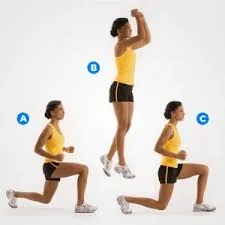
- As you stand, place your feet shoulder-width apart.
- Keeping your core active, jump your left foot forward and your right foot back. Next, drop yourself into a lunge by bending both knees.
- Hop both feet back to the starting position.
- Now place your right foot forward and your left foot back, then drop into a lunge on the other side. One representative is that.
4. Reverse Lunge to Knee-Up Jump

- Stand with your feet shoulder-width apart and contract your core.
- Step back with your right foot, landing on the ball of your right foot, keeping your right heel off the ground.
- Bend both knees to a 90-degree angle as you descend into a lunge. Bend your right arm forward and your left arm’s elbow slightly back. Keep your hips tucked in and your core working instead of pushing out your butt when jumping.
- Immediately lower yourself back into a lunge after landing gently on your left foot. One representative is that.
- Do each repetition on one side. Next, flip sides and repeat the process.
5. Tuck Jump

- Place your feet hip-width apart while standing. Bend your elbows until your forearms are straight out while keeping your arms close to your body at your sides.
- Do not drop your hips below your knees.
- Leap as high as you are able to. Drive the top of your knees toward your forearms and tighten your core as you jump. Instead of bending forward, try to keep your back straight.
- When you land, immediately return to the squat position with your knees relaxed and your feet hip-width apart.
6. Jump Squat With Heel Tap

- Place your hands behind your head and open your chest, expanding your elbows.
- Bend your knees, hinge forward at the hips, and push your butt back to lower yourself into a squat. Keep your chest raised, your back flat, and your core active.
- Push through your heels as you jump up, then bring them together for a quick tap at the top. When you land with your feet in the starting position, immediately lower yourself into the next squat.
7. Skater Hop
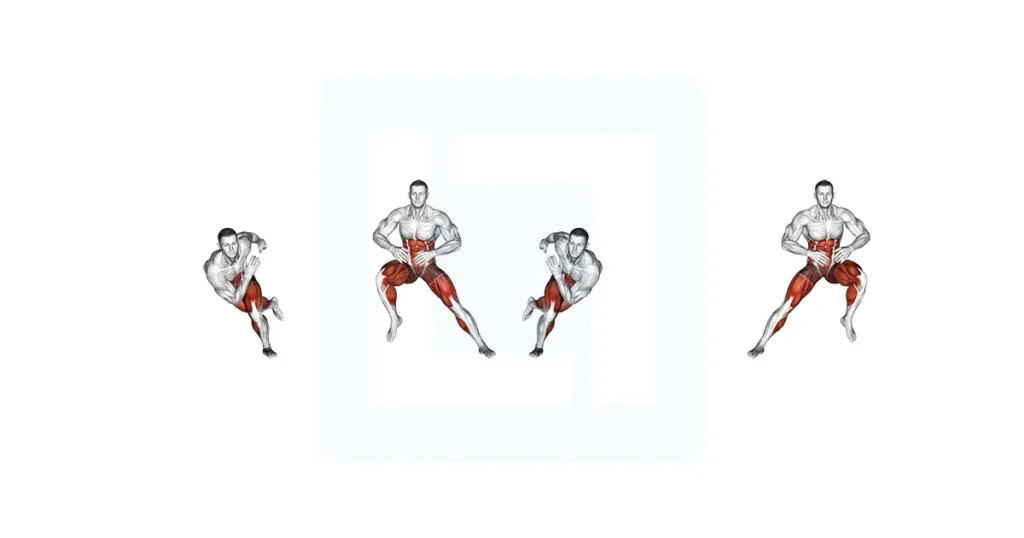
- As you stand, place your feet hip-width apart. Raise your right leg and leap to the right. Followed by straightening your left leg.
- As you land on your right foot, keep your left foot off the ground and swing it behind you. Swing your left hand in front of your body while your right arm swings behind your back.
- Leap with your left leg swung back to the left, landing lightly on your left foot while allowing your right foot to swing behind you. Swing your right arm in front of you while your left arm swings behind you.
- Continue switching sides.
8. Box Jump

- Stand on the balls of your feet with your feet hip-width apart, one foot away from a sturdy step or box.
- Bend your knees to lower yourself into a squat, then extend your arms behind you.
- Press through both feet and swing your arms forward to jump on top of the box.
- When you land on the box, make sure your knees are soft, and your feet are hip-width apart.
- Stand up, then take a step back to start another rep.
9. Single-Leg Deadlift to Jump

- As you stand, put your feet together. With your left knee slightly bent, shift your weight to your left leg, hinge at the hips, and tilt your torso forward. Stretch your right leg behind you with the knee bent and the toes pointing down toward the floor.
- Keeping your back flat and your core tight, extend your right hand toward the floor. At the bottom of the exercise, you want your torso to be almost parallel to the floor.
- Push through your left heel while keeping your core tight to jump as high as you can. Swing your right arm slightly bent behind you, and your left arm slightly bent in front of you.
- Lower yourself into a deadlift to start your next repetition after one soft landing.
- Once you have finished all of the repetitions on one side, repeat on the other.
10. Hands-Release Push-Up
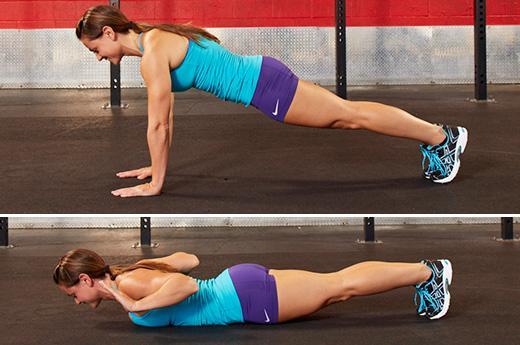
- Start with a high plank with your hands shoulder-width apart, palms flat, shoulders stacked slightly above your wrists, legs out in front of you, and your core and glutes engaged.
- Bend your elbows.
- Bring your chest down.
- Straighten your arms and push through your palms to lift both of them a few inches off the ground. Return your palms to the floor for one repetition.
What advantages do plyometric exercises offer?
- Plyometric exercises offer numerous advantages that may persuade you to incorporate them into your training regimen. According to Hodges, they can aid in improving coordination, strength, speed, endurance, and agility. According to Hodges, plyometric exercises can also strengthen your tendons and speed up the development of force, which is your body’s capacity to produce large amounts of power quickly. Athletes who play sports that demand rapid, forceful movements, like volleyball players or track athletes, may find this useful.
- They are essentially full-body exercises in terms of the muscle groups they target, according to Hodges. However, a lot of plyometric exercises, such as tuck jumps, pop squats, and jumping lunges, put more of an emphasis on your lower half and core. However, Hodges notes that there are also plyometric exercises that target the upper body, such as explosive medicine-ball throws and push-ups.
- Because plyometric training increases your body’s capacity to quickly absorb shock, it can also help lower your risk of injury in both sports and the gym. According to Hodges, “most injuries occur when the body goes beyond its range of motion with control.” For instance, you risk tearing a muscle, tendon, or ligament if you leap up to block the ball during a beach volleyball match and fail to land back on the ground with proper technique. You can lower your risk of injury in sports and exercise environments by improving your capacity to safely and effectively absorb shock with the right plyometric training.
- Another significant advantage? According to Hodges, they offer good value for the money spent on exercise. They are a good choice if you’re pressed for time but still want to get in a demanding workout because, as high-intensity movements, they can offer many advantages in a shorter period of time than lower-intensity movements.
Is it safe to perform plyometric exercises?
- Plyometric exercises have many advantages, but they also have a big drawback: because they are high-impact exercises done at maximum effort, they are more likely to cause injury than more conventional strength training or cardio. Because of this, it’s crucial to perfect a movement’s fundamental form (like lunges) before incorporating a plyometric component (like jump lunges). Additionally, it means that beginners should probably wait until they have some experience working out before beginning plyometric exercises; those who are just starting in fitness should get comfortable with the more conventional forms of the moves first.
- Plyometrics requires you to become proficient in more than just how to execute a move. The landing, or the final portion of the move, is also crucial.
- Hodges states, “I always start with landing mechanics when I’m doing plyometric training.” “I want to demonstrate how to land properly before I teach anyone how to jump.” This means landing back on the ground after appropriately absorbing shock. Depending on the movement you’re performing, the proper placement will vary, but for instance, if you’re performing a jump squat, it would involve landing softly. With your legs shoulder-width apart, knees slightly bent but not collapsing inward, an engaged core, and a strong upper body (so no swaying back and forth) (instead of letting your feet smack the ground). Beyond landing mechanics, it’s crucial to confirm that you can perform the entire movement correctly before adding a plyometric element to make it more intense. Are you unsure if you’re performing a move correctly or what good form means? Consult a certified fitness professional.
- Another crucial piece of advice is to warm up properly before performing any kind of plyometric exercise work, as doing so too soon can make you more likely to get hurt. To make sure his body is prepared for them, Hodges usually prefers to include these exercises in the middle or near the end of a workout.
- When you finally start doing plyometric exercises, pay close attention to your body. Either reduce the intensity of the exercise to restore proper form (e.g., by lowering the height of your box jumps) or simply stop performing plyometric exercises for the day if you see that your form is beginning to deteriorate (e.g., return to regular lunges instead of jump lunges).
- Plyometric exercises come in a variety of forms. Most people have heard of gym plyometrics, which involves jumping over hurdles or onto boxes.
- However, since these are more difficult moves, you should only try them with a trainer’s help after you’ve gained some muscle strength and skill.
- Remember that even the basic plyometric exercises outlined in this article can be difficult. Before beginning any plyometric training, consult your physician if you have experienced any joint problems, particularly in your knees, back, or hips, or if you have had any balance issues.
In what ways can plyometrics be incorporated into your exercise regimen?
- Are you eager to try a plyometric workout because you’re so excited about its advantages? That’s fantastic! You should first be aware of a few things, though.
- First of all, according to plyometric exercises, “not something you want to do every day.” Your fitness level and goals will determine the “right” amount of time each week to incorporate plyometric exercises. However, Hodges suggests that beginners generally begin with one to two days per week of plyometric exercise practice and then progressively increase the level of difficulty. To give your body enough time to recuperate, schedule adequate downtime between plyometric exercise sessions. Pay attention to your body and reduce your plans if you are too sore from yesterday’s workout to perform today’s plyometric exercises properly. Injury can result from trying plyometric exercises when your body isn’t functioning at its peak.
- Start with a low rep count when you’re ready to add plyometric exercises. Hodges suggests a general starting point of three to five repetitions. He clarifies, “You want those reps lower because you’re going to be very fatigued.” To maintain proper form and give every plyometric exercise move your all—or nearly your maximum effort—be sure to allow your body adequate rest time in between repetitions and sets. The intensity of the particular move, your goals, and your level of fitness will all affect how much rest you need. Just be sure to pay attention to how your body feels and adjust your rest times accordingly.
How to reduce the chance of injury while increasing effort
- Pick a surface that has some give. The best options for absorbing some of the impact as you land are a thick, firm mat (not a thin yoga mat), a well-padded, carpeted wood floor, or grass or dirt outside. Avoid jumping on asphalt, concrete, or tile surfaces.
- To begin, aim for only a few inches off the ground. Your impact on landing increases with the height of your jump.
- When you land, bend your legs. Keep your knees from locking.
- Avoid landing solely on your heels or the balls of your feet; instead, land gently.
FAQs
What is the meaning of plyometric exercises?
Plyometric exercises, which involve quick, explosive movements, employ the “stretch-shortening cycle” to improve strength, speed, and power. This cycle uses an eccentric (lengthening) muscle stretch followed by a powerful, explosive concentric (shortening) contraction, similar to a jump, to propel the body. Athletes in sports that require explosive movements frequently employ this technique, which enhances athletic performance by increasing power output.
Which exercise is an example of plyometrics?
Your question doesn’t have any answer options. One great example of a plyometric exercise is the box jump.
Justification: The goal of plyometric exercises is to generate power through rapid muscle contractions. A box jump requires you to use your leg muscles to leap quickly onto an elevated box. Other examples of plyometric exercises include push-ups with a jump, power skipping, vertical depth jumps, lateral jumps, and squat jumps.
Can plyometrics build muscle?
Plyometric exercises have been shown to improve muscle thickness and other indicators of muscle growth, particularly in the lower body and trunk. Although resistance training is believed to be the most efficient method for hypertrophy, plyometrics also encourages muscle protein balance and can produce increases in muscle size similar to those seen with weight training.
Who is the father of plyometrics?
Dr. Yuri Verkhoshansky is known as the “Father of Plyometrics” because he developed the “shock method” of sports training in the Soviet Union during the late 1960s and early 1970s. Eventually, this method was dubbed plyometrics. His research focused on high-intensity, explosive exercises like depth jumps that enhance an athlete’s power, speed, and coordination.
At what age to start plyometrics?
Young athletes (ages 7–10) can begin with low-impact exercises like hopping, skipping, and jump rope. Preteens and teens (ages 11 to 15) can progress to moderately intense jumps with proper form. Depth jumps and other high-intensity plyometric exercises should only be performed by older, well-trained teenagers.
Which sports benefit from plyometric training?
Plyometric sports include volleyball, squash, badminton, basketball, tennis, and various football codes. The term “plyometrics” was coined by Fred Wilt after he watched Soviet track and field athletes prepare for competitions.
Reference
- Davies, G., Riemann, B. L., & Manske, R. (2015, November 1). CURRENT CONCEPTS OF PLYOMETRIC EXERCISE. https://pmc.ncbi.nlm.nih.gov/articles/PMC4637913/
- CPT, J. M., & CPT, C. S. (2023, August 4). 12 plyometric exercises to build explosive strength and crank up your workout’s intensity. SELF. https://www.self.com/story/a-10-minute-fat-burning-plyometric-workout-you-can-do-at-homeCPT, J. M., & CPT, C. S. (2023, August 4). 12 plyometric exercises to build explosive strength and crank up your workout’s intensity. SELF. https://www.self.com/story/a-10-minute-fat-burning-plyometric-workout-you-can-do-at-home
- Solan, M. (2023, August 2). Plyometrics: Three explosive exercises even beginners can try. Harvard Health. https://www.health.harvard.edu/blog/plyometrics-three-explosive-exercises-even-beginners-can-try-202308022960
- Wikipedia contributors. (2025, June 30). Plyometrics. Wikipedia. https://en.wikipedia.org/wiki/Plyometrics
- A.S. Medvedev; V.V. Marchenko; S.V. Fomichenko (1983). “Speed-Strength Structure of Vertical Jumps by Qualified Weightlifters in Different Take-off Conditions (Condensed)”. Soviet Sports Review International-Teoriya I Praktika Fizicheskoi Kultury.
- Cronkleton, E. (2019, January 23). How to do 8 different plyometric exercises. Healthline. https://www.healthline.com/health/exercise-fitness/plyometric-exercises