
Shoulder Warm-up Exercise
Introduction:
Shoulder Warm-up Exercises are simple, gentle movements designed to increase blood flow, improve mobility, and prepare your shoulder joints and muscles for activity.
The most thrilling aspect of your workout isn’t warming up your shoulders. Many of us may overlook this important step since swinging your arms attracts more attention at the gym than using a treadmill to increase your heart rate.
But scheduling a specific shoulder warm-up can significantly enhance your workout results. Additionally, it’s among the best approaches to keep your shoulders safe from harm.
For shoulder workouts, how should you warm up?
Dynamic stretches, which are easy movements that push your joints through a wide range of motion, should be a part of a comprehensive shoulder warm-up regimen. These activities can improve blood flow to the surrounding muscles, lessen tendon stiffness, and boost your power production. Static stretches before a workout can actually impair your performance and increase your chance of injury.
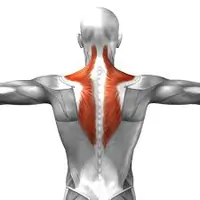
All planes of movement should be covered by the dynamic stretches, including internal and external rotation, adduction and abduction (lifting your arms to the sides and lowering them back down), and forward and backward flexion. Exercises should ideally also accommodate each person’s unique musculoskeletal limitations and asymmetries. While the lower trapezius and rotator cuff muscles are often weak, the upper trapezius and pectoralis major tend to be dominant in many persons. Therefore, combining shoulder warm-up exercises with upper back and chest movements is always a smart idea.
Dynamic stretches should be vigorous enough to increase blood flow to the muscles and your heart rate, but not so intense that they are solely motivated by momentum. Warming up is meant to engage the muscle, not to wear it out. Ballistic stretching actually has more negative effects than positive ones.
Warm-up Exercises:
This eight-move exercise uses dynamic stretches that include all planes of motion. When getting ready for shoulder workouts, routines that include shoulder exercises and upper-body workouts in general are a wonderful choice for beginners, people with bad posture, and those recovering from injuries.
As always, utilise light weights. Increasing your mobility and “waking up” your shoulder muscles doesn’t require a lot of tension. More difficult shoulder mobility exercises could be a good addition if you believe that weighted dynamic stretches are insufficient to get your body ready for a strenuous workout.
Standing straight-arm Circles:

- Place your feet shoulder-width apart as you stand.
- Make sure your arms are parallel to the floor by raising and extending them to the sides.
- Make little circular movements with your arms while maintaining a straight back and an engaged core.
- Make sure your shoulders are the source of the movement and that your body does not lean or sway to one side.
- Work your way up to bigger circles as your joints warm up. After completing at least 15 repetitions, change directions.
- Do an additional 15 backward reps.
Standing shoulder rolls:

- Place your feet shoulder-width apart as you stand.
- Shrug your shoulders while maintaining a straight back and an engaged core.
- Be careful not to hunch your back, thrust your head forward, or tense your neck muscles.
- After that, roll your shoulders back down and push your shoulder blades together.
- After completing at least 15 repetitions, change directions. Do an additional 15 backward reps.
Shoulder swing (lateral):

- Place your feet shoulder-width apart as you stand.
- Lift your arms and hold them out to the sides.
- Keeping your posture straight, cross your arms in front of you, then swiftly return them to the starting position.
- Throughout the exercise, maintain an engaged core to prevent swaying to the sides due to momentum. Perform a minimum of 15 repetitions.
Shoulder swing (back and forth):
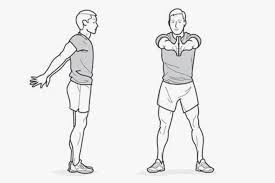
- Place your feet shoulder-width apart as you stand.
- Lift your arms and hold them out in front of you.
- Swing your arms back softly while maintaining a straight posture, then quickly return them to the beginning position.
- To avoid giving in to momentum and swaying back and forth, maintain an active core throughout the exercise. Perform a minimum of 15 repetitions.
Shoulder corkscrew:
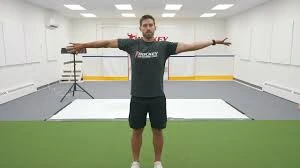
- Place your feet shoulder-width apart as you stand.
- Make sure your arms are parallel to the floor by raising and extending them to the sides.
- Start by slowly twisting your arms inwards and outwards while maintaining a straight back and an engaged core.
- Make sure your shoulders propel the action and that your body does not waver or tilt sideways. Perform a minimum of fifteen inward and fifteen outward turns.
Band Pull-apart:
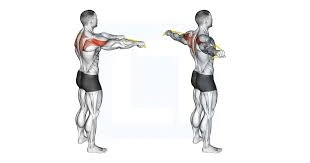
- Place your feet shoulder-width apart as you stand.
- Raise and extend your arms in front of you while holding one end of a light resistance band in each hand.
- Squeeze your shoulder blades and extend your arms to the sides while maintaining a straight posture.
- Hold the position for one or two seconds after your upper body forms the letter T, and then slowly return to the starting position.
- Avoid yanking the band or swaying back and forth; instead, move slowly and deliberately. Perform a minimum of 15 repetitions.
Banded face pull:
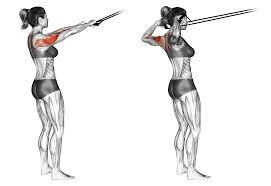
- Attach a triceps rope to a cable machine and choose a very small weight, or fasten a light resistance band to an anchor point at or just above eye level.
- To make sure there is enough tension, grasp the band in both hands while facing the anchor point and take a few steps back.
- Start by tightening your shoulder blades and drawing the band towards your face while maintaining a straight back and an engaged core.
- Naturally, your elbows should bend out to the sides.
- Hold the position for one or two seconds after the band approaches your face, and then slowly move back to the beginning position.
- Avoid swaying to the sides, hunching your back, or pulling the band. Perform a minimum of 15 repetitions.
Banded overhead reach:

- Place your feet shoulder-width apart as you stand.
- Raise and extend your arms in front of you after putting a light, small loop resistance band around your wrists.
- In order to keep the band slightly taut during the action, make sure your arms are apart.
- Raise your arms straight up overhead while maintaining a straight back and a tight core. Return to the starting position gradually.
Safety Advice:
- If you experience any pain, stop: When some discomfort is to be expected, you shouldn’t experience severe pain when performing these stretches or exercises. If you feel pain, stop immediately.
- Do not forget to breathe: Your shoulders, back, and other parts of your body can all feel less stressed and tense when you breathe. Having good breathing may also help you stretch or perform an exercise for longer.
- Take it gradually at first: Don’t try to do too much too quickly if you’re new to exercising or practicing shoulder exercises. As your strength increases, gradually increase the number of workouts and stretches you do.
- Consult your physician or physical therapist: Before performing shoulder mobility exercises and stretches, it’s crucial to consult your physician or physical therapist if you have had shoulder surgery, an injury, or severe shoulder pain.
FAQs
What are warm-up exercises for the shoulders?
Lean forward and support yourself with one hand on a table or counter. At your side, let your other arm hang loosely. Gently swing your arm back and forth. Repeat the exercise with your arm moving from side to side, then again in a circle.
Why is a shoulder warm-up important?
Injury prevention: A good shoulder warm-up lowers the chance of injuries such as shoulder impingement and rotator cuff tears. Dynamic stretches are essential because they increase flexibility and prime the shoulder for action. Examples of these movements are arm circles and cross-body swings.
What are the benefits of a warm-up?
It helps you work out more effectively and safely by raising your muscles’ temperature and flexibility. Before engaging in moderate- or vigorous-intensity aerobic exercise, a warm-up enables a slow rise in breathing and heart rate.
Can shoulder warm-ups improve posture?
Five easy workouts that prepare your shoulders for any activity are summarised here: Arm Circles: Use deliberate, circular arm motions to increase blood flow and range of motion. Scapular Retractions: To enhance posture and stability, strengthen the muscles surrounding your shoulder blades.
Can I warm up my shoulders daily?
It will significantly increase the longevity and function of your shoulder in just ten minutes. Avoid waiting for something to break. To be honest, I’d advise warming up your entire body every day. However, I understand that some people find that difficult, so start with your shoulders and see how they feel.
How do warm-ups reduce injury?
Improved Blood Flow: Warming up increases blood flow, which helps your muscles receive oxygen and nutrients, improving performance and lowering your chance of injury. Increased Flexibility: A good warm-up makes your muscles and connective tissues more pliable, which lessens stiffness and expands your range of motion.
What is a good shoulder warmup?
Face pulls are arguably the simplest and most efficient shoulder mobility and warm-up exercise. Accomplish this if you are only going to accomplish one thing! With your arms outstretched, grab a resistance band and draw it to your face. Perform two sets of fifteen repetitions.
References:
- Lindberg, S. (2020, January 10). 10 Shoulder mobility exercises and stretches. Healthline. https://www.healthline.com/health/shoulder-mobility-exercises#stretches.
- Gora, A. (2023, July 26). 8 Shoulder Warm-Up Exercises to Kick-Start your Upper-Body Sessions. Coach. https://www.coachweb.com/fitness/shoulder-exercises/shoulder-warm-up
- Motion, P. (2022, December 17). Shoulder warm-up exercises. Pivotal Motion Physiotherapy. https://pivotalmotion.physio/shoulder-warm-up/