Strength Training At Home With Minimal To No Equipment
Introduction
An essential component of any fitness programme is strength training, commonly known as weight training or resistance training. It increases muscle endurance and strength.
Strength training involves moving your body against opposition, like:
- The weight of your body
- Resistance bands, sometimes referred to as resistance bands or workout bands; free weights, such as dumbbells or barbells; resistance machines, such as cable machines, single-exercise machines, or multi-gym systems.
- Strength training is a flexible form of exercise that you may perform practically anywhere. Although strength training is a common kind of exercise at many gyms, you may also create an extensive plan that you can perform in the privacy and comfort of your own home.
What are the benefits of strength training?
Strength training can improve your fitness and health in a variety of ways, according to research.
- Increase lean muscle mass, decrease body fat, burn calories more effectively even after exercise, increase metabolism, improve weight loss, improve bone density and health, increase range of motion and flexibility, and enhance brain and cognitive abilities.
- lessen the signs of numerous chronic illnesses, such as diabetes, heart disease, arthritis, and back pain; enhance stability, balance, and posture; and increase life,
- enhance happiness, and general well-being
Benefits of Home Exercises
Fitting in a workout without going to the gym can be really simple and helpful with a home-based exercise program.
- Advantages
- Time is saved. There is no need to go or wait for machinery or equipment.
- It is inexpensive. Neither costly machinery nor gym fees are required.
- Exercise whenever you want. No matter the time of day or night, you can work out according to your own schedule.
- confidentiality. You don’t have to be self-conscious to work out.
- Proceed at your own speed. There’s no pressure to push yourself over your comfort zone or to keep up with people around you.
Getting started
Finding a comfortable workout space in your house is the first step when you’re ready to begin planning your strength training schedule. You need to find a space that allows you to freely move your arms and legs.
Although you don’t need to buy a lot of equipment, the following items can be useful if you do wish to buy a few:
- An exercise mat
- Resistance bands or tubing
- Dumbbells
- A kettlebell
- A stability ball
- A medicine ball
You can improvise by switching water bottles, sandbags, or canned foods for dumbbells or a kettlebell.
You might want to look for an online strength training workout for beginners if you’re just starting. This can teach you how to properly warm up and cool down, as well as do various exercises with proper form.
Start with a warmup
Spend at least five to ten minutes warming up before beginning your workout. This can be running on the spot, walking quickly, or doing exercises that target your arms, legs, and other main muscle groups.
Bodyweight strength training exercises
You can begin with a series of bodyweight exercises once your muscles have warmed up and are prepared to move.
Except for a workout mat if the floor is too hard, you don’t need any equipment for bodyweight exercises.
Make sure your motions are constantly controlled and fluid for each of these exercises.
Lunges
Your quadriceps, hamstrings, glutes, and calves are among the lower body muscles that are worked by a simple lunge.

To complete this task:
- To begin, take a tall stance with your feet shoulder-width apart.
- Step forward with your right foot and bring your hips down to the floor until your left knee is parallel to the floor and your right leg is at a 90-degree angle. Make sure your front knee stays inside your toes.
- To maintain an upright torso, lengthen your spine.
- For at least five seconds, maintain this posture.
- After that, step your right foot back to meet your left, then do the same with your left leg.
- After ten or twelve repetitions, take a little break and perform another set.
- Walking lunges, jumping lunges, torso-twisting lunges, and side lunges are examples of lung variations.
Squat to overhead raise
Start with lifting your arms above your head, without any weight if you’re new to strength training. You can add small dumbbells and increase the weight as you gain strength, so that you can perform this exercise with proper form.
This workout strengthens your triceps, shoulders, back, and core muscles in addition to your glutes and leg muscles.

To complete this task:
- Place your arms next to your body and stand with your feet slightly wider than your hips.
- Squat by slowly lowering your hips.
- To stand again, press up and lift your arms above your head.
- Go back to where you were.
- Perform 8–12 repetitions in 1–3 sets.
Planks
Planks are a great way to strengthen and stabilize your core. Your shoulders, chest, and back muscles can all be strengthened with this workout.

To complete this task:
- Keep your body upright, squeeze your buttocks, and contract your abdominal muscles while resting on only your forearms and toes.
- Try to maintain this posture for thirty seconds. Start with 20 seconds if that’s too difficult.
- Try to maintain the plank position for at least a minute as your strength and fitness increase.
- Try elevating one leg at a time while maintaining the plank posture when you’re ready for a more difficult variation of the exercise.
Pushups
Standard push-ups target the shoulders, triceps, and abdominal muscles, in addition to the chest muscles (pectoralis).

To complete this task:
- Place your palms directly below your shoulders to start in the plank posture.
- Lower your body by bending your elbows until your chest nearly touches the floor while maintaining a flat back and bracing your core.
- Push your body back up to the starting posture right away.
- Repeat eight to twelve times. As you gain strength, increase the number of sets from 1-2 to 3.
- You can perform a less difficult pushup by placing your weight on your knees rather than your toes.
Plyo push-ups, close-stance push-ups, and decline push-ups are more difficult variations of push-ups.
Dumbbell shoulder press
In addition to strengthening your core and chest muscles, this workout works the muscles in your arms and shoulders.
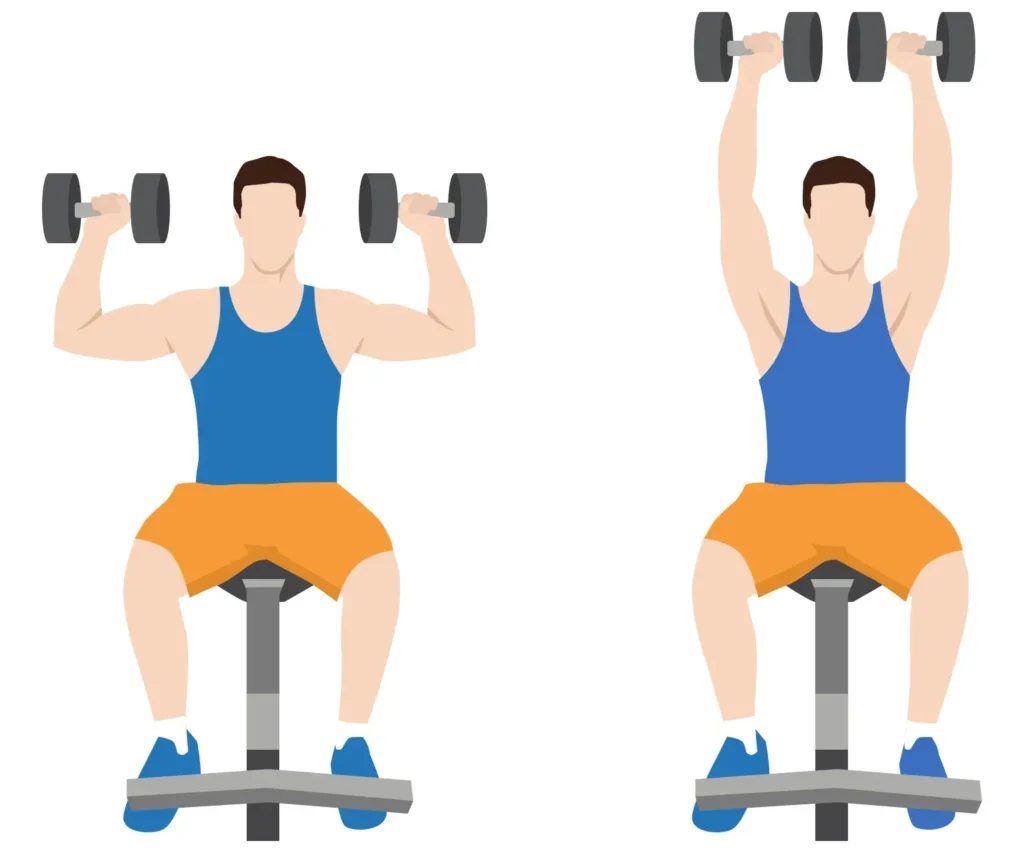
To complete this task:
- Place your feet shoulder-width apart as you stand.
- Raise the dumbbells to shoulder height after picking them up. You can turn your palms to face your body or forward.
- Lift the dumbbells above your head until your arms are completely outstretched.
- Return the dumbbells to shoulder height after pausing for a little while.
- Perform 8–12 repetitions in 1–3 sets.
Dumbbell triceps kickback
Both your shoulder muscles and your triceps are worked during this workout.
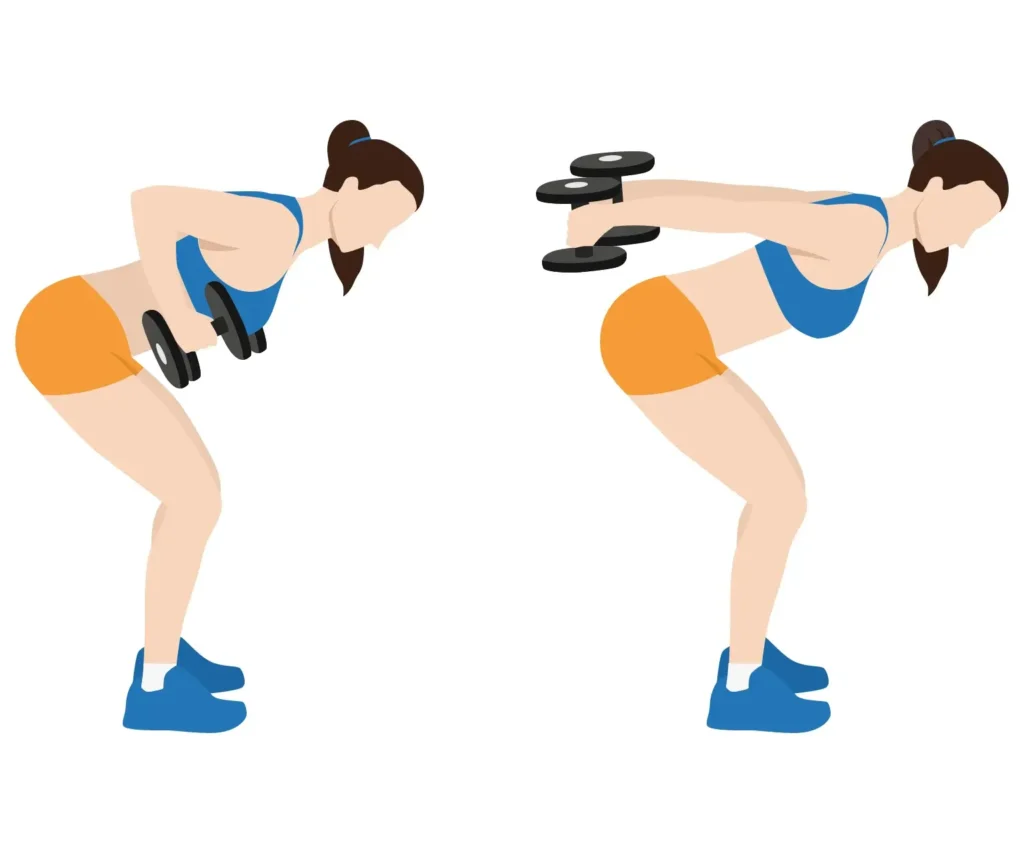
To complete this task:
- Take two dumbbells and grasp one in each hand.
- Make a 90-degree angle with your elbows and a 45-degree angle with your body.
- Next, extend your arms straight behind you while using your triceps.
- You can work on both arms simultaneously or one at a time.
- Start with 1-2 sets of 8–12 repetitions if you’re new, and as you gain strength, increase to 3 sets.
The resistance band pulls apart.
The muscles in your arms, shoulders, and back are worked during this workout.

To complete this task:
- Place your arms at chest height in front of you while standing.
- Using both hands, firmly grasp a resistance band. The band needs to run parallel to the floor.
- Pull the band toward your chest by extending your arms to your sides while maintaining a straight posture. Start this exercise with your mid-back.
- Squeeze your shoulder blades together while maintaining a straight spine, then gradually go back to where you were.
- Perform 15–20 repetitions in 1–3 sets.
Hip extension with resistance band
The muscles in your legs and hips are worked during this exercise. For this workout, a band with light to medium resistance is required.
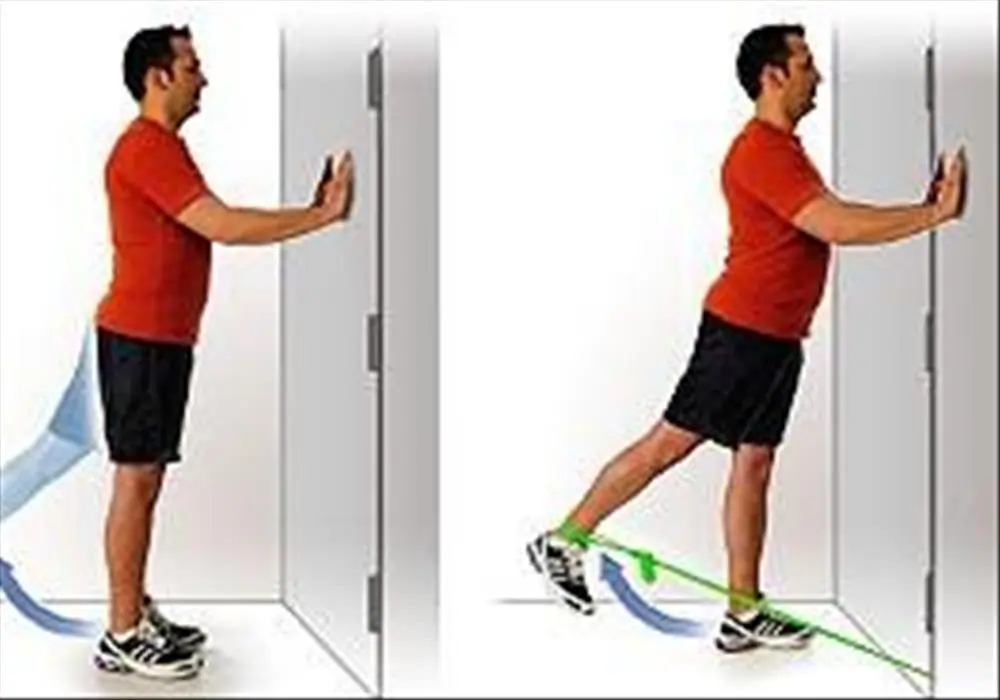
- Wrap the resistance band around each of your ankles. For balance, you can utilize a wall or a chair.
- Pull your left leg back as far as you can while maintaining a straight body line.
- Go back to the beginning position slowly.
- Repeat with your right leg after completing 12 repetitions with your left.
- Start with two sets on each side, and as your strength increases, progress to three sets.
Resistance band leg press
Your quads, hamstrings, calves, and glutes are all worked during this workout. This exercise requires you to work against gravity, much like a leg press on a weight machine.
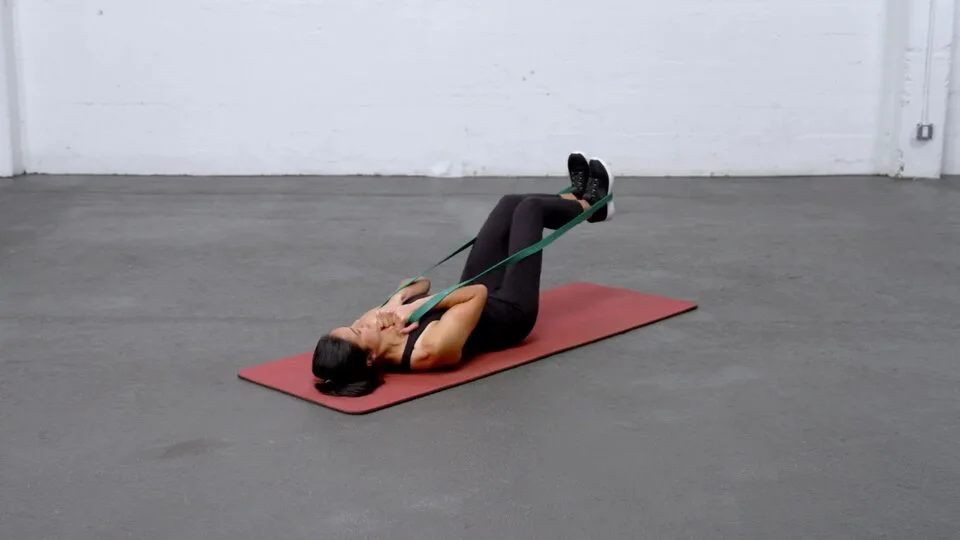
- Raise your feet off the floor while lying on your back.
- Make a 90-degree angle by bending your knees. Point your toes upward while flexing your feet.
- Hold the ends of the resistance band as you wrap it around your feet.
- To fully extend your legs, press your feet on the bands.
- To get your knees back to a 90-degree angle, bend them.
- Perform 10–12 repetitions in 1–3 sets.
FAQs
Is it possible to do strength training at home without equipment?
Yes, you can definitely do strength training at home without any equipment by using your own body weight to make it harder. Doing core exercises like push-ups, squats, lunges, planks, and glute bridges on a regular basis is a great way to build muscle and strength. To get the most out of your workouts, focus on slow, controlled, high-intensity movements.
Important exercises that don’t need any equipment:
For your upper body, do push-ups for your chest and triceps, dips on a chair for your triceps, and Superman for your back.
Squats, lunges, glute bridges, calf raises, and step-ups are all good for the lower body.
Planks, leg raises, crunches, and Russian twists are all good for your core.
How to Succeed:
Make it harder: As you get stronger, do more reps or sets, or take less time between sets.
Structure: Try to do a full-body workout two to three times a week, giving your muscles time to rest.
Intensity: To help your muscles grow, use a slow, controlled tempo to keep them under tension for longer.
If you want to add weight, you can use things around the house like water bottles, heavy books, or a backpack.
A Beginner’s Workout:
Warmup: 5 to 10 minutes of jogging in place, jumping jacks, and hip circles.
Three sets of 10 to 15 squats.
Push-ups: 3 sets of 8 to 12 reps (you can do them on your knees).
Do 10 lunges on each leg for three sets.
Plank: three sets of 30 to 60 seconds each.
Three sets of 15 glute bridges.
Why 5 reps for strength?
Rep ranges from 5 to 30 can create muscle as long as you press hard, according to a 2017 study. However, the 5 rep zone offers the ideal balance between strength increases and muscle growth without ruining your healing.
What’s the best exercise for type 2 diabetes?
For people with type 2 diabetes, the best type of exercise is a mix of aerobic activity (like brisk walking, swimming, or cycling) and resistance training (like lifting weights or using bands). At least 150 minutes of moderate-intensity aerobic exercise and 2–3 sessions of strength training per week can help you become more sensitive to insulin, control your blood sugar, and lower your A1C.
The best exercises for managing type 2 diabetes are:
Brisk walking is a simple and effective way to lower blood sugar.
Cycling (on a stationary bike or on the road): High-intensity rowing and cycling can make your body more sensitive to insulin by 30 to 40%.
Swimming and water aerobics are great for your heart health because they don’t put a lot of stress on your joints.
Use weights, resistance bands, or your own body weight (like squats and push-ups) to build muscle mass. This helps keep blood sugar levels in check.
Dancing is a fun and energetic way to get your heart healthy and get you motivated.
Interval Training (HIIT): Blood sugar management can be greatly improved by alternating short bursts of intensive activity with short periods of light activity.
Important Advice for Success:
Regularity: Avoid going without exercise for more than two days in a row.
Daily Movement: To lessen blood sugar spikes, take quick breaks to move every 30 minutes if you’re sitting at a desk.
Safety: Keep an eye on your blood sugar levels before and after working out, drink enough water, and look for injuries on your feet.
Start Slow: If you’re new to working out, start with shorter, lower-intensity workouts.
Can weight lifting improve bone density?
Why exercise is good for your bones – Yes, one of the best ways to make your bones denser and lower your risk of osteoporosis is to lift weights. When you do resistance training, it puts stress on your bones, which makes them denser, stronger, and more resistant. This is especially true for your hips, spine, and wrists.
Important Information About Lifting and Bone Health:
Mechanism: When you lift something, your muscles pull on your bones, which makes new bone grow.
For effective workouts, do compound movements like squats, deadlifts, and overhead presses.
Higher intensity (heavier weights) with fewer repetitions is usually better for training, but all resistance training is good.
Frequency: Research indicates that optimal outcomes are achieved with a minimum of two to three sessions weekly.
What exercises should be avoided with diabetes?
Be careful! severe heat or cold, isometric workouts, heavy lifting or straining, and highly demanding activities. Walking, everyday tasks, gardening, and fishing are examples of moderate activities. Stretching and lifting are moderately dynamic.
What is the miracle food for diabetes?
Leafy veggies with a dark green color
Rich in iron, calcium, potassium, and vitamins A, C, K, and folate, these meals fit on the Diabetes Plate’s non-starchy vegetables portion and are low in calories and carbs.
Do squats lower blood sugar?
Yes, squats are a great way to lower blood sugar levels. They are a “glucose sponge” because they use big muscles like the quads and glutes to pull sugar from the blood quickly for fuel. This makes insulin work better and lowers spikes after meals.
Important Information About Squats and Blood Sugar:
“Exercise Snacks”: Doing short bursts of activity, like 10–15 air squats every 45–60 minutes, is better for keeping blood sugar stable throughout the day than doing one long workout.
After Eating: Doing squats right after a meal can lower your blood sugar response by a lot.
No Equipment Needed: You can get good results from bodyweight squats or just sitting and standing up from a chair.
Effectiveness: Regular, intermittent squats are a great tool for those with sedentary occupations because studies show that they improve blood sugar management more than sedentary activity.
What are the 9 physical abilities?
Static strength, explosive strength, dynamic strength, trunk strength, extent of flexibility, dynamic flexibility, gross body coordination, gross body equilibrium, and stamina are the nine dimensions that make up one classification of physical aptitude.
What do eggs do to your muscles after 50?
Eggs Offer High-Quality Protein
The fact that eggs contain all nine essential amino acids in adequate proportions to enable efficient muscle growth, recovery, and maintenance contributes to the protein’s powerful edge.
What are the first signs of muscle loss?
Warning signs
Loss of appetite is one sign that you may be losing muscle mass, along with general symptoms of tiredness or poor energy. weight reduction. reduced power.
Is it better to lift heavy or light with more reps?
A good strategy to maintain lean muscle mass is to develop muscle endurance by lifting lesser weights for more repetitions. Lifting more weight for fewer repetitions increases muscle strength and speeds up muscle fatigue, both of which are excellent for building muscle mass.
What exercise increases bone density the most?
The very best kind of muscle-strengthening exercise for your bones is progressive muscle resistance training. It includes gradually increasing the amount of work your muscles must perform by employing weights or resistance bands. This occurs by progressively increasing the weight you lift, logically and stably.
How to get stronger without getting bigger?
To get stronger without making your muscles bigger (hypertrophy), lift heavy weights (80–90% of 1RM) for low reps (2–6 reps) and take long breaks (3–5 minutes) between sets. To make your muscles stronger without making them bigger, focus on compound movements, explosive training (plyometrics), and keep your calorie intake at a maintenance level.
Important Tips for Getting Strong Without Getting Big:
Low Reps, High Intensity: Do 2 to 6 sets of 80 to 90 percent of your one-rep max with heavy weights. This teaches the nervous system how to use more muscle fibers effectively instead of making new muscle tissue.
Long Breaks: Take a break of 3 to 5 minutes between sets. This lets your ATP (energy) levels fully recover, which lets you lift the most weight in each set.
Do compound lifts, which are exercises that work more than one joint and muscle group at the same time. Squats, deadlifts, bench presses, overhead presses, and pull-ups are all good examples.
Put Explosive Power First: Add plyometrics and explosive moves like medicine ball slams, clap push-ups, or box jumps to your workouts. These increase the “rate of force development” (the recruitment of fast-twitch muscle fibers) without hurting the muscles enough to make them bigger.
Control the amount of training: Don’t do too much overall. Too many sets and reps cause hypertrophy, so keep the total volume low and focus on intensity over quantity.
Keep your maintenance calories: Don’t eat more calories than you need. If you only eat enough to keep your weight the same, your body won’t be able to build more muscle.
Bodyweight and functional training: Use calisthenics like pull-ups, dips, and push-ups to build “relative strength,” which is strength compared to your own body weight.
Best Training Structure:
Reps: 2 to 6 for each set.
Sets: 3 to 5 for each exercise.
Intensity: 80–90% of your 1RM.
2–3 times a week, with time to rest in between.
Focus on these exercises:
Deadlifts, squats, weighted pull-ups, and overhead presses are all good for building strength.
Kettlebell swings, box jumps, and medicine ball slams are all good for building strength.
Planks and Turkish Get-ups are good for stability and core strength.
References
- An easy glute workout to lift and firm your butt. (2020, January 1). [Video]. NBC News. https://www.nbcnews.com/better/lifestyle/30-day-strength-training-routine-no-equipment-required-ncna988936
- Cronkleton, E. (2019, September 5). How to get a Full-Body Strength Training workout at home. Healthline. https://www.healthline.com/health/exercise-fitness/strength-training-at-home
- Harrison, C. (2025, October 23). Easy strength training you can do at home. UT MD Anderson. https://www.mdanderson.org/cancerwise/easy-strength-training-you-can-do-at-home.h00-159780390.html
- Physiologist, J. H. C. E. (2026, March 13). Strength exercises. British Heart Foundation. https://www.bhf.org.uk/informationsupport/heart-matters-magazine/activity/strength-exercises
- Strength training exercises without equipment: Build strength with no kit. (2025, March 17). PureGym. https://www.puregym.com/blog/no-equipment-strength-exercises/


