Building Upper Body Strength Using Only Bodyweight
Inroduction
To tone and strengthen your arm muscles, you don’t require expensive equipment. Planks, pushups, and arm circles are examples of body weight exercises that can assist you complete the task at any time and from any location.
The foundation of every complete fitness routine is arm strengthening. Strong arms are more than simply looks. Functionally, carrying, lifting, pushing, and pulling are just a few of the daily tasks that require arm strength.
Many exercises can help you tone and strengthen your arms without the use of weights, even though many classic arm-strengthening routines require weights and a gym.
What muscles are we targeting?
Your arms contain a variety of muscles, which range from your hands and wrists to your shoulders.
Additionally, the muscles in your shoulders and chest are essential to many of the arm motions you do daily.
The following are the main muscles found in the arms themselves:
Biceps brachii
This traditional muscle is responsible for externally rotating your hand and forearm as well as flexing your elbow.
Coracobrachialis
This muscle extends just behind your elbow from your shoulder to the middle of your upper arm. It helps you flex, or raise, your upper arm.
Brachialis
Flexing your elbow is largely dependent on the brachialis, a powerful elbow flexor that extends from the middle of your upper arm to just below the elbow.
Triceps brachii
Each of the three separate heads of this muscle starts at the shoulder and extends from the back of your upper arm to just below the elbow. It is in charge of both extending your shoulder and extending your elbow when you straighten your arm. It also moves your arm behind you.
Your arms’ strength output is mostly dependent on the muscles in your shoulders, upper back, and chest, in addition to the muscles in your arms.
These muscles are essential for almost every movement or stabilizing force required while utilizing your arms for tasks, even though they are not commonly considered arm muscles.
Among these muscles are:
Pectoralis major
The majority of arm motions, such as pushing, lifting, and lowering the arm from a flexed position, are controlled by the pectoralis major. Additionally, it helps with upper arm rotation and adducts the arm from a horizontal position.
Pectoralis minor
An essential scapular stabilizer is this muscle.
Posterior shoulder muscles
During pull-apart motions, for example, your upper arm is moved backward by these rear shoulder muscles.
Deltoids
Your arm may go upward in all directions thanks to the muscles surrounding the front, side, and posterior of the shoulder. They are also responsible for the upper arm’s rotation.
Rotator cuff muscles
These muscles help initiate arm motions in addition to being essential shoulder stabilizers.
Latissimus dorsi
When doing a lat pulldown or rowing motion, for example, this upper back muscle causes your upper arm to slide lower, inward, or backward.
To guarantee that you have sufficient, equal strength in every direction your arm may move, overall arm strengthening should concentrate on as many of these muscles as you can.
Your arm’s front and back muscles, as well as the muscles in your chest, shoulders, and upper back, are all necessary for arm motions.
Upper Body Strength Using Only Bodyweight Exercise
The various arm muscles are best targeted by the following workouts, which don’t require additional weight. The workouts are ranked from easy to challenging and may target both your arms and core muscles, among other muscle groups.
It’s important to note that strengthening the back and biceps without the use of an external weight is extremely challenging without a pull-up bar or suspension trainer, such as gymnastic rings or a TRX system.
During each round of these exercises, consider actively contracting your arm muscles. Your training will be of higher quality as a result of increased muscle activation.
Arm circles
This isometric workout for beginners improves the biceps and triceps while concentrating on the shoulder muscles. You can build circles of varying sizes, but make sure to keep your arm straight during the entire set.

To do arm circles:
- With your arms extended straight to your sides and your muscles stretched throughout the length of your arms, take a tall stance.
- With your arms straight and your elbows relaxed, slowly rotate them around your shoulders to create circles.
- Do three sets of ten to twenty repetitions in each direction. To slightly alter the amount of effort needed, you can complete sets of circles with different diameters.
Arm front raises
This exercise develops your biceps and triceps isometrically while focusing on the front of your shoulder.

To perform front lifts of the arms:
- With your thumbs pointing toward the ceiling and your arms extended straight forward, take a tall stance.
- When looking from the side, raise your arms straight and locked out until they point straight up overhead, with your upper arms covering your ears.
- Lower your arms slowly to the beginning position.
- Do three sets of ten to twenty repetitions.
Arm lateral raises
This exercise develops your biceps and triceps isometrically while focusing on the top of your shoulder.
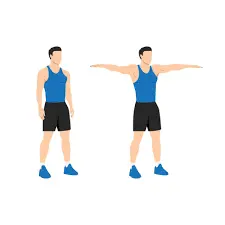
To do lateral arm raises:
- With your palms pointing inward toward your hips, stand with your arms by your sides.
- Raising your arms to the side while maintaining a straight posture will cause your body to form a “T” when viewed from the front.
- Lower yourself gradually to the beginning position.
- Do this ten to twenty times.
Wall angels
This exercise increases shoulder mobility while strengthening the triceps and shoulders.
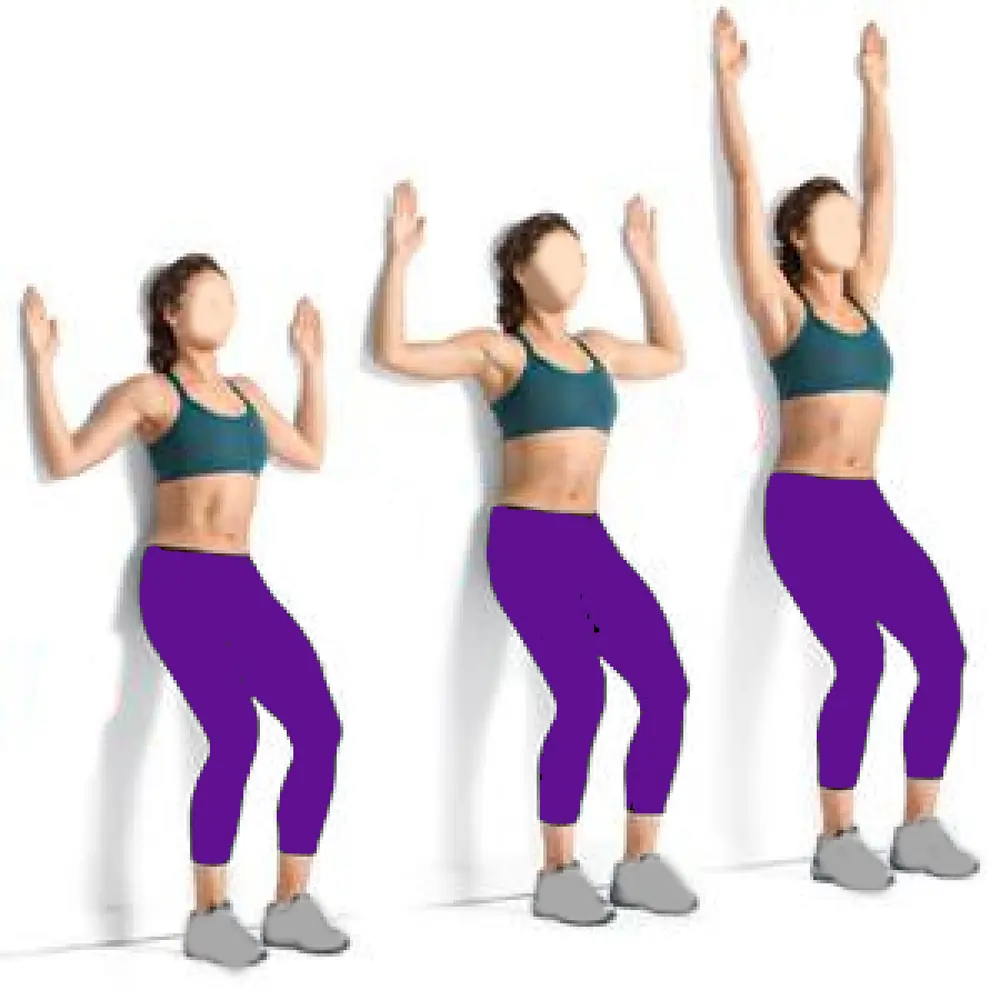
To perform wall angles:
- With your knees bent and your feet around 1-2 feet (or 0.5 meters) away from the wall, stand with your back to the wall. You should make contact with the wall with your head, upper back, and tailbone.
- As if you were raising your hands, bend your elbows to a 90-degree angle and raise your arms until your upper arms are parallel to the floor.
- Arm raise straight. Try to maintain touch with the wall with your arms, head, upper back, and tailbone.
- Go back to where you were.
- Repeat 10–12 times in three sets.
Downward Dog to plank
The triceps, shoulders, and chest are all strengthened by this workout. It’s a great method to start strengthening the peak of a pushup.

To carry out the Downward Dog to Plank:
- In the plank position, hands below your shoulders.
- If you find the pushup plank posture too difficult, you might begin with your knees on the floor.
- To reach the Downward Dog Pose, raise your hips and push back with your arms. If you begin on your knees, you will push back far enough to lift your knees off the ground.
- Return to the beginning position after briefly stabilizing in the Downward Dog Pose.
- Perform three sets of ten to twelve repetitions.
Plank tap
You can build your shoulders, triceps, and biceps with this variation of the plank exercise.

To execute the plank tap:
- In the plank position, hands below your shoulders.
- Maintain a neutral spine. Keep your feet together to increase the difficulty of the exercise. Widen your feet to make it easier.
- Before putting your left hand back on the ground, raise it to your right shoulder and tap it.
- Do the same with your left shoulder and right hand.
- Do three sets of ten to twelve repetitions on each side.
Pushup
This arm workout has an additional core component because you will need to use your core to maintain the position.
If the regular variation is too difficult, try doing the pushups on your knees.

To perform a push-up:
- The starting position is the hands under your shoulders.
- If necessary, lower the effort level by keeping your knees on the floor.
- Bend at the elbow to lower your entire body in coordination toward the floor. Maintain a 45-degree angle or keep your elbows at your sides. Your upper arm should be parallel to the floor as you lower your chest.
- To drive back to the top position, push through the floor while keeping control.
- Perform three sets of ten to twelve repetitions. You can switch back to the knees-down version if the sets seem too challenging.
Triceps dip
You only need a chair for this form of the dip. The triceps and chest are the main muscles worked during this workout.

To perform triceps dips using bodyweight:
- On the chair you are supporting yourself on, place your hands shoulder-width apart.
- To give yourself room when you dip down, move your pelvis and bottom forward until there is a space of 3–6 inches (8–15 cm) between your back and the chair.
- With your feet firmly placed on the ground, bend your legs to a 90-degree angle or spread them out in front of you, being careful not to lock your knees.
- Focus on using your triceps as you slowly lower your body straight down and then push yourself back up.
- Perform three sets of ten to twelve repetitions.
FAQs
What are upper-body bodyweight exercises?
Push-ups, dips, planks, and rows are all good bodyweight exercises for the upper body that work the chest, back, shoulders, and arms. Standard and diamond push-ups, pike push-ups, tricep dips, pull-ups (if you have a bar), and Superman holds are all important exercises for building back strength.
Pushing Movements for the Chest and Triceps
Push-ups work the chest, shoulders, and triceps. Beginners can do them on their knees or with their hands raised (incline).
Diamond Push-ups: Put more stress on the triceps.
Pike push-ups put the body in a V-shape to work the shoulders.
You can do tricep dips on a sturdy chair or step.
Dive Bomber Push-ups are a dynamic exercise that works the shoulders and chest.
Pulling and pushing movements for the back and shoulders
Push-ups work the chest, shoulders, and triceps. Beginners can do them on their knees or with their hands raised (incline).
Diamond Push-ups: Put more stress on the triceps.
Pike push-ups put the body in a V-shape to work the shoulders.
You can do tricep dips on a strong chair or step.
Dive Bomber Push-ups are a dynamic exercise that works your chest and shoulders.
Back and Shoulders (Pulling and Moving Backward)
Superman Holds: Lying on your stomach, lift your arms and legs to work your lower back and shoulders.
Plank Row/Plank to Push-up: Works the back muscles and makes the core more stable.
Prone I, Y, and T Raises: Lying on your stomach, lift your arms in the I, Y, and T positions to work your upper back and shoulders.
Downward Dog Scapular Push-ups: This exercise works on making your shoulders stronger and more stable.
Core and Upper Body Combinations
Burpee with Push-up: A full-body, high-intensity workout that strengthens the shoulders and core.
Plank Shoulder Taps: Get into a high plank position and tap your shoulders to strengthen your core and shoulders.
Side Planks: Build strength in the shoulders and obliques.
Tips for Working Out
Volume: Begin with two sets of 10 to 15 reps and add more sets as you get stronger.
To make exercises harder, you can slow down the movement, cut down on rest time, or add more reps.
Before you start, do some light movement, arm circles, and torso twists to warm up.
What are the top 5 bodyweight exercises?
Planks, push-ups, burpees, mountain climbers, and squats are some basic exercises you just cannot avoid if you have ever taken any kind of bodyweight training program. or the “Big 5” bodyweight exercises, as we like to refer to them.
What are upper exercises?
Exercises for the upper body, which focus on everything from your arms to your abdominal muscles (abs), are an excellent method to increase muscle growth, burn body fat, and build strength (depending on your goals).
What is the 10 rule in fitness?
How soon we can safely increase our exercise is guided by the 10 percent rule. You should avoid increasing your exercise by more than 10% per week. Weights, training duration, distance, and involvement in the sport itself are examples of this.
What bodyweight exercise targets the upper chest?
Decline push-ups, pike push-ups, and reverse grip push-ups are all good bodyweight exercises for the upper chest. They are all like incline bench presses. Putting your feet on a higher surface makes the load on the upper pec fibers (clavicular) heavier. These exercises build muscle and make you feel more tense without using any equipment.
Best Bodyweight Exercises for the Upper Chest
Decline push-ups: Put your hands on the floor and your feet on a sturdy chair, couch, or step. The upper chest works harder the steeper the angle (up to 45°).
Pike Push-ups: Lower your head between your hands while your hips are high in the air, and your body is in an inverted “V” shape. This works the shoulders and upper chest.
Push-ups with your palms facing backward (fingers pointing toward your feet) are called reverse grip push-ups. This move is good for your shoulders because it keeps your elbows close to your body and works your upper pecs.
Diamond/Close-Grip Push-ups: Keeping hands close together forces the upper and inner chest to work harder, particularly when done on a slight decline.
Bodyweight Dumbbell Flyes: To do these, lie on your back on a smooth floor with socks or small towels on your hands. Then, bring your arms together in a hugging motion, as you would with a cable crossover, to work on your upper chest.
Explosive/Clap Push-ups: From a decline position, push up hard enough so that your hands leave the ground. This will make your pectoral muscles work harder.
Important Tips for Success
Keep the Tension: Always keep your core tight when you move.
Elevation is Important: To give the upper chest priority over the middle or lower chest, always aim for a “decline” setup (feet higher than hands).
Form: To minimize upper pec activation and avoid shoulder injuries, keep elbows tucked at a 45-degree angle to the torso.
What is the 40 rule in the gym?
According to the 40% Rule, our body has only reached 40% of its capacity when our mind tells us to give up. Consider this in the context of a workout. How many times have we been in the middle of a lengthy grinder when that uncertainty starts to sneak into the back of our minds?
How many upper-body exercises?
One day of two or three upper body exercises and one day of two or three lower body exercises should be followed by a rest day for an upper/lower body split. At an intermediate level, this is excellent.
What are the 5 major upper-body muscle groups?
The chest, shoulders, back, arms, and core are the five main muscular groups in the upper body. Knowing these muscle groups enables you to design a well-rounded exercise program that efficiently works each one, guaranteeing the development of whole upper body strength.
What are the basic bodyweight exercises?
This easy 20-minute bodyweight workout doesn’t need any equipment and works the whole body through circuits to build strength and burn fat. Do the following 2–3 times, taking a break of 1–2 minutes between each round: Do 20 bodyweight squats, 10 push-ups (on your knees if you need to), 10 walking lunges on each leg, 10 inverted rows or superman raises, and a 15-30 second plank.
Routine for the Whole Body
Warm-up: Do jumping jacks for one minute.
Squats (20 reps): Keep your feet shoulder-width apart and lower your hips back and down.
Push-ups (10 reps): You can change the exercise by dropping to your knees or using a wall or chair.
Walking lunges (10 on each leg): Step forward and lower your hips until both knees are bent at a 90-degree angle.
Rows/Supermans (10 reps): Do inverted rows under a table or Superman reps (lie on your stomach and lift your arms and legs) to work your back.
Plank (15–30 seconds): Keep your body in a straight line from your head to your heels on your elbows or hands.
Cooldown: Stretch your legs and shoulders a little.
How to Succeed
To make it harder, try jumping lunges or elevated pike push-ups.
Intensity: Pick a hard pace and try to do as many reps as you can with good form.
How often: Do this routine two to three times a week, with at least one day off between sessions.
What is a bodyweight workout called?
Calisthenics is the main name for bodyweight exercises. This type of training uses the person’s own body weight as resistance to do multi-joint, compound movements that make them stronger, more flexible, and better at coordinating their movements with little or no equipment. Push-ups, pull-ups, squats, lunges, planks, and burpees are all common examples.
Important Parts of Calisthenics (Bodyweight Training):
Resistance: Instead of using weights, it moves the body against gravity.
Benefits: It focuses on building relative strength (strength in relation to body weight), balance, and mobility.
Accessibility: This is a workout that is often called “low-frills” because it can be done anywhere and at any time.
Origin: The word comes from the Greek words kallos (beauty) and sthenos (strength) and was first used in Ancient Greece.
Variety: There are movements for beginners, like planks, and advanced skills, like muscle-ups and human flags.
What is the definition of the upper body?
The upper body is the part of the body that is above the waist. It includes the chest, back, shoulders, arms, and neck. The pectorals, lats, deltoids, biceps, and triceps are just a few of the more than 120 muscles that make it up. Push-ups, pull-ups, rows, and overhead presses are some of the most important exercises for building strength and improving posture.
Important Muscle Groups and Their Anatomy
Pectorals, or chest muscles, help you push things.
Back (Latissimus Dorsi, Trapezius, Rhomboids): Important for pulling, stability, and posture.
Shoulders (Deltoids): They help with arm rotation and lifting things over your head.
Biceps, triceps, and forearms are important for pulling, pushing, and gripping.
Exercises for the Upper Body
Push-ups, bench presses, shoulder presses, and dips are all examples of pushing.
Pulling: Chin-ups, pull-ups, rows, and lat pulldowns.
Warm-up: roll your shoulders, make circles with your arms, and twist your torso.
Similar Words and Terms
The upper body
Upper extremity (usually means the arms and shoulders)
Top part
Anatomy of the upper body.
References
- 10 best upper body bodyweight exercises. (2023, October 10). PureGym. https://www.puregym.com/blog/10-best-upper-body-bodyweight-exercises/
- Cpt, T. R. B. (2023, April 29). 8 Weight-Free exercises to tone your arms. Healthline. https://www.healthline.com/health/fitness-exercise/arm-exercises-no-weights#muscles-worked
- Mudge, L. (2025, June 7). You only need your bodyweight and these six moves for a stronger upper body. Fit&Well. https://www.fitandwell.com/exercise/bodyweight-exercises/you-only-need-your-bodyweight-and-these-six-moves-for-a-stronger-upper-body
- Nyman, A. (2026, March 31). Upper body bodyweight exercises: Top 10 moves to build strength at home. Angles90®. https://angles90.com/blogs/a90-blog/upper-body-bodyweight-exercises?srsltid=AfmBOorNhawrUouA5SyATonCgKNtOwcRXY4B76Juk2z9a1FBqbVVKkc6
- Tracey, A. (2024, June 27). This 15-Minute bodyweight “Giant Set” workout will score you a huge upper-body pump. Men’s Health. https://www.menshealth.com/uk/workouts/a61435917/bodyweight-chest-shoulders-arms-workout/


