Yoga Breathing for Lung Capacity
Introduction
Healthy lungs are essential for delivering oxygen throughout the body, supporting energy levels, endurance, and overall well-being. While regular physical activity helps maintain respiratory health, yoga breathing exercises—also known as pranayama—are a simple and effective way to improve lung capacity naturally. These techniques focus on slow, controlled breathing that strengthens the respiratory muscles, enhances oxygen exchange, and promotes relaxation.
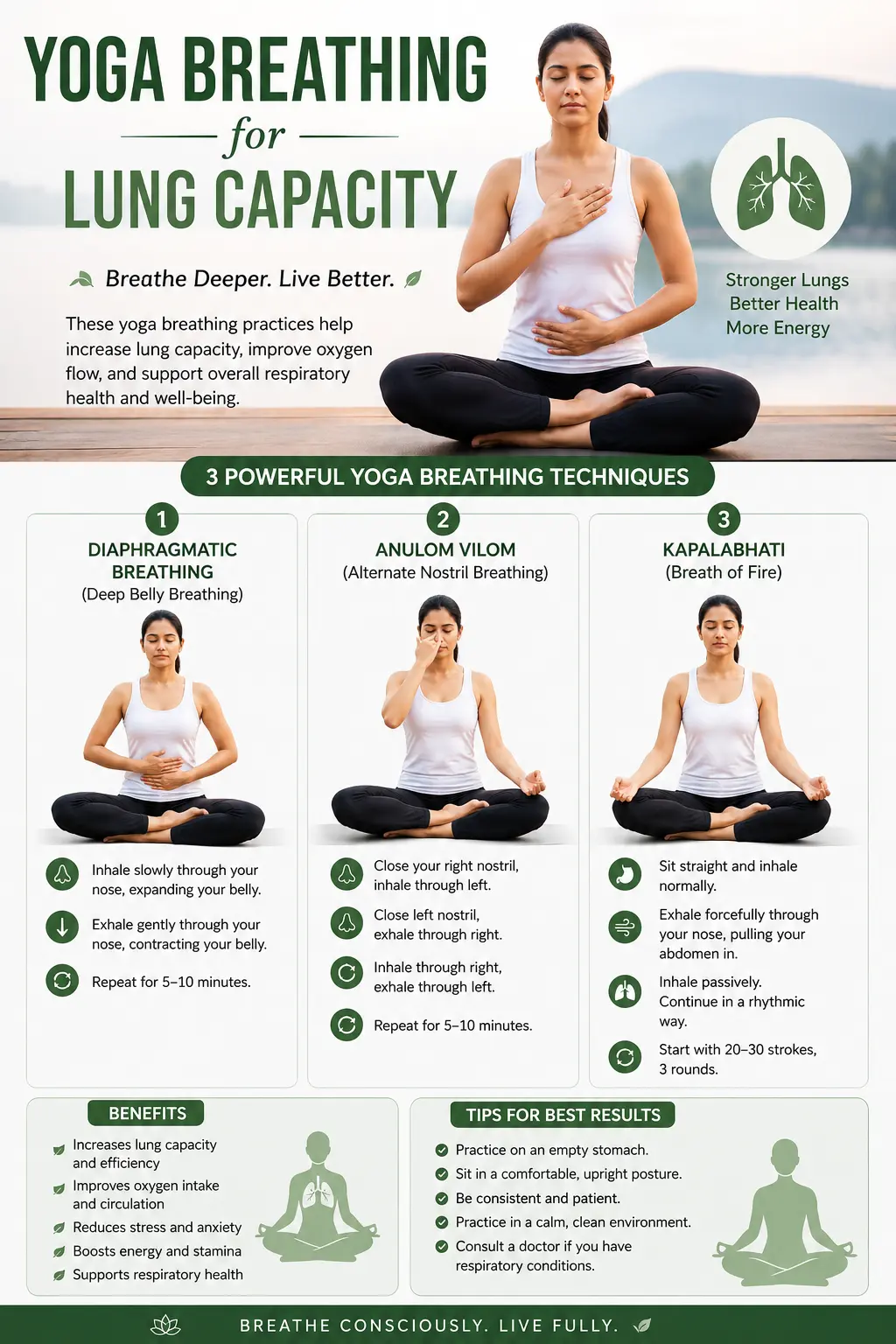
Practicing yoga breathing regularly can help improve breathing efficiency, reduce stress, and support better posture, all of which contribute to healthier lung function. Popular techniques such as diaphragmatic breathing, Anulom Vilom (alternate nostril breathing), and Kapalabhati can be practiced at home without any special equipment. They are suitable for beginners as well as experienced practitioners when performed with proper technique.
In addition to supporting lung health, yoga breathing can help calm the nervous system, improve concentration, and reduce feelings of anxiety. Many people also find that consistent practice enhances exercise performance and daily stamina by improving the body’s ability to use oxygen effectively.
For the best results, practice these breathing exercises in a quiet, well-ventilated space while sitting comfortably with a straight spine. Breathe gently, avoid straining, and stop if you experience dizziness or discomfort. If you have asthma, chronic lung disease, heart conditions, or are recovering from a respiratory illness, consult your healthcare provider before starting a new breathing routine.
With just 10–15 minutes of daily practice, yoga breathing can become a powerful habit for supporting stronger lungs, better breathing, and improved overall health.
What causes low lung capacity?
Over time, lung capacity might decline due to a variety of factors. Since our bodies inevitably slow down with age, aging is typically the primary issue.
- Other possible reasons include:
- Having obesity
- Not being physically active
- Chest wall deformities
- Having a high waist-to-hip ratio
- Vitamin D deficiency
- Pregnancy
What is normal lung capacity by age?
Lung function and capacity can differ significantly between individuals and even change over the course of our lives. The lungs can hold up to 6 liters (L), or around 1.5 gallons, of air.
Your lungs lose part of their suppleness as you age, and your breathing muscles may become weaker. Your lungs’ capacity to store air and their ability to exchange carbon dioxide and oxygen are both reduced as a result.
Spirometry is a technique used by doctors to determine lung capacity. The test’s findings can be used to diagnose diseases, including asthma and COPD. They can also demonstrate the effectiveness of therapies.
Spirometry examinations may reveal:
The amount of air you can exhale in one second is known as your forced expiratory volume (FEV1).
The entire amount of air you can exhale after taking a deep breath is known as forced vital capacity, or FVC.
Spirometry test results are expressed by doctors as a percentage of the “normal” value for an individual of your height, age, sex, and race. If your FEV1 is 80%, for instance, you can exhale 80% of the volume of air that a person with healthy lungs of your height, age, sex, and race could in one second.
FEV1 and FVC normal values are higher than 80% of the expected value. Lung disease may be indicated by values less than 80%.
Tips for keeping your lungs healthy
The best medicine is prevention. Maintaining the health of your lungs can help prevent issues later on. The following advice can help you maintain the health of your lungs:
- If you smoke, think about giving it up and staying away from environmental irritants and secondhand smoke.
- Consume foods high in fiber and antioxidants.
- Obtain immunizations, such as the pneumonia and flu shots. This can support lung health and help avoid lung infections.
- Frequent exercise can improve the health of your lungs.
- Boost the quality of the air inside. Reduce contaminants, including dust, mold, and artificial fragrances,s by using products like indoor air filters.
Yoga Breathing for Lung Capacity
Diaphragmatic breathing

Diaphragmatic breathing, sometimes known as “belly breathing,” activates the diaphragm, which is meant to perform the majority of the heavy lifting involved in breathing.
People with chronic obstructive pulmonary disease (COPD) benefit greatly from this method. The diaphragm could be strengthened because it is less effective in this condition. The method works best when you’re feeling relaxed.
For optimal outcomes, seek a physician or respiratory therapist to demonstrate how to perform this exercise if you have COPD. Remember that there is no scientific proof that breathing exercises can cure COPD, even though they may eventually lessen symptoms.
The COPD Foundation recommends that you practise diaphragmatic breathing by doing the following:
- Sit back or lie down with your shoulders relaxed.
- Feel the air flow into your abdomen and your stomach move out as you take a two-second breath through your nose. There should be more movement in your stomach than in your chest.
- While applying pressure to your abdomen, exhale for two seconds via pursed lips.
- Do it again.
Pursed-lips breathing

By keeping your airways open for a longer period of time, pursed-lip breathing may slow down your breathing and lessen the effort required. This enhances the exchange of CO2 and oxygen and facilitates lung function.
You may perform this breathing exercise at home even if no one has taught you how, and it’s frequently simpler for beginners than diaphragmatic breathing. You can practice it whenever you want.
To put the pursed-lips breathing technique into practice:
- Breathe in slowly through your nose.
- Put your lips together as though you’re going to blow on something or pout.
- Pursed lips, exhale as slowly as you can. It should take at least twice as long to do this as it took to breathe in.
- Do it again.
Alternate nostril breathing
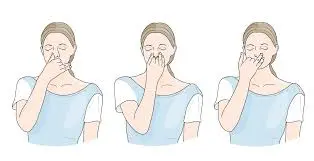
Yoga inspired the practice of alternate nostril breathing, which involves inhaling through one nostril while closing the other, then switching and repeating.
- Take these actions:
- Exhale, raise your right hand to your nose, and use your thumb to shut your right nostril.
- Take a breath through your left nostril, then use your fingers to shut it.
- Exhale through the right nostril after releasing it, then inhale through it and shut it.
- Breathe out through the left nostril.
- Finally, exhale through your left nostril after repeating for up to five minutes.
Bhujangasana (Cobra Pose)
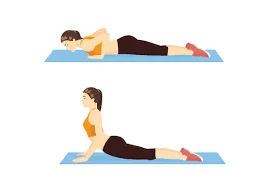
Bhujangasana is a mild backbend that helps the lungs expand more fully and opens up the chest. While keeping your lower body on the ground, you progressively raise your chest while lying on your stomach in this pose. The rib cage expands as the chest elevates, giving the lungs more room. Because Cobra Pose promotes deeper inhalation, regular practice can increase breathing efficiency. Additionally, it fortifies the muscles surrounding the spine and chest, which facilitate normal breathing.
Matsyasana (Fish Pose)

It’s well known that Fish Pose opens the throat and chest. The upper torso arches backward in this stance, greatly expanding the chest. The airflow into the lungs may be enhanced by this expansion. Additionally, it promotes deep breathing and stretches the muscles in between the ribs. Additionally, Fish Pose improves posture, which is crucial because bad posture frequently restricts lung expansion. Regularly performing Fish Pose can encourage improved breathing techniques and help you keep an upright posture.
Setu Bandhasana (Bridge Pose)

One yoga practice that helps expand lung capacity is called the Bridge Pose. This pose involves bending your knees while lying on your back and raising your hips. The diaphragm and lungs have room to expand as the chest rises. The muscles in the chest, back, and abdomen that aid in breathing are strengthened by this pose. Additionally, it enhances blood circulation, which facilitates the movement of oxygen throughout the body. During this pose, deep breathing enables the lungs to absorb more air.
Ardha Matsyendrasana (Seated Spinal Twist)
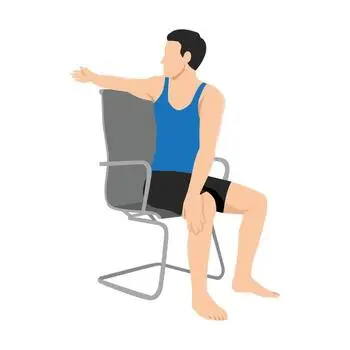
The Seated Spinal Twist stimulates the internal organs while gently twisting the spine. The twisting motion promotes fuller breathing and increases chest flexibility, even though it may not appear to be directly related to the lungs. One side of the chest extends, and the other contracts during the twist. Fresh air enters the lungs more efficiently as they return to the center. Additionally, this can enhance lung health and breathing awareness.
Dhanurasana (Bow Pose)

The entire front of the body is stretched in Bow Pose (dhanurasana), an asana that opens the chest. Lying on your stomach, you raise your legs and chest off the floor while holding your ankles. This pose improves the respiratory muscles and opens up the chest cavity. It facilitates deeper breathing by enabling the lungs to open more completely. Additionally, dhanurasana increases shoulder and chest flexibility.
Tadasana (Mountain Pose)

Despite its seeming simplicity, tadasana is crucial for increasing breathing capacity. Maintaining alignment while standing tall allows the lungs to spontaneously expand. Many people slouch when sitting or standing, which makes it difficult to breathe. By bringing the chest, shoulders, and spine into alignment, mountain pose aids in posture correction. To develop your breathing patterns, concentrate on taking calm, deep breaths while maintaining the pose.
Sukhasana with Deep Breathing (Easy Pose)

Sukhasana, also known as Easy Pose, is frequently utilized for meditation and breathing techniques. The lungs and diaphragm can operate freely when one is seated comfortably with a straight spine. This stance can greatly increase lung capacity when paired with deep breathing. Stress can also be decreased by doing this.
Which pranayama increases lung capacity?
Pranayama helps to systematically strengthen your respiratory muscles, improve diaphragm function, and increase alveolar recruitment. Use specific techniques like Bhastrika, Anulom Vilom, and Kapalbhati to optimize airflow dynamics and oxygen utilization, helping you to naturally expand your vital capacity.
These basic techniques work really well to increase your lung capacity:
Bhastrika (Bellows breath)
How: Breathe in and out sharply and quickly. Work your chest and diaphragm actively.
Effect: Dislodges secretions, clears airways, increases strength of inspiratory/expiratory muscles
Anulom Vilom (Alternate Nostril Breathing):
How: Cover the right nostril with your thumb, breathe in through the left. Now close your left nostril and breathe out through the right; do the reverse.
Effect: Better alveolar recruitment, airway resistance, and lung function balance
Kapalabhati (Skull-Shining Breath):
How: Focus on forceful exhalations and let your inhalation happen passively.
Effect: Clears respiratory airways, develops abdominal support for diaphragmatic breathing, and effectively eliminates carbon dioxide.
Kumbhaka (Hold Breath):
How: Inhale deeply, hold your breath for a specific period of time, then exhale slowly and at length.
Effect: Generates advantageous intrathoracic pressure changes with marked enhancement in respiratory muscle endurance.
Note: If you have existing respiratory or cardiovascular conditions (such as severe asthma or COPD), consult a medical professional or a certified yoga therapist before beginning intensive pranayama.
Can I regain my lung capacity?
Yes, you can make your lungs work more efficiently. You can increase the volume of air you can use. You can build up your respiratory muscles, remove the stale air that gets trapped, nd boost your oxygen processing. There’s no way to grow back lost lung tissue.
How to Increase Lung Capacity and Efficiency:
Diaphragmatic Breathing: This is also called belly breathing. It strengthens the main muscle used for breathing and helps you learn how to take deeper and more efficient breaths.
Aerobic exercise: This naturally builds respiratory muscles and improves oxygen exchange.
Rib Stretches: Stand straight, exhale all the air you can, then inhale slowly to your full capacity to help you expand your chest wall and improve the flexibility of your rib cage.
Pursed-lip breathing: This technique helps to keep your airways open for longer so that each breath is more effective, a nd it helps to release stale air that is trapped.
Stop Smoking: If you smoke, quitting is the best way to prevent further damage and improve your lung function.
Can yoga improve lung function?
Yes, it has a good effect on lung function. Physical postures (asanas) and mindful breathing techniques (pranayama) strengthen the respiratory muscles, increase the expansion of the chest wall, and enhance the elasticity of the lungs.
Key Advantages
Greater Capacity: With frequent practice,e you can boost your Forced Vital Capacity (FVC) and Peak Expiratory Flow Rate (PEF), which means you can breathe in and move more air.
Stronger Muscles: Pranayama makes the diaphragm and intercostal muscles more enduring, so you can breathe more efficiently with less effort.
Clinical Support: Yoga is frequently employed as an adjunctive therapy to assist patients with conditions like asthma and COPD in managing breathlessness and enhancing oxygen transfer.
Guidelines
Consistency: Studies have shown that it takes about 4 to 12 weeks of consistent practice to see significant improvements in lung function.
See Your Physician: It’s crucial to obtain medical approval before beginning if you have a chronic lung condition. You should also look for certified instructors who can provide accommodations.
What are the signs of weak lungs?
Early Detection: Identifying the Early Signs of Lung…Mild lung symptoms indicate that your respiratory system is having difficulty supplying enough oxygen to your body.
Important warning signs include:
- Shortness of breath that doesn’t go away
- A cough that lasts 8 or more weeks
- Chest tightness
- Unusual fatigue
- Wheezing.
These symptoms are most often caused by other conditions such as infections, asthma, or COPD.
Early identification of lung deterioration may greatly enhance your long-term comfort and treatment outcomes. Look for the following primary indicators:
Core Respiratory Symptoms
- Shortness of Breath (Dyspnea): You become winded doing normal activities such as climbing stairs, carrying groceries, or dressing.
- Chronic Cough: A cough that lasts for eight weeks or longer.
- Excess Mucus or Phlegm: Producing too much mucus for a month or more, or coughing up thick, discolored mucus.
- Wheezing: This is a high-pitched whistling sound made on breathing out, caused by narrowed or blocked airways.
Systemic and physical signs
Unexplained Fatigue: Persistent tiredness and fatigue that doesn’t improve with rest, due to less oxygen being delivered throughout the body.
Chest Pain or Tightness: Unexplained, persistent chest pain that may be aggravated by coughing or deep breathing.
Frequent Infections: Recurrent or chronic respiratory infections like bronchitis or pneumonia.
Swelling in Extremities: A build-up of fluid causing swollen legs, ankles, or feet, which can be caused by the heart having to work harder due to the lungs being weaker.
Blue Lips or Nails (Cyanosis): A crucial indicator of dangerously low oxygen levels is a bluish or grayish tinge to the skin, lips, or fingernails.
Static Lung volumes: Spirometer
Two vessels make up a spirometer: one holds water, while the other floats upside down in the first. When someone breathes through the connecting tube, air enters and exits the inner vessel, causing it to rise and fall.
This up-and-down movement is captured as a spirogram that is adjusted to account for variations in the inner vessel’s volume.
The bell rises, and the pen falls when you exhale, creating a moving chart. The airflow rate is measured by the slope of the spirogram on the moving drum, and the air volume is measured by the amplitude of the deflection.
Time is plotted on the horizontal axis (x-axis), and volume is plotted on the vertical axis (y-axis).
A measurement made up of multiple “volumes” is typically referred to as a “capacity.”
There are four standard lung volumes and four standard lung capacities, which are combinations of two or more standard lung volumes.
First, tidal volume, or normal breathing, is assessed.
The individual then takes a maximal inspiration, which is followed by a maximal expiration. The vital capacity is the volume of air that is breathed.
Nevertheless, following a maximal expiration, some gas remained in the lung; this is known as the residual volume.
The functional residual capacity (FRC) is the amount of gas in the lung following a typical expiration.
Elastic forces determine some lung volumes, especially the FRC. It is a practical place to start when thinking about the different lung volumes and how they are divided.
The sum of the four volumes mentioned above is the total lung capacity:
The sums of specific lung volumes can be used to calculate vital capacity, functional residual capacity, and inspiratory capacity:
IRV + VT + ERV = VC
ERV + RV = FRC
VT + IRV = IC
The Tidal volume
The FRC is the equilibrium between the chest wall’s outward elastic recoil and the lungs’ inward elastic recoil.
If the subsequent inspiration happens before the relaxation volume is attained, the FRC > relaxation volume (rapid breathing rates, strong resistance to expiratory airflow in the larynx or peripheral airways, or active contraction of the inspiratory muscles at end expiration).
Residual volume or any capacity containing RV (such as FRC or TLC) cannot be measured with a spirometer. Instead, we can measure RV using two general methods that are both based on the law of conservation of mass.
1. RV is calculated using the volume of distribution of either nitrogen or helium (He).
2. Boyle’s law is used to calculate RV.
The Residual volume
A guy weighing 70 kg has a VT of roughly 500 mL/breath.
For instance, it may rise when exercising.
The Expiratory reserve volume (ERV)
The force produced by the expiration muscles and the lungs’ inward elastic rebound in opposition to the chest wall’s outward elastic recoil defines it. The RV is significantly influenced by the dynamic compression of the airways during the forced expiratory effort, which causes airway collapse and traps gas in the alveoli.
A healthy adult weighing 70 kg has an RV of roughly 1.5 L.
A healthy individual needs an RV because it maximizes energy expenditure. An abnormally high pressure is needed to reinflate an airway when it contracts.
Despite episodic breathing, blood flows continuously to the lungs and other parts of the body. The blood’s composition would fluctuate greatly between a high PO2 at the peak of inspiration and a low PO2 at the nadir of expiration if the RV were 0.
The Inspiratory Reserve Volume (IRV)
The difference between the RV and the functional residual capacity (FRC) determines it. A healthy adult weighing 70 kg has an ERV of roughly 1.5 L.
The Inspiratory capacity (IC)
The inspiratory muscles’ power of contraction, the lung’s and the chest wall’s inward elastic recoil, and the starting point—the FRC plus the VT—all determine it. A typical adult weighing 70 kg has an IRV of roughly 2.5 L.
The Total lung capacity (TLC)
As a result, it equals the VT + the IRV. A typical adult weighing 70 kg has an IC of roughly 3 L.
The Vital capacity
The power of the inspiratory muscles’ contraction, as well as the lungs’ and the chest wall’s inward elastic recoil, determines it. The RV, VT, IRV, and ERV are the four lung volumes that make up the TLC. For a healthy adult weighing 70 kg, the TLC is around 6 L.
The Functional Residual Capacity (FRC)
Additionally, the sum of the VT, IRV, and ERV equals the VC. It is based on the same principles that define RV and TLC.
FAQs
Can yoga breathing improve lung capacity?
In addition to enhancing lung health and capacity, gentle breathing exercises like yoga or tai chi can help you manage the stress, worry, and despair that, regrettably, can occasionally accompany lung disease.
What is the 7-second lung-clearing trick?
The “7-second lung-clearing trick” is really just controlled coughing (or the huff cough or airway clearance technique, as respiratory therapists call it) to help move and clear out the mucus from your airways.
How to Do the 7 Second Technique:
Sit & Relax: Sit up in a chair, relax your shoulders, and keep your feet flat on the floor.
Breathe in:
Hold: Breathe out, hold that breath for 2-3 seconds so the air can get behind the mucus.
The “Huff”: Instead of a hard cough, lean forward slightly and blow the air out forcefully but slowly through your mouth,h making a “haaa” sound (as if you were trying to fog up a mirror).
Repeat: To get the phlegm out of your throat, do this one or two times. Then, cough normally and gently to clear it.
How to increase lung capacity fast?
Just take a deep breath.
You can get closer to your lungs’ maximum capacity by practicing deep breathing. Be mindful of lowering the diaphragm as you slowly inhale and carefully extend your belly. The next step is to spread your ribs so they open up like wings. Lastly, let the upper chest rise and expand.
What is the 4-4-4-4 breathing method?
Square Breathing: How to Use Breathwork to Reduce Stress…The 4-4-4-4 breathing method, also known as box breathing, is a simple rhythmic breathwork technique designed to relax the nervous system, reduce stress, and improve focus. Its name comes from the four equal phases it has, similar to the four sides of a square.
How to Do It
Inhale:
Breathe in, fill your lungs, and hold for a count of 4 seconds.
Exhale: Exhale slowly through your mouth (or nose) for 4 seconds.
Hold: Hold your lungs empty for a count of 4 seconds.
Repeat this cycle for 3 to 5 minutes or until you are centered.
Why it works:
Why It’s Effective
Nervous System Regulation: Slow, calm breathing tells your brain that you are safe, which helps your body transition out of the “fight-or-flight” (sympathetic) stress response and into a “rest-and-digest” (parasympathetic) state.
Stress Reduction: Deep, rhythmic breathing aids in decreasing cortisol and lowering heart rate.
Mental Clarity: Focusing on the rhythm of your counting distracts your mind from anxious thoughts, making it a great tool for handling panic, insomnia, or overwhelming tasks.
Which pranayama is best for COPD?
For COPD (Chronic Obstructive Pulmonary Disease), the best pranayama practices are low-intensity and gentle, with a focus on slow exhalation and diaphragmatic control. Examples include Bhramari (Humming Bee Breath), Anulom Vilom (Alternate Nostril Breathing), and Dirgha (Three-Part Breath).
What repairs lungs quickly?
The lungs heal quickly when irritants are removed, mucus is thinned, and circulation is improved. Quit smoking and stay away from polluted air to speed up your recovery. Drink plenty of fluids to thin airway secretions, do deep breathing exercises to increase lung capacity, and engage in light cardiovascular exercise to improve oxygenation.
References
- American Lung Association. (n.d.). Yoga, Tai Chi, and Your Lungs: The Benefits of Breathing through Exercise. https://www.lung.org/blog/yoga-tai-chi-and-your-lungs
- Gotter, A. (2024, March 15). Breathing exercises to increase lung capacity. Healthline. https://www.healthline.com/health/how-to-increase-lung-capacity#diaphragmatic-breathing
- Health benefits of Yogic breathing: Top 10 reasons to try it. (n.d.). https://www.manipalcigna.com/health-benefits/health-benefits-of-yogic-breathing
- Smith, E. N. (2025, November 4). Yogic breathing for better lung capacity. YogaUOnline. https://yogauonline.com/yoga-practice-teaching-tips/yoga-practice-tips/yogic-breathing-for-better-lung-capacity/
- The Art of Living. (2023, September 12). How to Increase Lung Capacity with Easy Breathing Exercises. Art Of Living (United States). https://www.artofliving.org/us-en/breathwork/breathing-exercises-101/how-to-increase-lung-capacity
- The Yoga Institute. (2022, July 4). How to increase lung capacity: 5 Techniques to Increase lung Capacity – The Yoga Institute. The Yoga Institute. https://theyogainstitute.org/how-to-increase-lung-capacity-5-techniques-to-increase-lung-capacity
- Unknown. (n.d.). Lung volumes and Alveolar ventilation. https://aiimsrishikesh.edu.in/documents/lung_volumes_alveolar_ventilation.pdf#:~:text=Because%20anatomical%20dead%20space%20is%20approximately%20150,volume%2C%20and%20VD%20is%20dead%20space%20volume.