Ashtanga Namaskara (Eight Limb Pose)
What is Ashtanga Namaskara?
Ashtanga Namaskara is a yoga flow position that builds on Surya Namaskara. The Ashtanga Namaskara is a simplified form of the Surya Namaskar movement’s Four-Limbed Staff Pose.
The grounding motion in this stance is as if you are paying tribute to the sun and expressing thanks for supplying energy to this world.
In Sanskrit, “Ashta” represents eight, “Anga” represents bodily parts or limbs, and “Namaskara” means welcoming or bending down to someone with respect.
Muscle Use During Ashtanga Namaskara:
Ashtanga Namaskara strengthens the following muscles, hence it may be utilised in yoga sequences that target the corresponding one(s):
- Arms and Shoulders Muscles
- Lower Back Muscles
- Core (abs) Muscles
- Gluteus
- Pelvic Muscles
Video of Ashtanga Namaskara
How To Perform?
Getting into the Pose
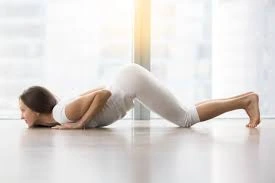
- From the plank posture, carefully lower your legs, torso, and chin to the ground. The shoulders should be above the hands.
- Continue breathing throughout the position.
- Once you’re comfortable, adjust your elbows so they’re near the sides and not jutting outwards.
- The buttocks will be pointed upwards, with the toes tucked beneath.
- Maintain your posture and take several deep breaths.
Getting out of the Pose
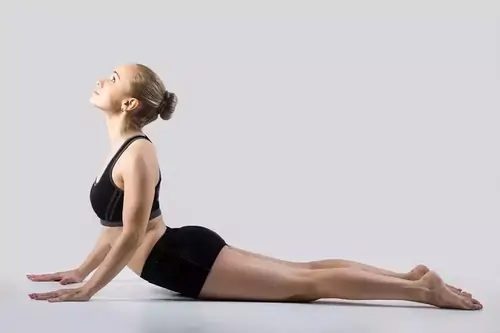
- To depart the position, elevate the chin and slide the chest through your hands.
- Untuck the toes, straighten the legs, and sweep up into a Cobra position.
- You can also use your hands to push back into Vajrasana and then hold the Child’s Pose for approximately a minute.
Benefits:
Stretches, Strengthens, Lengthens: It strengthens the glutes, thighs, arms, and wrists, in addition to the biceps, rhomboids, and trapezius muscles in the back. It improves the range of motion for backbends. It stretches the frontal neck muscles and strengthens the cervical and lumbar spine.
Flexibility and Range of Motion / Alignment and Posture: This position yields a supported backbend. The back curvature is supported at eight points on the body. It increases the range of motion for backbends by strengthening the cervical spine and lower back.
Chest, Diaphragm, and Breath: The upper and middle back are strengthened. The chest contacts the floor, and the arm support allows for a modest chest expansion. The chest opening leads to an increase in lung capacity.
Awareness and Concentration: The Eight-Limbed Pose (Ashtangasana) involves both body and breath awareness.
Energising, de-stressing, and relaxing: The Eight-Limbed posture (Ashtangasana) is an energising pose that prepares you for deeper backbends. It mentally and physically prepares the body to move to the next posture.
Stimulation and Organs/Circulation and Systems: This extension stimulates the lymph nodes around the neck, as well as the salivary and thyroid glands. Activating the lymph nodes around the neck helps to remove toxins and is beneficial to the lymphatic system. Stimulating the thyroid and pituitary glands regulates the body’s thyroxin levels, which are crucial for joint and bone health. It also regulates the body’s metabolism. The salivary glands produce a digestive enzyme, which is the initial step in the digestion process when chewing food.
Therapeutic, healing, and ailments: The Eight-Limbed Pose (Ashtangasana) is beneficial for reducing lower back pain since it strengthens the lumbar spine. It’s an excellent position for strengthening the upper body, particularly the shoulders and arms. It can be used to treat thyroid imbalance. It can cure both flat feet and Plantar Fasciitis, which is characterised by inflammation of the plantar fascia muscles in the soles.
Balance and Emotions: Because the belly is drawn in and the core muscles are engaged, practicing the Eight-Limbed Pose with awareness can assist in stimulating the manipura chakra. When this chakra is active, it stimulates the internal organs that regulate digestion.
Follow-up Poses
- Upward-Facing Dog Pose
- Cobra Pose
- Child’s Pose
- Downward-Facing Dog Pose
Preparatory Poses for Ashtanga Namaskara:
Adho Mukha Svanasana (Downward-Facing Dog Pose)
- Bend into a Standing Forward Fold, placing your hands on the ground and walking your four limbs through, forming a triangle with your arms and feet.
- Maintain a firm core, place your feet level on the ground, and bend your spine like a dog extending its body when yawning. Hold this stance for a few seconds before proceeding to the next.
Utthita Chaturanga Dandasana (High Plank Pose)
- Hold a high plank position for a few seconds to bring your spine back to neutral alignment.
- Make a straight line between your glutes, tailbone, neck, and head. Ensure that your core muscles are fully engaged and that your attention is focused on your hands.
Variations:
One-Legged Eight-Limbed Pose (Bent Knee Variation):

- To test your core stability in the Eight-Limbed position, continue the primary position by raising either leg up.
- Lift and hold your leg for a few seconds while maintaining the knee bent.
One-Legged Eight-Limbed Pose (Straight Leg Variation):
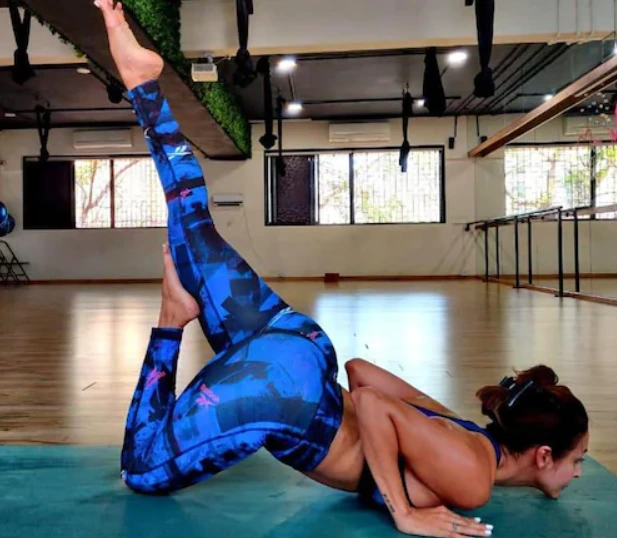
- Continue with the last variation, but ensure that your lifted leg is engaged, straight, and your toes point to the ceiling.
- Hold this position for a few seconds before releasing and repeating with your other leg. This technique gradually increases your core stability and strength.
Contraindications & Precautions:
- If you have a neck injury, never place your chin on the ground and apply body weight to it.
- If you have a shoulder issue, this posture may make it worse.
- If your knees are sensitive, bringing them to the ground might be painful.
- The pose’s shape, which encourages excessive arching, may cause lower back discomfort. If you have a hypermobile lower back or a lower back injury, proceed with caution and remember to tone your tummy (transverse abdominus) to protect your lower back.
- If you have a herniated disc or spondylolisthesis, this position should be avoided.
- If you suffer from migraines, this attitude may trigger or worsen them.
Common Mistakes:
- To avoid dropping the hips too early, keep them elevated until the chest and chin are in touch with the ground.
- To prevent shoulder tension, keep elbows tight to the sides and aimed towards the heels.
- To maintain stability during collapsing, lower down gently and controllably, activating the core muscles.
- To relieve neck stress, lie your forehead on the ground instead of your chin.
- To minimize injury or discomfort, avoid rushing into the position and instead, engage the back muscles gradually.
- To avoid not synchronizing your breath, remember to inhale as you raise and exhale as you drop.
- Ignoring body signals: As with other yoga postures, Ashtanga Namaskara requires you to listen to your body and stay within your limits.
FAQs
What is the alignment for Ashtanga Namaskara?
Your toes should be tucked in. Your upside-down two feet should be level with the ground. Your toes, knees, and ankles should form a line. Your palms should be just beneath your shoulders.
What are the contraindications for Ashtanga Yoga?
Anyone with shoulder, neck, wrist, knee, back, or leg ailments should avoid this position. If you have back discomfort, you should avoid doing this asana. Carpal tunnel syndrome patients should avoid this asana.
What is the most significant part of Ashtanga yoga?
Ashtanga yoga is divided into six series, the most essential of which are the basic and secondary. These two series, called “yoga chikitsa” and “nadi shodhana,” are systematic sequences of yoga postures that help you improve strength, flexibility, and focus.
What is the chakra of Ashtanga Namaskara?
The name is of Sanskrit origin, with “Ashtanga” meaning eight limbs (ashta, anga) and “namaskara” meaning greeting. This is equivalent to a salute to the sun with eight limbs. 2) Which chakra is awakened during Ashtanga Namaskara? The practice of this asana helps to activate the manipura chakra.
When not to practice Ashtanga?
When the sun and moon align, their gravitational pull and influence on humans increase; hence, Ashtanga yoga practitioners avoid practicing during full or new moons. It is best to allow our bodies to rest and repair during these phases of the lunar cycle.
References:
- Sattamaya, P. (2024, January 6). How to practice the Eight-Limbed Pose. https://www.shvasa.com/yoga-blog/how-to-practice-the-eight-limbed-pose
- Ashtanga namaskara (Eight-Limbed pose). (n.d.). MyYogaTeacher. https://myyogateacher.com/yoga-asana/ashtanga-namaskara
- Stephen. (2023, March 31). How to do Ashtanga Namaskara – Benefits & Yoga Pose Tutorial. Adventure Yoga Online. https://adventureyogaonline.com/ashtanga-namaskara-benefits/
- Eight-Limbed Yoga Pose(Ashtanga Namaskara). Tummee. https://www.tummee.com/yoga-poses/Ashtanga Namaskara