Elbow Mobility Exercises
Introduction
Elbow mobility exercises help improve the flexibility and movement of the elbow joint. These exercises are commonly used in physiotherapy to reduce stiffness, improve range of motion, and support recovery after injury, surgery, or conditions such as arthritis and tendonitis.
Regular practice can help make daily activities like lifting, reaching, and carrying objects easier and more comfortable.
Perform these exercises gently and within a pain-free range. Consistent elbow mobility training can enhance joint function, increase circulation, and maintain healthy movement of the arm and forearm.
What is the elbow joint?
The joint that joins your upper arm to your forearm is called the elbow.
Your elbows are a component of your skeletal system, much like all other joints. Cartilage, muscles, ligaments, nerves, and blood arteries are also found in your elbows.
If you have elbow discomfort or other symptoms that make using your elbow difficult, see a doctor. To assist you in returning to your regular activities and routine, they will identify the cause and provide remedies.
Function
What is the function of the elbow?
To bend your arm, flex your elbow. It has four possible directions of motion:
- Extension: Reaching objects by extending your arm farther from your body.
- Bending your lower arm toward your body is called flexion, which is the opposite of extension.
- Supination: Raising your hand’s palm.
- Pronation: Lowering your palm.
Anatomy
Where is the elbow joint located?
The area of your arm that bends where your forearm and upper arm meet is called the elbow joint.
Which type of joint is the elbow?
Healthcare professionals categorize joints according to:
What they are composed of.
How they move is their role.
A synovial joint is the elbow. The greatest range of motion is seen in synovial joints. They consist of a hollow in one bone that another bone can fit into. The extremities of the bones that comprise a synovial joint are covered in slippery hyaline cartilage.
The area between the bones is lined with a fluid-filled sac called a synovial membrane, which lubricates and shields the joint. Synovial joints move with the least amount of friction possible because of this additional cushioning.
The elbow functions as a pivot joint (a trochoginglymus joint) as well as a hinge joint. Hinge joints function similarly to the hinges that secure a door. While some of their components are stationary, others must travel a certain distance to open and close. To bend and straighten your arm, your elbow hinges.
It’s a pivot joint as well. Pivot joints do not move from their initial position; instead, they spin in place. You can move your palm up and down by turning your forearm over, thanks to your elbow pivoting.
What is the structure of the elbow joint?
The components of your elbow joints are:
- Bones.
- Cartilage.
- Ligaments.
- Muscles.
- Nerves.
- Blood vessels.
Bones in the elbow joint
- Humerus (upper arm bone).
- Ulna (the longer bone in your forearm).
- Radius (the shorter forearm bone).
Cartilage in the elbow
Your joints are shielded by cartilage, a strong and elastic tissue. Your entire body uses it as a shock absorber. Hyaline cartilage lines your elbows. The most prevalent kind of cartilage in your body is hyaline cartilage. Some medical professionals refer to it as articular cartilage.
Your joints’ smooth, slippery hyaline cartilage facilitates the seamless passage of bones past one another. Hyaline cartilage lines the surfaces of your radius, ulna, and humerus that come into contact with one another.
Elbow joint ligaments
Ligaments serve as the cords that join bones.
Your elbows consist of three primary ligaments:
- The ligament that joins your ulna to the inside edge of your humerus is called the medial collateral ligament.
- The ligament that joins your ulna to the outside edge of your humerus is called the lateral collateral ligament.
- An annular ligament is a ligament that joins your ulna and humerus to the head (top) of your radius.
Muscles in the elbow
Stretchy fibers make up the soft tissue that forms muscles. They flex, or tense up, to pull and move body parts. Your elbow is moved by muscles that are connected to your arm bones.
Your lower arm can flex inward toward your body thanks to muscles that regulate flexion. Among them are the:
- Biceps.
- Brachialis.
- Brachioradialis.
- Your lower arm can be moved outward and away from your body using two extensor muscles:
- Triceps.
- Anconeus.
- The supination-controlling muscles allow you to raise your palm:
- Supinator.
- The biceps
- Your palm can be lowered with the aid of the pronator muscles:
- Brachioradialis.
Nerves in the elbow
Electrical impulses are transmitted from your brain to the rest of your body through nerves, which function as wires. You may move your muscles and experience sensations thanks to these impulses. The following nerves can cause elbow pain:
- Radial nerve.
- Ulnar nerve.
- Median nerve.
- Musculocutaneous nerve.
Blood vessels in the elbow
The pathways that transport blood throughout your body are called blood vessels. They start and finish at your heart, creating a complete loop that resembles a circuit.
- Radial artery.
- Ulnar artery.
- Brachial artery.
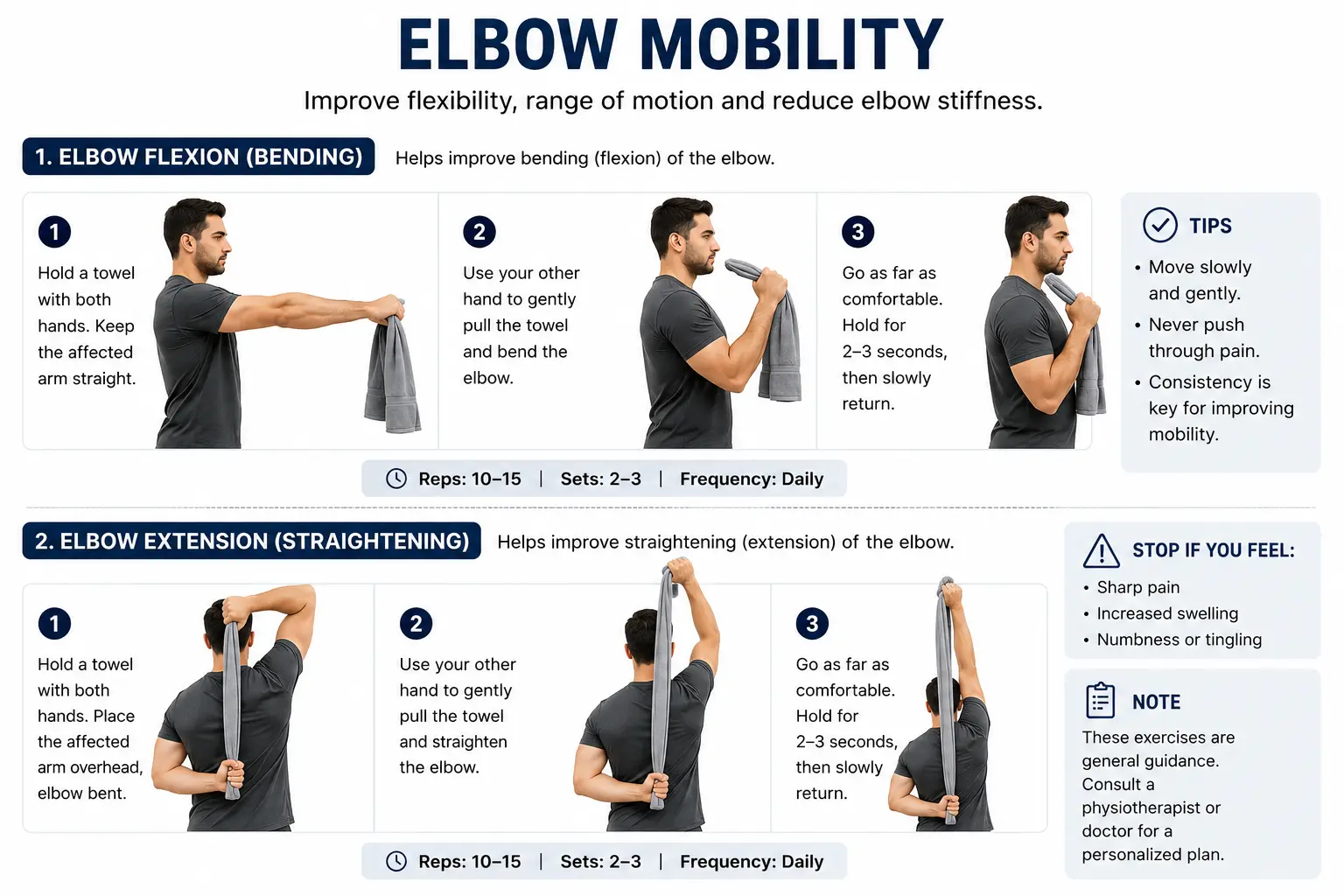
Elbow Mobility Exercises
Elbow Bend (Flexion)
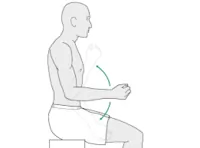
Raise your arm to one side while maintaining a straight posture. Slowly raise your arm till your hand touches your shoulder. Hold for 15 to 30 seconds. Ten times over, repeat. You can also perform this exercise with a small weight.
Elbow Straightening (Extension)
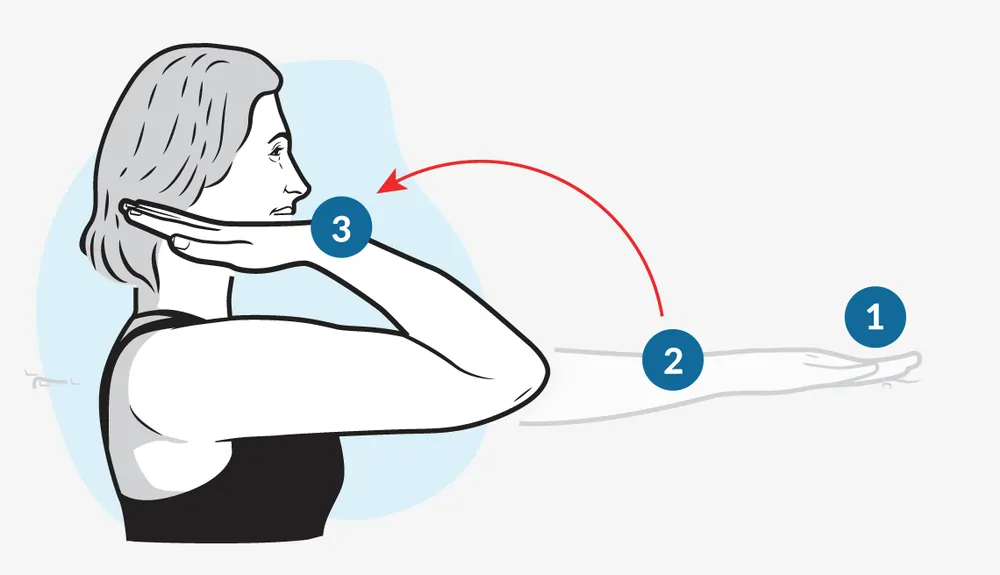
As much as you can, straighten your elbow without shifting your shoulder.
Forearm Rotations (Pronation & Supination)

Supination: Turn your palm up by rotating outward.
Pronation: Turn your palm downward by rotating inward.
Wrist Flexion and Extension Stretches
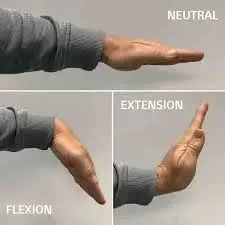
With your wrist raised, place your right arm in front of you. Start with your right arm if you want to stretch both elbows. Turn your hand so that your right wrist is pointing up.
To enhance your extension, just place your upper arm flat on a table and let gravity pull your elbow straight.
To point your right hand downward, bend your wrist. Your right lower arm and elbow should begin to stretch; you might only be able to move your hand a little without help.
This technique for bending your wrist is called a wrist flexor stretch.
To further bend your right hand, use your left hand. Pull your right hand and fingers with your left hand to further bend your wrist. With the aid of your left hand, you should be able to position your right hand so that it is perpendicular to your lower arm. For fifteen to thirty seconds, maintain this position with your right hand.
As you utilise your left hand, the stretch in your right lower arm should get more intense. The stretch will be noticeable to you, but avoid pulling your right hand until it hurts.
With your left hand and arm, repeat each of these actions. After you’ve finished stretching your right arm and hand, do the same with your left arm and hand. Alternate between your two arms until you’ve finished two to four stretches on each.
Additionally, you should hold the stretch for 15 to 30 seconds on your left arm.
In between one-arm stretches, you can take a brief break. In between stretches, you might also wish to shake your arm.
To finish the wrist extensor stretch, turn your hand downward. You follow the identical motions to finish the extensor stretch, but with your palm facing downward. The stretch will go from the underside of your lower arm to the upper part due to the shift in the direction of your palm.
Similar to the flexor stretch, your arm will stretch, but stop it before it hurts.
Another way to vary this stretch is to extend your arm in front of you and stare at the back of your hand as if you’ve just had a manicure. Extend your fingers and wrist back with your other hand. Push them forward after that.
In general, elbow stiffness improves with physical therapy in 6 weeks to 3 months. However, after a bad injury or surgery, it may take 6 to 12 months to completely heal. How long it takes you to get back on your feet depends a lot on the underlying cause, how well you follow your rehab, and whether you had to have surgery.
Time to Recovery by Reason
Soft Tissue Injuries (Sprains/Strains)
Timeline: Return to basic mobility in 4-6 weeks.
Recovery: Most patients return to full functional range within 3 months if supervised range-of-motion (ROM) exercises are initiated early.
Fractures (Broken Bones)
Time frame: 3 to 6 months.
Recovery: 3 to 6 weeks in a cast, then specific rehabilitation. Maximum functional motion is often between 4 months and 1 year.
After Surgery (i.e., Open Release):
Time frame: 3-6 months.
Recover.y The first 6 months are the most important window for rehabilitation. Maximum arc of motion is frequently obtained by 16 weeks post-operation.
Stages of Getting Well
Early Healing & Protection (Weeks 0-:2) Splint or cast to help bones and soft tissues begin to heal. Towards the end of this phase, gentle movement is often introduced to prevent permanent stiffness.
Mobilisation & Stretching (Weeks 3-12): Her physiotherapy is key. The emphasis is on four main movements of specific passive and active range-of-motion exercises: flexion, extension, pronation, and supination.
Strength & Return to Activity (3-12 months): Rebuilding strength and stamina. Continued stretching and home exercises are directed toward the end-range of motion.
Conditions and Disorders
Anything that harms your bones or connective tissue can have an impact on your elbows, such as:
- Arthritis.
- Elbow (olecranon) bursitis.
- Nursemaid elbow.
- Tendinitis.
Among the most frequent elbow injuries are those caused by sports:
- Sprains.
- Tennis elbow (later epicondylitis).
- Golfer’s elbow (medial epicondylitis).
- Elbow Dislocation
- Elbow fractures (broken elbows).
What are common symptoms of an elbow injury?
The type of elbow injury or problem you have will determine the symptoms you have. Typical elbow symptoms include:
- Elbow pain, particularly when bending or moving your arm.
- Swelling or inflammation.
- Rigidity.
- Instability is the sensation that your elbow isn’t as stable or sturdy as it usually is.
- Bruising, redness, or discoloration.
- A sensation of heat or warmth.
What are common tests done on elbows?
See a doctor as soon as you feel any changes or pain in your elbow, particularly if you’ve been hurt in a fall. The following are a few of the most popular tests that medical professionals use to identify problems:
- Elbow X-rays.
- Ultrasounds.
- Computed tomography (CT) scans.
- Magnetic resonance imaging (MRI).
- Joint aspiration.
- Blood tests.
FAQs
How can I improve my elbow mobility?
Make a straight angle with your elbow. Hold a lightweight, palm down, like a tin of beans. Slowly bend your wrist in your direction, then release it. Twice a day, perform three sets of fifteen repetitions.
Which four muscles are involved in elbow flexion?
Flexors of the Elbow
The brachialis, brachioradialis, and biceps brachii are the main muscles involved in elbow flexion. One of the secondary elbow flexors is the pronator teres.
Why can’t I fully extend my elbow?
You could not be able to straighten your arm for a variety of reasons, some of which are as follows: a hyperextended elbow or an isolated joint. break in the elbow’s surrounding bones. Severe tendon irritation surrounding the elbow.
What is a joint mobility exercise?
The capacity of joints to freely move within their typical ranges of motion is known as joint mobility, and it is crucial for a variety of activities and locomotion. Stretching and joint mobilisation exercises can assist in improving it, and ongoing low-grade movement promotes long-term flexibility.
Which vitamin deficiency results in elbow joint pain?
Joint discomfort may be indirectly caused by a vitamin D deficiency, which can weaken bones and raise the risk of fractures. Additionally, a lack of vitamin D may be associated with a higher risk and severity of osteoarthritis, a frequent source of joint pain, according to some studies.
References:
- 1oahct.com. (n.d.). ELBOW EXERCISES. https://oahct.com/wp-content/uploads/2020/04/OAH-ELBOW-EXERCISES.pdf
- Comella, T. (2023, December 13). Improving elbow range of motion. E3 Rehab. https://e3rehab.com/elbow-range-of-motion/
- Exercises for the elbows. (n.d.). Arthritis UK. https://www.arthritis-uk.org/information-and-support/living-with-arthritis/health-and-wellbeing/exercising-with-arthritis/exercises-for-healthy-joints/exercises-for-the-elbows/
- NHS inform. (2026, March 13). Exercises for elbow problems | NHS inform. NHS Inform. https://www.nhsinform.scot/illnesses-and-conditions/muscle-bone-and-joints/arm-shoulder-and-hand-problems-and-conditions/exercises-for-elbow-problems/
- pliability // 22 Best Elbow Mobility Exercises to Reduce Pain and Boost Strength. (2024, September 30). https://pliability.com/stories/elbow-mobility-exercises
- Comella, T. (2023, December 13). Improving elbow range of motion. E3 Rehab. https://e3rehab.com/elbow-range-of-motion/
- Exercises for the elbows. (n.d.). Arthritis UK. https://www.arthritis-uk.org/information-and-support/living-with-arthritis/health-and-wellbeing/exercising-with-arthritis/exercises-for-healthy-joints/exercises-for-the-elbows/
- Frank, J., MD. (2026, January 30). Simple Ways to Stretch Your Elbow: 13 Steps (with Pictures). wikiHow. https://www.wikihow.com/Stretch-Your-Elbow