Tolasana Yoga (Scale Pose)
What is Tolasana?
Tolasana Yoga, also known as Scale Pose, is an advanced seated arm-balance that builds strong core muscles, arms, and shoulders. Practiced in Padmasana or cross-legged position, this pose enhances balance, stability, and body control while improving concentration and inner strength.
As such, it is a yoga stance of an intermediate level. Scale stance or balance pose are frequent names for it. This pose is also known as tolasana, dolasana, utthita padmasana, elevated lotus stance, or swing pose.
Tolasana focuses on extending the hamstring, thigh, and arm muscles. Additionally, it strengthens the hips, back, shoulders, wrists, and abdomen.
Meaning:
The practitioner must start with the padmasana in order to achieve this pose. Afterwards, the arms are pressed to the floor as the entire body is raised off the ground. The body swings between the arms in the last stance. The name comes from the fact that it looks like a weighing scale.
This asana enhances the balance between the body and the mind because of its balanced character. Physical advantages include strengthening the shoulders, arms, and core.
Muscle Work During Tolasana:
- Biceps and Triceps Muscles
- Core Muscles
- Gluteus Muscle
- Hip Muscles
How to Perform?
- Dandasana is a position where you sit on your mat with your legs out in front.
- Pull your left foot onto your right thigh and your right foot onto your left thigh with your hands. Maintain their proximity to the hip joint.
- Ensure that the heels are pointing upward.
- With your palms on the ground, keep your hands by your sides.
- Lift your abdominal muscles and straighten your spine.
- Lift your hips and trunk off the ground by pressing your palms to the ground.
- Look ahead.
- Hold the posture for three to five breaths.
- Breathe out while lowering your knees and hips to the ground gently.
- Repeat the pose by releasing your legs and crossing them in the other direction.
- Let go of your legs and extend them forward as you reach the floor.
- Release any tension in your arms by relaxing in dandasana.
Benefits:
Increases power:
The arms support the entire weight of the body. It strengthens the muscles in the hands, wrists, and shoulders. Tolasana works the arms’ brachioradialis, triceps, and biceps. While maintaining the posture, the core muscles are also used in addition to the arms. It tones and works the muscles of the abdomen. As a result, the core becomes stronger.
Boosts adaptability:
The wrist, arm, and shoulder muscles are extensively stretched. In addition, the muscles of the legs and hips are also affected. The outer hip and leg muscles are stretched while maintaining the position. As a result, tolasana improves wrist, ankle, and hip flexor flexibility. A supporting study demonstrates that tolasana increases the body’s flexibility.
Improved digestion:
The abdominal organs work along with the abdominal muscles. This improves the digestive system by stimulating the digestive organs’ activity.
Boost awareness and equilibrium:
Tolasana activates the Mula bandha (root lock) and Uddiyana bandha (upward abdominal lock). As the Uddiyana bandha helps raise the trunk off the ground, this aids in bringing balance. In a similar vein, the Mula bandha enhances the feeling of balance and connection.
Reduces tension and anxiety:
The practitioner can meditate for extended periods of time if they have more confidence. By removing toxins from the body, this technique soothes both the body and the psyche.
Beginner’s Advice:
- Before beginning tolasana, make sure you are at ease executing padmasana.
- You can practise the pose with Ardha padmasana if you’re a beginner. This will simply raise the buttocks off the ground, which is its single drawback. But the muscles in the outer calf and lower leg stay on the ground.
- Blocks for yoga. To obtain the additional length for the arms, place a block beneath each hand. Lifting the legs is somewhat easier as a result.
Preparatory Pose:
Baddha Konasana (Bound Angle Pose):
Stretching, activating, and strengthening your glutes, inner thighs, and knees for the main posture, this prep pose is a great way to open your hips. Inhale, bend your knees, and begin in staff pose.
Make the shape of butterfly wings with your legs by pressing the soles of your feet against one another. In this position, sit with your spine erect and lock both feet with your interlaced fingers. For more intense blood circulation in the lower body, practitioners might lean their torso forward.
Padmasana (Lotus Pose):
In the staff pose, begin with your legs. Then raise your left foot over your right thigh and bend your left leg from the knee. Do the same with your right leg.
In Gayan Mudra, relax your shoulders, maintain a straight spine, close your eyes, and place your hands on your knees. Hold this stance for five minutes while paying attention to your breathing.
In addition to helping you develop a solid foundation for your leg formation in the scale pose, this warm-up posture’s mindfulness will provide you with a great deal of mental attention for the arm balancing.
Eka Hasta Bhujasana (Elephant’s Trunk Pose):
Beginners may find it difficult to balance the scale pose. For beginners and intermediate yogis to gently engage their core muscles, this pose is ideal.
Bend your left leg after striking the staff stance. Next, hook your left leg over the tricep muscle of your left arm. With your hands by your sides, grasp the mat and press your fingers into it as if you were attempting to grasp the earth.
Breathe in, contract your core so that your ribs form a deep curve around your spine. Lastly, lean forward a little such that your resting right leg lifts off the ground as you press into the ground.
Variations:
Tolasana Arm Variation:

Start with the standard sitting position, but while you sit lotus-legged, move your palms inside your legs instead of outside. This variant can be held for a few minutes by practitioners at the intermediate level.
This posture is an advanced variation for a straightforward reason: the shift in palm placement intensifies core balance, making the sequence even more difficult.
Tolasana Leg Variation:

It’s time to test your arms by combining the Garbha Pindasana and Tolasana, two distinct yoga poses.
To begin, simply take a seated lotus position, balance your lotus legs into the scale stance by pushing your finger into the mat, and then, with even more control, pull your lotus legs close to your chest to hover in the embryo pose. After holding this variant for 15 to 30 seconds, let go.
Tolasana Twisting Variation:
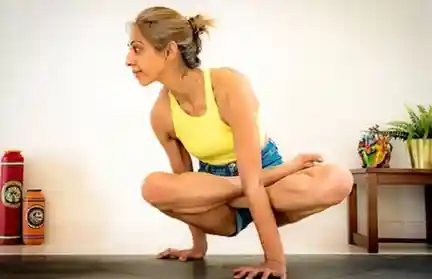
Instead of placing your hands on the sides while sitting in the lotus leg posture, place one hand in front of you.
Your shoulders and core muscles will be challenged by this unusual arm placement. Hold this variant for one to three minutes on each side after switching arms and repeating the same procedure.
If you find this variation too difficult, you can alternatively place yoga blocks beneath your palms.
Precautions and Contraindications:
- If you have a wrist, arm, or shoulder ailment, avoid doing tolasana.
- The asana should not be done while you are menstruating.
- If you have high blood pressure, stay away from it.
- This pose should be avoided by those who have acute osteoporosis or osteoarthritis.
FAQs
Can beginners perform Tolasana?
Although tolasana is not a pose for beginners, they can begin their practice with exercises that strengthen their forearms and core. Additionally, beginning yogis can advance more quickly by including wall support or yoga blocks in their practice.
What is Tolasana good for?
Tolasana is excellent for practitioners who desire to strengthen their core or develop toned arms and shoulders.
What are the benefits of Tolasana?
Tolasana offers several advantages, such as improved hip mobility, core muscular conditioning, and upper body toning. In addition to these, yogis use the scale pose to achieve emotional advantages like as improved mindfulness, balanced emotions, and increased attention.
What are the different preparatory poses in Tolasana?
Plank Pose, Elephant’s Trunk Pose, Lotus Pose, Crow Pose, and Bound Angle Pose are all ideal preparatory poses for building the muscle groups required for Tolasana practice.
Who should avoid performing Tolasana?
If you have significant back discomfort, injuries, or tense muscles, do not perform Tolasana. Women with menstruation or elderly people with arthritis should likewise avoid striking this stance.
What are the different stretches in Tolasana?
Tolasana helps practitioners stretch their biceps, forearms, shoulders, and glute muscles as a whole because it is both an arm balance and a hip opener.
References:
- Tolasana Yoga (Scale Pose): Steps, Benefits, & Variations – Fitsri Yoga. https://www.fitsri.com/poses/tolasana
- Allen, W. (2025a, August 25). Tolasana. https://myyogateacher.com/yoga-asana/tolasana
- Scale Pose Yoga Pose (Tolasana). Tummee. https://www.tummee.com/yoga-poses/Tolasana.